
In the domain of power transmission for heavy machinery, the demand for large, robust, and efficient miter gears and bevel gears is constant. These components are fundamental in redirecting shaft rotation, often under immense load. Traditionally, the manufacturing of straight bevel gears with standard tooth proportions is well-established. However, a significant challenge arises with a specific tooth form known as the “double-recessing” or “dually tapered” tooth. In this design, both the addendum and dedendum are tapered from the heel to the toe of the tooth, leading to a root line that does not converge at the same apex as the pitch cone. This geometry offers superior strength and smoother meshing characteristics for very large gears but poses a substantial manufacturing hurdle. For years, domestic industry lacked both the specialized methodology and the dedicated equipment to produce these double-recessing tooth forms on large-scale straight bevel gears. This document details a first-person account of the calculated modifications and procedural adaptations made to a standard Y236-type template-following bevel gear planer, enabling it to successfully machine large, double-recessing straight bevel gears—a critical advancement for applications such as those in mining and metallurgy where gear failure is not an option.
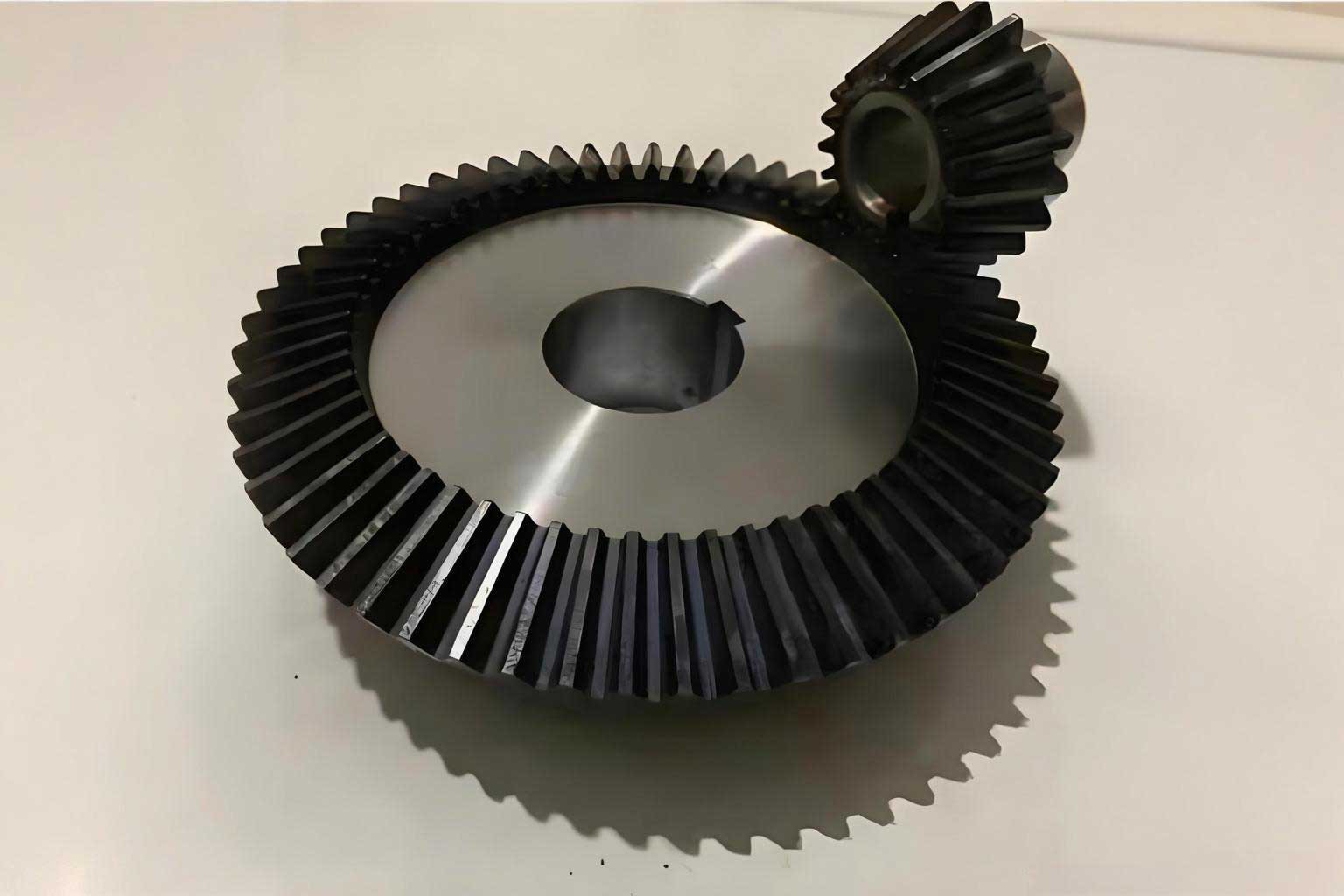
The core of the challenge lies in the non-coincident apexes of the pitch cone and the root cone in a double-recessing tooth design. On a standard bevel gear, the root line converges at the pitch cone apex. For a double-recessing gear, these lines intersect at a point along the pitch cone line, creating a distinct geometric offset. Our primary task was to manipulate the machine’s kinematics to replicate this geometry. The entire process begins with precise calculation, followed by physical adjustments to the machine’s components: the headstock, the tool carriage, and the template system.
Fundamental Calculations: Locating the Intersection Point
The foundational step involves calculating the distance from the pitch cone apex to the intersection point of the pitch line and the root line. This parameter, which we will denote as $L_i$, is crucial for all subsequent machine adjustments. Consider the geometry of the pinion (small gear). The dedendum at the heel (large end), $h_{fp}$, can be derived from the gear’s basic parameters.
The dedendum is given by:
$$ h_{fp} = \frac{d_{fp} – d_p}{2 \tan(\delta_p)} $$
where $d_{fp}$ is the root diameter at the heel, $d_p$ is the pitch diameter at the heel, and $\delta_p$ is the pitch cone angle of the pinion.
The angular difference between the pitch cone angle and the root cone angle $\Delta\delta_p$ is:
$$ \Delta\delta_p = \delta_p – \delta_{fp} = \arctan\left(\frac{h_{fp}}{R}\right) $$
where $\delta_{fp}$ is the root cone angle and $R$ is the outer cone distance (pitch cone radius).
From the trigonometric relationship in the cone, the distance from the intersection point to the heel along the pitch line, $l_i’$, is:
$$ l_i’ = \frac{h_{fp}}{\sin(\Delta\delta_p)} $$
Finally, the distance from the pitch cone apex to the intersection point, $L_i$, is:
$$ L_i = R – l_i’ = R – \frac{h_{fp}}{\sin\left(\arctan\left(\frac{h_{fp}}{R}\right)\right)} $$
This simplifies approximately to:
$$ L_i \approx R – \frac{h_{fp}}{\left(\frac{h_{fp}}{R}\right)} = 0 $$
for small angles, but for our precise case, the full formula must be computed with the actual values.
A parallel calculation is performed for the gear (large gear) to determine its specific $L_i$. These calculated $L_i$ values become the cornerstone for physically offsetting the machine’s headstock.
Machine Modification 1: Headstock Translation
The standard setup of a Y236 planer assumes the gear blank’s pitch cone apex is positioned at the machine’s rotational center. To machine a double-recessing tooth, we must instead position the intersection point of the pitch and root cones at this center. This is achieved by translating the entire headstock on the machine table in two directions: along the machine’s X-axis (affecting the cone distance) and Y-axis (affecting the mounting distance).
The required translation amounts, $T_x$ and $T_y$, are derived directly from $L_i$ and the pitch cone angle $\delta$:
$$ T_x = L_i \cdot \cos(\delta) $$
$$ T_y = L_i \cdot \sin(\delta) $$
For the pinion with parameters $\delta_p$ and $L_{ip}$:
$$ T_{xp} = L_{ip} \cdot \cos(\delta_p), \quad T_{yp} = L_{ip} \cdot \sin(\delta_p) $$
For the gear with parameters $\delta_g$ and $L_{ig}$:
$$ T_{xg} = L_{ig} \cdot \cos(\delta_g), \quad T_{yg} = L_{ig} \cdot \sin(\delta_g) $$
This translation is the first critical adjustment. It effectively misaligns the gear blank’s theoretical pitch cone apex from the machine center, thereby ensuring that during the cutting stroke, the tool follows a path relative to the correct root cone apex, generating the desired double-recessing root line geometry. This principle applies equally to complex miter gears where the shaft angle is 90 degrees and the pitch angles are 45 degrees, though the calculations are specific to each gear’s geometry.
Machine Modification 2: Tool Carriage Adjustment
The headstock translation solves the cone geometry but introduces a secondary issue: it alters the effective cutting position of the tools relative to the gear blank, thereby affecting the tooth thickness. When the head is translated by $T_y$, the nominal chordal tooth thickness at the heel, $s_c$, will be incorrect if the tool carriage remains in its standard position.
The necessary single-side adjustment for the tool carriage, $\Delta T_c$, is calculated to compensate for this. The goal is to pre-open the distance between the two cutting tools before the machine’s stylus engages the template. The adjustment is a function of the Y-axis translation and the pitch cone angle:
$$ \Delta T_c = \frac{T_y}{2 \cos(\delta)} $$
Therefore, for the pinion:
$$ \Delta T_{cp} = \frac{T_{yp}}{2 \cos(\delta_p)} $$
And for the gear:
$$ \Delta T_{cg} = \frac{T_{yg}}{2 \cos(\delta_g)} $$
In our practical application, the required $\Delta T_c$ for the large gears we were machining exceeded the original design limits of the Y236’s tool carriage mechanism (which was only about 6mm). This necessitated physical modifications to the carriage. We reinforced the carriage clamping bolts, the carriage body itself, and the tool lift screws. These enhancements successfully increased the maximum permissible single-side adjustment to over 15mm, accommodating our specific gear parameters. This step is vital for achieving the correct tooth profile and ensuring proper meshing of the finished miter gears.
Machine Modification 3: Template Selection and Installation
The Y236 is a template-following machine. The template governs the in-and-out motion of the tool during the cutting stroke to generate the tooth profile. For a standard gear, the template’s base angle corresponds to the gear’s pitch cone angle. For our modified setup, we must select a template with a calculated “equivalent” pitch cone angle, $\delta_t$, that will produce the correct tooth curvature on the offset gear blank.
This equivalent angle is derived from the geometry of the equivalent cylindrical gear in the tooth’s normal section. The base circle diameter of the virtual cylindrical gear is $d_b = m_t \cdot z_v \cdot \cos(\alpha)$, where $m_t$ is the transverse module, $z_v$ is the virtual number of teeth, and $\alpha$ is the pressure angle. The relationship leads to the formula for the template’s pitch cone angle:
$$ \delta_t = \arcsin\left(\frac{\sin(\delta)}{\cos(\beta_{av})}\right) $$
Where $\beta_{av}$ is the average spiral angle (zero for straight teeth). For straight teeth, it simplifies, but the key is the correction from the standard $\delta$. A more direct operational formula we used is:
$$ \delta_t = \delta – \Delta\delta \cdot k $$
Where $k$ is a correlation factor based on machine kinematics and gear parameters, often determined through empirical testing alongside calculation.
Furthermore, the inclination angle of the template mounting must be corrected. This correction, $\Delta \gamma$, ensures the tool enters and exits the cut correctly relative to the new gear geometry. It is a function of the machine’s basic settings and the calculated translation:
$$ \Delta \gamma \approx \arctan\left(\frac{T_y}{A_0}\right) $$
Where $A_0$ is the basic machine setting distance. This correction is applied during the template installation on the machine.
| Parameter | Symbol | Pinion (Small Gear) | Gear (Large Gear) |
|---|---|---|---|
| Module (Heel) | $m$ | 22 mm | 22 mm |
| Number of Teeth | $z$ | 19 | 65 |
| Pitch Cone Angle | $\delta$ | 16° 18′ | 73° 42′ |
| Outer Cone Distance | $R$ | ~409.5 mm | ~409.5 mm |
| Dedendum (Heel) | $h_f$ | Calculated | Calculated |
| Intersection Distance ($L_i$) | $L_i$ | ~ -12.7 mm* | ~ +45.2 mm* |
| Headstock X-Translation | $T_x$ | ~ -12.2 mm | ~ +12.6 mm |
| Headstock Y-Translation | $T_y$ | ~ -3.5 mm | ~ +43.4 mm |
| Tool Carriage Adjustment | $\Delta T_c$ | ~ -1.8 mm | ~ +12.5 mm |
| Selected Template Angle | $\delta_t$ | ~ 15° 30′ (Example) | ~ 74° 30′ (Example) |
| Template Inclination Corr. | $\Delta \gamma$ | ~ -0.5° | ~ +6.0° |
*Note: A negative $L_i$ indicates the intersection point lies beyond the pitch cone apex (towards the imaginary apex extension), while positive lies between apex and heel.
Workpiece Setup and Machining Procedure
With all calculations complete and machine modifications in place, the physical machining process follows. A custom fixture is essential to hold the large, heavy gear blank securely and accurately on the machine table. The workpiece must be carefully indicated and aligned to ensure its theoretical axis coincides with the machine’s adjusted setup.
The machine’s “mounting distance” setting, which positions the gear blank relative to the cutter head, is re-established according to the machine manual but with critical attention: the manual’s value typically does not account for the machine’s own reference shoulder. This shoulder height must be measured and included in the final mounting distance calculation for absolute accuracy.
Machining is performed in two distinct stages:
- Roughing: The goal is to remove the bulk of the material efficiently. Deeper cuts are taken, and the process may involve indexed roughing cuts around the gear blank before the final form is generated.
- Finishing: This final pass uses lighter cuts and the precisely selected and aligned template. The tool follows the template path exactly, generating the final, accurate double-recessing tooth profile with the required surface finish. The process is repeated for each tooth space until the entire gear is complete.
This two-stage process is crucial for managing tool wear, minimizing cutting forces on the modified machine structure, and achieving the final gear quality. The successful application of these gears in a demanding environment like a steel mill’s conveyor or crusher drive validates the entire methodology. The meshing performance, load capacity, and noise levels of these custom-machined miter gears met or exceeded the requirements, proving that standard equipment, through intelligent modification and precise calculation, can overcome apparent manufacturing limitations.
Conclusion and Broader Implications
The development of this process represents a significant pragmatic achievement in gear manufacturing. It demonstrates that the barrier to producing advanced tooth geometries like the double-recessing form is not always the need for prohibitively expensive, specialized machinery. Often, the solution lies in a deep understanding of both the gear geometry and the existing machine tool’s kinematics. By deconstructing the required tooth form into a series of calculated offsets and mechanical adjustments, we transformed a conventional Y236 bevel gear planer into a capable machine for this complex task.
The key takeaways are systematic: begin with rigorous geometric and trigonometric analysis to define all offset parameters; implement these through controlled translations of major machine components like the headstock; compensate for induced side-effects like altered tooth thickness via tool carriage adjustments; and finally, correlate the machine’s forming medium (the template) to the new setup through calculated equivalent angles. This approach is not limited to the Y236 or to the specific size of gear described; it provides a conceptual framework that can be adapted to other template-based or even CNC gear generators for producing non-standard bevel and miter gears. It underscores the enduring value of mechanical ingenuity in the digital age, enabling the production of critical, custom power transmission components like large, heavy-duty miter gears for essential industries.