
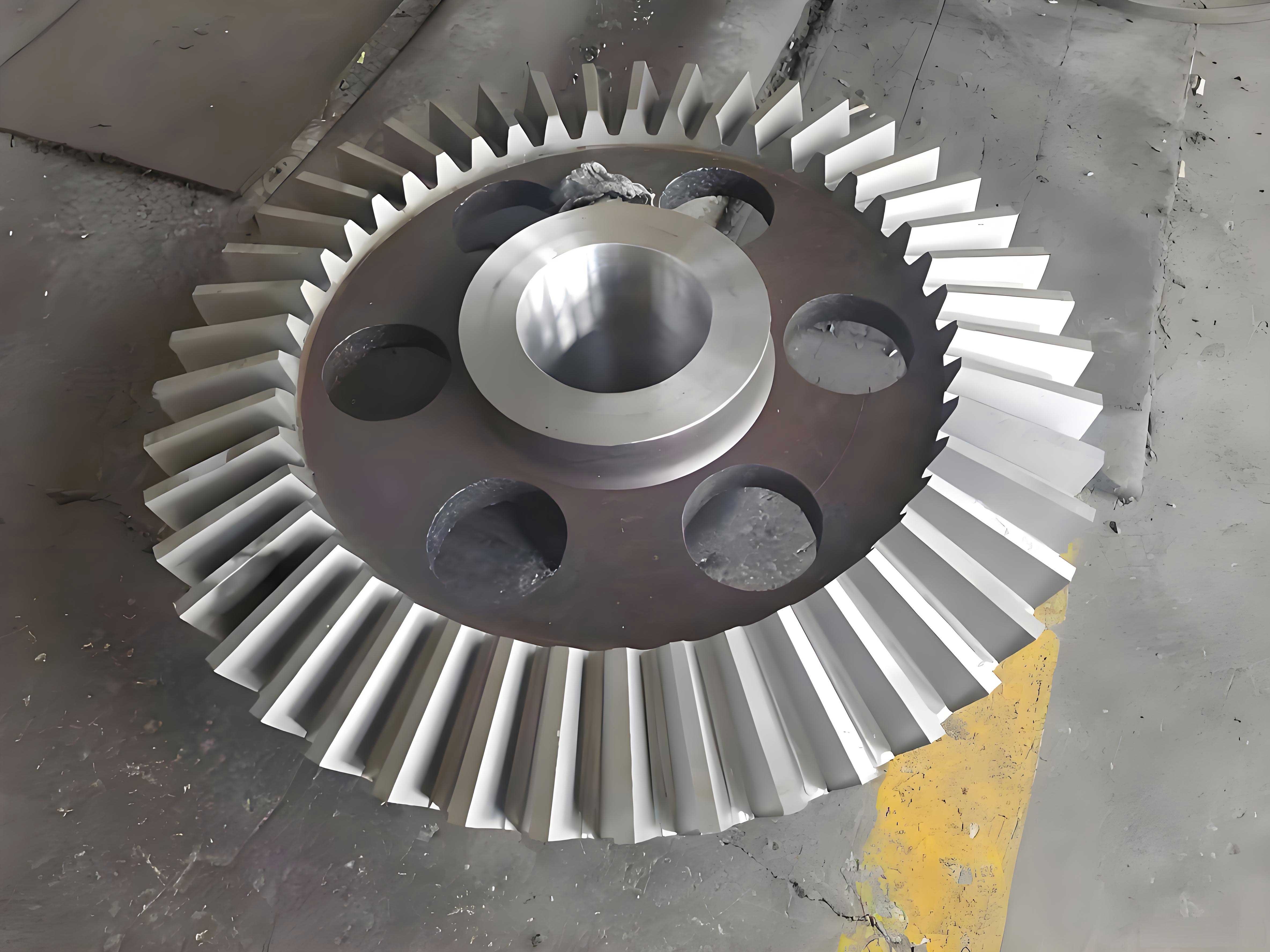
In the field of mechanical engineering, the design and analysis of gear systems are critical for ensuring reliable performance in various industrial applications. Among these, miter gears, also known as straight bevel gears, play a pivotal role in transmitting motion and power between intersecting shafts, typically at a 90-degree angle. These gears are widely used in conveyors, vehicle differentials, and machine tools due to their simplicity in design, ease of adjustment, and efficient power transmission. However, the unique structural characteristics of miter gears, such as tapered teeth from the large end to the small end, pose challenges in accurately predicting their dynamic behavior under operational conditions. Traditional static analyses often fall short in capturing the full spectrum of stresses and strains during meshing, which can lead to premature failure or suboptimal design. Therefore, a transient dynamic analysis is essential to simulate the time-varying loads and responses, providing a more comprehensive understanding of the gear performance. In this study, I aim to conduct a detailed transient dynamic analysis of a miter gear pair using ANSYS Workbench, focusing on stress and strain distributions under different rotational speeds. By leveraging finite element methods, I seek to enhance the design accuracy and durability of miter gears, ensuring they meet strength requirements while optimizing dynamic characteristics. The analysis will incorporate key parameters, material properties, and meshing techniques, with results summarized through tables and formulas to facilitate insights. Throughout this article, I will frequently refer to miter gears to emphasize their importance and application in mechanical systems.
To begin the analysis, I first established a three-dimensional assembly model of the miter gear pair. Given the complex geometry of miter gears, where tooth profiles vary along the length from the large end to the small end, direct modeling using standard CAD software can be cumbersome. Instead, I utilized GearTrax, a specialized gear design software, to automatically generate the gear profiles based on specified parameters. The miter gears in this study are derived from a conveyor system developed by a design company, with key parameters ensuring proper meshing conditions. For miter gears to mesh correctly, the module and pressure angle at the large end must be equal, and the cone distances should match. Based on these conditions, I designed an active gear and a driven gear with the following specifications, as summarized in Table 1. The three-dimensional model was then assembled in SolidWorks, ensuring accurate alignment and contact between the gear teeth. This model serves as the foundation for subsequent finite element analysis, allowing for precise simulation of the meshing process. The use of miter gears in such applications highlights their versatility, and the modeling step is crucial for capturing real-world behavior.
| Parameter | Active Gear | Driven Gear |
|---|---|---|
| Module (mm) | 2.5 | 2.5 |
| Number of Teeth | 17 | 35 |
| Pressure Angle (°) | 20 | 20 |
| Shaft Angle (°) | 90 | 90 |
| Pitch Cone Angle (°) | 25.906 | 64.093 |
After modeling, I proceeded to define the material properties for the miter gears. The gears are made of quenched and tempered 45 steel, a common choice for mechanical components due to its balanced combination of high strength, plasticity, and toughness. This material ensures that the miter gears can withstand varying operational loads without failure. In ANSYS Workbench, I configured the material properties within the Engineering Data module. The key properties include density, elastic modulus, Poisson’s ratio, bulk modulus, and shear modulus, as detailed in Table 2. These parameters are essential for accurate stress-strain calculations during transient dynamics, as they influence the gear’s response to applied loads. The material assignment was applied to the entire assembly, ensuring consistency in the analysis. The selection of 45 steel for miter gears is widespread in industrial settings, underscoring the practicality of this study.
| Property | Value |
|---|---|
| Density (kg/m³) | 7,860 |
| Elastic Modulus, E (GPa) | 2.07 |
| Poisson’s Ratio | 0.3 |
| Bulk Modulus (GPa) | 1.725 |
| Shear Modulus (GPa) | 7.9615 |
Next, I performed mesh generation on the miter gear assembly. Mesh quality directly impacts the accuracy and efficiency of finite element analysis; overly dense meshes can lead to excessive computational time and resource usage, while coarse meshes may yield inaccurate results. In ANSYS Workbench, I used the Mesh module to discretize the model. Given the intricate geometry of miter gears, I employed tetrahedral elements for overall meshing, which are suitable for complex shapes. To capture detailed stress distributions on the tooth surfaces, where meshing occurs, I refined the mesh in the contact regions, setting an element size of 1.5 mm. This approach balances precision and computational cost. The final mesh consisted of 48,030 nodes and 27,086 elements, as shown in the mesh model. Proper meshing is vital for simulating the dynamic interactions between miter gears, especially during transient conditions where loads vary with time.
With the model prepared, I moved to the transient dynamic analysis. Transient dynamics is a time-domain analysis technique that evaluates the response of a structure to time-varying loads, providing insights into stress, strain, and displacement over time. In ANSYS Workbench, I utilized the Transient Structural module for this purpose. The governing equation for transient dynamics is derived from classical mechanics and is expressed as:
$$ [M]\{\ddot{x}\} + [C]\{\dot{x}\} + [K]\{x\} = \{F(t)\} $$
where $[M]$ is the mass matrix, $[C]$ is the damping matrix, $[K]$ is the stiffness matrix, $\{\ddot{x}\}$ is the nodal acceleration vector, $\{\dot{x}\}$ is the nodal velocity vector, $\{x\}$ is the nodal displacement vector, and $\{F(t)\}$ is the time-dependent load vector. This equation forms the basis for simulating the dynamic behavior of miter gears under operational conditions. For the analysis, I set up boundary conditions and loads to mimic real-world scenarios. The active gear was assigned a rotational velocity, while the driven gear was subjected to a resisting torque to simulate load conditions. Three different rotational speeds were applied to the active gear: 30 rpm, 60 rpm, and 90 rpm, with a constant torque of 20 N·m on the driven gear. The contact between the miter gears was defined as frictional with a coefficient of 0.2, and revolute joints were applied to allow rotational motion while constraining other degrees of freedom. The analysis time was set to 1 second, with appropriate sub-step configurations for accuracy. These settings ensure that the transient response of the miter gears is captured effectively, highlighting the dynamic stresses during meshing.
Upon solving the transient dynamics, I analyzed the results to determine stress and strain distributions. The maximum equivalent stress and strain were extracted for each rotational speed, as summarized in Table 3. The stress and strain values are critical for assessing the strength of the miter gears. According to material mechanics, the allowable stress $[\sigma]$ is calculated based on the yield strength $\sigma_s$ and a safety factor $S$:
$$ [\sigma] = \frac{\sigma_s}{S} $$
For 45 steel, the yield strength is 355 MPa, and with a safety factor of 1.2, the allowable stress is approximately 295.8 MPa. Comparing the maximum equivalent stresses from the analysis, all values are below this threshold, indicating that the miter gears meet strength requirements. The stress and strain contours revealed that the maximum values occur at the large end of the miter gears, where the teeth engage. This is consistent with the geometry of miter gears, as the large end experiences higher loads due to the tapered design. The results demonstrate that transient dynamics provides a more accurate depiction of gear behavior compared to static analysis, especially for miter gears under varying speeds.
| Rotational Speed (rpm) | Maximum Equivalent Stress (MPa) | Maximum Equivalent Strain (mm) |
|---|---|---|
| 30 | 288.6 | 1.44 × 10⁻³ |
| 60 | 274.3 | 1.37 × 10⁻³ |
| 90 | 272.85 | 1.36 × 10⁻³ |
To further elucidate the trends, I plotted the maximum equivalent stress over time for each rotational speed. As shown in the curves, when the resisting torque on the active gear is constant, increasing the rotational speed leads to a decrease in the maximum equivalent stress, with the stress values stabilizing over time. This phenomenon can be attributed to inertial effects and dynamic load distribution in miter gears. At higher speeds, the gears may experience smoother engagement, reducing peak stresses. The time-history curves highlight the transient nature of the analysis, capturing stress fluctuations that static methods would miss. These insights are invaluable for optimizing miter gear designs, particularly in applications where speed variations are common. By analyzing miter gears under different conditions, engineers can better control dynamic characteristics and enhance system reliability.
The importance of miter gears in mechanical systems cannot be overstated. Their ability to transmit power at right angles makes them indispensable in many industries. Through this transient dynamic analysis, I have demonstrated that miter gears designed with 45 steel can withstand operational loads within safe limits. The use of finite element methods, particularly ANSYS Workbench, allows for detailed simulations that inform design improvements. For instance, the stress concentration at the large end suggests that reinforcing this area or optimizing tooth profiles could further enhance durability. Additionally, the inverse relationship between speed and stress implies that operating miter gears at higher speeds might reduce wear, provided other factors like lubrication and alignment are considered. This analysis underscores the value of dynamic simulations in the design process, offering a pathway to more robust and efficient miter gear systems.
In conclusion, the transient dynamic analysis of miter gears provides a comprehensive understanding of their behavior under time-varying loads. By modeling a gear pair from a conveyor system, setting material properties, meshing, and applying boundary conditions, I simulated three rotational speeds: 30 rpm, 60 rpm, and 90 rpm. The results show that maximum equivalent stresses are 288.6 MPa, 274.3 MPa, and 272.85 MPa, respectively, all below the allowable stress of 295.8 MPa for 45 steel. This confirms that the miter gears satisfy strength requirements. Moreover, the stress decreases with increasing speed and stabilizes over time, with peak values occurring at the large end. These findings highlight the efficacy of transient dynamics in gear analysis, offering insights for parameter design and dynamic control. Future work could explore other materials, gear geometries, or loading conditions to expand on this study. Ultimately, the integration of such analyses into design workflows will lead to more reliable and high-performing miter gears in industrial applications.