
In mechanical transmission systems, the straight bevel gear plays a critical role in transferring motion and power between intersecting shafts, typically at a 90-degree angle. Due to its unique structural characteristics, such as tapered teeth that vary in size from the large end to the small end, the straight bevel gear is widely used in industrial applications like conveyor systems, vehicle differentials, and machine tools. However, the complex geometry and dynamic loading conditions during operation necessitate a thorough analysis to ensure durability and precision in design. Traditional static analyses often fall short in capturing the transient effects encountered during actual operation. Therefore, this study focuses on performing a transient dynamic analysis of a straight bevel gear mechanism using finite element software, specifically ANSYS Workbench, to simulate the meshing behavior and stress distribution under varying rotational speeds. The primary objective is to provide a comprehensive understanding of the stress and strain patterns, which can enhance the design accuracy and longevity of straight bevel gears. By examining different operational scenarios, this analysis aims to contribute to the optimization of straight bevel gear systems in real-world applications.
The straight bevel gear mechanism analyzed in this work is derived from a conveyor system design, where precise power transmission is essential. The gear pair consists of an active gear and a driven gear, with their parameters carefully selected to meet the requirements of efficient meshing. The modeling process involved using specialized gear design software to generate accurate three-dimensional representations, as directly creating these models in standard CAD software can be challenging due to the tapered tooth profiles. Key parameters, such as module, number of teeth, pressure angle, and shaft angle, were defined to ensure proper engagement. For instance, the module was set to 2.5 mm, with the active gear having 17 teeth and the driven gear 35 teeth, resulting in pitch cone angles of 25.906 degrees and 64.093 degrees, respectively. This ensures that the meshing conditions, where the module and pressure angle at the large end are equal, are satisfied, allowing for smooth power transmission. The assembly of the straight bevel gear pair was completed in SolidWorks, resulting in a robust model ready for further analysis.
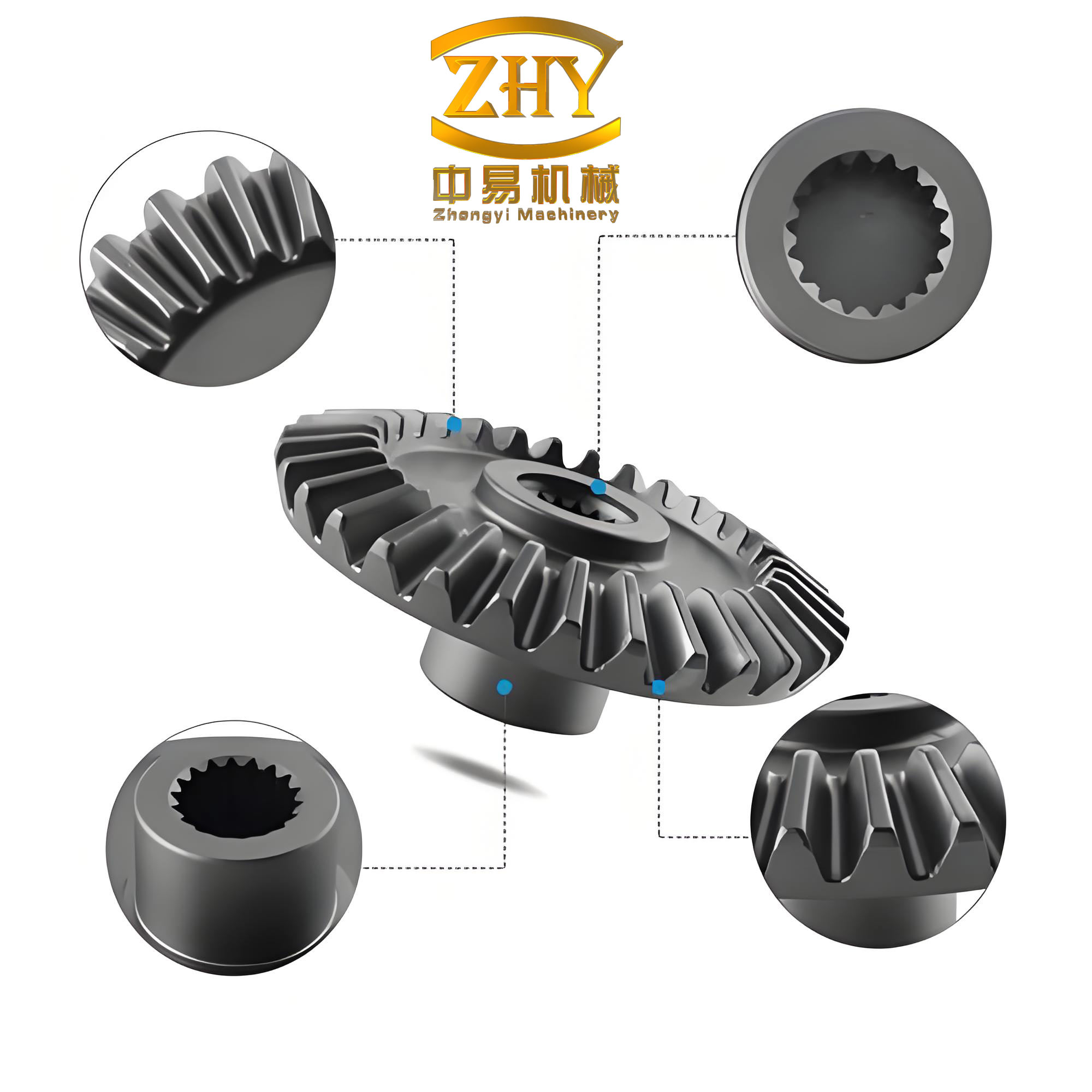
Material properties are crucial in determining the structural response of the straight bevel gear under dynamic loads. The gears are made of 45 steel, which undergoes quenching and tempering to achieve a balance of high strength, plasticity, and toughness. This material is commonly used in gear applications due to its reliability under varying operational conditions. The key material properties include a density of 7,860 kg/m³, an elastic modulus of 2.07 GPa, a Poisson’s ratio of 0.3, a volume modulus of 1.725 GPa, and a shear modulus of 7.9615 GPa. These properties were assigned in the ANSYS Workbench Engineering Data module to ensure accurate simulation results. The use of 45 steel allows the straight bevel gear to withstand the stresses encountered during meshing, thereby enhancing its service life. The table below summarizes the material properties for clarity.
| Property | Value |
|---|---|
| Density (kg/m³) | 7,860 |
| Elastic Modulus (GPa) | 2.07 |
| Poisson’s Ratio | 0.3 |
| Volume Modulus (GPa) | 1.725 |
| Shear Modulus (GPa) | 7.9615 |
Mesh generation is a critical step in finite element analysis, as it directly influences the accuracy and computational efficiency of the results. For the straight bevel gear assembly, a tetrahedral mesh was employed due to the complex geometry of the gear teeth. This type of mesh allows for better adaptation to irregular shapes, ensuring that stress concentrations in critical areas, such as the tooth surfaces, are accurately captured. The global mesh size was set to 1.5 mm, with additional refinement applied to the meshing tooth profiles to enhance precision. This approach resulted in a mesh with 48,030 nodes and 27,086 elements, providing a balance between detail and computational resources. The meshed model of the straight bevel gear assembly was then prepared for transient dynamic analysis, focusing on the regions where high stresses are expected, such as the large end of the teeth.
Transient dynamic analysis is essential for understanding the behavior of the straight bevel gear under time-varying loads, as it accounts for inertial and damping effects that static analyses ignore. The fundamental equation governing transient dynamics is derived from classical mechanics and can be expressed as:
$$ [M]\{\ddot{x}\} + [C]\{\dot{x}\} + [K]\{x\} = \{F(t)\} $$
where [M] is the mass matrix, [C] is the damping matrix, [K] is the stiffness matrix, $\{\ddot{x}\}$ is the acceleration vector, $\{\dot{x}\}$ is the velocity vector, $\{x\}$ is the displacement vector, and $\{F(t)\}$ is the time-dependent force vector. In ANSYS Workbench, the Transient Structural module was utilized to solve this equation for the straight bevel gear pair. The analysis setup included defining rotational joints (Body-Ground: Revolute) for both gears, which constrained all degrees of freedom except rotation. Frictional contact was applied between the tooth surfaces with a coefficient of 0.2, and named selections were used to efficiently define the contact and target surfaces. The simulation duration was set to 1 second, with initial, minimum, and maximum substeps of 25, 20, and 250, respectively, to ensure convergence. Loads were applied as rotational velocities to the active gear at 30 r/min, 60 r/min, and 90 r/min, and a counter-torque of 20 N·m was applied to the driven gear to simulate operational resistance.
The results of the transient dynamic analysis provide valuable insights into the stress and strain distribution of the straight bevel gear under different rotational speeds. The maximum equivalent stress and strain were extracted from the simulation, revealing that the highest values consistently occurred at the large end of the gear teeth, where meshing forces are most concentrated. For instance, at 30 r/min, the maximum equivalent stress was 288.6 MPa, with a corresponding strain of 1.44 × 10⁻³ mm. As the rotational speed increased to 60 r/min and 90 r/min, the maximum equivalent stress decreased to 274.3 MPa and 272.85 MPa, respectively, while the strain values reduced to 1.37 × 10⁻³ mm and 1.36 × 10⁻³ mm. This trend indicates that higher rotational speeds lead to a reduction in stress magnitude and a more stable stress distribution, which is beneficial for the durability of the straight bevel gear. The table below summarizes these results for comparison.
| Rotational Speed (r/min) | Maximum Equivalent Stress (MPa) | Maximum Equivalent Strain (mm) |
|---|---|---|
| 30 | 288.6 | 1.44 × 10⁻³ |
| 60 | 274.3 | 1.37 × 10⁻³ |
| 90 | 272.85 | 1.36 × 10⁻³ |
To evaluate the strength of the straight bevel gear, the maximum equivalent stress values were compared to the allowable stress of the material. For 45 steel, the yield strength is 355 MPa, and with a safety factor of 1.2, the allowable stress is calculated as:
$$ [\sigma] = \frac{\sigma_s}{S} = \frac{355}{1.2} \approx 295.8 \text{ MPa} $$
Since all observed stress values are below this threshold, the design of the straight bevel gear meets the strength requirements. Furthermore, the time-history curves of the maximum equivalent stress show that as rotational speed increases, the stress fluctuations diminish, leading to a more concentrated and stable pattern. This behavior can be attributed to the dynamic effects, where higher speeds reduce the impact forces during meshing. The analysis underscores the importance of considering transient dynamics in the design process of straight bevel gears, as it provides a more accurate representation of real-world operating conditions compared to static approaches.
In addition to stress analysis, the strain distribution further confirms that the large end of the straight bevel gear is the critical region requiring attention in design and manufacturing. The deformation patterns align with the stress concentrations, highlighting the need for potential optimizations, such as fillet radii adjustments or material enhancements, to mitigate fatigue risks. The use of finite element analysis in this context allows for iterative improvements, ensuring that the straight bevel gear can withstand prolonged operational demands. Moreover, the findings from this study can be extended to other types of bevel gears, contributing to broader advancements in gear transmission systems.
In conclusion, the transient dynamic analysis of the straight bevel gear mechanism demonstrates that the gear design is robust under varying rotational speeds, with stress levels remaining within safe limits. The reduction in maximum equivalent stress with increasing speed suggests that operational stability improves at higher velocities, which is advantageous for applications requiring high-speed transmission. This study emphasizes the value of dynamic simulation tools in enhancing the reliability and performance of straight bevel gears, providing a foundation for future research on parameter optimization and dynamic characteristic control. By integrating these insights into the design process, engineers can develop more efficient and durable straight bevel gear systems for industrial use.