
In engineering practice, absolutely smooth surfaces do not exist. For spur gears manufactured by forming or generating methods, the initial surface roughness is of the same order of magnitude as the elastohydrodynamic (EHD) film thickness. Therefore, when analyzing the elastohydrodynamic lubrication of spur gears, the influence of surface roughness must be considered. During the running-in process, wear debris is generated, which enters the lubricating oil and affects its lubrication performance. Numerous studies have been conducted domestically and internationally on the effects of surface roughness and solid particles. However, few have comprehensively considered both factors simultaneously in the transient thermal elastohydrodynamic lubrication analysis of spur gears. This article establishes an elastohydrodynamic mathematical model containing solid particles, modifies the Reynolds equation, and incorporates the influence of continuous wavy roughness. Numerical solutions for the elastohydrodynamic lubrication in the meshing zone of spur gear teeth during the running-in process are obtained, and the effects of solid particles and roughness on pressure, film thickness, and temperature are analyzed. The results indicate that continuous wavy roughness causes certain fluctuations in pressure and film thickness. When solid particles are considered, the pressure increases, and the film thickness decreases. The greater the particle velocity, the smaller the film thickness, with a reduction in minimum film thickness and a certain decrease in maximum temperature rise. The temperature rise in the region where particles are located decreases. When the roughness wavelength is small, roughness induces a larger temperature rise in contact areas with thinner film thickness. This study provides insights into optimizing spur gear lubrication under realistic operating conditions.
The spur gear is a fundamental component in mechanical transmission systems, widely used in various industries such as automotive, aerospace, and manufacturing. The performance and longevity of spur gears heavily depend on the lubrication conditions between meshing teeth. During the running-in process, surface asperities are worn down, and solid particles from wear debris enter the lubricant, altering the lubrication regime. Understanding the transient thermal elastohydrodynamic lubrication behavior under these conditions is crucial for designing durable spur gear systems. This article delves into a detailed numerical analysis to elucidate the complex interactions between surface roughness, solid particles, and lubricant properties in spur gear contacts.
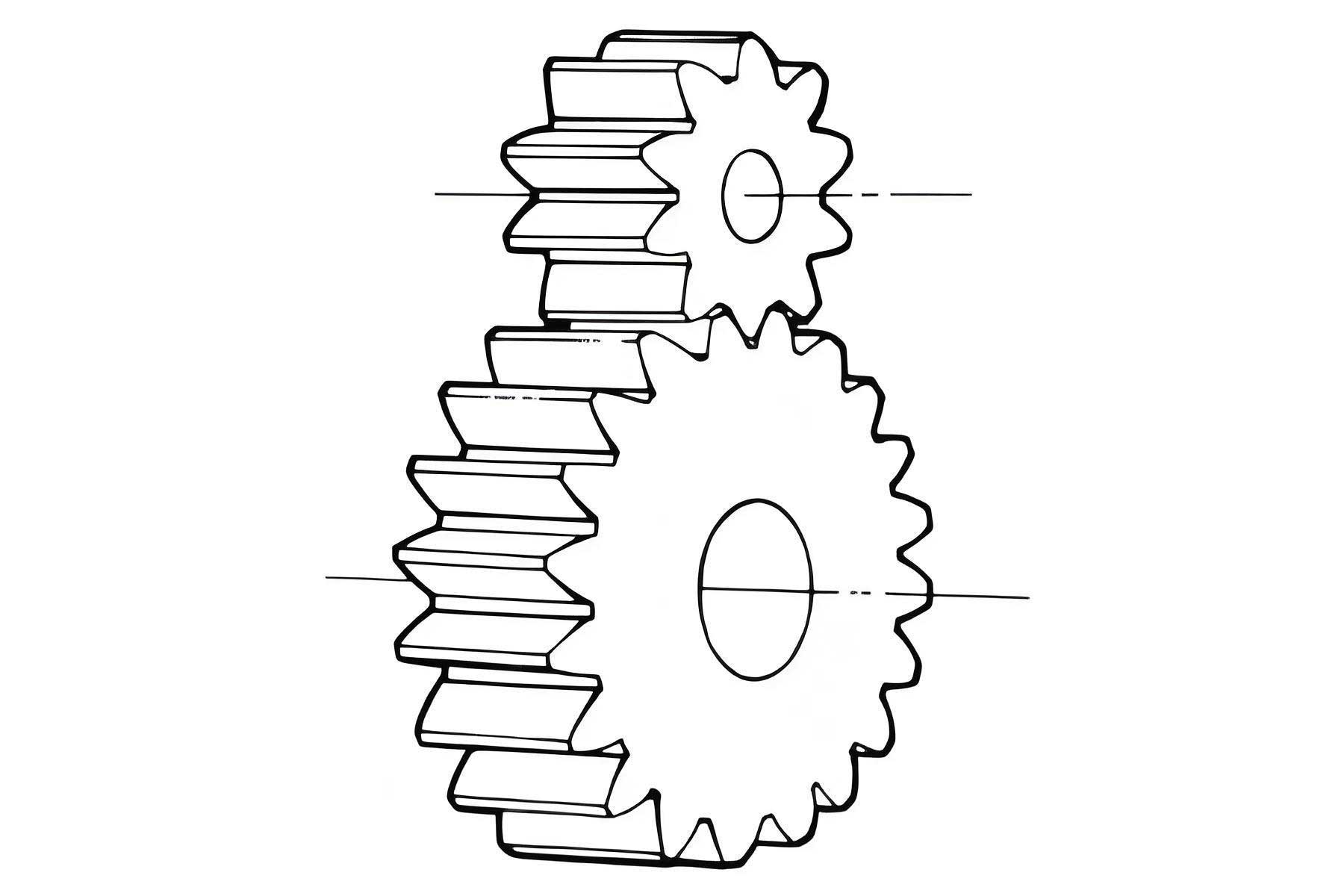
The mathematical model for elastohydrodynamic lubrication considering solid particles is derived as follows. The contact area is divided into three regions: Region 1 and Region 3 where no solid particles are present, and Region 2 where a solid particle is entrapped. The Reynolds equation for Region 1 and Region 3, considering thermal effects, is given by:
$$ \frac{\partial}{\partial x} \left( \frac{\rho}{\eta_e} h^3 \frac{\partial p}{\partial x} \right) = 12 u \frac{\partial}{\partial x} \left( \rho^* h \right) + 12 \frac{\partial}{\partial t} \left( \rho_e h \right) $$
where \( p \) is the film pressure, \( h \) is the film thickness, \( u = (u_1 + u_2)/2 \) is the entrainment velocity for regions without particles, \( x \) is the coordinate variable, \( \rho \) is density, \( \eta \) is viscosity, and subscript \( e \) denotes equivalent parameters related to viscosity and density variations. The equivalent parameters are defined as:
$$ \left( \frac{\rho}{\eta} \right)_e = 12 \left( \frac{\eta_e \rho’_e}{\eta’_e} – \rho”_e \right) $$
$$ \rho^* = \frac{\rho_e \eta_e (u_2 – u_1) + \rho_e u_1}{u} $$
$$ \rho_e = \frac{1}{h} \int_0^h \rho \, dz $$
$$ \rho’_e = \frac{1}{h^2} \int_0^h \rho \int_0^z \frac{1}{\eta} \, dz’ \, dz $$
$$ \rho”_e = \frac{1}{h^3} \int_0^h \rho \int_0^z \frac{z’}{\eta} \, dz’ \, dz $$
$$ \eta_e = h / \int_0^h \frac{1}{\eta} \, dz $$
$$ \eta’_e = h^2 / \int_0^h \frac{z}{\eta} \, dz $$
For Region 2, which contains a solid particle, the modified Reynolds equation considering thermal effects is derived based on the force balance of a lubricant micro-element. Assuming a spherical solid particle with semi-length \( z_0 \) in the z-direction, located at \( z_p \), and moving with velocity \( u_p \), the equation becomes:
$$ \frac{\partial}{\partial x} \left( \frac{\rho}{\eta^*_e} (h – 2z_0)^3 \frac{\partial p}{\partial x} \right) = 48 \frac{\partial}{\partial x} \left[ \rho^* (h – 2z_0) \frac{u_1 + u_2 + 2u_p}{4} \right] + 48 \frac{\partial}{\partial t} \left[ \rho_e (h – 2z_0) \right] $$
where \( \left( \frac{\rho}{\eta} \right)^*_e = 48 \left( \frac{\eta_e \rho’_e}{\eta’_e} – \rho”_e \right) \). This equation accounts for the presence of the solid particle by modifying the film thickness term and incorporating the particle velocity into the entrainment velocity. The boundary conditions for the Reynolds equation are:
$$ p(x_{\text{in}}, t) = 0, \quad p(x_{\text{out}}, t) = 0, \quad p \geq 0 \quad \text{for} \quad x_{\text{in}} < x < x_{\text{out}} $$
The film thickness equation for spur gear contacts, considering surface roughness, is expressed as:
$$ h = h_0 + \frac{x^2}{2R(t)} – \frac{2}{\pi E} \int_{-\infty}^{x} p(\xi, t) \ln(x – \xi)^2 \, d\xi – S_{12} $$
where \( h_0 \) is the rigid central film thickness, \( R(t) \) is the time-varying composite radius of curvature, \( E \) is the composite elastic modulus of the gear materials, and \( S_{12} \) is the composite roughness function for gear 1 and gear 2. The roughness function is modeled as a continuous wavy profile: \( S_{12} = A \sin[2\pi (x – u t) / L] \), where \( A \) is the roughness amplitude and \( L \) is the roughness wavelength. This formulation allows us to simulate the effect of surface asperities on the lubricant film in spur gear meshing.
The load equation ensures force balance over the contact area:
$$ \int_{x_{\text{in}}}^{x_{\text{out}}} p(x, t) \, dx = w(t) $$
where \( w(t) \) is the time-varying load per unit width on the spur gear tooth. The energy equation for the lubricant, accounting for heat generation due to viscous dissipation and compression, is:
$$ \rho c \left( \frac{\partial T}{\partial t} + u \frac{\partial T}{\partial x} + v \frac{\partial T}{\partial z} \right) = k \frac{\partial^2 T}{\partial z^2} – \frac{T}{\rho} \frac{\partial \rho}{\partial T} \left( \frac{\partial p}{\partial t} + u \frac{\partial p}{\partial x} \right) + \eta \left( \frac{\partial u}{\partial z} \right)^2 $$
where \( T \) is temperature, \( c \) is specific heat, \( k \) is thermal conductivity, and \( v \) is the velocity component in the z-direction. The boundary conditions for temperature are: \( T(x, 0, t) = T_1 \) and \( T(x, h, t) = T_2 \) for the gear surfaces, and adiabatic conditions at the inlet and outlet. The viscosity-pressure-temperature relationship is given by the Roelands equation:
$$ \eta = \eta_0 \exp\left\{ (\ln \eta_0 + 9.67) \left[ -1 + (1 + 5.1 \times 10^{-9} p)^{Z} \left( \frac{T – 138}{T_0 – 138} \right)^{-S} \right] \right\} $$
where \( \eta_0 \) is the ambient viscosity, \( T_0 \) is ambient temperature, \( Z \) and \( S \) are constants. The density-pressure-temperature relationship is:
$$ \rho = \rho_0 \left[ 1 + \frac{0.6 \times 10^{-9} p}{1 + 1.7 \times 10^{-9} p} – \alpha (T – T_0) \right] $$
where \( \rho_0 \) is ambient density and \( \alpha \) is the thermal expansion coefficient. These equations form a complete set for modeling transient thermal elastohydrodynamic lubrication in spur gears.
To solve these equations numerically, we employ dimensionless variables. Let \( X = x/b \), \( P = p/p_H \), \( H = hR_0/b^2 \), \( \bar{\eta} = \eta/\eta_0 \), \( \bar{\rho} = \rho/\rho_0 \), \( \bar{T} = T/T_0 \), \( \tau = t u_0/b \), where \( b \) is the half-width of the Hertzian contact under reference load \( w_0 \), \( p_H \) is the maximum Hertzian pressure under \( w_0 \), \( R_0 \) is the reference radius of curvature, and \( u_0 \) is the entrainment velocity at the pitch point. The time-varying coefficients for load, radius, and velocity are defined as \( C_{wt} = w/w_0 \), \( C_{Rt} = R/R_0 \), and \( C_{ut} = u/u_0 \), respectively. These dimensionless groups simplify the equations and enhance numerical stability.
The numerical method involves the multigrid technique for pressure solution, the multigrid integration method for elastic deformation, and the column-by-column scanning method for temperature calculation. A W-cycle with six grid levels is used, with 961 uniformly distributed nodes on the finest grid. The Gauss-Seidel iteration is applied on each grid level. The initial values for pressure and temperature at each time step are taken from the previous step. For the first instant at mesh-in, steady-state solutions are used as initial guesses. Along the line of action, 120 time steps are divided from mesh-in to mesh-out. The convergence criteria are: relative error for dimensionless pressure and load less than \( 10^{-3} \), and for dimensionless temperature less than \( 10^{-4} \). This robust approach ensures accurate solutions for the complex spur gear lubrication problem.
The parameters used in the analysis are listed in Table 1, which includes gear geometry, material properties, lubricant characteristics, and operating conditions. These parameters are typical for industrial spur gear applications, ensuring the relevance of our findings.
| Parameter | Value |
|---|---|
| Oil viscosity, \( \eta_0 \) (Pa·s) | 0.075 |
| Viscosity-pressure coefficient, \( \alpha \) (Pa\(^{-1}\)) | 2.19 × 10\(^{-8}\) |
| Viscosity-temperature coefficient, \( \beta \) (K\(^{-1}\)) | 0.042 |
| Oil environmental density, \( \rho_0 \) (kg/m\(^3\)) | 870 |
| Specific heat, \( c \) (J·kg\(^{-1}\)·K\(^{-1}\)) | 2000 |
| Heat conduction coefficient, \( k \) (W·m\(^{-1}\)·K\(^{-1}\)) | 0.14 |
| Gear density, \( \rho_{1,2} \) (kg/m\(^3\)) | 7850 |
| Gear specific heat, \( c_{1,2} \) (J·kg\(^{-1}\)·K\(^{-1}\)) | 470 |
| Gear heat conduction coefficient, \( k_{1,2} \) (W·m\(^{-1}\)·K\(^{-1}\)) | 46 |
| Young’s modulus, \( E_{1,2} \) (Pa) | 2.06 × 10\(^{11}\) |
| Poisson’s ratio, \( \nu_{1,2} \) | 0.3 |
| Number of teeth, \( z_1, z_2 \) | 35, 140 |
| Module, \( m \) (mm) | 2 |
| Rotate velocity of pinion, \( n_1 \) (r/min) | 1000 |
| Tooth width, \( B \) (mm) | 20 |
| Gear pressure angle, \( \phi \) (°) | 20 |
| Transmitted power, \( P \) (kW) | 12 |
| Addendum coefficient, \( h^* \) | 1.0 |
| Teeth gap coefficient, \( c^* \) | 0.25 |
| Environmental temperature, \( T_0 \) (K) | 313 |
The time-varying load during the meshing cycle of spur gears is shown in Figure 2, with points A, B, C, D, and E representing five instants. The load variation is critical as it affects the pressure distribution and film thickness in the contact zone. The solid particle is assumed spherical with dimensionless radius 0.22, centered at dimensionless coordinate \( X_c = -1.3 \). The dimensionless roughness amplitude \( A \) is 0.015, and the dimensionless wavelength \( L \) is 0.1, unless specified otherwise.
The effects of roughness and solid particles on pressure and film thickness are analyzed first. Figure 3 illustrates the pressure and film thickness distribution for \( A = 0.015 \) and \( L = 0.1 \). It is observed that the pressure in the region containing the solid particle increases significantly. Continuous wavy roughness causes fluctuations in pressure and film thickness, especially in areas where the film is thinner. When solid particles are considered, the film thickness decreases compared to cases without particles, indicating that particles can degrade lubrication performance in spur gear contacts. These fluctuations are due to the sinusoidal roughness profile altering the local geometry and flow dynamics.
Table 2 summarizes the impact of particle velocity on minimum film thickness and maximum temperature rise for different roughness wavelengths. This table helps quantify the interactions between particle dynamics and surface topography in spur gear lubrication.
| Particle Velocity \( u_p \) (m/s) | Roughness Wavelength \( L \) | Minimum Film Thickness \( h_{\text{min}} \) (μm) | Maximum Temperature Rise \( \Delta T_{\text{max}} \) (K) |
|---|---|---|---|
| 0.5 | 0.1 | 0.465 | 15.2 |
| 0.8 | 0.1 | 0.452 | 14.8 |
| 1.2 | 0.1 | 0.438 | 14.5 |
| 0.8 | 0.45 | 0.468 | 13.9 |
| 0.8 | 0.05 | 0.445 | 16.1 |
From Table 2, we see that as particle velocity increases, the minimum film thickness decreases, which can lead to increased wear in spur gears. The maximum temperature rise also decreases slightly with higher particle velocity, likely due to enhanced heat convection by moving particles. Smaller roughness wavelengths result in higher temperature rises, emphasizing the importance of surface finish in spur gear design.
The influence of particle velocity on pressure and film thickness is further examined in Figure 4 for \( A = 0.015 \) and \( L = 0.1 \). Particle velocity has negligible effect on pressure distribution, but film thickness reduces notably with increasing velocity. This reduction is attributed to the particle displacing lubricant and altering flow patterns. High-velocity particles can thus exacerbate lubrication challenges in spur gear systems, especially during running-in when debris is abundant.
Time-varying effects are crucial in spur gear lubrication due to changing kinematics along the line of action. Figure 5 shows transient pressure and film thickness at instants A, B, C, D, and E for \( A = 0.015 \), \( L = 0.1 \), and particle velocity \( u_p = 0.8 \) m/s. The secondary pressure peak shifts from the inlet to outlet and back, influenced by load variation and squeeze film effects. Roughness and particle effects are most pronounced at instant C, where load is high. Each instant shows film necking, with roughness causing visible fluctuations. These dynamics underscore the need for transient analysis in spur gear lubrication studies.
The temperature distribution under time-varying conditions is analyzed for different roughness wavelengths. Figure 6 presents temperature profiles at instants B, C, and D for \( u_p = 0.8 \) m/s and \( A = 0.015 \), with \( L = 0.45 \) and \( L = 0.1 \). Solid particles cause significant temperature rises in their vicinity, with the maximum at instant C. For larger \( L \) (0.45), roughness induces minor temperature increases in thin-film regions. For smaller \( L \) (0.1), roughness leads to substantial temperature rises in areas with reduced film thickness. This is because shorter wavelengths create more frequent asperity contacts, generating more frictional heat. Such thermal effects can accelerate lubricant degradation and surface damage in spur gears.
The combined effects of continuous wavy roughness and solid particles on minimum film thickness and maximum temperature are summarized in Figure 7 for \( A = 0.015 \) and \( L = 0.1 \). As particle velocity increases, minimum film thickness decreases, potentially compromising spur gear durability. Maximum temperature decreases slightly with higher particle velocity, but the reduction is modest. The temperature rise in the particle region diminishes with velocity, suggesting that faster particles may carry away some heat. However, the overall impact on spur gear temperature is complex and depends on multiple factors.
To validate our numerical results, we compare the minimum film thickness from our simulations with predictions from the Dowson-Higginson empirical formula for spur gear contacts. The dimensionless Dowson formula is:
$$ H_{\text{min}} = 2.65 G^{0.54} U^{0.7} W^{-0.13} $$
where \( G = \alpha E’ \), \( U = \eta_0 u / (E’ R) \), \( W = w / (E’ R) \), and \( E’ \) is the effective elastic modulus. The dimensional form is:
$$ h_{\text{min}} = \alpha^{0.54} (\eta_0 u)^{0.7} E’^{-0.03} R^{0.43} w^{-0.13} $$
Table 3 compares our numerical results with empirical values at five meshing positions corresponding to instants A to E. The relative errors are within 10%, confirming the accuracy of our numerical method for spur gear lubrication analysis.
| Meshing Position | Numerical Result \( h_{\text{min}} \) (μm) | Empirical Value \( h_{\text{min}} \) (μm) | Relative Error (%) |
|---|---|---|---|
| 1 (A) | 0.5233 | 0.5136 | 1.9 |
| 2 (B) | 0.5142 | 0.5126 | 3.1 |
| 3 (C) | 0.4651 | 0.5040 | 7.7 |
| 4 (D) | 0.5121 | 0.5539 | 7.5 |
| 5 (E) | 0.6849 | 0.6490 | 5.5 |
The temperature distribution under different particle velocities is explored in Figure 8 for \( A = 0.015 \) and \( L = 0.1 \). Higher particle velocities reduce the temperature rise in the particle region, possibly due to improved heat dissipation. However, continuous wavy roughness expands the high-temperature zone in Region 3, leading to elevated temperatures at the outlet. This necessitates efficient cooling strategies for spur gear lubricants to maintain performance and longevity.
In conclusion, our analysis of transient thermal elastohydrodynamic lubrication in spur gears during running-in, considering solid particles and surface roughness, yields several key findings. Continuous wavy roughness induces fluctuations in pressure and film thickness, potentially leading to localized stress concentrations and wear. Solid particles increase pressure and reduce film thickness, with higher particle velocities exacerbating film thinning. The minimum film thickness decreases with particle velocity, while the maximum temperature rise shows a slight decrease. Temperature rises are significant in particle-laden regions, and smaller roughness wavelengths cause higher temperature increases in thin-film areas. These insights highlight the importance of controlling surface finish and managing wear debris in spur gear systems. Future work could explore the effects of particle shape, size distribution, and lubricant additives on spur gear lubrication. Additionally, experimental validation would further enhance the robustness of our model. By integrating these factors, engineers can better design spur gear transmissions for improved reliability and efficiency in demanding applications.
The mathematical models and numerical methods developed here provide a framework for analyzing complex lubrication scenarios in spur gears. The inclusion of time-varying effects, thermal aspects, and real-world factors like roughness and particles makes this study relevant for practical gear design. We hope that this work contributes to advancing the understanding of elastohydrodynamic lubrication in spur gears and supports the development of more durable mechanical systems.