
In the field of mechanical transmissions, particularly in aerospace applications, the selection between straight bevel gear and zero spiral bevel gear systems is critical due to their distinct performance characteristics. This study focuses on analyzing the transmission properties of these gears through finite element modeling and transient simulation using ANSYS/LS-DYNA. The primary objective is to compare key aspects such as contact forces, stress distribution, and vibrational behavior under identical operational conditions. The straight bevel gear serves as the baseline for validation, ensuring the accuracy of the simulation methodology before extending the analysis to the zero spiral bevel gear. Understanding these differences is essential for optimizing gear design in high-precision industries like aviation, where reliability and efficiency are paramount.
The finite element model for the straight bevel gear was developed to replicate real-world loading scenarios, with rotational speed applied to the driving gear and resistive torque to the driven gear. This setup allowed for the extraction of contact forces, which were compared against theoretical calculations to verify the model’s reliability. The results showed a close alignment, with errors below 5%, confirming the validity of the approach. Subsequently, a comparable model for the zero spiral bevel gear was constructed, maintaining similar gear ratios, tooth counts, and loading parameters to facilitate a direct comparison. The simulation parameters included a rotational speed of 1500 rpm and a torque of 50 Nm, reflecting typical aerospace operational conditions. The meshing and element selection were optimized to capture dynamic interactions accurately, with a focus on transient response over multiple engagement cycles.
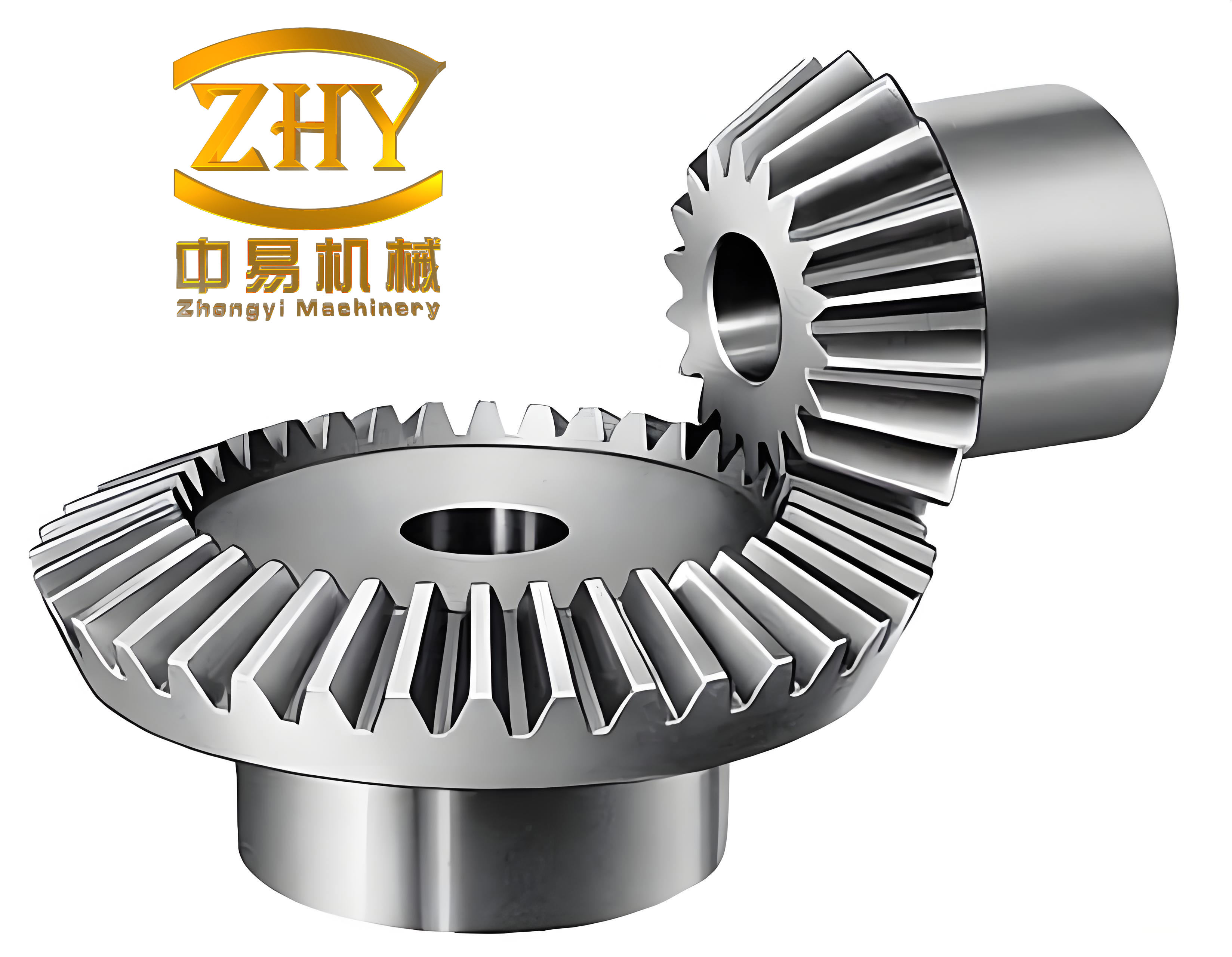
Contact force analysis revealed significant disparities between the straight bevel gear and the zero spiral bevel gear. For the straight bevel gear, the contact force exhibited substantial fluctuations during stable operation, with an amplitude of 1925 N, whereas the zero spiral bevel gear demonstrated a much smoother response, with an amplitude of only 95 N. This indicates that the zero spiral bevel gear provides superior stability in transmission. The Fourier transform (FFT) of the contact force curves further highlighted these differences. For the straight bevel gear, the FFT analysis showed peak frequencies of 11.8 Hz during loading, 11,567.1 Hz during transition, and 43,625.0 Hz during stable operation, with corresponding amplitudes of 751.6 N, 773.5 N, and 774.4 N, respectively. In contrast, the zero spiral bevel gear had lower frequencies and amplitudes: 12.5 Hz (492.1 N) during loading, 1,900.0 Hz (305.4 N) during transition, and 1,949.0 Hz (70.3 N) during stable operation. These results underscore the reduced dynamic excitations in the zero spiral bevel gear, which contribute to enhanced operational smoothness. The contact force for a straight bevel gear can be theoretically approximated using the formula: $$F_t = \frac{2T}{d_m}$$ where \(F_t\) is the tangential force, \(T\) is the applied torque, and \(d_m\) is the mean diameter. However, the simulation accounts for dynamic effects, leading to the observed variations.
| Parameter | Straight Bevel Gear | Zero Spiral Bevel Gear |
|---|---|---|
| Stable Force Amplitude (N) | 1925 | 95 |
| Loading Phase Frequency (Hz) | 11.8 | 12.5 |
| Loading Phase Amplitude (N) | 751.6 | 492.1 |
| Transition Phase Frequency (Hz) | 11,567.1 | 1,900.0 |
| Transition Phase Amplitude (N) | 773.5 | 305.4 |
| Stable Phase Frequency (Hz) | 43,625.0 | 1,949.0 |
| Stable Phase Amplitude (N) | 774.4 | 70.3 |
Stress distribution under ideal conditions was evaluated through von Mises stress contours and extracted stress curves along the tooth face and root. For the straight bevel gear, the contact pattern spread across a larger portion of the tooth height, with some divergence, whereas the zero spiral bevel gear showed concentrated stress near the toe region. The maximum surface stress on the pinion was 532 MPa for the straight bevel gear and 756 MPa for the zero spiral bevel gear, indicating higher localized stress in the latter due to reduced contact area. Conversely, root stress analysis revealed that the straight bevel gear experienced higher tensile stresses (226 MPa on the pinion and 185 MPa on the gear) compared to the zero spiral bevel gear (174 MPa and 147 MPa, respectively). The compressive root stresses, however, were greater in the zero spiral bevel gear for the gear component (235 MPa vs. 150 MPa). The bending stress at the root can be modeled using the equation: $$\sigma_b = \frac{F_t \cdot K_a \cdot K_m}{b \cdot m_n \cdot Y}$$ where \(\sigma_b\) is the bending stress, \(K_a\) is the application factor, \(K_m\) is the load distribution factor, \(b\) is the face width, \(m_n\) is the normal module, and \(Y\) is the Lewis form factor. This formula highlights the influence of gear geometry on stress concentrations, particularly for the straight bevel gear design.
| Component | Stress Type | Straight Bevel Gear | Zero Spiral Bevel Gear |
|---|---|---|---|
| Pinion | Surface Stress | 532 | 756 |
| Root Tensile Stress | 226 | 174 | |
| Gear | Surface Stress | 522 | 536 |
| Root Tensile Stress | 185 | 147 |
Under misalignment conditions, such as a 0.1° reduction in shaft angle, 0.3 mm axial displacement of the pinion, and 0.1 mm axial displacement of the gear, the stress patterns shifted significantly. For the straight bevel gear, the contact area moved toward the toe, with the pinion engaging near the root and the gear near the tip, leading to increased stress concentrations. The maximum surface stress reached 635 MPa on the pinion and 756 MPa on the gear. In comparison, the zero spiral bevel gear also showed deviation but with lower root stresses; for instance, the pinion root tensile stress was 194 MPa versus 251 MPa for the straight bevel gear. The compressive root stress on the gear was 284 MPa for the zero spiral bevel gear, compared to 351 MPa for the straight bevel gear. These findings emphasize the sensitivity of the straight bevel gear to installation errors, which can exacerbate stress imbalances and reduce service life. The contact stress under load can be described by the Hertzian contact theory: $$\sigma_c = \sqrt{\frac{F_n}{\pi \cdot b} \cdot \frac{1}{\frac{1-\nu_1^2}{E_1} + \frac{1-\nu_2^2}{E_2}} \cdot \frac{1}{R}}$$ where \(\sigma_c\) is the contact stress, \(F_n\) is the normal force, \(b\) is the face width, \(\nu\) is Poisson’s ratio, \(E\) is the modulus of elasticity, and \(R\) is the effective radius of curvature. This equation illustrates why the zero spiral bevel gear, with its localized contact, exhibits higher surface stresses but better overall stability.
| Component | Stress Type | Straight Bevel Gear | Zero Spiral Bevel Gear |
|---|---|---|---|
| Pinion | Surface Stress | 635 | 825 |
| Root Tensile Stress | 251 | 194 | |
| Gear | Surface Stress | 756 | 695 |
| Root Tensile Stress | 290 | 246 |
Vibrational analysis focused on the axial displacement and acceleration of the gear, as this directly impacts noise and transmission stability. The straight bevel gear exhibited a maximum axial displacement amplitude of 0.0897 mm and a root mean square (RMS) value of 0.0392 mm, whereas the zero spiral bevel gear had values of 0.0353 mm and 0.0157 mm, respectively. Acceleration derived from displacement data showed a peak of \(6.801 \times 10^7 \, \text{mm/s}^2\) for the straight bevel gear, compared to \(2.425 \times 10^7 \, \text{mm/s}^2\) for the zero spiral bevel gear. This indicates that the zero spiral bevel gear generates less vibration, contributing to quieter and more reliable operation. The vibrational response can be linked to the dynamic mesh stiffness, which for a straight bevel gear varies more significantly due to its linear tooth engagement, unlike the gradual engagement in spiral designs. The natural frequency of vibration can be estimated using: $$f_n = \frac{1}{2\pi} \sqrt{\frac{k}{m}}$$ where \(k\) is the mesh stiffness and \(m\) is the effective mass. The lower vibrational levels in the zero spiral bevel gear align with its smoother force transmission, as observed in the contact force analysis.
| Parameter | Straight Bevel Gear | Zero Spiral Bevel Gear |
|---|---|---|
| Displacement Amplitude (mm) | 0.0897 | 0.0353 |
| RMS Displacement (mm) | 0.0392 | 0.0157 |
| Acceleration Amplitude (mm/s²) | \(6.801 \times 10^7\) | \(2.425 \times 10^7\) |
In conclusion, the straight bevel gear and zero spiral bevel gear demonstrate distinct transmission characteristics that influence their suitability for aerospace applications. The straight bevel gear shows higher contact force fluctuations, greater vibrational amplitudes, and increased sensitivity to misalignment, leading to elevated root stresses in many scenarios. Conversely, the zero spiral bevel gear offers improved stability with lower force variations and vibrations, albeit with higher localized surface stresses. These differences highlight the trade-offs between load distribution and dynamic performance. For instance, in applications where noise reduction and smooth operation are critical, the zero spiral bevel gear may be preferable, whereas the straight bevel gear could be chosen for its simpler manufacturing and lower cost in less demanding environments. This analysis provides a foundation for selecting the appropriate gear type based on specific operational requirements, ensuring optimal performance and longevity in advanced mechanical systems.