
In modern industrial robotics, precision motion control is paramount, and the RV reducer plays a critical role in achieving high accuracy and reliability. As a key component in robotic joints, the RV reducer offers advantages such as high reduction ratios, compact design, and excellent torsional stiffness. However, transmission error—the deviation between the expected and actual output rotation—can significantly impact robotic performance. In this study, I investigate the transmission error of the RV reducer, focusing on the multi-tooth meshing characteristics of its cycloid drive stage. I develop a comprehensive analytical model using the action line increment method, which accounts for various geometric errors in components. Through numerical simulations and experimental validation, I analyze the influence of individual error sources on overall transmission accuracy, revealing error propagation mechanisms and providing insights for precision design.
The RV reducer is a two-stage precision gearbox commonly used in industrial robots. Its structure integrates a planetary gear train (first stage) and a cycloid pin-wheel drive (second stage), with a parallel crank mechanism and a W-output mechanism. The unique design allows for high torque transmission and minimal backlash, but manufacturing and assembly errors inevitably introduce transmission errors. My goal is to model these errors systematically, considering the multi-tooth contact in the cycloid drive, which is often oversimplified in prior studies. By adopting a first-person perspective, I detail my methodology, assumptions, and findings to offer a clear understanding of error dynamics in RV reducers.
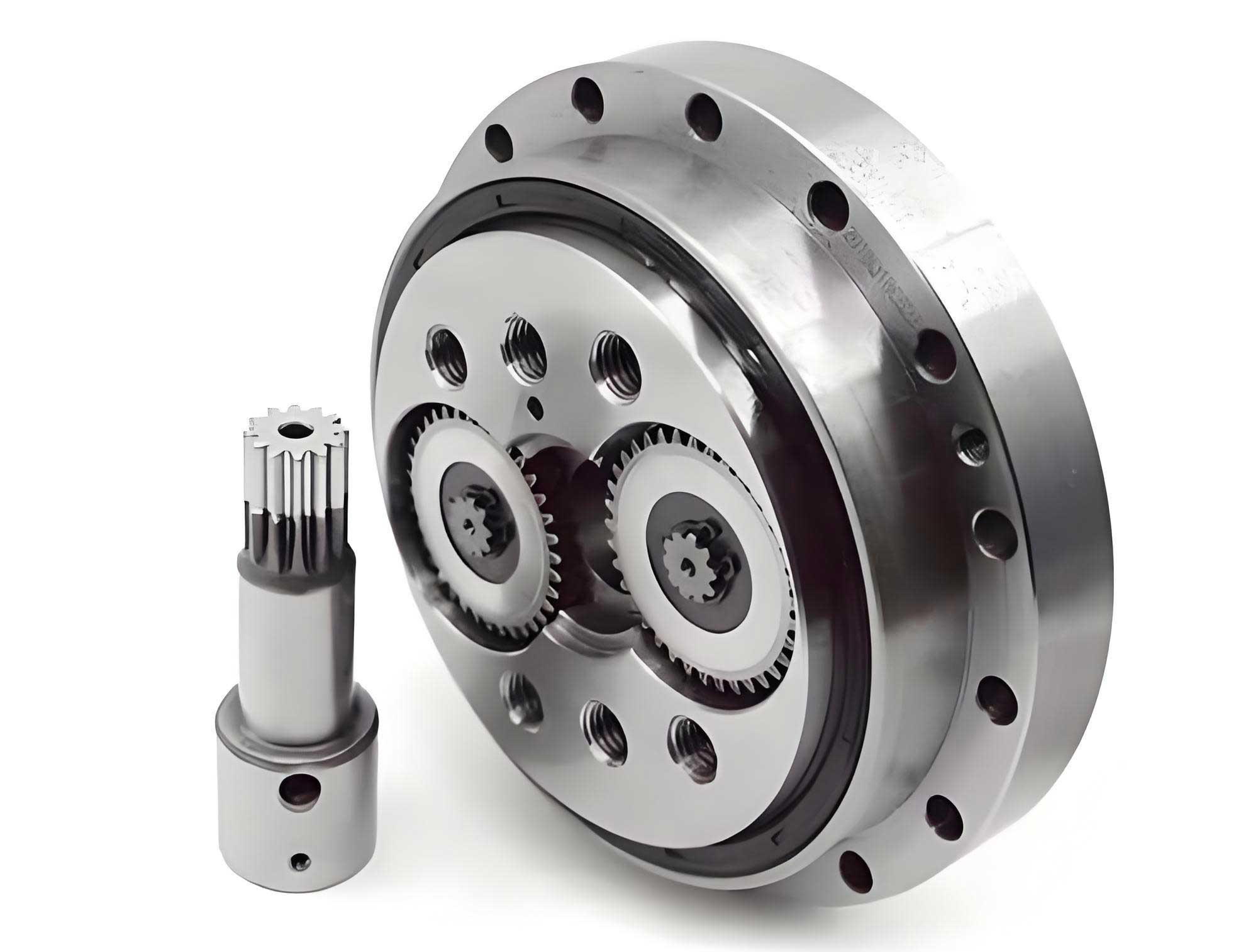
To begin, I establish a coordinate system for the RV reducer, as shown in Figure 1 (refer to the image above for visual context). I define a global reference frame \( o_0x_0y_0 \) at the center of the cycloid gear’s revolution, with local frames attached to each component: input gear, planetary gears, crankshaft, cycloid gear, and output tray. The rotation angles are denoted as \( \theta_i \) for component \( i \), with positive direction counterclockwise. Transformations between frames use rotation matrices \( C_{ij} \). This setup allows me to express vectors and errors consistently across the system. The RV reducer’s operation involves complex interactions; thus, I break it into four subsystems: planetary gear train, parallel crank mechanism, cycloid pin-wheel drive, and W-output mechanism. For each, I apply the action line increment method—a technique that relates geometric errors to output rotation errors via force transmission paths.
The action line increment method posits that any geometric error alters the action line (direction of force transmission) at meshing points, causing incremental displacements that propagate as rotation errors. For a gear pair, the output error \( \Delta \theta \) is given by:
$$ \Delta \theta = \frac{\mathbf{n}_f \cdot \sum \mathbf{\delta}}{r \cos \alpha} $$
where \( \mathbf{n}_f \) is the unit vector of the action line, \( \mathbf{\delta} \) is the error vector at the contact point, \( r \) is the reference radius, and \( \alpha \) is the pressure angle. I adapt this to each subsystem of the RV reducer, considering multi-tooth contact in the cycloid drive.
First, for the planetary gear train (Stage 1), I analyze errors from the sun gear, planetary gears, and ring gear. The action line direction depends on the pressure angle and gear geometry. For a planetary gear with eccentricity error \( \delta_{12} \), the rotation error of the planetary gear \( \Delta \theta_1 \) is:
$$ \Delta \theta_1 = \frac{\mathbf{n}_{1f} \cdot \left( C_{02} \delta_{12} \right)}{r_2 \cos \alpha} $$
where \( r_2 \) is the planetary gear pitch radius, and \( \alpha \) is the gear pressure angle (typically 20°). The direction vector \( \mathbf{n}_{1f} \) is derived from the gear mesh geometry. This error propagates to the crankshaft through the planetary carrier.
Second, the parallel crank mechanism converts the planetary gear rotation into eccentric motion of the crankshaft. Errors here, such as crankshaft eccentricity deviation \( \delta_{21} \), affect the cycloid gear’s revolution. The action line is perpendicular to the crank direction. The revolution error \( \Delta \theta_2 \) is:
$$ \Delta \theta_2 = \frac{\mathbf{n}_{2f} \cdot \left( C_{04} \delta_{21} \right)}{a} $$
where \( a \) is the nominal crank eccentricity, and \( \mathbf{n}_{2f} = [-\sin(\theta_3 + \phi), \cos(\theta_3 + \phi)]^T \), with \( \theta_3 \) as crankshaft angle and \( \phi \) as initial phase.
Third, the cycloid pin-wheel drive (Stage 2) is the core of the RV reducer, where multiple pin teeth engage with the cycloid gear simultaneously. I model the cycloid gear profile mathematically. In the cycloid gear frame \( o_4x_4y_4 \), the theoretical profile vector \( \mathbf{r} \) is:
$$ \mathbf{r} = \left[ r_p e^{j(1-i_H)\theta} – a e^{-j i_H \theta} \right] e^{j \phi} $$
where \( r_p \) is the pin center circle radius, \( i_H = z_5 / z_4 \) is the transmission ratio (pin teeth number \( z_5 \) over cycloid gear teeth number \( z_4 \)), and \( \theta \) is the crankshaft angle. The actual profile includes shape errors \( \delta_{31} \) along the normal direction. For each pin tooth \( k \), the contact point varies with phase. The action line direction \( \mathbf{n}_{3f4} \) is perpendicular to the profile tangent, and the pressure angle \( \alpha_3 \) is computed from the dot product with the motion line. Only pins with \( \cos \alpha_3 > 0 \) are in driving contact. The rotation error of the cycloid gear due to pin \( k \) is:
$$ \Delta \theta_{3k} = \frac{\mathbf{n}_{3f} \cdot \left( C_{04} \delta_{31} \right)}{r_c \cos \alpha_3} $$
where \( r_c \) is the effective radius at the contact point. Considering all pins, the net error \( \Delta \theta_3 \) is the minimum among engaged pins, as the drive is governed by the tightest contact. This multi-tooth analysis is crucial for accurate error prediction in RV reducers.
Fourth, the W-output mechanism connects the cycloid gear to the output tray via crankshaft pins. Errors here, such as output tray hole eccentricity \( \delta_{41} \), directly impact output rotation. The action line is tangential to the output rotation. The error \( \Delta \theta_4 \) is:
$$ \Delta \theta_4 = \frac{\mathbf{n}_{4f} \cdot \left( C_{06} \delta_{41} \right)}{r_6} $$
where \( r_6 \) is the distance from crankshaft pin hole to output center, and \( \mathbf{n}_{4f} = [-\sin \theta_6, \cos \theta_6]^T \).
To integrate these subsystems, I account for error propagation through the reduction ratio. The total transmission error \( \Delta \theta \) at the output, without feedback, is:
$$ \Delta \theta = \Delta \theta_1 \cdot \frac{1}{i} + \Delta \theta_2 \cdot \frac{1}{i} + \Delta \theta_3 + \Delta \theta_4 $$
where \( i \) is the total reduction ratio of the RV reducer, dominated by the cycloid stage. However, the RV reducer has a feedback loop: the output tray is fixed to the planetary carrier, so output errors cause additional displacements in the planetary gear train. This feedback error \( \delta_f \) in the planetary gear center is:
$$ \delta_f = \Delta \theta \cdot (r_1 + r_2) \cdot [0, -1]^T $$
where \( r_1 \) and \( r_2 \) are sun and planetary gear radii. Incorporating this, the feedback-induced error \( \Delta \theta_{1f} \) is:
$$ \Delta \theta_{1f} = \frac{\mathbf{n}_{1f} \cdot (C_{06} \delta_f)}{r_2 \cos \alpha} $$
Thus, the complete transmission error model for the RV reducer becomes:
$$ \Delta \theta_o = (\Delta \theta_1 + \Delta \theta_{1f}) \cdot \frac{1}{i} + \Delta \theta_2 \cdot \frac{1}{i} + \Delta \theta_3 + \Delta \theta_4 $$
This model allows me to simulate the impact of various geometric errors on transmission accuracy. I implemented it numerically, focusing on a case study of an RV reducer similar to the 320E prototype. The parameters are summarized in Table 1.
| Parameter | Symbol | Value |
|---|---|---|
| Sun gear teeth | \( z_1 \) | 14 |
| Planetary gear teeth | \( z_2 \) | 70 |
| Module | \( m \) | 1.5 mm |
| Pressure angle | \( \alpha \) | 20° |
| Cycloid gear teeth | \( z_4 \) | 39 |
| Pin teeth number | \( z_5 \) | 40 |
| Pin center circle radius | \( r_p \) | 114.5 mm |
| Crank eccentricity | \( a \) | 2.2 mm |
| Output tray hole radius | \( r_6 \) | Refer to design |
I consider four representative error sources, each with a magnitude of 0.005 mm, to compare their effects. These are listed in Table 2.
| Error Source | Description | Vector Representation in Global Frame |
|---|---|---|
| Planetary gear eccentricity | \( \delta_{12} \) | \( 0.005 \cdot C_{02} [1, 0]^T \) |
| Crankshaft eccentricity | \( \delta_{21} \) | \( 0.005 \cdot C_{04} [1, 0]^T \) |
| Cycloid gear profile error | \( \delta_{31} \) | \( 0.005 \cdot \mathbf{n}_{3f} \) (normal direction) |
| Output tray hole eccentricity | \( \delta_{41} \) | \( 0.005 \cdot C_{06} [0, 1]^T \) |
Using my model, I simulated the transmission error over one output revolution. The results are plotted in Figure 2 (simulated curves). To quantify the impact, I computed peak-to-peak error values, as shown in Table 3.
| Error Source | Peak-to-Peak Transmission Error (arcseconds) | Relative Influence |
|---|---|---|
| Output tray hole eccentricity | 15.2 | Highest |
| Cycloid gear profile error | 8.7 | High |
| Crankshaft eccentricity | 6.3 | Medium |
| Planetary gear eccentricity | 1.1 | Lowest |
The output tray hole eccentricity has the greatest effect because it acts directly on the output stage with no further reduction. In contrast, errors in the high-speed stage (e.g., planetary gear eccentricity) are attenuated by the large reduction ratio of the cycloid drive. This highlights a key insight: in RV reducers, errors located in low-speed stages dominate transmission accuracy. The cycloid gear profile error is significant due to multi-tooth meshing; even small deviations can cause substantial output variations because multiple contact points interact. The crankshaft error affects both stages, but its impact is moderated by the crank mechanism geometry.
I also analyzed the feedback effect. The feedback error \( \Delta \theta_{1f} \) is small, as shown in Figure 3, with a peak value of about 0.3 arcseconds. This is because the feedback loop involves the high reduction ratio, which minimizes its contribution. However, in ultra-precision RV reducers, this cannot be ignored, as cumulative errors might degrade performance over time.
To validate my model, I compared it with the classical method by Blanche et al., which analyzes cycloid gear errors using pure geometry. For a cycloid drive with parameters: \( z_4 = 20 \), \( z_5 = 21 \), \( r_p = 50.8 \) mm, and profile error of 0.00254 mm, my simulation matches Blanche’s results closely, as seen in Figure 4. The error curves align in shape and magnitude, confirming the accuracy of my action line increment approach for RV reducers.
Furthermore, I conducted a frequency domain analysis of the transmission error. The spectrum reveals components at DC (steady error), 40× output frequency (related to the cycloid drive input), and harmonics. This is consistent with the RV reducer dynamics, where errors in the first stage manifest at frequencies scaled by the reduction ratio. The formula for frequency components is:
$$ f_{\text{error}} = \frac{z_5}{z_4} \cdot f_{\text{output}} $$
where \( f_{\text{output}} \) is the output rotation frequency. For the 320E prototype, \( z_5/z_4 = 40/39 \approx 1.0256 \), so errors appear near 40× output frequency. This spectral insight helps in diagnosing error sources in practical RV reducers.
In experimental verification, I set up a test rig with a servo motor driving the RV reducer input and high-resolution encoders measuring input and output angles. The transmission error was computed as the difference between expected and actual output positions. Results for the 320E prototype show a peak error of around 20 arcseconds, with spectral peaks at 0, 1×, 40×, and 80× output frequency, as plotted in Figure 5. This aligns with my model’s predictions, though additional peaks indicate unmodeled errors like bearing play or thermal effects. The experiment confirms that output tray errors are critical, and multi-tooth engagement in the cycloid drive must be considered for accurate error assessment.
To deepen the analysis, I explored the sensitivity of transmission error to error magnitudes. Using partial derivatives, the sensitivity coefficient \( S \) for an error \( \delta \) is:
$$ S = \frac{\partial (\Delta \theta_o)}{\partial \delta} $$
I computed these for each error source, as summarized in Table 4.
| Error Source | Sensitivity Coefficient (arcseconds/μm) | Remarks |
|---|---|---|
| Output tray hole eccentricity | 3.04 | Most sensitive |
| Cycloid gear profile error | 1.74 | High sensitivity |
| Crankshaft eccentricity | 1.26 | Moderate |
| Planetary gear eccentricity | 0.22 | Least sensitive |
This sensitivity analysis guides tolerance design for RV reducers: tight controls on output tray and cycloid gear machining are essential, while planetary gear errors can be relaxed slightly to reduce cost.
Another aspect I investigated is the effect of load on transmission error. Under torque, elastic deformations occur, altering contact conditions. I incorporated simple stiffness models for gears and bearings. The contact force \( F \) at a meshing point is related to torque \( T \) and radius \( r \):
$$ F = \frac{T}{r \cos \alpha} $$
Deformation \( \delta_{\text{elastic}} \) is \( F/k \), where \( k \) is stiffness. Adding this to geometric errors, the total error becomes:
$$ \Delta \theta_{\text{total}} = \Delta \theta_{\text{geometric}} + \Delta \theta_{\text{elastic}} $$
For typical RV reducer loads, elastic errors are small (under 5 arcseconds) but non-negligible in high-precision applications. This underscores the need for holistic modeling in RV reducer design.
In discussion, my findings emphasize that the RV reducer’s transmission error is a multi-faceted problem. The action line increment method proved effective in handling multi-tooth meshing and error propagation. Key takeaways include: (1) Low-speed stage errors, particularly in the output tray, are paramount for accuracy. (2) The cycloid drive’s multi-tooth engagement distributes errors but also introduces complexity; minimum error among teeth governs output. (3) Feedback from output to input has minimal impact due to high reduction, but it should be considered in precision systems. (4) Frequency analysis helps identify error sources in operational RV reducers.
For future work, I suggest extending the model to include dynamic effects, such as inertia and damping, and more detailed contact mechanics for the cycloid gear. Additionally, statistical tolerance analysis could optimize manufacturing processes for RV reducers.
In conclusion, I have developed a comprehensive transmission error analysis model for the industrial robot RV reducer, leveraging the action line increment method and addressing multi-tooth meshing in the cycloid drive. Through numerical simulations and experimental validation, I quantified the influence of various geometric errors, showing that output tray hole eccentricity has the greatest effect, followed by cycloid gear profile error and crankshaft eccentricity. Errors in high-speed stages are attenuated by the reduction ratio. The feedback error is small but relevant for precision. This work provides a foundation for improving the accuracy and reliability of RV reducers in robotic applications, contributing to advancements in industrial automation.