
In the field of precision engineering, the accurate measurement of transmission error in bevel gear pairs is crucial for ensuring high-performance power transmission in applications such as aerospace, automotive, and machinery. As a researcher focused on gear metrology, I have developed a comprehensive approach to measure transmission error in bevel gear pairs by optimizing the mounting distance, which directly influences meshing quality and operational smoothness. This article details the principles, methodologies, and software tools I employed to achieve precise transmission error assessment, emphasizing the importance of adjustable mounting distance for bevel gear pairs. The goal is to provide a robust framework that integrates measurement, analysis, and statistical process control (SPC) to enhance the manufacturing and validation of bevel gear pairs.
Transmission error, defined as the deviation between the actual and theoretical angular positions of the output gear in a bevel gear pair, serves as a key indicator of传动平稳性 (transmission smoothness). For bevel gear pairs, minimizing transmission error is essential to reduce vibration and noise, thereby improving overall system reliability. The measurement of transmission error in bevel gear pairs typically involves single-flank engagement testing, where the gears are meshed under controlled conditions. However, the accuracy of such measurements heavily depends on the mounting position of the bevel gear pair. In practice, the optimal mounting distance—where the bevel gear pair exhibits minimal transmission error—must be determined through systematic adjustment. My work addresses this by proposing an algorithm for mounting distance optimization and developing a dedicated measurement and control software. This approach not only facilitates precise transmission error acquisition but also enables advanced analysis, including error decomposition, frequency spectrum evaluation, and SPC-based process monitoring for bevel gear pairs.
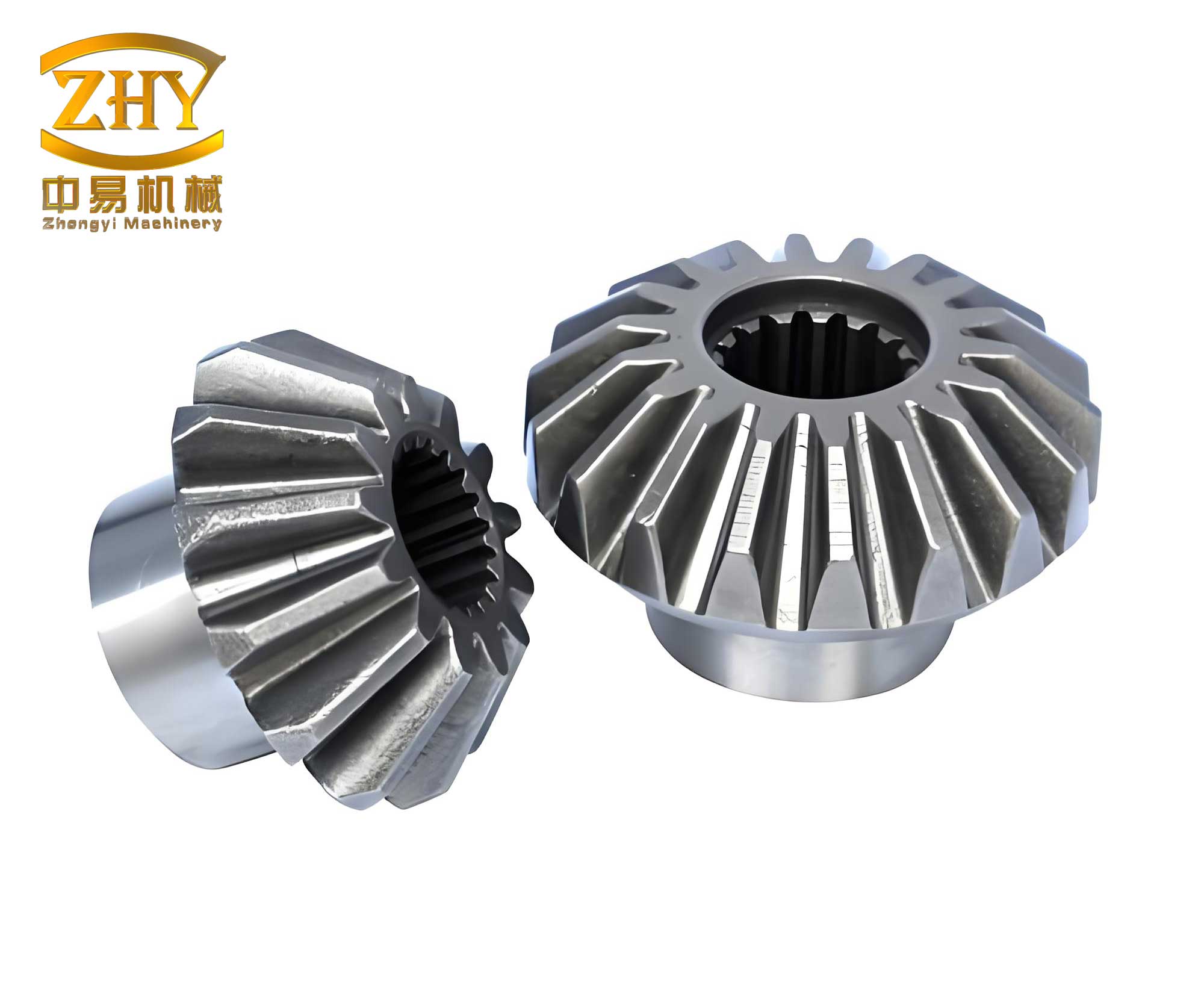
The fundamental principle behind transmission error measurement in bevel gear pairs is based on single-flank engagement. In an ideal bevel gear pair, the input gear (pinion) and output gear (wheel) rotate with a fixed transmission ratio, defined by their tooth numbers. For instance, if the input gear has $$Z_1$$ teeth and the output gear has $$Z_2$$ teeth, the theoretical angular displacement of the output gear, denoted as $$\theta_2’$$, when the input gear rotates by $$\theta_1$$, is given by:
$$\theta_2′ = \frac{Z_1}{Z_2} \theta_1.$$
However, due to manufacturing imperfections, assembly errors, and other factors, the actual angular displacement $$\theta_2$$ deviates from this ideal value. The transmission error $$TE_0$$ is thus calculated as:
$$TE_0 = \theta_2 – \theta_2′ = \theta_2 – \frac{Z_1}{Z_2} \theta_1.$$
This error is typically measured in micrometers (μm) and reflects the instantaneous deviations during gear rotation. For bevel gear pairs, the measurement setup involves high-resolution rotary encoders, such as Renishaw REXM series circular gratings, attached to both the input and output shafts. These encoders capture angular positions, which are then processed to compute the transmission error curve over one or more revolutions of the bevel gear pair. The system I utilized incorporates a motor-driven input shaft and a loaded output shaft, controlled via Siemens Simotion controllers, ensuring synchronized motion and data acquisition for accurate bevel gear pair analysis.
To achieve reliable results, the bevel gear pair must be installed at its optimal mounting distance. This distance refers to the axial position of the gears relative to their theoretical mounting points, and it significantly affects contact pattern and backlash. Adjusting the mounting distance for bevel gear pairs involves two parameters: the pinion mounting distance and the wheel mounting distance. The pinion mounting distance controls the contact zone location, while the wheel mounting distance ensures proper backlash. In my approach, I employ a search-based algorithm to find the best mounting distance by minimizing a quality factor derived from the transmission error spectrum. The process begins with the bevel gear pair installed at the theoretical mounting distance, which serves as the reference point. Then, the mounting distances are varied in steps, and at each position, the transmission error is measured. The adjustment follows an alternating pattern, as illustrated below, where the pinion mounting distance is decreased by $$\Delta H$$, and the wheel mounting distance is increased by $$\Delta H \cdot \tan \delta_1$$ to maintain constant backlash, with $$\delta_1$$ being the pitch cone angle of the pinion in the bevel gear pair.
The quality factor $$F$$ is used to evaluate each mounting position for the bevel gear pair. It is computed from the amplitudes of the first three meshing harmonics in the transmission error frequency spectrum, obtained via Fast Fourier Transform (FFT). The formula for $$F$$ is:
$$F = \left( \frac{H_1}{T_1} \right) \times Q_1 + \left( \frac{H_2}{T_2} \right) \times Q_2 + \left( \frac{H_3}{T_3} \right) \times Q_3,$$
where $$H_1$$, $$H_2$$, and $$H_3$$ are the amplitudes of the first, second, and third meshing harmonics in μm, respectively; $$T_1$$, $$T_2$$, and $$T_3$$ are the tolerance values for these harmonics in μm; and $$Q_1$$, $$Q_2$$, and $$Q_3$$ are influence factors typically set based on empirical data for bevel gear pairs. The mounting position with the smallest $$F$$ value corresponds to the optimal mounting distance for the bevel gear pair. This method ensures that the bevel gear pair operates with minimal transmission error, thereby enhancing its performance in practical applications. The search process is automated in the software, allowing for efficient optimization across multiple points, as summarized in the following table describing the step sequence.
| Step | Pinion Mounting Distance Change | Wheel Mounting Distance Change | Direction |
|---|---|---|---|
| 1 | 0 (theoretical) | 0 | Center |
| 2 | $$-\Delta H$$ | $$+\Delta H \cdot \tan \delta_1$$ | Negative |
| 3 | $$+\Delta H$$ | $$-\Delta H \cdot \tan \delta_1$$ | Positive |
| 4 | $$-2\Delta H$$ | $$+2\Delta H \cdot \tan \delta_1$$ | Negative |
| 5 | $$+2\Delta H$$ | $$-2\Delta H \cdot \tan \delta_1$$ | Positive |
Once the transmission error curve is acquired for the bevel gear pair at the optimal mounting distance, it undergoes comprehensive evaluation. According to standards such as GB11365-89 and DIN3965-1986, the transmission error of a bevel gear pair can be decomposed into four key deviations: the gear pair tangential composite total deviation $$F_{is}’$$, the gear pair tooth-to-tooth tangential composite deviation $$f_{is}’$$, the gear pair working cumulative pitch deviation $$F_p$$, and the gear pair working single pitch deviation $$f_{pt}$$. These deviations are extracted from the transmission error curve, as illustrated below. For a sampled transmission error signal $$\phi[i]$$ with $$N$$ points, where $$i = 1, \ldots, N$$, the calculations are as follows:
$$F_{is}’ = \max(\phi[i]) – \min(\phi[i]),$$
which represents the peak-to-peak value of the transmission error curve for the bevel gear pair. The tooth-to-tooth deviation $$f_{is}’$$ is derived by dividing the curve into meshing intervals corresponding to each tooth engagement. For the $$k$$-th meshing interval, the variation $$\phi[k]$$ is computed as:
$$\phi[k] = \max(\phi[k_i]) – \min(\phi[k_i]),$$
and then $$f_{is}’ = \max(\phi[k])$$ over all intervals. The cumulative pitch deviation $$F_p$$ is obtained by taking the midpoint error value for each pitch angle, forming an array $$\phi[m]$$ for $$m = 1, \ldots, Z$$ (where $$Z$$ is the number of teeth on the output gear of the bevel gear pair), and calculating:
$$F_p = \max(\phi[m]) – \min(\phi[m]).$$
Similarly, the single pitch deviation $$f_{pt}$$ is the maximum absolute difference between adjacent values in the $$\phi[m]$$ array:
$$f_{pt} = \max(|\phi[n] – \phi[n+1]|) \quad \text{for} \quad n = 1, \ldots, Z-1.$$
These deviations provide insights into the geometric accuracy and meshing behavior of the bevel gear pair, enabling targeted improvements in manufacturing. Additionally, frequency spectrum analysis via FFT reveals harmonic components that may not be visible in the time-domain curve. For a bevel gear pair with an output gear of $$Z$$ teeth and $$N$$ sampling points per revolution, setting the sampling frequency to $$N$$ simplifies the identification of rotational and meshing frequencies. For example, the rotational harmonic appears at 1 Hz, and the first, second, and third meshing harmonics at $$Z$$ Hz, $$2Z$$ Hz, and $$3Z$$ Hz, respectively. This analysis helps in diagnosing issues like tooth profile errors or misalignment in the bevel gear pair.
Precision grading of bevel gear pairs is performed based on international standards. Using GB11365-89, the tangential composite tolerance $$F_{is}’$$ and tooth-to-tooth tangential composite tolerance $$f_{is}’$$ for a bevel gear pair are computed from individual gear tolerances. For a pinion and wheel with deviations $$F_{i1}’$$, $$F_{i2}’$$, $$f_{i1}’$$, and $$f_{i2}’$$, the pair tolerances are:
$$F_{is}’ = \sqrt{ (F_{i1}’)^2 + (F_{i2}’)^2 },$$
$$f_{is}’ = \sqrt{ (f_{i1}’)^2 + (f_{i2}’)^2 }.$$
DIN3965-1986 provides similar formulas but includes a broader range of precision grades. The table below compares tolerance values for a sample bevel gear pair with a pinion module of 4, mid-point pitch diameter of 96 mm, and wheel module of 4, mid-point pitch diameter of 140 mm. This highlights the differences between standards, with GB11365-89 generally offering larger tolerances for the same grade, underscoring the need for careful selection in bevel gear pair applications.
| Precision Grade | GB11365-89 $$F_{is}’$$ (μm) | GB11365-89 $$f_{is}’$$ (μm) | DIN3965-1986 $$F_{is}’$$ (μm) | DIN3965-1986 $$f_{is}’$$ (μm) |
|---|---|---|---|---|
| 4 | 39.2 | 13.8 | 36.1 | 15.6 |
| 5 | 60.7 | 23.7 | 50.3 | 21.2 |
| 6 | 93.1 | 34.5 | 70.8 | 30.4 |
| 7 | 131.0 | 48.8 | 99.2 | 41.7 |
| 8 | 185.2 | 71.4 | 138.1 | 58.7 |
To ensure consistent manufacturing quality for bevel gear pairs, Statistical Process Control (SPC) is applied to monitor key parameters like $$F_{is}’$$ and $$f_{is}’$$. SPC uses control charts to assess whether the production process is in a state of statistical control. For bevel gear pairs, I recommend using mean-standard deviation control charts, with at least 20 batches of data, each containing a minimum of 5 samples. The control limits are calculated as follows for the mean chart:
$$\text{CL} = \mu = \bar{\bar{x}},$$
$$\text{UCL} = \mu + \frac{3\sigma}{\sqrt{n}} = \bar{\bar{x}} + A_s \cdot \bar{s},$$
$$\text{LCL} = \mu – \frac{3\sigma}{\sqrt{n}} = \bar{\bar{x}} – A_s \cdot \bar{s},$$
where $$\bar{\bar{x}}$$ is the overall mean, $$\bar{s}$$ is the average standard deviation, and $$A_s$$ is a factor based on sample size. For the standard deviation chart:
$$\text{CL} = \mu_s = \bar{s},$$
$$\text{UCL} = \mu_s + 3\sigma_s = B_U \bar{s},$$
$$\text{LCL} = \mu_s – 3\sigma_s = B_L \bar{s},$$
with $$B_U$$ and $$B_L$$ derived from standard tables. These charts help detect variations in the manufacturing process for bevel gear pairs, enabling timely corrections and maintaining high precision.
The measurement system for bevel gear pairs integrates hardware and software components. The hardware setup includes rotary encoders for angular displacement capture, a data acquisition card (e.g., Kontron) for signal processing, and servo motors with controllers for precise motion control. The software, developed in Visual C++ using MFC framework, provides a user-friendly interface for parameter setting, data acquisition, error analysis, mounting distance optimization, and SPC. Key functionalities of the software for bevel gear pair measurement are:
- Parameter configuration for bevel gear pairs, including gear geometry, motion parameters, and standards.
- Real-time transmission error measurement and curve display for bevel gear pairs.
- Error decomposition and precision grading based on GB11365-89 or DIN3965-1986.
- Automated mounting distance search for bevel gear pairs using the quality factor method.
- SPC statistical analysis with control chart generation for bevel gear pair deviations.
- Data storage, retrieval, and report printing for bevel gear pair measurements.
The software architecture employs object-oriented design, with classes such as CParameter for gear data, CTransmission for error processing, and CSPC for statistical analysis. Sequence diagrams ensure smooth interaction, such as when adding a new bevel gear pair parameter set. Testing was conducted via test cases covering menu functionality, servo control, sensor data acquisition, and measurement accuracy for bevel gear pairs. For instance, a test case for menu display verifies that all options are accessible and interfaces render correctly, ensuring reliability for bevel gear pair applications.
Experimental validation was performed on a bevel gear pair with the parameters listed below. The pinion and wheel were initially mounted at the theoretical distance, then adjusted to find the optimal mounting distance using the search algorithm. Transmission error curves were recorded at various positions, and the quality factor was computed from harmonic amplitudes. The results demonstrate the effectiveness of the method for bevel gear pairs.
| Parameter | Pinion | Wheel |
|---|---|---|
| Number of Teeth | 24 | 35 |
| Module | 4 | 4 |
| Pressure Angle (°) | 20 | 20 |
| Theoretical Mounting Distance (mm) | 102.9 | 82.1 |
The mounting distance search involved points at offsets of -0.4 mm, -0.2 mm, +0.2 mm, and +0.4 mm from the theoretical position for the pinion in the bevel gear pair. At each point, the transmission error was measured, and the harmonic amplitudes were extracted. The table below summarizes the quality factor calculations, showing that the -0.4 mm position yielded the smallest $$F$$ value, indicating the optimal mounting distance for this bevel gear pair.
| Mounting Distance Offset (mm) | $$H_1$$ (μm) | $$H_2$$ (μm) | $$H_3$$ (μm) | Quality Factor $$F$$ |
|---|---|---|---|---|
| -0.4 | 45.2 | 22.1 | 10.5 | 2.31 |
| -0.2 | 48.7 | 24.3 | 11.8 | 2.45 |
| +0.2 | 50.1 | 25.6 | 12.4 | 2.52 |
| +0.4 | 52.3 | 26.9 | 13.1 | 2.61 |
Transmission error curves for the bevel gear pair at the theoretical and optimal mounting distances are compared. At the theoretical distance, the curve exhibited larger fluctuations, with $$F_{is}’ = 836 \mu m$$ and $$f_{is}’ = 173 \mu m$$. After optimization, at the best mounting distance, these values reduced to $$F_{is}’ = 826 \mu m$$ and $$f_{is}’ = 161 \mu m$$. Both configurations corresponded to DIN grade 12, but the optimized bevel gear pair showed improved smoothness, validating the adjustment method. The frequency spectrum analysis further confirmed reduced harmonic amplitudes at the optimal position, emphasizing the importance of mounting distance for bevel gear pair performance.
In conclusion, the method and software I developed for transmission error measurement in bevel gear pairs with adjustable mounting distance offer a comprehensive solution for precision gear analysis. By integrating mounting distance optimization, detailed error evaluation, and SPC monitoring, this approach enhances the accuracy and reliability of bevel gear pair assessments. The experimental results confirm that the optimal mounting distance significantly reduces transmission error, leading to better operational characteristics for bevel gear pairs. Future work could extend this methodology to other gear types, such as face gear pairs, but the core principles remain applicable to bevel gear pairs. Overall, this research contributes to advancing gear metrology, ensuring that bevel gear pairs meet stringent quality standards in high-performance applications.