
With the rapid development of new energy vehicles (NEVs), transmission gear order noise—once masked by internal combustion engine (ICE) vibrations—has become a critical NVH (Noise, Vibration, and Harshness) challenge. Traditional reactive optimization methods often clash with tight project timelines and limited resources. This paper introduces a proactive design methodology rooted in “DNA” principles, emphasizing early-stage integration of order noise mitigation strategies to enhance first-pass success rates, reduce development cycles, and minimize validation costs.
1. Conceptual Design Phase
The foundation of transmission gear DNA design lies in addressing NVH risks at the earliest stages. Key deliverables include:
- A comprehensive design verification report covering system architecture, performance boundaries, strength validation, and risk identification.
- Initial 3D packaging models.
- 2D drawings specifying tolerances, surface finishes, and cleanliness requirements.
- Bill of Materials (BOM) and Design Failure Mode and Effects Analysis (DFMEA).
To balance competing priorities (performance, weight, reliability, cost, etc.), a decision matrix is employed (Table 1). Each criterion (e.g., benchmarking, performance, weight) is assigned a weight (2, 5, or 8), and alternatives are scored (1–9) to compute weighted totals.
Table 1: Decision Matrix for Transmission Gear Design Alternatives
| Criterion | Weight | Alternative A | Alternative B | Alternative C |
|---|---|---|---|---|
| Benchmarking | 5 | 5 | 7 | 3 |
| Performance (NVH) | 8 | 5 | 9 | 5 |
| Weight | 5 | 5 | 3 | 7 |
| Reliability | 8 | 5 | 5 | 9 |
| Cost | 8 | 5 | 3 | 7 |
| Weighted Total | — | 285 | 297 | 321 |
1.1 Origins of Transmission Gear Order Noise
Order noise arises primarily from meshing impacts between gear teeth. These impacts propagate through shafts, bearings, and the transmission housing, radiating as audible noise. Key factors include:
- Meshing Frequency: Determined by rotational speed and tooth count. High-speed NEV motors (e.g., 16,000 RPM) exacerbate meshing frequencies, necessitating careful gear ratio selection.
- Meshing Energy: Governed by backlash and inertia. Minimizing backlash reduces impact energy:
E=21mv2
where v=aΔt. Reducing acceleration time (Δt) or inertia (m) lowers energy.
1.2 Critical Design Parameters
- Contact Ratio: Higher transverse (εα) and axial (εβ) contact ratios reduce impact severity but must avoid tooth tip thinning.
- Alignment: Axial/radial misalignment increases backlash variability, amplifying noise. Stiff shaft supports and precision bearings minimize deflection.
- Manufacturing Precision: Tight tolerances (e.g., single-flank testing for profile/form errors) ensure consistent backlash and contact patterns.
2. Detailed Design Phase
A system-level model (e.g., MASTA, ROMAX) simulates transmission dynamics, incorporating shaft flexure, bearing stiffness, and housing interactions.
2.1 Macro-Level Optimization
- Misalignment Analysis: Evaluates gear pair deviations under load (Figure 1). Key contributors include shaft deflection, bearing clearance, and housing flexibility.
- Resonance Avoidance: Critical orders (e.g., motor slot/pole frequencies) must deviate by >7% from gear meshing orders to prevent resonance.
Table 2: Transmission Error (PPTE) Across Load Conditions
| Load Condition | High-Speed Stage PPTE (µm) | Low-Speed Stage PPTE (µm) |
|---|---|---|
| 30% Torque | 0.176 | 0.214 |
| 60% Torque | 0.055 | 0.119 |
| 90% Torque | 0.360 | 0.171 |
2.2 Micro-Level Optimization
- Transmission Error (TE): Minimizing TE peak-to-peak values (<0.5 µm) via micro-geometry modifications (crowning, tip/root relief).
- Design of Experiments (DOE): Identifies optimal tooth profile parameters (Table 3).
Table 3: DOE for Tooth Profile Optimization
| Factor | Level 1 | Level 2 | Level 3 |
|---|---|---|---|
| Lead Profile (fHβ) | +Tol | Nominal | -Tol |
| Crowning (Cβ) | +Tol | Nominal | -Tol |
Sensitivity analysis (Figure 2) reveals high-speed stages are more sensitive to profile adjustments than low-speed stages.
3. Validation and Testing
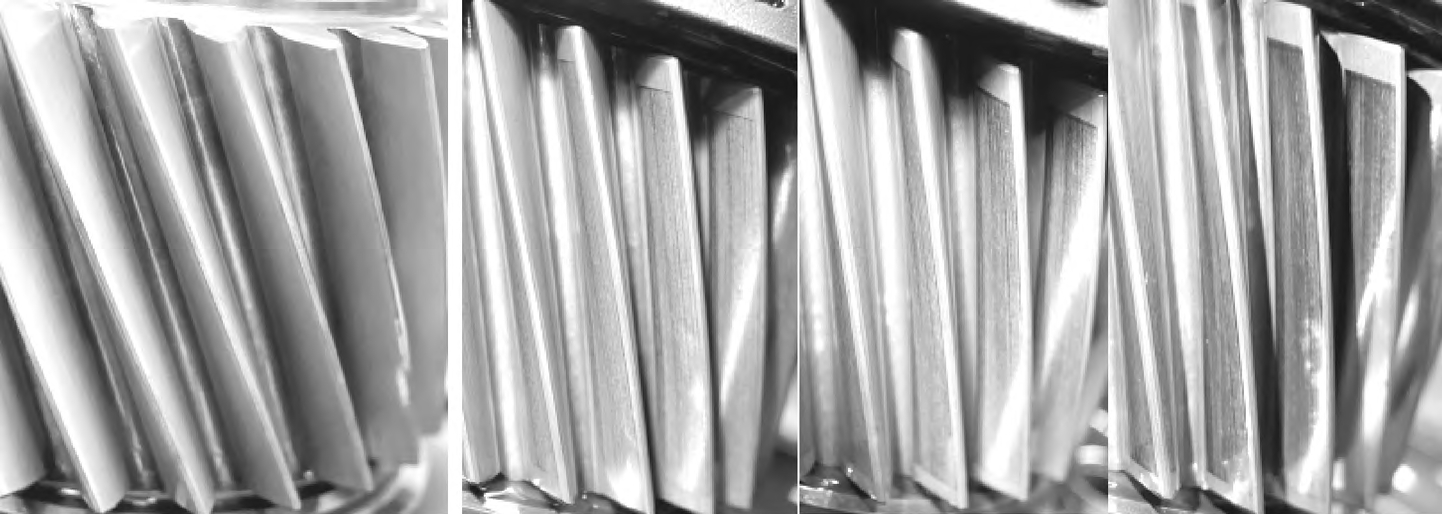
Prototypes undergo durability, NVH, and contact pattern testing. Post-test gear inspection (Figure 3) confirms minimal wear and uniform contact distribution.
3.1 Key Outcomes
- NVH Performance: Order noise reduced by 6–8 dB(A) across critical speed ranges.
- Efficiency: Meshing losses reduced by 12% through optimized contact patterns.
- Robustness: Design tolerances validated against manufacturing variability.
4. Conclusion
The DNA methodology integrates NVH considerations into the earliest design phases, enabling high-performance transmission gears with minimal rework. By leveraging system simulation, DOE, and precision manufacturing, this approach addresses the unique challenges of NEV transmissions while enhancing scalability and cost efficiency. Future work will explore AI-driven optimization and advanced materials for ultra-high-speed applications.