
Abstract: This paper presents the design of an ultrasonic gear honing composite amplitude transformer combining a ring plate with an amplitude transformer based on Mindlin plate theory and the transfer matrix method. The bending vibration frequency equation of the amplitude transformer is deduced, and its vibration characteristics are studied. The results indicate that the frequency of the ultrasonic gear honing composite amplitude transformer decreases with the increase of the segment length of the transformer, increases with the increase of the ring thickness, and decreases with the increase of the outer diameter of the ring. This study provides a feasible design method for composite bending vibration amplitude transformers and offers insights into the dynamic characteristics of ultrasonic gear honing vibration systems.
1. Introduction
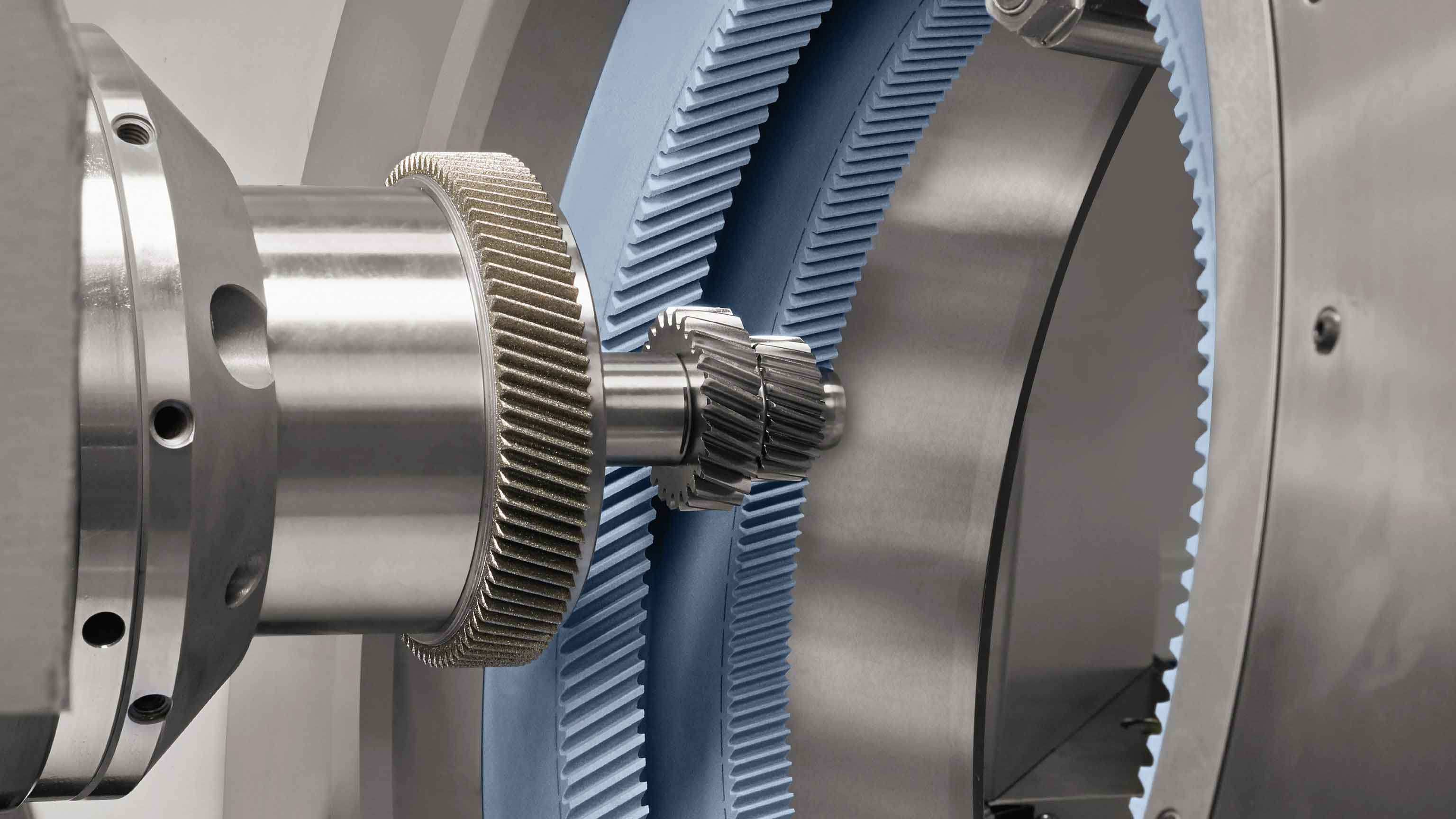
Ultrasonic gear honing is a technology that applies ultrasonic vibration cutting techniques to hard gear honing processes. The high-frequency vibration enhances the actual cutting speed and cutting ability of abrasive particles, resulting in a significantly better surface quality of the processed gears compared to conventional gear honing. From the perspectives of processing efficiency, quality, and economy, ultrasonic gear honing achieves superior results. For most amplitude transformers composed of gears and amplitude rods, the amplitude rod undergoes one-dimensional longitudinal vibration, while the gear undergoes bending vibration. The vibration modes of the two are entirely different, and the coupling resonance relationship at the connection is relatively complex. Additionally, the gear serves as a non-resonant element of the amplitude transformer. In practical work, theoretical analytical methods, equivalent circuit methods, or transfer matrix methods are commonly used to design amplitude transformers. Each of these methods has varying degrees of applicability.
Previous studies based on classical thin plate theory have conducted in-depth research on bending vibration amplitude transformers, highlighting deficiencies in the thin plate theory itself, imperfect mathematical models of amplitude transformers, large errors in results, and limited applicability. Therefore, it is necessary to explore thick plate vibration methods. This paper aims to improve the performance of composite amplitude transformers by deriving the transfer matrix of the composite amplitude transformer based on Mindlin’s thick plate theory and completing the design of a conical composite bending vibration amplitude transformer, along with an investigation of its amplitude.
2. Structure of the Amplitude Transformer
The composite amplitude transformer employs conical amplitude rods of equal length at both ends. The diameters of the large and small ends of the amplitude rod are denoted as d1 and d2, respectively, and the lengths of the large, small, and middle segments are l1, l2, and the length between the segments, respectively. The gear is simplified as an annular plate with uniform thickness, where the inner radius a = d2/2, the outer radius is b, and the plate thickness is h. The gear is mounted on the spindle of the small end of the amplitude rod and secured with a nut, which is ignored in calculations due to its small size relative to the gear. The amplitude rod undergoes one-dimensional longitudinal vibration, while the gear undergoes bending vibration under the action of the amplitude rod, resulting in overall longitudinal-bending coupled vibration of the amplitude transformer.
3. Frequency Equation of the Amplitude Transformer
3.1 Transfer Matrix of the Annular Plate
In ultrasonic gear honing, to obtain good processing quality, the gear is required to undergo axisymmetric transverse bending vibration with a nodal diameter of 0. As a circular ring plate in this vibration mode, its tangential internal forces and deformations must always be zero. Therefore, based on Mindlin’s plate theory, the mechanical and deformation components on the inner and outer surfaces of the annular plate are expressed using subscripts and relevant parameters.
3.2 Transfer Matrix of the Amplitude Transformer
For ease of study, conical amplitude rods of equal length at both ends are considered, with the characteristic equation of their four-port network transmission matrix given by:
F1ξ100=a11a11′A110a12a12′A120a21a21′A211a22a22′A220F0ξ000
Where F1 and ξ1 are the force and amplitude at the output end of the amplitude rod, respectively, and F0 and ξ0 are the force and amplitude at the input end, respectively. For uniform cross-section rods and conical amplitude rods, specific expressions for the matrix elements are provided.
By expanding and transforming Equation (19), the overall transfer matrix D of the composite amplitude transformer is obtained, and the frequency equation of the composite amplitude transformer is derived as:
D31D33−D41D43=0
If the material and geometric parameters are known, the resonant frequency of the system can be determined using this frequency equation.
4. Dynamic Analysis
Specific parameters of the composite amplitude transformer are provided, and MATLAB software is used to plot the relationship curve between the error Δ of the solution to the frequency equation and the middle segment length l2 of the amplitude rod. The design length of the middle segment l2 is determined to be 90 mm where the error curve intersects the line with an error of 0.
Using the material properties of 45 steel, the displacement amplitudes of the composite amplitude transformer are calculated, yielding curves of the amplitude variations of the amplitude rod and annular plate with their respective geometric dimensions.
5. Frequency Characteristic Analysis
Tables summarizing the changes in the resonant frequency of the system with variations in the radii of the amplitude rod ends, the thickness of the annular plate, and the outer diameter of the annular plate are provided below.
| Table 3: Effect of Annular Plate Thickness on Resonant Frequency |
|---|
| Annular Plate Thickness (h) |
| 16 mm |
| 18 mm |
| 20 mm |
| Table 4: Effect of Annular Plate Outer Diameter on Resonant Frequency |
|---|
| Annular Plate Outer Diameter (b) |
| 55 mm |
| 60 mm |
| 65 mm |
| Table 5: Effect of Amplitude Rod End Radii on Resonant Frequency |
|---|
| Ratio of Large to Small End Radii |
| Constant Ratio |
| …… |
The results indicate that as the thickness of the annular plate increases, the resonant frequency of the composite amplitude transformer increases. Conversely, as the outer diameter of the annular plate increases, the resonant frequency decreases. When the ratio of the radii of the large and small ends of the amplitude rod remains constant, the resonant frequency of the system increases with the increase of both end radii. The theoretical calculations are generally consistent with the finite element simulation results.
6. Testing
To verify the correctness of the theoretical analysis and finite element simulation results, a simplified model of the composite amplitude transformer was processed using 45 steel according to the designed dimensions. The annular plate and conical amplitude rod were connected with a nut, and testing was conducted using an impedance analyzer. The test results showed that the admittance circle was a single circle, and the admittance curve of the tested amplitude transformer was normal, indicating good vibration performance. The resonant frequency was 30.537 kHz, with a design frequency error of 1.79%, which is within the acceptable range for engineering applications.
7. Conclusion
Based on Mindlin’s thick plate theory, the resonant frequency equation for an ultrasonic gear honing composite amplitude transformer combining a ring plate with a conical amplitude rod was derived using the transfer matrix method. The vibration characteristics were studied, and the influence of various parameters of the amplitude transformer on the system resonant frequency was analyzed. The results show that the theoretical calculations, finite element simulations, and test results are generally consistent. The system frequency decreases with the increase of the segment lengths of the amplitude rod, increases with the increase of the ring plate thickness, and decreases with the increase of the ring plate outer diameter. These findings provide a reference for the practical application of composite amplitude transformers and demonstrate that the composite amplitude transformer designed based on the transfer matrix method meets production application requirements.