
In recent years, skiving technology has emerged as a high-precision and efficient gear manufacturing process that combines the principles of hobbing and shaping. This method involves the continuous rotation of a tool and workpiece at a fixed axis angle and speed ratio, enabling rapid material removal along the gear tooth direction. The design of the skiving tool is critical to the success of this process, and traditional methods based on inverse solutions of workpiece tooth surfaces often face limitations in universality and accuracy. In this article, I propose a novel design approach for a universal skiving tool applicable to various involute cylindrical gears, including spur gears and helical gears, by leveraging the line contact meshing of staggered-axis involute helical surfaces. This method eliminates theoretical edge errors and ensures consistent performance after regrinding.
The skiving process operates on the principle of spatial meshing, where the tool and workpiece rotate at high speeds around their respective axes, which are positioned at a specific angle to each other. The relative motion generated by this configuration facilitates the cutting action, while an axial feed motion completes the tooth surface machining. For spur gears, the tooth surfaces are generated as involute helicoids with zero helix angles, allowing for simplified modeling. The key to achieving high-quality machining lies in ensuring that the cutting edge curve contacts the workpiece tooth surface along a line of conjugation, which requires precise control of the meshing conditions.
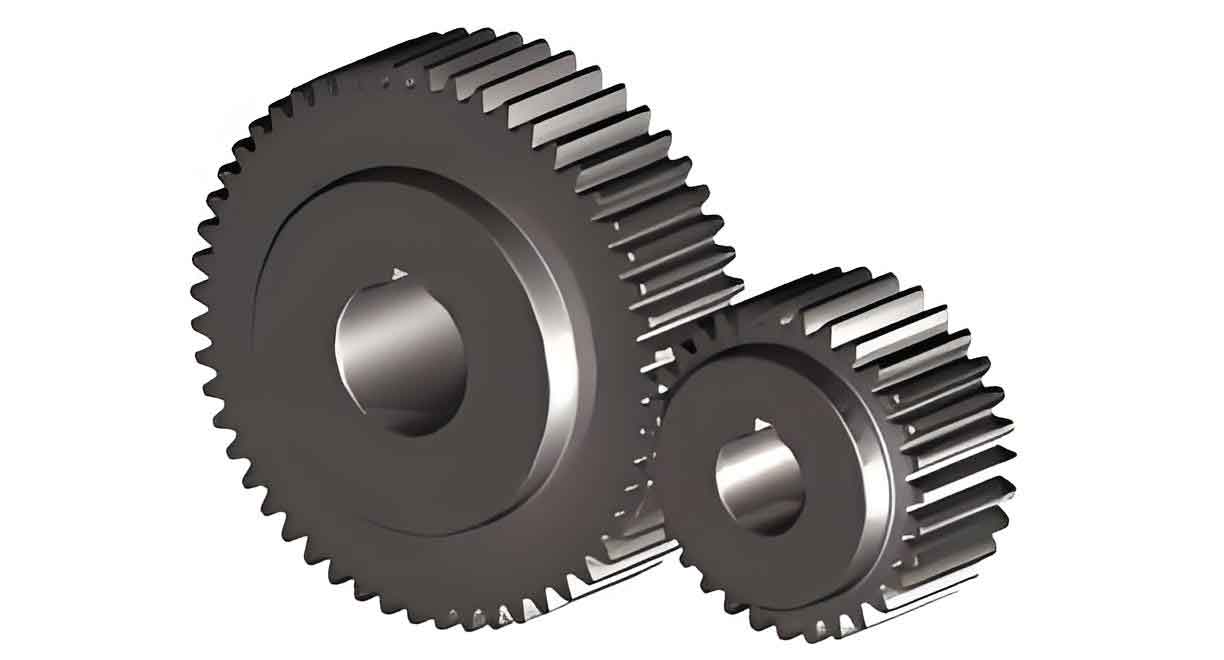
To understand the line contact meshing of staggered-axis involute helical surfaces, consider the formation of an involute helicoid. It is generated by a straight line on a plane that rolls without slipping on a base cylinder. For spur gears, this line is parallel to the cylinder axis, resulting in a straight tooth profile. The parametric equations of the involute helicoid in a coordinate system Oxyz are given by:
$$ x = r_b \cos\theta + t \cos\lambda_b \sin\theta $$
$$ y = r_b \sin\theta – t \cos\lambda_b \cos\theta $$
$$ z = p\theta – t \sin\lambda_b $$
where \( r_b \) is the base radius, \( \theta \) is the rotation angle, \( t \) is a parameter along the generating line, \( \lambda_b \) is the base helix lead angle, and \( p \) is the spiral parameter with \( p = r_b \tan\lambda_b \). The unit normal vector to this surface is:
$$ \mathbf{n} = (-\sin\lambda_b \sin\theta, \sin\lambda_b \cos\theta, -\cos\lambda_b) $$
For two involute helical surfaces to achieve line contact meshing under staggered axes, specific conditions must be met. The shortest distance between the axes should satisfy \( a = r_{b1} + r_{b2} \) for external meshing or \( a = |r_{b1} – r_{b2}| \) for internal meshing, and the axis angle \( \psi \) should be \( \beta_{b1} + \beta_{b2} \) for external meshing or \( |\beta_{b1} – \beta_{b2}| \) for internal meshing, where \( \beta_b \) is the base helix angle. Under these conditions, the surfaces share a common tangent plane, enabling line contact. The relative velocity at any contact point can be derived to ensure the meshing equation \( \mathbf{n} \cdot \mathbf{v} = 0 \) is satisfied, leading to the speed ratio condition:
$$ r_{b1} \cos\beta_{b1} \omega_1 = – r_{b2} \cos\beta_{b2} \omega_2 $$
for external meshing, with a similar expression for internal meshing. This foundational principle allows the design of a universal tool that can engage with various workpiece geometries.
In the design of the skiving tool, I start by defining the conjugate surface as an involute helicoid. This surface serves as the reference for generating the cutting edges. For a right-handed tool, the left and right cutting edges correspond to different sides of the tooth. The base circle half-thickness angle \( \mu_b \) is calculated as:
$$ \mu_b = \frac{s_b}{2r_b} = \frac{\pi m \cos\alpha + 2m z \cos\alpha \cdot \text{inv}\alpha}{4r_b} $$
where \( s_b \) is the base circle thickness, \( m \) is the module, \( \alpha \) is the pressure angle, and \( z \) is the number of teeth. The parametric equations for the left cutting edge surface are:
$$ x = r_b \cos(\theta – \mu_b) + t \cos\lambda_b \sin(\theta – \mu_b) $$
$$ y = r_b \sin(\theta – \mu_b) – t \cos\lambda_b \cos(\theta – \mu_b) $$
$$ z = p\theta – t \sin\lambda_b $$
The cutting edge is obtained as the intersection of this conjugate surface with the rake face, which is designed as a plane. The rake face equation is:
$$ z \cos\beta_b + y \sin\beta_b = (x – r_b) \tan\gamma $$
where \( \gamma \) is the rake angle. By solving these equations, the cutting edge curve \( \mathbf{r}_e(\theta) \) is derived as a function of \( \theta \), ensuring a single-parameter representation. This approach avoids the complexities of inverse solutions and guarantees accuracy.
To address tool regrinding, the flank face design must maintain the cutting edge accuracy after material removal. The flank consists of the tooth tip flank and the side flank. The tooth tip flank is formed by a conical surface with a base radius equal to the tip radius \( r_a \), a base angle of \( \frac{\pi}{2} – \alpha_e \), and an axis aligned with the tool axis at the base helix angle \( \beta_b \). For the side flank, I consider a helical motion of the cutting edge. As the tool is reground, the rake face shifts, and the new cutting edge is formed by intersecting the updated rake face with a modified conjugate surface that has an adjusted base circle thickness parameter \( \mu_b – \Delta\mu \). The change \( \Delta\mu \) is given by:
$$ \Delta\mu = \frac{p_c \theta_c [\tan(\beta_{bt} + \alpha_c) – \tan\beta_{bt}]}{r_b} $$
where \( p_c \) is the spiral parameter for the helical motion, \( \theta_c \) is the rotation angle, and \( \alpha_c \) is the side relief angle. The family of cutting edge curves under this motion forms the side flank surface, ensuring that reground tools retain the same precision as new ones.
The machining parameters for skiving include the tool installation angle, axis distance, offset, and speed relationships. The axis angle \( \psi \) is set as:
$$ \psi = |\beta_{bt} + i \beta_{bp}| $$
where \( i = -1 \) for internal gears and \( i = 1 \) for external gears. The axis distance \( a \) is calculated as:
$$ a = r_{bp} + i r_{bt} $$
The offset \( \rho \) ensures proper engagement between the tool tip and the workpiece root. For internal gears, the offset is determined by solving:
$$ \rho = r_{fp} \cos\theta_p – r_{at} \cos\psi \cos\theta_t $$
$$ a = r_{fp} \sin\theta_p – r_{at} \sin\theta_t $$
$$ \cos\theta_p \sin\theta_t – \sin\theta_p \cos\psi \cos\theta_t = 0 $$
and for external gears:
$$ \rho = r_{fp} \cos\theta_p + r_{at} \cos\psi \cos\theta_t $$
$$ a = r_{fp} \sin\theta_p + r_{at} \sin\theta_t $$
$$ \cos\theta_p \sin\theta_t + \sin\theta_p \cos\psi \cos\theta_t = 0 $$
The rotational speeds of the tool and workpiece must satisfy the meshing condition, accounting for the feed rate \( f \). The relationship is:
$$ \omega_t = i \frac{r_{bp} \cos\beta_{bp}}{r_{bt} \cos\beta_{bt}} \omega_p – \frac{\sin\beta_{bp}}{r_{bt} \cos\beta_{bt}} f $$
These parameters ensure correct conjugation during machining.
To validate the proposed design method, I conducted simulations using VERICUT software. The tool parameters are summarized in Table 1, and the workpiece parameters and machining settings are listed in Table 2. The tool model was designed with a base helix angle of 18.7472°, and it was tested on various workpieces, including internal and external spur gears and helical gears. The simulation results showed that the tool successfully generated tooth surfaces with minimal deviations. In the root area, a transition surface with a residual of 0.1 mm was observed, but the remaining tooth surfaces had errors below 0.01 mm, confirming the method’s accuracy and universality.
| Parameter | Value |
|---|---|
| Number of Teeth | 41 |
| Base Helix Angle (°) | 18.7472 |
| Base Radius (mm) | 81.3719 |
| Tip Radius (mm) | 93 |
| Root Radius (mm) | 83 |
| Rake Angle (°) | 15 |
| Tip Relief Angle (°) | 9 |
| Base Relief Angle (°) | 4 |
| Parameter | Workpiece 1 | Workpiece 2 | Workpiece 3 | Workpiece 4 |
|---|---|---|---|---|
| Number of Teeth | 125 | 125 | 100 | 70 |
| Gear Type | Internal Spur | External Spur | Internal Helical | External Helical |
| Base Helix Angle (°) | 0 | 0 | -14.0761 | 18.7472 |
| Base Radius (mm) | 234.9232 | 234.9232 | 193.7563 | 138.9277 |
| Tip Radius (mm) | 246 | 254 | 203.0552 | 152.9849 |
| Root Radius (mm) | 255 | 245 | 212.0522 | 143.9849 |
| Axis Angle (°) | 18.7472 | 18.7472 | 32.8233 | 37.4945 |
| Axis Distance (mm) | 153.5512 | 316.2951 | 112.3844 | 220.2996 |
| Offset (mm) | 53.1482 | 117.4599 | 43.6174 | 80.6880 |
| Workpiece Speed (rpm) | 246 | 246 | 246 | 246 |
| Tool Speed (rpm) | 750 | 750 | 600.0189 | 420.0252 |
| Feed Rate (mm/min) | 6 | 6 | 6 | 6 |
In conclusion, the universal skiving tool design method based on staggered-axis involute helical surface meshing offers a straightforward and error-free approach for manufacturing involute cylindrical gears. By directly deriving the cutting edge from the conjugate surface and incorporating regrinding considerations, this method ensures high precision and adaptability to different gear geometries, including spur gears with varying modules and helix angles. The simulation results demonstrate its effectiveness, providing a reliable solution for advanced gear machining processes.