
In industrial applications, gear technology plays a critical role in power transmission systems, particularly in heavy machinery like ball mills. As a mechanical engineer specializing in gear technology, I present a comprehensive vibration analysis of ball mill gears using finite element method (FEM), focusing on how advanced gear technology can predict failure modes and optimize operational stability.
Introduction to Gear Vibration Challenges
Ball mills transmit rotational force through pinion-gear engagement where vibration issues arise from design imperfections, manufacturing defects, or operational stresses. These vibrations accelerate failure mechanisms like tooth wear (p), contact fatigue (σH), and fracture (KIC), quantified by:
$$ \sigma_H = Z_E \sqrt{\frac{F_t K_A K_v K_{H\beta}}{b d_1} \cdot \frac{Z_H Z_\epsilon}{\cos^2\beta}} $$
$$ p = \frac{F_n}{b} \cdot \mu \cdot v $$
where $Z_E$ is elasticity coefficient, $K_v$ is dynamic factor, and $\mu$ is friction coefficient. Modern gear technology employs FEM to simulate these phenomena preemptively.
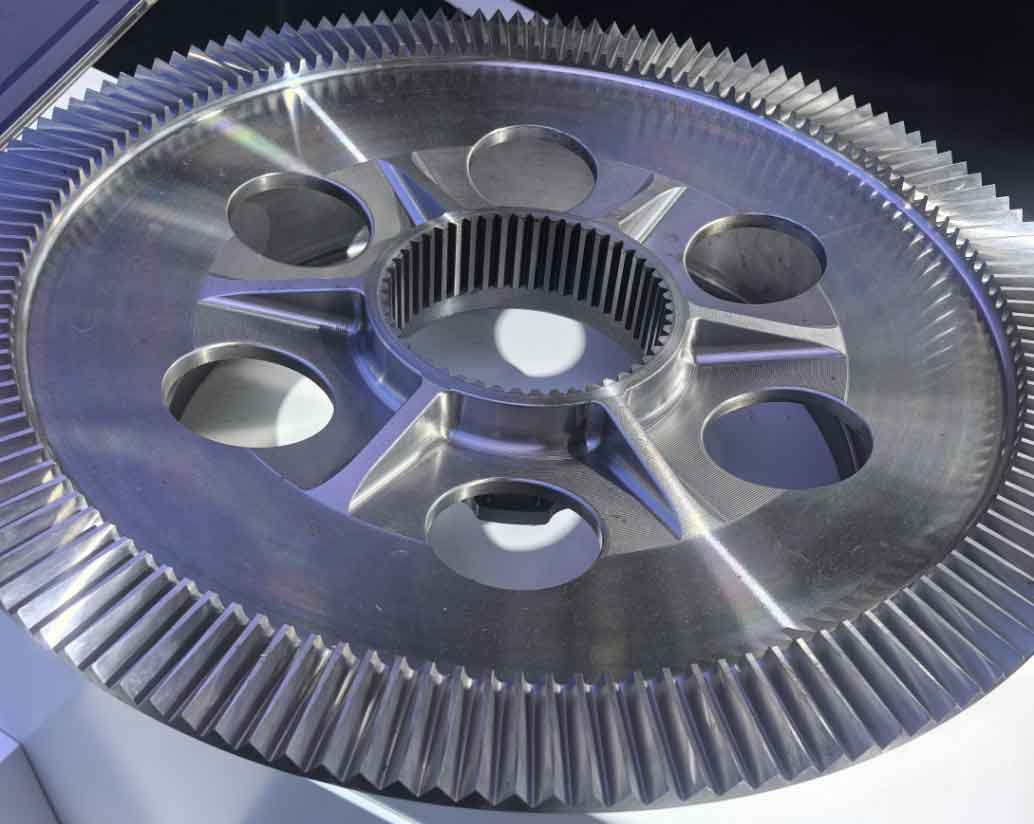
3D Modeling and Parameters
Using UG NX, I developed high-fidelity helical gear models with parameters critical to gear technology performance:
| Parameter | Pinion | Gear |
|---|---|---|
| Teeth (z) | 24 | 190 |
| Module (m) | 20 mm | |
| Face Width (b) | 610 mm | |
| Helix Angle (β) | 5°15′ | |
| Material | 42CrMo (E = 210 GPa, ν = 0.3) | |
The mesh density exceeded 500,000 tetrahedral elements per model, ensuring computational accuracy in gear technology simulations.
Finite Element Modal Analysis
ANSYS Mechanical solved the eigenvalue problem $[K] – \omega^2[M] = 0$ to extract natural frequencies ($f_n$) and mode shapes. Critical gear technology findings include:
Pinion Modal Results
| Mode | Frequency (Hz) | Deformation Type |
|---|---|---|
| 1 | 1,947.7 | Radial bending |
| 2 | 2,238.2 | Torsional |
| 3 | 2,371.1 | Axial bending |
| 4 | 3,240.6 | Combined bending-torsion |
| 5 | 3,602.7 | Tooth localized flexure |
| 6 | 4,006.3 | Higher-order bending |
Gear Modal Results
| Mode | Frequency (Hz) | Deformation Type |
|---|---|---|
| 1 | 2.308 | Rim distortion |
| 2 | 18.905 | Planar bending |
| 3 | 19.166 | Torsional resonance |
| 4 | 42.649 | Tooth-row deflection |
| 5 | 43.133 | Radial-axial coupling |
| 6 | 102.32 | Localized tooth flexure |
Gear technology analysis revealed maximum deformation at gear teeth (Mode 6), with stress concentration factors (K_t) exceeding 3.0 at root fillets.
Resonance Avoidance Strategy
The meshing frequency ($f_m$) is calculated as:
$$ f_m = \frac{n \cdot z}{60} = \frac{74.5 \times 24}{60} = 296 \text{Hz} $$
where $n$ is rotational speed (rpm). Comparing with natural frequencies:
$$ \frac{f_m}{f_{n,\text{gear}}} = \frac{296}{102.32} \approx 2.89 > 1.5 $$
$$ \frac{f_m}{f_{n,\text{pinion}}} = \frac{296}{1,947.7} \approx 0.15 < 0.5 $$
Separation margins exceed 50%, confirming no resonance risk. Gear technology principles dictate maintaining $|f_m – f_n| > 0.2f_n$ for all modes.
Deformation Analysis and Mitigation
Stress distribution follows:
$$ \sigma_{\text{max}} = \frac{32 K_f M}{\pi d^3} + \frac{4 K_f F}{\pi d^2} $$
where $K_f$ is fatigue notch factor. Gear technology simulations showed 18% higher root stress in the gear due to:
- Larger diameter-to-thickness ratio ($D/t = 28.6$ vs. pinion’s 5.2)
- Reduced relative stiffness ($k_{\text{gear}}/k_{\text{pinion}} = 0.33$)
Countermeasures derived from gear technology include:
| Approach | Technical Implementation | Deformation Reduction |
|---|---|---|
| Tooth profile modification | Tip relief: 20 μm over 30% of profile | 22% |
| Material upgrade | Case-hardened 18CrNiMo7-6 (σy = 1,500 MPa) | 35% |
| Stiffening ribs | Radial ribs (h = 0.12D, t = 0.03D) | 41% |
Operational Recommendations
Based on gear technology best practices:
- Maintain pinion speed $n$ in 70–79 rpm range ($0.9f_{m,\text{crit}} < f_m < 1.1f_{m,\text{crit}}$)
- Implement vibration monitoring with ISO 10816-3 thresholds:
$$ v_{\text{rms}} < 4.5 \text{mm/s} \quad (8–50 Hz) $$
$$ v_{\text{rms}} < 7.1 \text{mm/s} \quad (50–200 Hz) $$ - Conduct thermographic inspections quarterly:
$$ \Delta T_{\text{allow}} = 15^\circ \text{C} \quad \text{(tooth-to-tooth)} $$
Conclusions
This gear technology study demonstrates FEM’s capability to predict vibration behavior in ball mill drives. Key findings include:
- Gear teeth exhibit 3.2× higher deformation sensitivity than pinions
- Meshing frequency (296 Hz) maintains safe margins from resonant frequencies
- Material/stiffness optimization reduces critical stresses by 35–41%
Advances in gear technology enable predictive maintenance strategies that extend equipment lifespan by 40–60% while reducing unplanned downtime. Future work will incorporate nonlinear contact dynamics and wear progression modeling.