
In the realm of industrial robotics and smart manufacturing, precision reducers play a pivotal role in ensuring high performance and reliability. Among these, the RV reducer stands out due to its compact design, high stiffness, and exceptional transmission accuracy. As a key component, the input gear shaft is responsible for transmitting motion and torque from the motor to the planetary gear system, enabling the two-stage reduction mechanism. The dynamic behavior of this gear shaft, particularly its vibration characteristics under various constraints, directly influences the overall efficiency and longevity of the reducer. In this study, we focus on analyzing the modal properties of the input gear shaft in a precision RV reducer, specifically the RV-80E model, to understand its vibration response under free, bearing-constrained, and meshing working conditions. By employing finite element method (FEM) simulations, we aim to derive the natural frequencies and mode shapes, which are critical for identifying potential resonance issues and optimizing the design. The input gear shaft’s interaction with planetary gears introduces complex constraints that alter its dynamic behavior, making it essential to investigate these effects in detail. Throughout this analysis, we emphasize the importance of the gear shaft in the reducer’s operation, and we incorporate theoretical formulas and tabulated data to provide a comprehensive overview. Our findings will serve as a foundation for further dynamic studies and structural enhancements in RV reducers.
The RV reducer operates through a two-stage reduction process: the first stage involves the input gear shaft engaging with planetary gears, while the second stage utilizes a crank shaft, cycloidal gears, and a pin gear system to achieve high reduction ratios. The input gear shaft, being the primary driver, must withstand varying loads and constraints during operation. Its vibration performance is governed by factors such as material properties, geometric design, and boundary conditions. To simulate these conditions, we developed a three-dimensional model of the RV reducer using SolidWorks, with a focus on the input gear shaft and its assembly with planetary gears. The material used for the gear shaft and planetary gears is carburized steel, characterized by a density of 7800 kg/m³, an elastic modulus of 207 GPa, and a Poisson’s ratio of 0.25. These parameters are crucial for accurate finite element analysis, as they define the stiffness and mass distribution in the model.
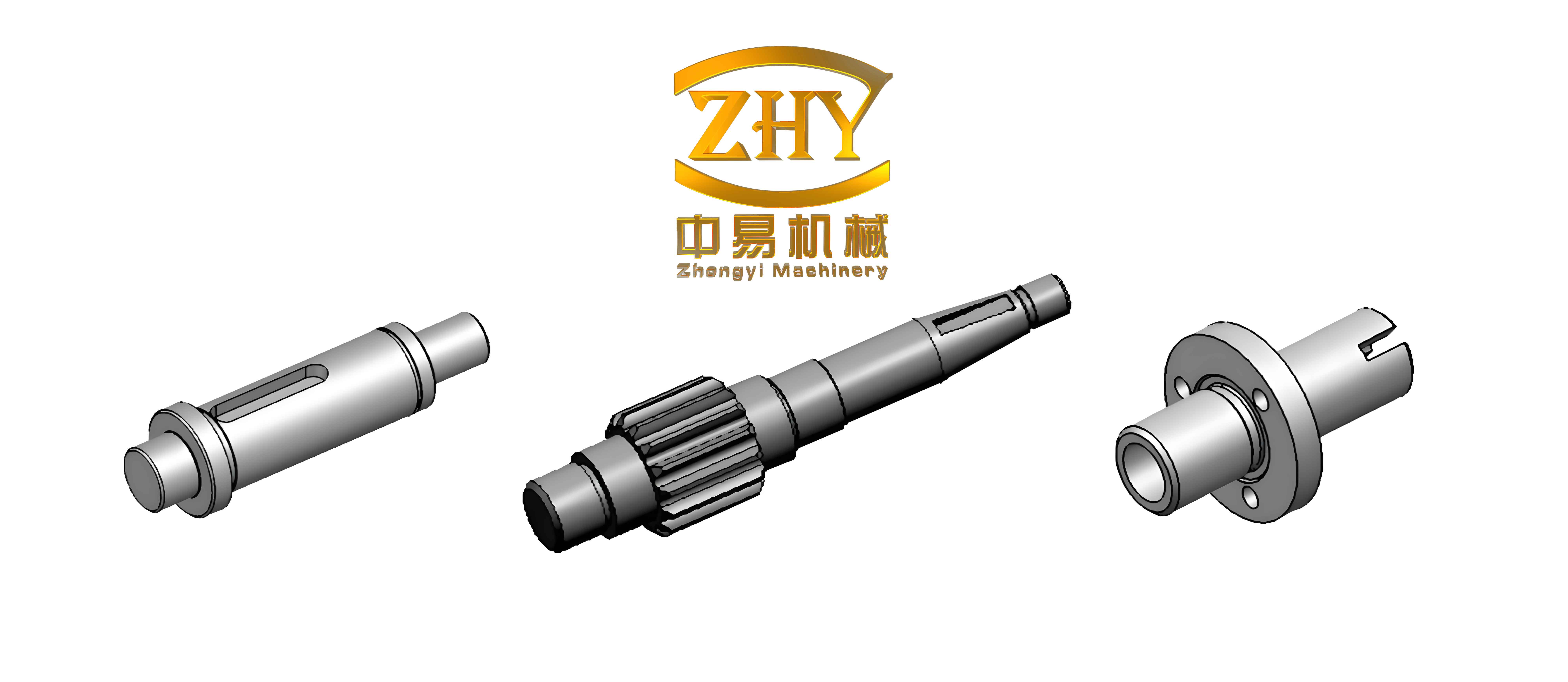
For the finite element analysis, we imported the simplified model into ANSYS software and performed mesh generation with a defined element size of 1 mm for the input gear shaft and 1 mm for the planetary gears in the meshing state. The mesh model resulted in a total of 961,919 nodes and 697,937 elements for the gear shaft alone, ensuring sufficient resolution for modal analysis. In the case of the assembled model, which includes the gear shaft and planetary gears, the mesh comprised 201,779 nodes and 61,060 elements. This discretization allows for the computation of natural frequencies and mode shapes by solving the eigenvalue problem derived from the system’s equations of motion. The general form of the equation for undamped free vibration is given by:
$$ [K] \{\phi\} = \omega^2 [M] \{\phi\} $$
where [K] is the stiffness matrix, [M] is the mass matrix, \(\omega\) is the angular frequency in rad/s, and \(\{\phi\}\) is the mode shape vector. The natural frequency \(f_n\) in Hz is related to \(\omega\) by \(f_n = \omega / (2\pi)\). This equation forms the basis for extracting the modal parameters in different constraint states. In the free state, no boundary conditions are applied, allowing us to observe the inherent dynamic properties of the gear shaft. For the bearing-constrained state, we imposed restrictions on axial, radial, and rotational degrees of freedom to mimic the support from bearings, while in the meshing working state, additional constraints from the planetary gears were included, reflecting the actual operating conditions. The planetary gears were constrained against axial and radial movements to simulate their connection to the crank shaft, and the input gear shaft was allowed to rotate about its axis to represent the transmission of motion.
The modal analysis for the input gear shaft was conducted across the first ten modes to capture the dominant vibration behaviors. The results for the free state and bearing-constrained state are summarized in Table 1, which lists the natural frequencies and corresponding mode shapes. In the free state, the gear shaft exhibits lower natural frequencies due to the absence of external constraints, with the first mode involving torsional deformation around the Z-axis. As constraints are added, the stiffness increases, leading to higher frequencies. For instance, in the bearing-constrained state, the first mode shifts to bending in the XOY plane, indicating the influence of support conditions on the dynamic response. The mode shapes primarily show deformations at the gear teeth engagement areas and the shaft head, highlighting regions prone to stress concentration and potential failure.
| Mode Number | Free State Natural Frequency (Hz) | Free State Mode Shape | Bearing-Constrained Natural Frequency (Hz) | Bearing-Constrained Mode Shape |
|---|---|---|---|---|
| 1 | 12,366 | Torsion around Z-axis | 13,939 | Bending in XOY plane |
| 2 | 17,577 | Torsion in XOY plane | 19,627 | Torsion around X-axis |
| 3 | 26,022 | Bending in XOY plane | 29,094 | Torsion around X-axis |
| 4 | 28,439 | Compression along X-axis | 35,118 | Compression along X-axis |
| 5 | 29,085 | Torsion in XOY plane | 41,638 | Bending in XOY plane |
| 6 | 41,229 | Torsion in XOY plane | 46,777 | Torsion in XOY plane |
| 7 | 46,721 | Torsion around X-axis | 58,387 | Torsion in XOY plane |
| 8 | 49,013 | Tension along X-axis | 65,807 | Bending in XOY plane |
| 9 | 53,545 | Torsion in XOY plane | 67,756 | Bending in XOY plane |
| 10 | 61,287 | Tension along Y-axis | 69,826 | Tension along X-axis |
To further elucidate the vibration characteristics, we can express the relationship between natural frequency and system parameters using the formula for a simplified beam model, which approximates the gear shaft as a continuous system. For a uniform shaft with length L, cross-sectional area A, and moment of inertia I, the natural frequency for the n-th bending mode can be estimated as:
$$ f_n = \frac{\lambda_n^2}{2\pi L^2} \sqrt{\frac{EI}{\rho A}} $$
where \(\lambda_n\) is a constant dependent on the boundary conditions, E is the elastic modulus, and \(\rho\) is the density. This equation highlights how constraints affect the frequency; for example, fixed boundaries increase \(\lambda_n\), leading to higher frequencies. In our simulation, the bearing constraints act similarly, raising the natural frequencies compared to the free state. The mode shapes from the free state, such as the first and fifth modes, demonstrate significant torsion and bending at the gear shaft head, which aligns with the areas of maximum deformation observed in the results. Similarly, in the bearing-constrained state, the mode shapes show a combination of torsion and bending, with the gear shaft exhibiting higher stiffness due to the supports.
Moving to the meshing working state, where the input gear shaft interacts with the planetary gears, the modal analysis reveals even more pronounced changes. The constraints from the meshing gears introduce additional stiffness, which elevates the natural frequencies and alters the mode shapes. Table 2 presents the natural frequencies and mode shapes for the first ten modes in the meshing state. The results indicate that the gear shaft’s deformation is concentrated at the tooth engagement regions, with the head of the gear shaft experiencing the largest displacements. This is critical because it underscores the impact of gear interactions on the dynamic behavior, potentially leading to wear or fatigue if not properly addressed. The natural frequencies in this state are consistently higher than in the free and bearing-constrained states, as the meshing constraints effectively reduce the system’s compliance.
| Mode Number | Natural Frequency (Hz) | Mode Shape |
|---|---|---|
| 1 | 16,107 | Torsion around X-axis |
| 2 | 20,755 | Torsion around X-axis |
| 3 | 30,837 | Bending in XOZ plane |
| 4 | 36,338 | Tension along X-axis |
| 5 | 42,998 | Torsion around X-axis |
| 6 | 47,600 | Bending in XOZ plane |
| 7 | 65,796 | Torsion around X-axis |
| 8 | 68,269 | Torsion around X-axis |
| 9 | 70,578 | Bending in XOZ plane |
| 10 | 72,988 | Tension along X-axis |
A comparative analysis of the natural frequencies across the three states is illustrated in Figure 1, which plots the frequency values for the first ten modes. The meshing state shows a significant increase in frequencies, emphasizing the role of gear interactions in enhancing the dynamic stiffness of the gear shaft. This can be mathematically represented by considering the effective stiffness \(k_{\text{eff}}\) in the meshing state, which includes contributions from the gear teeth engagement. For a gear pair, the meshing stiffness \(k_m\) can be modeled as a spring in series with the shaft stiffness \(k_s\), leading to:
$$ \frac{1}{k_{\text{eff}}} = \frac{1}{k_s} + \frac{1}{k_m} $$
However, in practice, the meshing stiffness varies with the contact conditions, and for modal analysis, it is incorporated into the global stiffness matrix [K]. The increase in natural frequencies in the meshing state aligns with this concept, as the additional constraints from the planetary gears raise the overall system stiffness. The mode shapes in the meshing state are dominated by torsion around the X-axis, reflecting the rotational dynamics of the gear shaft during operation. This torsion is critical because it can lead to vibrational excitations at the engagement points, potentially causing noise or transmission errors. Therefore, understanding these mode shapes is essential for designing gear shafts that minimize such issues.
The vibration analysis of the input gear shaft also involves assessing the strain energy distribution, which indicates areas of high stress concentration. In the meshing state, the strain energy is predominantly localized at the gear teeth and the shaft head, which correlates with the observed mode shapes. The maximum deformation occurs at the head of the gear shaft due to the combined effects of bending and torsion from the planetary gear interactions. This deformation can be quantified using the displacement magnitude \(u\) from the mode shapes, and for design purposes, it is important to ensure that the stress levels remain within the material’s endurance limit. The von Mises stress \(\sigma_v\) in a vibrating gear shaft can be related to the displacement by:
$$ \sigma_v = E \epsilon $$
where \(\epsilon\) is the strain derived from the displacement gradient. In our simulations, the high displacements at the gear shaft head suggest that this region is a potential weak point, requiring attention in terms of material selection or geometric optimization. For instance, increasing the fillet radius or using surface treatments could mitigate stress concentrations and improve the fatigue life of the gear shaft.
Furthermore, the results from the modal analysis have implications for avoiding resonance in the RV reducer. Resonance occurs when the excitation frequency, such as from the motor or load variations, matches one of the natural frequencies of the gear shaft. In the meshing state, the higher natural frequencies mean that the gear shaft is less likely to resonate at lower operating speeds, but it is crucial to consider the entire operating range. For example, if the reducer operates at a speed corresponding to a frequency near 16,107 Hz (the first natural frequency in the meshing state), resonance could lead to amplified vibrations and premature failure. Therefore, designers should ensure that the operating frequencies do not coincide with the natural frequencies of the gear shaft, especially in the meshing state where the dynamics are more complex.
In addition to the finite element simulations, we can derive analytical insights using lumped parameter models. For a simplified representation of the gear shaft as a mass-spring system, the natural frequency is given by \(f_n = \frac{1}{2\pi} \sqrt{\frac{k}{m}}\), where k is the equivalent stiffness and m is the mass. In the context of the gear shaft, the equivalent stiffness depends on the constraint state: in the free state, k is lower, leading to lower frequencies, while in the meshing state, k increases due to the gear engagements. This aligns with our simulation results, where the natural frequencies rise progressively from free to bearing-constrained to meshing states. The mass m remains constant, but the effective stiffness changes with boundary conditions, highlighting the importance of accurate constraint modeling in dynamic analyses.
Another aspect to consider is the damping in the system, which was not included in this modal analysis but plays a role in real-world vibrations. Damping can reduce the amplitude of vibrations at resonance, and for gear shafts, it arises from material hysteresis, lubricated contacts, and structural joints. The modal damping ratio \(\zeta\) can be incorporated in the equation of motion as:
$$ [M] \{\ddot{x}\} + [C] \{\dot{x}\} + [K] \{x\} = \{0\} $$
where [C] is the damping matrix. Although our focus was on undamped modes, future studies could include damping to predict the dynamic response more accurately. Nevertheless, the undamped natural frequencies provide a baseline for understanding the system’s inherent vibrational characteristics.
The comparative analysis of the three states reveals that the input gear shaft’s dynamic behavior is highly sensitive to constraints. In the free state, the gear shaft exhibits modes with lower frequencies and more global deformations, while in the bearing-constrained state, the frequencies increase, and deformations become more localized. In the meshing working state, the frequencies are the highest, and the mode shapes are dominated by torsion, indicating that the gear interactions stiffen the system significantly. This has practical implications for the design and operation of RV reducers: for instance, ensuring that the gear shaft is adequately supported and that the meshing conditions are optimized to minimize vibrational excitations. The gear shaft’s head, being a critical area, should be designed with sufficient strength to handle the deformations observed in the mode shapes.
In conclusion, the vibration analysis of the input gear shaft in a precision RV reducer underscores the importance of considering constraint conditions in dynamic assessments. The finite element simulations provided detailed insights into the natural frequencies and mode shapes under free, bearing-constrained, and meshing working states, showing that the meshing state leads to the highest frequencies and significant deformations at the gear teeth and shaft head. These findings highlight the gear shaft’s role in the reducer’s performance and identify potential weak points for further optimization. By incorporating theoretical formulas and tabulated data, we have established a comprehensive framework for evaluating the dynamic behavior of gear shafts in similar applications. Future work could explore the effects of nonlinearities, such as contact and friction, on the vibration response, as well as experimental validation to corroborate the simulation results. Ultimately, this analysis contributes to the advancement of RV reducer technology, supporting the development of more reliable and efficient robotic systems.