
In this study, I develop a dynamic simulation method for spur gear transmission systems that accounts for the non-uniform distribution of tooth root cracks. Spur gears are widely used in various industrial applications due to their high efficiency and compact structure, but root cracks can lead to severe failures if undetected. The proposed model incorporates a sliced gear approach to compute time-varying meshing stiffness (TVMS) and analyzes the resulting vibration characteristics, providing insights for fault detection in spur gears.
The dynamics of spur gear systems are influenced by several factors, including mesh stiffness and contact forces. When root cracks are present, the stiffness varies along the tooth width, leading to asymmetric load distribution and increased vibration. I begin by dividing the gear into multiple thin slices along the tooth width direction. Each slice is treated as a two-dimensional cantilever beam with uniformly distributed root cracks, allowing for the calculation of TVMS for individual slices. The TVMS for a single tooth pair can be expressed as:
$$ \frac{1}{K_m} = \frac{1}{K_{tg}} + \frac{1}{K_{tp}} + \frac{1}{K_{fg}} + \frac{1}{K_{fp}} + \frac{1}{K_h} $$
where \( K_{tg} \) and \( K_{tp} \) represent the tooth stiffness of the gear and pinion, \( K_{fg} \) and \( K_{fp} \) denote the fillet foundation stiffness, and \( K_h \) is the Hertzian contact stiffness. For each spur gear slice, the tooth stiffness is further broken down into bending, shear, and axial components:
$$ \frac{1}{K_t} = \frac{1}{K_b} + \frac{1}{K_s} + \frac{1}{K_a} $$
with the bending stiffness \( K_b \), shear stiffness \( K_s \), and axial stiffness \( K_a \) calculated as follows:
$$ \frac{1}{K_b} = \int_0^d \frac{(x \cos \alpha_r – h \sin \alpha_r)^2}{E I_x} dx $$
$$ \frac{1}{K_s} = \int_0^d \frac{1.2 \cos^2 \alpha_r}{G A_x} dx $$
$$ \frac{1}{K_a} = \int_0^d \frac{\sin^2 \alpha_r}{E A_x} dx $$
Here, \( E \) is Young’s modulus, \( G \) is the shear modulus, \( I_x \) is the area moment of inertia, and \( A_x \) is the cross-sectional area. The crack depth affects these parameters, reducing the effective stiffness in cracked regions. The fillet foundation stiffness is improved to account for root cracks:
$$ \frac{1}{K_f} = \frac{\cos^2 \alpha’}{d_w E} \left[ L \left( \frac{u_f’}{S_f’} \right)^2 + M \left( \frac{u_f’}{S_f’} \right) + P \left( 1 + Q \tan^2 \alpha’ \right) \right] $$
and the Hertzian contact stiffness is given by:
$$ \frac{1}{K_h} = \frac{4(1 – \nu^2)}{\pi E d_w} $$
where \( \nu \) is Poisson’s ratio and \( d_w \) is the slice width. The non-uniform TVMS leads to uneven meshing forces along the tooth width of the spur gears. The dynamic transmission error (DTE) for each slice is derived considering longitudinal and vertical displacements:
$$ \delta_i = -R_{bg} \beta_g – R_{bp} \beta_p – \left[ (Z_g – L_i \phi_g) – (Z_p – L_i \phi_p) \right] \cos \alpha_r – \left[ (X_p + L_i \psi_p) – (X_g + L_i \psi_g) \right] \sin \alpha_r – \text{err}_i $$
where \( R_{bg} \) and \( R_{bp} \) are base circle radii, \( L_i \) is the distance from the slice to the gear center, and \( \alpha_r \) is the pressure angle. The meshing force for the \( i \)-th slice is then:
$$ F_{mi} = K_{mi} \delta_i + C_{mi} \dot{\delta}_i $$
This force causes unbalanced moments, contributing to rolling and yaw motions in the spur gears. The equations of motion are derived using d’Alembert’s principle, considering five degrees of freedom for both gear and pinion: longitudinal (X), vertical (Z), rolling (φ), rotational (β), and yaw (ψ). The longitudinal motion equation is:
$$ m_k \ddot{X}_k + N_{kx1} + N_{kx2} \pm \sum_{i=1}^{n_s} F_{mxi} = 0 $$
and the vertical motion equation is:
$$ m_k \ddot{Z}_k + N_{kz1} + N_{kz2} \mp \sum_{i=1}^{n_s} F_{mzi} – m_k g = 0 $$
where \( m_k \) is the mass, \( N_{kxj} \) and \( N_{kzj} \) are bearing contact forces, and \( g \) is gravity. The rolling and yaw motion equations are:
$$ J_{kx} \ddot{\phi}_k – N_{kz1} L_a + N_{kz2} L_a \pm \sum_{i=1}^{n_s} T_{\phi i} = 0 $$
$$ J_{kz} \ddot{\psi}_k + N_{kx1} L_a – N_{kx2} L_a \pm \sum_{i=1}^{n_s} T_{\psi i} = 0 $$
with \( T_{\phi i} = F_{mi} L_i \cos \alpha_r \) and \( T_{\psi i} = F_{mi} L_i \sin \alpha_r \). The rotational motion equation includes damping:
$$ J_{ky} \ddot{\beta}_k – T_{ke} + C_k \dot{\beta}_k – \sum_{i=1}^{n_s} F_{mi} R_{bk} = 0 $$
Bearing dynamics are modeled with spring-damper elements, and the contact forces between the outer ring and bearing seat are:
$$ N_{kxj} = K_{bx} \left[ X_k – (-1)^j \psi_k L_i – X_{kbj} \right] + C_{bx} \left[ \dot{X}_k – (-1)^j \dot{\psi}_k L_i – \dot{X}_{kbj} \right] $$
$$ N_{kzj} = K_{bz} \left[ Z_k + (-1)^j \phi_k L_i – Z_{kbj} \right] + C_{bz} \left[ \dot{Z}_k + (-1)^j \dot{\phi}_k L_i – \dot{Z}_{kbj} \right] $$
and the forces on the bearing seat are:
$$ F_{kxj} = K_{bx} X_{kbj} + C_{bx} \dot{X}_{kbj} $$
$$ F_{kzj} = K_{bz} Z_{kbj} + C_{bz} \dot{Z}_{kbj} $$
The overall system has 18 degrees of freedom. To solve these equations, I employ a fast explicit numerical integration method with parameters φ and ψ set to 0.5 for stability. The matrix form of the motion equations is:
$$ \mathbf{M} \ddot{\mathbf{X}}(t) + \mathbf{C} \dot{\mathbf{X}}(t) + \mathbf{K} \mathbf{X}(t) = \mathbf{F}(t) $$
where \( \mathbf{M} \), \( \mathbf{C} \), and \( \mathbf{K} \) are mass, damping, and stiffness matrices, respectively.
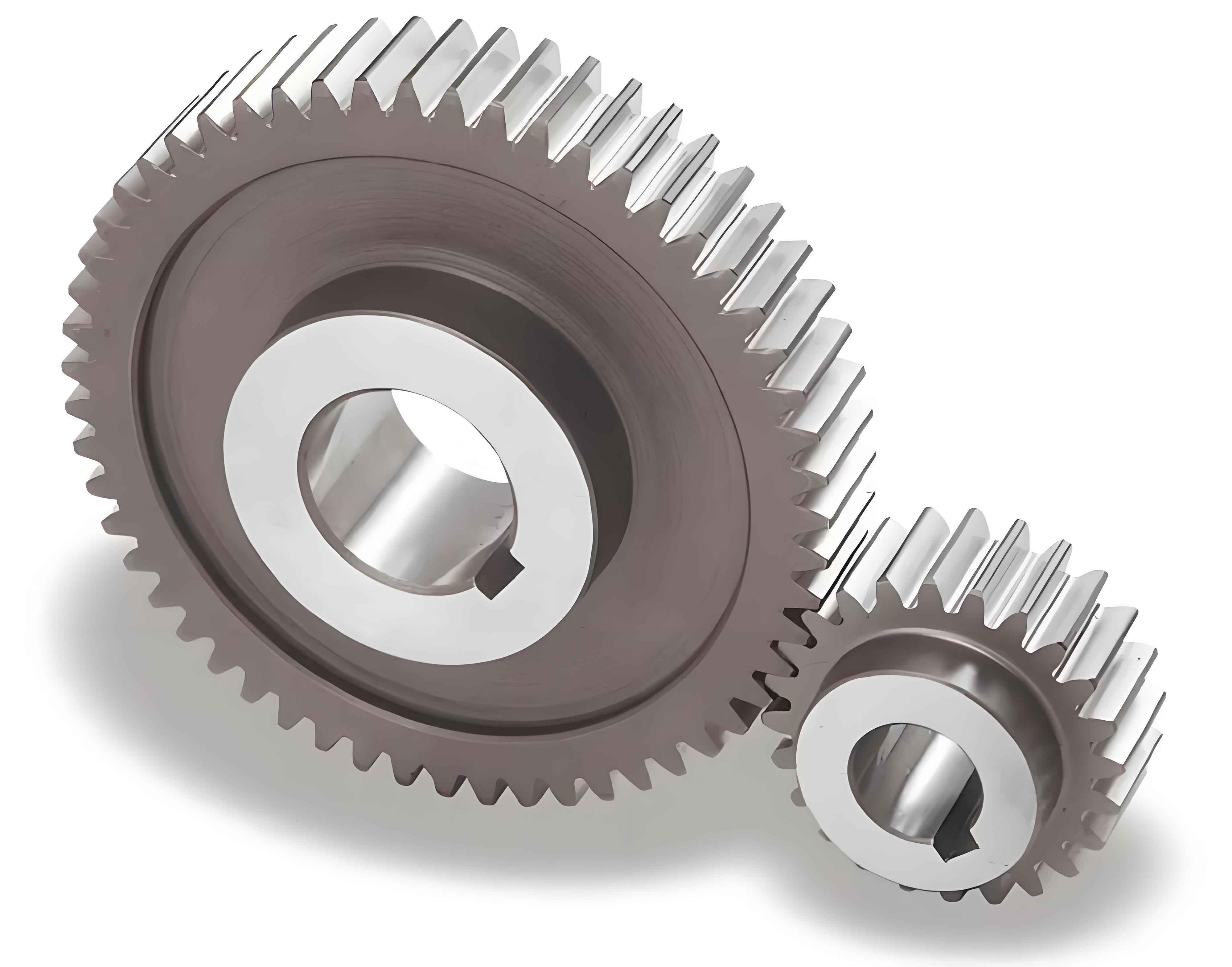
For dynamic simulation, I analyze a spur gear pair with parameters summarized in Table 1. The gear design includes a module of 8 mm, pressure angle of 20°, and 120 teeth for the gear and 23 for the pinion. The crack parameters assume a slice count \( n_s = 20 \), crack length ratio μ = 50%, crack depth \( q_c = 9 \) mm, and crack angle ν = 70°. The operating conditions include a drive torque \( T_p = -1500 \) N·m and pinion speed \( v_p = 71 \) rad/s.
| Symbol | Parameter | Gear Value | Pinion Value |
|---|---|---|---|
| M | Module (mm) | 8 | 8 |
| α_r | Pressure Angle (°) | 20 | 20 |
| Z | Number of Teeth | 120 | 23 |
| W | Face Width (mm) | 136 | 175 |
| E | Young’s Modulus (GPa) | 200 | 200 |
| υ | Poisson’s Ratio | 0.3 | 0.3 |
| h_a^* | Addendum Coefficient | 1 | 1 |
| c_n^* | Tip Clearance Coefficient | 0.25 | 0.25 |
The TVMS results show that cracked slices have lower stiffness compared to healthy spur gears, as illustrated in Figure 6. The DTE varies between slices, with higher errors in cracked regions. For instance, when a crack initiates from the left side, the left slice exhibits higher DTE than the right slice. The meshing forces also become uneven, as shown in Figure 8, where the left slice experiences different force magnitudes due to the crack.
Bearing vibration responses are critical for fault diagnosis. The rolling and yaw accelerations demonstrate that cracked spur gears produce distinct pulses during meshing. The rolling acceleration peaks at 53.8 rad/s², while yaw acceleration reaches 19.6 rad/s², indicating higher sensitivity in the vertical direction. The longitudinal and vertical bearing accelerations are analyzed using time histories and spectra. In the longitudinal direction, the left bearing shows more pronounced pulses, with an average amplitude of 0.25 m/s², compared to 0.2 m/s² for the right bearing. The vertical accelerations are stronger due to gravity, with peaks around 1 m/s² for the cracked side.
Frequency domain analysis reveals sidebands around the meshing frequency \( f_m = 260 \) Hz and its harmonics, which are indicative of crack faults in spur gears. The sideband energy ratio (SER) is used as a statistical indicator:
$$ \text{SER}_i = \frac{\sum_{j=1}^6 (s_{jif_{m-j}} + s_{jif_{m+j}})}{s_{jif_m}} $$
where \( s_{jif_{m \pm j}} \) are the sideband components. The SER values decrease with increasing crack severity, providing a quantitative measure for fault detection. Additionally, kurtosis and impulse factor are computed from time-domain data:
$$ \text{Ku} = \frac{N \sum_{i=1}^N (x_i – \bar{x})^4}{\left( \sum_{i=1}^N (x_i – \bar{x})^2 \right)^2} $$
$$ \text{If} = \frac{x_p}{\frac{1}{N} \sum_{i=1}^N |x_i|} $$
These indicators show parabolic trends with crack extension, with higher values on the cracked side, confirming the model’s ability to monitor crack propagation in spur gears.
In conclusion, the proposed sliced model effectively captures the non-uniform effects of root cracks on spur gear dynamics. The asymmetric TVMS leads to uneven meshing forces and vibrations, which are more severe on the cracked side. The statistical indicators and frequency analysis provide reliable tools for fault diagnosis, making this approach valuable for real-world applications in monitoring spur gear systems.