
In this study, we explore the vibration characteristics of spur gears, focusing on the effects of tip relief and time-varying center distance. Spur gears are fundamental components in mechanical transmission systems, widely used in automotive, aerospace, and industrial machinery due to their simplicity and efficiency. However, as power density demands increase, vibration issues become critical, affecting durability and reliability. We aim to develop an accurate dynamic model to predict and mitigate vibration loads in spur gear systems.
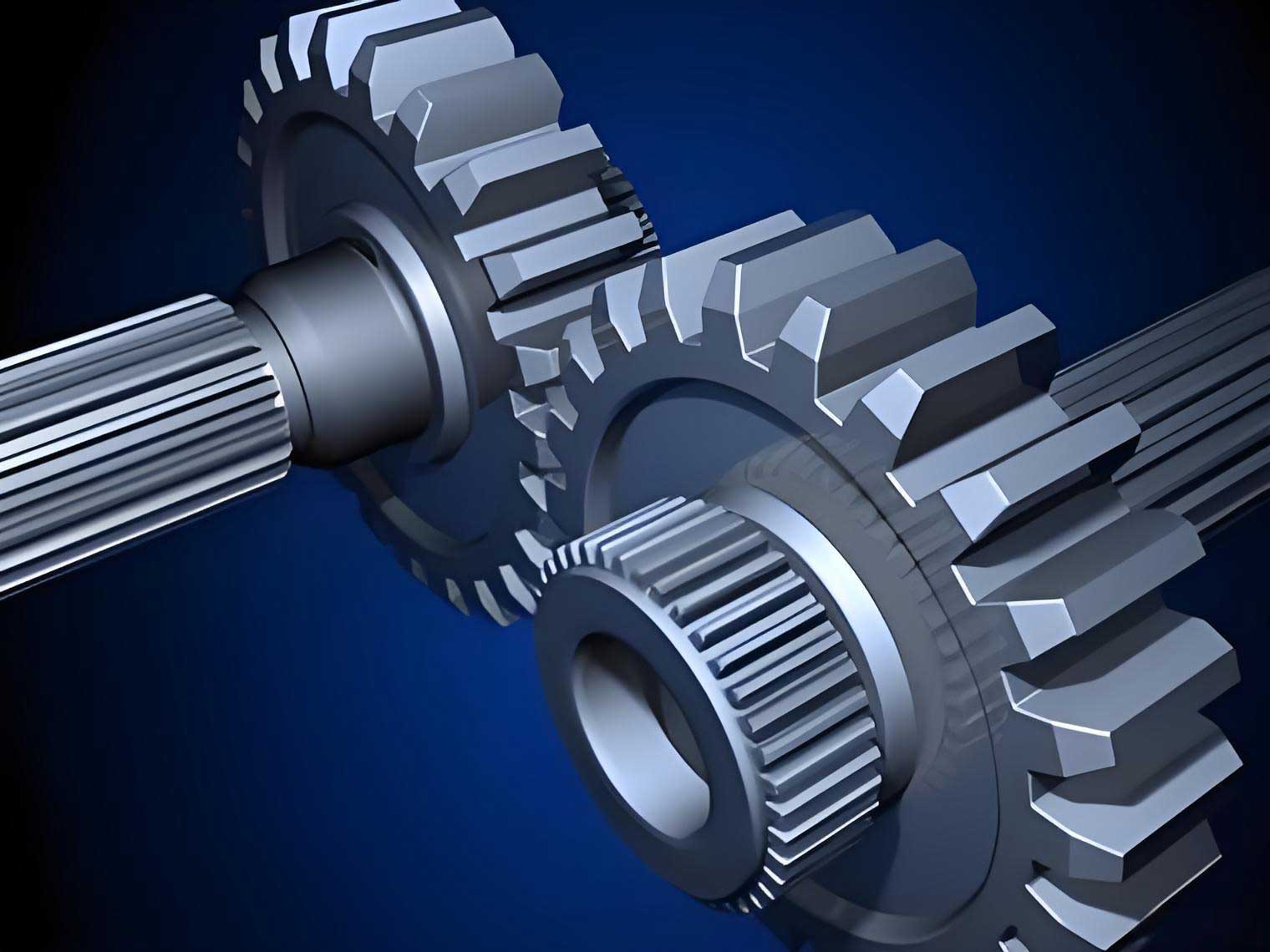
The vibration of spur gears arises from nonlinear factors such as time-varying mesh stiffness and backlash. Traditional models often assume constant parameters, but dynamic effects like geometric eccentricity and transverse vibrations can alter the center distance, influencing mesh angle and clearance. Additionally, tip relief is a common technique to reduce impact loads during mesh transitions. We integrate these aspects to create a comprehensive gear mesh model and couple it with a nonlinear dynamic model for spur gear systems.
We consider spur gears with involute profiles, where the mesh process involves single and double tooth contact zones. The dynamic mesh stiffness varies with position, and tip relief modifies the tooth profile to soften stiffness transitions. Our approach accounts for time-varying rotational speed, time-varying center distance due to lateral displacements, and tip relief effects. We derive analytical expressions for dynamic pressure angle, dynamic backlash, and dynamic mesh stiffness, enhancing the accuracy of vibration predictions.
The gear mesh model is coupled with a 10-degree-of-freedom (DOF) lateral-torsional-rocking nonlinear dynamic model for a single-stage spur gear transmission. This model includes geometric eccentricity, gyroscopic moments, and load distribution along the tooth width. We use numerical methods, such as the fourth-order Runge-Kutta algorithm, to solve the coupled equations and analyze vibration responses under varying speeds and torques. Our findings provide insights into optimizing tip relief for different operating conditions, ultimately reducing dynamic loads in spur gears.
Gear Mesh Model for Spur Gears
We begin by developing a gear mesh model for spur gears that incorporates dynamic parameters. The spur gear pair is represented in a two-dimensional plane, with each gear having translational and rotational degrees of freedom. The mesh force acts along the line of action, coupled through mesh stiffness, damping, and backlash.
Dynamic Pressure Angle
In spur gears, the center distance can vary due to installation errors, geometric eccentricity, and vibration displacements. This variation affects the mesh pressure angle. Let us define the absolute coordinate system with origin at the rotational center of gear 1. The position vectors for the mass centers of gear 1 and gear 2 are given by:
$$ \mathbf{R}_1 = [x_1 + e_1 \cos(\phi_1)]\mathbf{i} + [y_1 + e_1 \sin(\phi_1)]\mathbf{j} $$
$$ \mathbf{R}_2 = [x_2 + e_2 \cos(\phi_2) + l]\mathbf{i} + [y_2 + e_2 \sin(\phi_2)]\mathbf{j} $$
where \(x_i\) and \(y_i\) are translational displacements, \(e_i\) is geometric eccentricity, \(\phi_i\) is rotational angle, and \(l\) is the initial center distance with deviation \(e_a\): \(l = m(z_1 + z_2)/2 + e_a\), with \(m\) as module and \(z_i\) as tooth numbers. The dynamic center distance \(L\) is:
$$ L = \| \mathbf{R}_2 – \mathbf{R}_1 \| = \sqrt{(l + \Delta x)^2 + (\Delta y)^2} $$
where \(\Delta x = x_2 – x_1 + e_2 \cos(\phi_2) – e_1 \cos(\phi_1)\) and \(\Delta y = y_2 – y_1 + e_2 \sin(\phi_2) – e_1 \sin(\phi_1)\). The dynamic pressure angle \(\alpha\) is then:
$$ \alpha = \cos^{-1}\left( \frac{r_{b1} + r_{b2}}{L} \right) $$
where \(r_{bi}\) is the base circle radius. The position angle \(\gamma\) is:
$$ \gamma = \tan^{-1}\left( \frac{\Delta y}{l + \Delta x} \right) $$
These expressions account for time-varying center distance in spur gears, influencing mesh geometry.
Dynamic Backlash
Backlash is essential to prevent jamming in spur gears, and it changes with center distance variations. The dynamic backlash \(\tilde{b}\) is:
$$ \tilde{b} = b + \Delta b $$
where \(b\) is the initial backlash, and \(\Delta b\) is the change due to center distance:
$$ \Delta b = (r_{b1} + r_{b2}) [\text{inv}(\alpha) – \text{inv}(\alpha_t)] $$
Here, \(\alpha_t\) is the theoretical pressure angle, and \(\text{inv}(\alpha) = \tan \alpha – \alpha\) is the involute function. This dynamic backlash affects the nonlinear contact conditions in spur gears.
Dynamic Mesh Stiffness
Mesh stiffness in spur gears varies with the contact position, expressed as a function of the pressure angle at the mesh point. Considering time-varying speed and center distance, the pressure angle at the mesh point on gear 1 is:
$$ \alpha_m = \tan^{-1}\left[ \text{sign}(\gamma)(\alpha_t – \alpha + \gamma) + \int_0^t \omega(t) dt + \tan a_s \right] $$
where \(\omega(t)\) is time-varying rotational speed, and \(a_s\) is the initial mesh point pressure angle. The mesh stiffness calculation depends on the mesh zone: single-tooth, double-tooth, or relief zones. For spur gears with tip relief, we define five cases based on mesh position. The single-tooth mesh stiffness \(k_s(\alpha_m(t))\) is computed using analytical methods that consider tooth flexibility. For double-tooth mesh, the stiffness is the sum of two pairs: \(k_{s1}(\alpha_m(t)) + k_{s2}(\alpha_m(t))\). In relief zones, the stiffness is adjusted based on relief amounts \(P_1(t)\) and \(P_2(t)\) for gears 1 and 2, respectively. The general expressions are:
Case 1: Mesh in single-tooth zone: \(\tilde{k}_{m1}(t) = k_s(\alpha_m(t))\).
Case 2: Mesh in double-tooth zone: \(\tilde{k}_{m2}(t) = k_{s1}(\alpha_m(t)) + k_{s2}(\alpha_m(t))\).
Case 3: Mesh in relief zone of gear 1: \(\tilde{k}_{m3}(t) = \frac{k_{s1}(\alpha_m(t))}{1 + k_{s2}(\alpha_m(t)) P_1(t) / F_m(t)}\) if \(E_1(t) > 0\), else \(k_{s1}(\alpha_m(t))\), where \(E_1(t) = \delta_1(t) – P_1(t)\) and \(\delta_1(t) = F_m(t) / k_{s1}(\alpha_m(t))\).
Case 4: Mesh in relief zone of gear 2: \(\tilde{k}_{m4}(t) = \frac{k_{s2}(\alpha_m(t))}{1 + k_{s1}(\alpha_m(t)) P_2(t) / F_m(t)}\) if \(E_2(t) > 0\), else \(k_{s2}(\alpha_m(t))\), with \(E_2(t) = \delta_2(t) – P_2(t)\) and \(\delta_2(t) = F_m(t) / k_{s2}(\alpha_m(t))\).
Case 5: Mesh in relief zones of both gears: \(\tilde{k}_{m5}(t)\) has piecewise expressions based on \(E_3(t) = P_1(t) – P_2(t)\). This dynamic mesh stiffness model for spur gears captures the effects of tip relief and time-varying parameters.
Gear Mesh Force Equation
The mesh force \(F_m\) for spur gears is derived using dynamic backlash and stiffness:
$$ F_m = \tilde{k}_m f(\tilde{b}, \Delta) + \tilde{c}_m f_1(\tilde{b}, \Delta) $$
where \(\tilde{k}_m\) is the dynamic mesh stiffness, \(\tilde{c}_m\) is mesh damping: \(\tilde{c}_m = \xi \sqrt{\tilde{k}_m m_1 m_2 / (m_1 + m_2)}\), with \(\xi\) as damping ratio, \(m_i\) as masses. The functions \(f\) and \(f_1\) represent backlash nonlinearity:
$$ f(\tilde{b}, \Delta) = \begin{cases} \Delta – \tilde{b}, & \Delta > \tilde{b} \\ 0, & |\Delta| \le \tilde{b} \\ \Delta + \tilde{b}, & \Delta < -\tilde{b} \end{cases} $$
$$ f_1(\tilde{b}, \Delta) = \begin{cases} \dot{\Delta}, & |\Delta| > \tilde{b} \\ 0, & |\Delta| \le \tilde{b} \end{cases} $$
The dynamic transmission error \(\Delta\) for spur gears is:
$$ \Delta = (x_1 – x_2) \sin(\alpha + \gamma) – (y_1 – y_2) \cos(\alpha + \gamma) + r_{b1} \theta_{z1} + r_{b2} \theta_{z2} + p(t) $$
where \(\theta_{zi}\) is torsional displacement, and \(p(t)\) is profile deviation due to tip relief. This mesh model integrates all dynamic aspects for spur gears.
Nonlinear Dynamic Model of Spur Gear System
We establish a 10-DOF lateral-torsional-rocking coupled nonlinear dynamic model for a single-stage spur gear transmission. Each spur gear has five degrees of freedom: translations \(x_i\) and \(y_i\), and rotations \(\theta_{xi}\), \(\theta_{yi}\), and \(\theta_{zi}\). The system includes supports modeled as stiffness and damping matrices, with gyroscopic effects and load distribution along tooth width.
The kinetic energy \(T\), potential energy \(U\), and dissipative energy \(V\) are:
$$ T = \frac{1}{2} \sum_{i=1}^2 \left[ m_i (\dot{\mathbf{R}}_i)^2 + I_{xi} \dot{\theta}_{xi}^2 + I_{yi} \dot{\theta}_{yi}^2 + I_{zi} \dot{\theta}_{zi}^2 \right] $$
$$ U = \sum_{i=1}^2 \frac{1}{2} \mathbf{q}_i^T \mathbf{K}_i \mathbf{q}_i $$
$$ V = \sum_{i=1}^2 \frac{1}{2} \dot{\mathbf{q}}_i^T \mathbf{D}_i \dot{\mathbf{q}}_i $$
where \(\mathbf{q}_i = [x_i, y_i, \theta_{xi}, \theta_{yi}, \theta_{zi}]^T\), \(\mathbf{K}_i\) and \(\mathbf{D}_i\) are stiffness and damping matrices for gear supports. Applying Lagrange’s equation:
$$ \frac{d}{dt} \left( \frac{\partial T}{\partial \dot{z}_k} \right) – \frac{\partial T}{\partial z_k} + \frac{\partial U}{\partial z_k} + \frac{\partial V}{\partial \dot{z}_k} = Q_k $$
where \(z_k\) are generalized coordinates and \(Q_k\) are generalized forces. Considering gyroscopic moments and mesh forces, we derive the equations of motion for spur gears:
For gear 1:
$$ m_1 \ddot{x}_1 – m_1 e_1 \dot{\theta}_{z1}^2 \cos(\theta_{z1} + \psi_1) – m_1 e_1 \ddot{\theta}_{z1} \sin(\theta_{z1} + \psi_1) + \mathbf{K}_{11} \mathbf{q}_1 + \mathbf{C}_{11} \dot{\mathbf{q}}_1 = F_m \sin \Phi $$
$$ m_1 \ddot{y}_1 – m_1 e_1 \dot{\theta}_{z1}^2 \sin(\theta_{z1} + \psi_1) + m_1 e_1 \ddot{\theta}_{z1} \cos(\theta_{z1} + \psi_1) + \mathbf{K}_{12} \mathbf{q}_1 + \mathbf{C}_{12} \dot{\mathbf{q}}_1 = -F_m \cos \Phi $$
$$ I_{x1} \ddot{\theta}_{x1} + \mathbf{K}_{13} \mathbf{q}_1 + \mathbf{C}_{13} \dot{\mathbf{q}}_1 + I_{z1} \dot{\theta}_{z1} \dot{\theta}_{x1} = -F_m \tau \cos \Phi $$
$$ I_{y1} \ddot{\theta}_{y1} + \mathbf{K}_{14} \mathbf{q}_1 + \mathbf{C}_{14} \dot{\mathbf{q}}_1 – I_{z1} \dot{\theta}_{z1} \dot{\theta}_{y1} = -F_m \tau \sin \Phi $$
$$ (I_{z1} + m_1 e_1^2) \ddot{\theta}_{z1} – m_1 \ddot{x}_1 e_1 \sin(\theta_{z1} + \psi_1) + m_1 \ddot{y}_1 e_1 \cos(\theta_{z1} + \psi_1) + \mathbf{K}_{15} \mathbf{q}_1 + \mathbf{C}_{15} \dot{\mathbf{q}}_1 = -F_m r_{b1} + T_1 $$
For gear 2:
$$ m_2 \ddot{x}_2 – m_2 e_2 \dot{\theta}_{z2}^2 \cos(\theta_{z2} + \psi_2) – m_2 e_2 \ddot{\theta}_{z2} \sin(\theta_{z2} + \psi_2) + \mathbf{K}_{21} \mathbf{q}_2 + \mathbf{C}_{21} \dot{\mathbf{q}}_2 = -F_m \sin \Phi $$
$$ m_2 \ddot{y}_2 – m_2 e_2 \dot{\theta}_{z2}^2 \sin(\theta_{z2} + \psi_2) + m_2 e_2 \ddot{\theta}_{z2} \cos(\theta_{z2} + \psi_2) + \mathbf{K}_{22} \mathbf{q}_2 + \mathbf{C}_{22} \dot{\mathbf{q}}_2 = F_m \cos \Phi $$
$$ I_{x2} \ddot{\theta}_{x2} + \mathbf{K}_{23} \mathbf{q}_2 + \mathbf{C}_{23} \dot{\mathbf{q}}_2 + I_{z2} \dot{\theta}_{z2} \dot{\theta}_{x2} = F_m \tau \cos \Phi $$
$$ I_{y2} \ddot{\theta}_{y2} + \mathbf{K}_{24} \mathbf{q}_2 + \mathbf{C}_{24} \dot{\mathbf{q}}_2 – I_{z2} \dot{\theta}_{z2} \dot{\theta}_{y2} = -F_m \tau \sin \Phi $$
$$ (I_{z2} + m_2 e_2^2) \ddot{\theta}_{z2} – m_2 \ddot{x}_2 e_2 \sin(\theta_{z2} + \psi_2) + m_2 \ddot{y}_2 e_2 \cos(\theta_{z2} + \psi_2) + \mathbf{K}_{25} \mathbf{q}_2 + \mathbf{C}_{25} \dot{\mathbf{q}}_2 = -F_m r_{b2} + T_2 $$
where \(\Phi = \alpha + \gamma\), \(\tau\) is load distribution factor, \(T_i\) are external torques, and \(\mathbf{K}_{ij}\), \(\mathbf{C}_{ij}\) are rows of stiffness and damping matrices. This model for spur gears accounts for coupled vibrations and nonlinearities.
The dynamic mesh stiffness depends on vibration displacements and forces, requiring iterative coupling with the dynamic model. We implement a numerical solution using Fortran, with the fourth-order Runge-Kutta method for integration. The simulation flowchart involves initializing parameters, calculating dynamic mesh parameters, solving equations, and updating stiffness iteratively.
Vibration Characteristics Study of Spur Gears
We analyze the vibration characteristics of spur gears under different tip relief conditions and operating parameters. The spur gear pair parameters are summarized in Table 1.
| Parameter | Value |
|---|---|
| Number of teeth, \(z_1 / z_2\) | 35 / 45 |
| Module, \(m\) (mm) | 6 |
| Masses, \(m_1 / m_2\) (kg) | 6.5 / 10.2 |
| Moments of inertia, \(I_{x1} / I_{x2}\) (kg·mm²) | 0.024 / 0.058 |
| Moments of inertia, \(I_{y1} / I_{y2}\) (kg·mm²) | 0.024 / 0.058 |
| Moments of inertia, \(I_{z1} / I_{z2}\) (kg·mm²) | 0.043 / 0.11 |
| Backlash, \(b\) (mm) | 0.2 |
| Center distance deviation, \(e_a\) (mm) | 0.01 |
| Geometric eccentricity, \(e_i\) (mm) | 0.05 |
| Load distribution factor, \(\tau\) | 0.01 |
We consider three spur gear configurations: (1) no relief, (2) short tip relief with relief length 2 mm and amount 0.02 mm, and (3) long tip relief with relief length 6 mm and amount 0.02 mm. The relief is applied linearly on both spur gears.
Effect of Rotational Speed on Vibration of Spur Gears
We set input torque to 2500 N·m and vary speed from 0 to 5000 r/min. The peak-to-peak mesh force for spur gears is plotted against speed. For spur gears without relief, the peak-to-peak force shows local minima at 1300, 2800, and 4000 r/min, and local maxima at 1300 and 3500 r/min due to resonance near natural frequencies. At 5000 r/min, the maximum force is 40.24 kN, while at 2800 r/min, it is 21.52 kN.
For spur gears with short tip relief, the force increases linearly up to 3600 r/min, then decreases to 4600 r/min, and increases again. The maximum force is 53.210 kN at 3500 r/min, and minimum is 2.619 kN at 200 r/min. There is a critical speed of 2500 r/min; above this, short relief spur gears have higher vibration than no-relief spur gears.
For spur gears with long tip relief, the force variation is smooth, with maximum 6.636 kN at 3400 r/min and minimum 4.400 kN at 1300 r/min. No critical speed exists; long relief spur gears consistently have lower vibration than no-relief spur gears across the speed range, making them suitable for wide-speed applications.
We examine time-domain and frequency-domain responses at specific speeds. At 1000 r/min, spur gears without relief show impact loads at mesh transitions, while relief spur gears reduce these impacts. Frequency analysis reveals that no-relief spur gears have high-frequency components (e.g., 8x, 9x, 11x mesh frequency), with 11x amplitude of 1.122 kN. Short relief spur gears have dominant 1x and 3x mesh frequencies, with 3x amplitude of 1.133 kN. Long relief spur gears have 3x and 4x mesh frequencies, with 4x amplitude of 0.258 kN. Tip relief in spur gears suppresses high-frequency vibrations.
Mesh stiffness time-domain plots show that relief softens stiffness transitions in spur gears. At 2500 r/min, short relief spur gears become more sensitive, with increased impact loads, while long relief spur gears remain stable. At 5000 r/min, both no-relief and short relief spur gears exhibit increased impacts, with short relief exceeding no-relief. Long relief spur gears maintain low vibration, with force amplitudes dominated by lower mesh harmonics.
Table 2 summarizes peak-to-peak mesh forces at key speeds for spur gears.
| Speed (r/min) | No Relief | Short Relief | Long Relief |
|---|---|---|---|
| 1000 | 25.1 | 12.5 | 5.2 |
| 2500 | 21.5 | 45.3 | 6.9 |
| 5000 | 40.2 | 55.0 | 7.5 |
Effect of Torque on Vibration of Spur Gears
We set input speed to 2500 r/min and vary torque from 0 to 5000 N·m. For spur gears without relief, the peak-to-peak mesh force increases linearly with torque. For spur gears with tip relief, the force first decreases then increases, indicating an optimal torque for minimum vibration. For short relief spur gears, the minimum force occurs at 400 N·m, while for long relief spur gears, it is at 1600 N·m.
Critical torques exist: for short relief spur gears, below 2500 N·m, vibration is higher than no-relief spur gears; for long relief spur gears, below 500 N·m, vibration is higher. Above these, relief spur gears perform better. Long relief spur gears generally have lower vibration across torques, suitable for wide-torque ranges.
At 400 N·m, short relief spur gears show higher vibration than no-relief spur gears, with tooth separation during mesh exit. Frequency spectra show no-relief spur gears have dominant 4x mesh frequency at 0.538 kN, short relief have 1x at 3.47 kN, and long relief have 1x at 1.338 kN. Mesh stiffness plots indicate reduced overlap for relief spur gears at low torque.
At 1600 N·m, long relief spur gears achieve minimum vibration, with force amplitudes much lower than others. No-relief spur gears have 4x amplitude of 2.124 kN, short relief have 1x at 4.533 kN, and long relief have 2x at 0.895 kN. Stiffness transitions are smoothed for long relief spur gears.
At 5000 N·m, all spur gears show increased impacts. No-relief spur gears have 4x amplitude of 6.631 kN, short relief have 1x at 6.838 kN, and long relief have 5x at 3.938 kN. Overlap increases with torque for relief spur gears.
Table 3 summarizes peak-to-peak mesh forces at key torques for spur gears.
| Torque (N·m) | No Relief | Short Relief | Long Relief |
|---|---|---|---|
| 400 | 10.2 | 15.8 | 12.1 |
| 1600 | 24.5 | 30.2 | 8.9 |
| 5000 | 55.0 | 60.5 | 25.3 |
Conclusions on Spur Gears Vibration
Our study on spur gears with tip relief and time-varying center distance yields several key conclusions. First, we derived analytical expressions for dynamic pressure angle, dynamic backlash, and dynamic mesh stiffness, incorporating time-varying center distance, speed, and tip relief for spur gears. These enhance the gear mesh model accuracy.
Second, we established a 10-DOF lateral-torsional-rocking coupled nonlinear dynamic model for spur gear systems, including geometric eccentricity, gyroscopic moments, and load distribution. This model is coupled with the gear mesh model for comprehensive vibration analysis.
Third, rotational speed effects show that short tip relief in spur gears increases vibration above a critical speed (2500 r/min), while long tip relief spur gears have no critical speed and maintain lower vibration across speeds. Thus, long relief is preferable for wide-speed spur gear applications.
Fourth, torque effects reveal that for spur gears without relief, vibration increases linearly with torque. For spur gears with tip relief, vibration first decreases then increases, with optimal torques for minimum vibration (400 N·m for short relief, 1600 N·m for long relief). Critical torques exist below which relief spur gears have higher vibration than no-relief spur gears, with long relief having a lower critical torque (500 N·m) than short relief (2500 N·m). Long relief spur gears generally exhibit lower vibration over a wide torque range.
Overall, tip relief design for spur gears should consider operating conditions: long relief is effective for broad speed and torque ranges, while short relief may be suitable for specific low-speed or high-torque scenarios. Our models provide a foundation for optimizing spur gear systems to reduce dynamic loads, improve durability, and enhance reliability in mechanical transmissions.
Future work could extend this analysis to helical spur gears or multi-stage spur gear systems, and experimental validation would further confirm the findings. The methodologies developed here contribute to the advanced dynamics understanding of spur gears in engineering applications.