
In modern textile manufacturing, seamless knitting machines represent a pinnacle of efficiency and precision, producing garments with superior elasticity and comfort through integrated forming technology. The operational stability and fabric quality of these machines are heavily influenced by the dynamic behavior of their transmission systems. Among these, helical gears and synchronous belt drives are critical components, each with distinct vibration signatures that affect overall performance. This article delves into the vibration characteristics of these two典型传动机构, employing theoretical modeling and experimental validation to provide insights for optimal selection and placement in machinery design. The focus is on helical gears, a key element in power transmission due to their unique几何 properties, and synchronous belts, known for their precision and suitability for long-distance drives. Understanding their vibrational dynamics is essential for enhancing machine reliability and product quality.
The transmission system in a seamless underwear machine typically includes a motor, motor同步带, a drive gear shaft assembly incorporating helical gears, a large gear mounting plate, upper and lower main synchronous belts, a main drive shaft, and components like the needle cylinder and half-disc. The helical gear drive, part of the drive gear shaft assembly, transmits power from the motor to the needle cylinder, enabling rotational motion. Its design offers high load capacity and smooth operation but introduces axial forces due to the helix angle. In contrast, the synchronous belt drive, particularly the lower main synchronous belt within the large gear mounting plate, ensures stable power transmission over相对较大的 spans with minimal slippage. Both systems generate vibrations during operation—from gear meshing impacts, belt tension variations, and external excitations—which can lead to wear, noise, and reduced accuracy. Thus, analyzing their vibration特性 through rigorous methods is paramount for advancing textile machinery engineering.
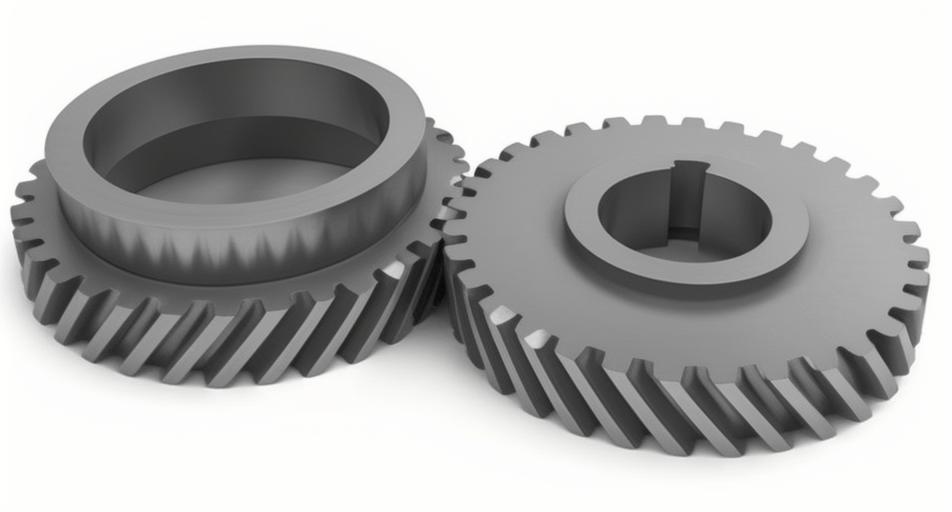
To theoretically assess the vibration behavior, we first establish dynamic models for both传动机构. For helical gears, the system involves bending-torsion-axial coupling vibrations due to the helix angle, resulting in a multi-degree-of-freedom model. Consider a helical gear pair consisting of a drive helical gear (active) and a needle cylinder gear (passive), with a helix angle $\beta$. The generalized displacement vector for this system is given by:
$$ \{\delta\} = \{ y_p, z_p, \theta_p, y_g, z_g, \theta_g \}^T $$
where $y_i$, $z_i$, and $\theta_i$ (with $i = p, g$) represent the translational displacements in the y-direction (meshing direction) and z-direction (axial direction), and rotational displacement, respectively, for the gear centers. The forces in the y and z directions, $F_y$ and $F_z$, are derived from meshing stiffness, damping, and errors:
$$ F_y = \cos \beta \cdot \left[ k_m (y_p + \theta_p R_p – y_g + \theta_g R_g – e_y) + c_m (\dot{y}_p + \dot{\theta}_p R_p – \dot{y}_g + \dot{\theta}_g R_g – \dot{e}_y) \right] $$
$$ F_z = \sin \beta \cdot \left\{ k_m \left[ z_p + (\theta_p R_p + y_p) \tan \beta – z_g + (y_g – \theta_g R_g) \tan \beta – e_z \right] + c_m \left[ \dot{z}_p – (\dot{y}_p + \dot{\theta}_p R_p) \tan \beta – \dot{z}_g + (\dot{y}_g – \dot{\theta}_g R_g) \tan \beta – \dot{e}_z \right] \right\} $$
Here, $k_m$ is the normal meshing stiffness, $c_m$ is the normal damping, $e$ is the normal meshing error with components $e_y = e \cos \beta$ and $e_z = e \sin \beta$, and $R_p$ and $R_g$ are the base circle radii. Applying Newton’s second law, the equations of motion for the drive helical gear and needle cylinder gear are:
$$ m_p \ddot{y}_p + c_{py} \dot{y}_p + k_{py} y_p = -F_y $$
$$ m_p \ddot{z}_p + c_{pz} \dot{z}_p + k_{pz} z_p = F_z $$
$$ I_p \ddot{\theta}_p = -F_y R_p – T_p $$
$$ m_g \ddot{y}_g + c_{gy} \dot{y}_g + k_{gy} y_g = F_y $$
$$ m_g \ddot{z}_g + c_{gz} \dot{z}_g + k_{gz} z_g = -F_z $$
$$ I_g \ddot{\theta}_g = -F_y R_g – T_g $$
where $m_i$, $I_i$, $c_{iy}$, $c_{iz}$, $k_{iy}$, $k_{iz}$ (for $i = p, g$) are masses, moments of inertia, damping, and stiffness coefficients in the y and z directions, and $T_p$ and $T_g$ are input and load torques. Combining these into matrix form yields the振动分析 model:
$$ [m]\{\ddot{\delta}\} + [c]\{\dot{\delta}\} + [k]\{\delta\} = [P] $$
with the load matrix $[P]$ expressed as:
$$ [P] = \begin{bmatrix} \cos \beta \cdot (k_m e_y + c_m \dot{e}_y) \\ \sin \beta \cdot (k_m e_z + c_m \dot{e}_z) \\ -T_p + R_p \cos \beta \cdot (c_m \dot{e}_y + k_m e_y) \\ -\cos \beta \cdot (k_m e_y + c_m \dot{e}_y) \\ \sin \beta \cdot (k_m e_z + c_m \dot{e}_z) \\ -T_g + R_g \cos \beta \cdot (c_m \dot{e}_y + k_m e_y) \end{bmatrix} $$
This model highlights that vibrations in helical gears depend on factors like helix angle $\beta$, base radii, and external torques. The axial component ($z$-direction) is particularly influenced by $\beta$, leading to potential wear and complex vibrational patterns. helical gears, with their helical teeth, exhibit smoother meshing and higher load capacity but require careful management of axial forces.
For the synchronous belt drive, we focus on vertical vibrations perpendicular to the belt, which are predominant due to tension fluctuations and bending stiffness. Consider a belt segment with density $\rho$, inclination angle $\theta$, bending stiffness $EI$, and tension $F$. The equation of motion for small vibrations $y(x,t)$ is derived from force平衡:
$$ EI \frac{\partial^4 y}{\partial x^4} – F \frac{\partial^2 y}{\partial x^2} + \rho \frac{\partial^2 y}{\partial t^2} = 0 $$
When the belt moves with speed $v(t)$, the acceleration includes convective terms, leading to:
$$ \frac{\partial^2 y}{\partial t^2} = \frac{\partial^2 y}{\partial t^2} + 2v \frac{\partial^2 y}{\partial x \partial t} + v^2 \frac{\partial^2 y}{\partial x^2} + \frac{dv}{dt} \frac{\partial y}{\partial x} $$
Substituting into the vibration equation gives:
$$ \frac{EI}{\rho} \frac{\partial^4 y}{\partial x^4} + \frac{\partial^2 y}{\partial t^2} + 2v \frac{\partial^2 y}{\partial x \partial t} + (v^2 – c^2) \frac{\partial^2 y}{\partial x^2} = 0 $$
where $c = \sqrt{F_0 / \rho}$ and $F_0$ is the initial tension. This shows that belt vibrations are influenced by span length $L$, tension $F_0$, and speed $v$, with frequency increasing with $v$. Synchronous belts offer advantages like precise timing and damping but require tension control to minimize vibrations.
To validate these theoretical insights, an experimental setup was designed to measure vibrations in both传动机构. A triaxial acceleration sensor was attached to external housing points corresponding to the helical gear drive and lower main synchronous belt drive locations. The seamless knitting machine was operated at speeds ranging from 50 to 80 r/min, and vibration signals in the x, y, and z directions were captured. Data were processed to obtain acceleration frequency spectra, with all measurements taken under steady-state conditions to ensure reliability. The experimental approach allowed for a direct comparison of vibrational characteristics without delving into specific component details or personal identifiers.
The results from the helical gear drive analysis revealed distinct vibrational patterns across directions. At machine speeds from 50 to 80 r/min, the acceleration frequency spectra in the 0–1000 Hz range showed that the x-direction (axial) exhibited the most complex vibrational成分, with multiple excitation points, while the y and z directions became smoother at higher speeds. This aligns with the theoretical model, where the helix angle in helical gears induces significant axial forces, leading to pronounced x-direction vibrations. For instance, at 50 r/min, the spectra displayed broad frequency content, but as speed increased to 80 r/min, the特征频率 became more distinct, indicating stabilization. The dominance of axial vibrations in helical gears underscores the importance of robust axial supports and lubrication in design.
In contrast, the synchronous belt drive showed a consistent increase in characteristic frequency with machine speed, as summarized in the table below. The vibrations were generally平稳, with fewer excitation points compared to helical gears, reflecting the belt’s damping capacity and suitability for long-distance transmission.
| Machine Speed (r/min) | Helical Gear x-direction (mm/s²) | Helical Gear y-direction (mm/s²) | Helical Gear z-direction (mm/s²) | Synchronous Belt x-direction (mm/s²) | Synchronous Belt y-direction (mm/s²) | Synchronous Belt z-direction (mm/s²) |
|---|---|---|---|---|---|---|
| 50 | 0.000677 | 0.000569 | 0.000930 | 0.000504 | 0.001053 | 0.000806 |
| 55 | 0.000582 | 0.000337 | 0.000595 | 0.000329 | 0.000308 | 0.000363 |
| 60 | 0.000685 | 0.000347 | 0.000609 | 0.000493 | 0.000352 | 0.000422 |
| 65 | 0.000713 | 0.000322 | 0.000624 | 0.000526 | 0.000299 | 0.000462 |
| 70 | 0.000806 | 0.000383 | 0.000644 | 0.000640 | 0.000392 | 0.000524 |
| 75 | 0.000926 | 0.000696 | 0.000960 | 0.000670 | 0.000676 | 0.000760 |
| 80 | 0.000933 | 0.001297 | 0.001522 | 0.000780 | 0.000867 | 0.000848 |
The table above presents the root mean square (RMS) values of vibration acceleration for both传动机构 across directions. Overall, the helical gear drive tends to have higher RMS values, especially in the x-direction, confirming the theoretical prediction of axial vibration prominence. For helical gears, the x-direction RMS values are consistently elevated, e.g., from 0.000677 mm/s² at 50 r/min to 0.000933 mm/s² at 80 r/min, highlighting the impact of螺旋角. In comparison, the synchronous belt drive shows lower and more uniform RMS values, with exceptions at某些 speeds where y and z directions vary, indicating its inherent stability. This data reinforces that helical gears, while efficient for high-load applications, require careful vibration management, whereas synchronous belts excel in maintaining平稳 operation over extended spans.
Further analysis of frequency spectra indicates that both传动机构 share identical characteristic frequencies at the same machine speed, but differ in amplitude and complexity. For helical gears, the特征频率 increased linearly with speed, from approximately 374.4 Hz at 50 r/min to 590.6 Hz at 80 r/min, as observed in experimental plots. This trend is captured by the relationship $f \propto N$, where $N$ is the rotational speed, due to meshing frequency dependencies. The synchronous belt drive exhibited a similar frequency rise, validating the theoretical model $v^2$ influence in the vibration equation. The consistency between theoretical and experimental results underscores the reliability of the dynamic models for both helical gears and synchronous belts.
Discussion of these findings emphasizes the practical implications for seamless knitting machine design. helical gears, with their ability to handle substantial loads and provide smooth power transmission, are ideal for direct啮合 with critical components like the needle cylinder gear. However, their vibration profile, particularly axial oscillations, necessitates robust housing and periodic maintenance to prevent wear. In contrast, synchronous belt drives, with their minimal vibration and high damping, are suited for connecting distant shafts, such as in the lower main drive, where stability is paramount. The choice between these传动机构 should consider factors like load magnitude, transmission distance, and vibration tolerance. For instance, in applications where space constraints or noise reduction are critical, helical gears might be preferred despite their axial challenges, while synchronous belts offer advantages in setups requiring precise timing and low maintenance.
Expanding on the theoretical aspects, the vibration models for helical gears can be refined by incorporating additional parameters such as tooth profile modifications, thermal effects, and lubrication conditions. The equation $$ [m]\{\ddot{\delta}\} + [c]\{\dot{\delta}\} + [k]\{\delta\} = [P] $$ can be extended to include nonlinear stiffness terms $k_{nl}(\delta)$ to account for large deformations or impact forces. Similarly, for synchronous belts, the vibration equation $$ \frac{EI}{\rho} \frac{\partial^4 y}{\partial x^4} + \frac{\partial^2 y}{\partial t^2} + 2v \frac{\partial^2 y}{\partial x \partial t} + (v^2 – c^2) \frac{\partial^2 y}{\partial x^2} = 0 $$ might be adapted for variable tension scenarios using numerical methods like finite element analysis. These enhancements could lead to more accurate predictions and better design optimization for textile machinery.
In terms of experimental validation, future work could involve更高速度 ranges or different loading conditions to explore vibrational limits. The use of advanced sensors, such as laser Doppler vibrometers, could provide more detailed spatial vibration maps for helical gears and synchronous belts. Additionally, statistical analysis of vibration data, including kurtosis and skewness, might reveal insights into wear progression and failure modes. For helical gears, monitoring axial vibration levels could serve as a diagnostic tool for early detection of misalignment or tooth damage, thereby reducing downtime. For synchronous belts, tension monitoring systems could be integrated to maintain optimal vibrational performance.
The comparative analysis also highlights the role of material properties in vibration behavior. helical gears made from hardened steels or composites may exhibit different damping characteristics, influencing the matrix $[c]$ in the dynamic model. Similarly, synchronous belts with fiber-reinforced structures can alter the bending stiffness $EI$, affecting vibration frequencies. Exploring these material aspects could lead to innovations in传动机构 design, such as using viscoelastic layers in helical gear housings or optimized belt tooth profiles to mitigate vibrations.
From an industrial perspective, the findings advocate for tailored maintenance schedules based on vibration signatures. For machines employing helical gears, regular inspections of axial bearings and lubrication systems are crucial, as indicated by the elevated x-direction vibrations. For those using synchronous belts, tension adjustments and belt replacement intervals can be optimized using vibration frequency trends. Implementing condition-based monitoring systems that leverage these vibrational insights could enhance overall equipment effectiveness in textile manufacturing plants.
In conclusion, this comprehensive study on the vibration characteristics of helical gears and synchronous belt drives in seamless knitting machines demonstrates that both传动机构 have distinct dynamic behaviors rooted in their design principles. helical gears, characterized by their helix angle, provide high load capacity but introduce significant axial vibrations, necessitating careful engineering to manage wear and stability. Synchronous belts, on the other hand, offer平稳 operation with vibrations primarily dependent on speed and tension, making them ideal for long-distance drives. The theoretical models and experimental data presented herein align closely, validating the approach and providing a foundation for future research. By understanding these vibrational dynamics, manufacturers can make informed decisions on传动机构 selection and placement, ultimately improving machine performance and product quality in the textile industry. The emphasis on helical gears throughout this analysis underscores their importance in power transmission systems, and ongoing advancements in modeling and sensing will continue to refine their application in high-precision machinery.