
Spur gear transmission systems are integral components across various sectors such as aerospace, marine engineering, and rail transportation, prized for their high efficiency, compact design, and operational reliability. However, operating under harsh conditions inevitably subjects these components to various failure modes. Among them, the tooth root crack stands out as a critical and prevalent fault. This type of crack, if undetected, can propagate and lead to catastrophic tooth fracture, resulting in significant machinery downtime and potential safety hazards. Therefore, a profound understanding and accurate modeling of the dynamic behavior of spur gear pairs in the presence of root cracks are paramount for developing effective condition monitoring and predictive maintenance strategies. This study addresses the challenge of non-uniform crack distribution, a realistic scenario where a crack may initiate and propagate more severely on one side of the gear face due to localized stress concentrations or manufacturing imperfections.
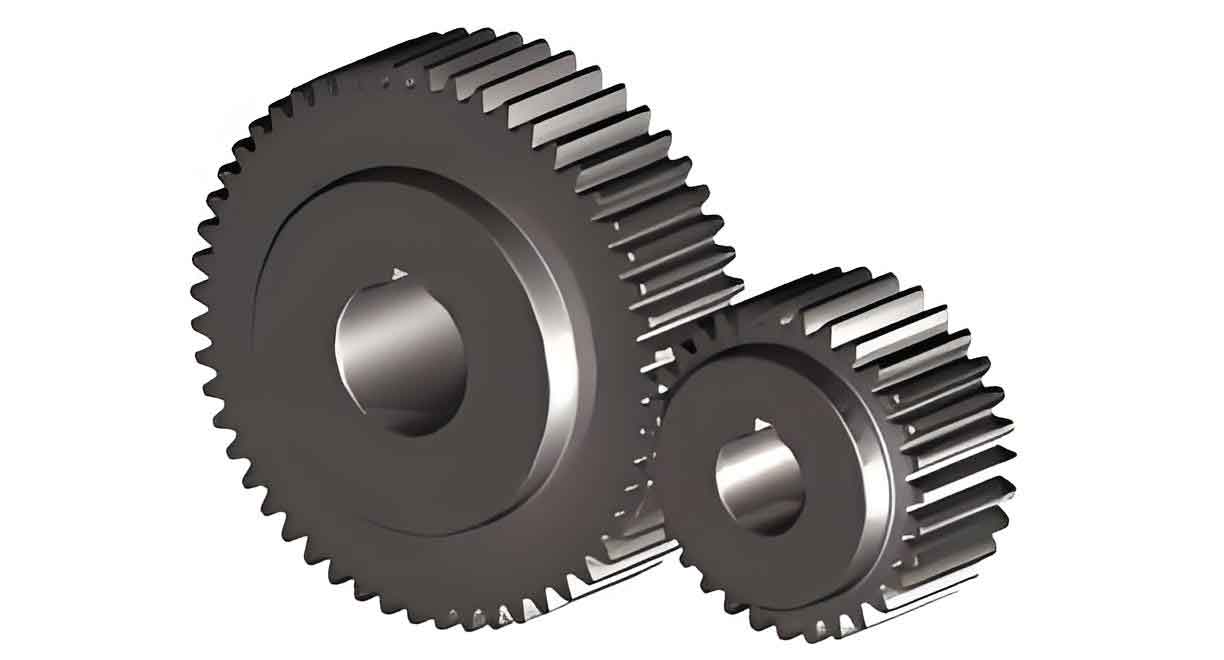
Building upon extensive prior research on cracked gears, this work proposes a refined dynamic simulation methodology for spur gear transmissions. The novel contribution lies in explicitly accounting for the non-uniform distribution of a root crack along the tooth width, a factor often simplified or overlooked in lumped-parameter models. The core of the approach is a “slicing method,” where the gear tooth is discretized into several thin, independent slices along its face width. Each slice is treated as a two-dimensional cantilevered beam with a uniformly distributed crack of a specific depth. This allows for the precise calculation of the Time-Varying Mesh Stiffness (TVMS) for every individual slice, capturing the localized reduction in stiffness caused by the crack. The dynamic interactions, including longitudinal, vertical, rocking, and yawing motions induced by the asymmetric mesh force distribution, are fully considered. The derived equations of motion are solved numerically to reveal the vibration characteristics, with a particular focus on bearing responses. The validity of the dynamic insights is further corroborated through statistical indicators derived from the simulated signals, establishing a clear link between crack propagation patterns and measurable vibration features.
Dynamic Modeling of a Spur Gear Pair with Non-Uniform Root Crack
The three-dimensional dynamic model of the spur gear pair is established with five degrees of freedom for both the gear and the pinion: longitudinal (X), vertical (Z), rocking (φ), rotational (β), and yawing (ψ) motions. The gear/pinion and its shaft are treated as a rigid body with concentrated mass and inertia at their respective centers. The supporting bearings are simplified as spring-damper elements in the longitudinal and vertical directions, neglecting the detailed dynamics of rolling elements. The gear mesh interface is represented by a spring-damper unit acting along the Line of Action (LOA).
Modeling Time-Varying Mesh Stiffness with Non-Uniform Cracks
The key innovation is the treatment of a non-uniform root crack. The gear tooth is divided into $$n_s$$ slices along its face width. Assuming each slice is sufficiently thin, the crack depth within a single slice is considered constant, enabling the use of established analytical methods for TVMS calculation of a 2D gear tooth model with a uniform root crack. For each slice \( i \), the total mesh stiffness $$K_{m,i}$$ is a combination of tooth stiffness and Hertzian contact stiffness:
$$ \frac{1}{K_{m,i}} = \frac{1}{K_{t g,i}} + \frac{1}{K_{t p,i}} + \frac{1}{K_{f g,i}} + \frac{1}{K_{f p,i}} + \frac{1}{K_{h,i}} $$
Where subscripts \( g \) and \( p \) denote gear and pinion, and \( t \), \( f \), and \( h \) represent tooth, fillet-foundation, and Hertzian contact stiffness, respectively. The tooth stiffness for a slice is itself a series combination of bending, shear, and axial compressive stiffnesses:
$$ \frac{1}{K_{t,i}} = \frac{1}{K_{b,i}} + \frac{1}{K_{s,i}} + \frac{1}{K_{a,i}} $$
These are calculated using strain energy principles and integral formulas considering the variable cross-section and the cracked region. The fillet-foundation stiffness is calculated using an improved method that accounts for the changed compliance due to the crack path. The Hertzian contact stiffness for a slice of width $$d_w$$ is given by:
$$ K_{h,i} = \frac{\pi E d_w}{4(1-\nu^2)} $$
By calculating $$K_{m,i}$$ for all $$i = 1, 2, …, n_s$$, we obtain the TVMS profile for each slice, which will differ based on its individual crack depth, leading to a non-uniform stiffness distribution across the face width of the cracked spur gear.
Mesh Force and Bearing Contact Force Model
The non-uniform TVMS directly leads to uneven distribution of dynamic mesh force. The Dynamic Transmission Error (DTE) for the \( i \)-th slice, $$\delta_i$$, incorporates the relative displacements between gear and pinion, including contributions from rocking and yawing angles:
$$ \delta_i = [R_{bg}\beta_g – R_{bp}\beta_p – (Z_g + L_i \phi_g) – (Z_p + L_i \phi_p)]\cos\alpha_r – [(X_p – L_i \psi_p) – (X_g – L_i \psi_g)]\sin\alpha_r – e_{rr}(t) $$
Here, $$R_b$$ is the base radius, $$L_i$$ is the distance from the slice to the gear mass center, $$\alpha_r$$ is the pressure angle, and $$e_{rr}$$ is the static transmission error. The mesh force for the \( i \)-th slice is:
$$ F_{mi,i} = K_{m,i} \delta_i + C_{m,i} \dot{\delta}_i $$
This uneven mesh force creates unbalanced moments about the gear’s mass center, contributing to rocking ($$\phi$$) and yawing ($$\psi$$) motions:
$$ T_{\phi,i} = F_{mi,i} L_i \cos\alpha_r, \quad T_{\psi,i} = F_{mi,i} L_i \sin\alpha_r $$
The bearing forces are derived from the relative displacement between the inner race (connected to the gear/pinion) and the outer race (connected to the bearing housing). For bearing \( j \) (j=1,2 left/right) on component \( k \) (k=g/p), the longitudinal ($$N_{kxj}$$) and vertical ($$N_{kzj}$$) contact forces are:
$$ N_{kxj} = K_{bx}(X_k – L_a \psi_k – X_{kbj}) + C_{bx}(\dot{X}_k – L_a \dot{\psi}_k – \dot{X}_{kbj}) $$
$$ N_{kzj} = K_{bz}(Z_k + L_a \phi_k – Z_{kbj}) + C_{bz}(\dot{Z}_k + L_a \dot{\phi}_k – \dot{Z}_{kbj}) $$
The forces between the bearing housing and the fixed support ($$F_{kxj}, F_{kzj}$$) follow a similar spring-damper model.
Equations of Motion for the Spur Gear System
Applying D’Alembert’s principle, the 18-degree-of-freedom equations of motion are derived. For conciseness, the general matrix form is presented:
$$ \mathbf{M}\ddot{\mathbf{X}}(t) + \mathbf{C}\dot{\mathbf{X}}(t) + \mathbf{KX}(t) = \mathbf{F}(t) $$
Where $$\mathbf{M}$$, $$\mathbf{C}$$, $$\mathbf{K}$$ are the system mass, damping, and stiffness matrices, respectively. $$\mathbf{X}(t)$$ is the displacement vector containing all 18 DOFs, and $$\mathbf{F}(t)$$ is the force vector containing mesh excitations, input torque, and gravity. The stiffness matrix $$\mathbf{K}$$ incorporates the time-varying and spatially non-uniform mesh stiffnesses $$K_{m,i}$$. This set of nonlinear differential equations is solved using an efficient explicit numerical integration algorithm (Fast Explicit Integration Method) suitable for handling the parametric excitations from the TVMS.
Dynamic Simulation and Analysis of Spur Gears with Cracks
The proposed model is employed to analyze the vibration characteristics of a single-stage spur gear transmission. The primary design parameters of the gear pair are summarized in Table 1.
| Symbol | Parameter | Gear Value | Pinion Value |
|---|---|---|---|
| M | Module (mm) | 8 | 8 |
| $$\alpha_r$$ | Pressure Angle (°) | 20 | 20 |
| Z | Number of Teeth | 120 | 23 |
| W | Face Width (mm) | 136 | 175 |
| E | Young’s Modulus (GPa) | 200 | 200 |
| $$\nu$$ | Poisson’s Ratio | 0.3 | 0.3 |
Table 1: Main Design Parameters of the Spur Gears.
The simulation assumes a steady-state operating condition with an input torque $$T_p = -1500 \text{ Nm}$$ and a pinion speed $$\omega_p = 71 \text{ rad/s}$$. A crack is assumed to initiate from one side (left) of a gear tooth, with a length equal to 50% of the face width ($$\mu=0.5$$), a depth $$q_c=9 \text{ mm}$$, and a crack propagation angle $$\nu=70^\circ$$. The gear is sliced into $$n_s=20$$ elements.
Simulation of Bearing Dynamic Response
The non-uniform mesh stiffness induces an asymmetric mesh force distribution. Figure 6 conceptually illustrates the varying TVMS for slices on the cracked and healthy sides. This asymmetry generates unbalanced moments, exciting significant rocking and yawing vibrations in the spur gear pair. As shown in the simulated time histories, the rocking angular acceleration (driven by the vertical force component) exhibits higher amplitude pulses (up to 53.8 rad/s²) compared to the yawing motion (up to 19.6 rad/s²) when the cracked tooth is in mesh.
These gear body motions directly influence the bearing responses. The vertical bearing vibrations are more pronounced than the longitudinal ones, mirroring the stronger rocking excitation. Crucially, the bearing on the side where the crack initiates (left side) shows more distinct impact pulses in its vibration acceleration compared to the opposite (right) bearing. This differential response provides a clear signature for fault localization in spur gear systems. The time interval between successive pulses corresponds to the pinion rotation period, confirming the fault’s origin.
Frequency domain analysis further confirms the fault. The spectrum of bearing vibration acceleration reveals sidebands around the fundamental gear mesh frequency ($$f_m = 260 \text{ Hz}$$) and its harmonics, a classic indicator of modulation caused by a localized fault like a tooth crack. The amplitude of these sidebands is notably higher in the spectrum obtained from the bearing closer to the crack.
Statistical Indicator Analysis
To quantitatively assess the severity and progression of the non-uniform crack, statistical indicators are applied to the simulated bearing vibration signals. Two time-domain indicators, Kurtosis ($$K_u$$) and Impulse Factor ($$I_f$$), are used:
$$ K_u = \frac{N \sum_{i=1}^{N}(x_i – \bar{x})^4}{\left[\sum_{i=1}^{N}(x_i – \bar{x})^2\right]^2} $$
$$ I_f = \frac{|x_p|}{\frac{1}{N}\sum_{i=1}^{N}|x_i|} $$
where $$x_i$$ is the signal, $$\bar{x}$$ is its mean, and $$x_p$$ is its peak value. Both indicators are sensitive to the impulsiveness in the signal caused by the crack fault. Their evolution with increasing crack length ($$\mu$$) follows a parabolic trend, reaching a maximum when the crack extends to about half the face width, indicating the most severe fault signature.
Furthermore, a frequency-domain indicator, the Sideband Energy Ratio (SER), is employed to measure the energy of modulation sidebands relative to the mesh frequency harmonics:
$$ SER_i = \frac{\sum_{j=1}^{6}(s_{if_m-j} + s_{if_m+j})}{s_{if_m}} $$
where $$s_{if_m \pm j}$$ represents the amplitude of the \( j \)-th sideband around the \( i \)-th mesh harmonic. The SER value calculated from the left bearing signal (near the crack) is consistently lower than that from the right bearing. As a more severe crack increases modulation, it often reduces the dominance of the pure mesh harmonic, leading to a lower SER. This provides a complementary metric for diagnosing the non-uniform crack severity in spur gear transmissions.
Conclusion
This study has developed and demonstrated a refined dynamic model for spur gear transmission systems that explicitly accounts for the non-uniform distribution of tooth root cracks along the face width. By employing a “slicing method,” the model accurately captures the localized reduction in mesh stiffness and the consequent asymmetric distribution of dynamic mesh force. This asymmetry generates measurable rocking and yawing vibrations in the spur gears, which in turn induce characteristic patterns in the bearing vibration responses.
The simulation results conclusively show that for a crack initiating from one side of a spur gear tooth, the bearing on that same side exhibits more severe vibration impacts and higher sideband activity in the frequency spectrum compared to the bearing on the opposite side. This differential response serves as a clear diagnostic feature for both detecting the presence of a crack and localizing its origin. The analysis of statistical indicators, including Kurtosis, Impulse Factor, and Sideband Energy Ratio, quantitatively validates the dynamic simulation findings and establishes reliable metrics for monitoring crack progression. The proposed model, therefore, provides a robust theoretical foundation and practical guidance for the condition monitoring, fault diagnosis, and severity assessment of root cracks in spur gear drives, ultimately contributing to improved reliability and safety of mechanical transmission systems.