
Abstract
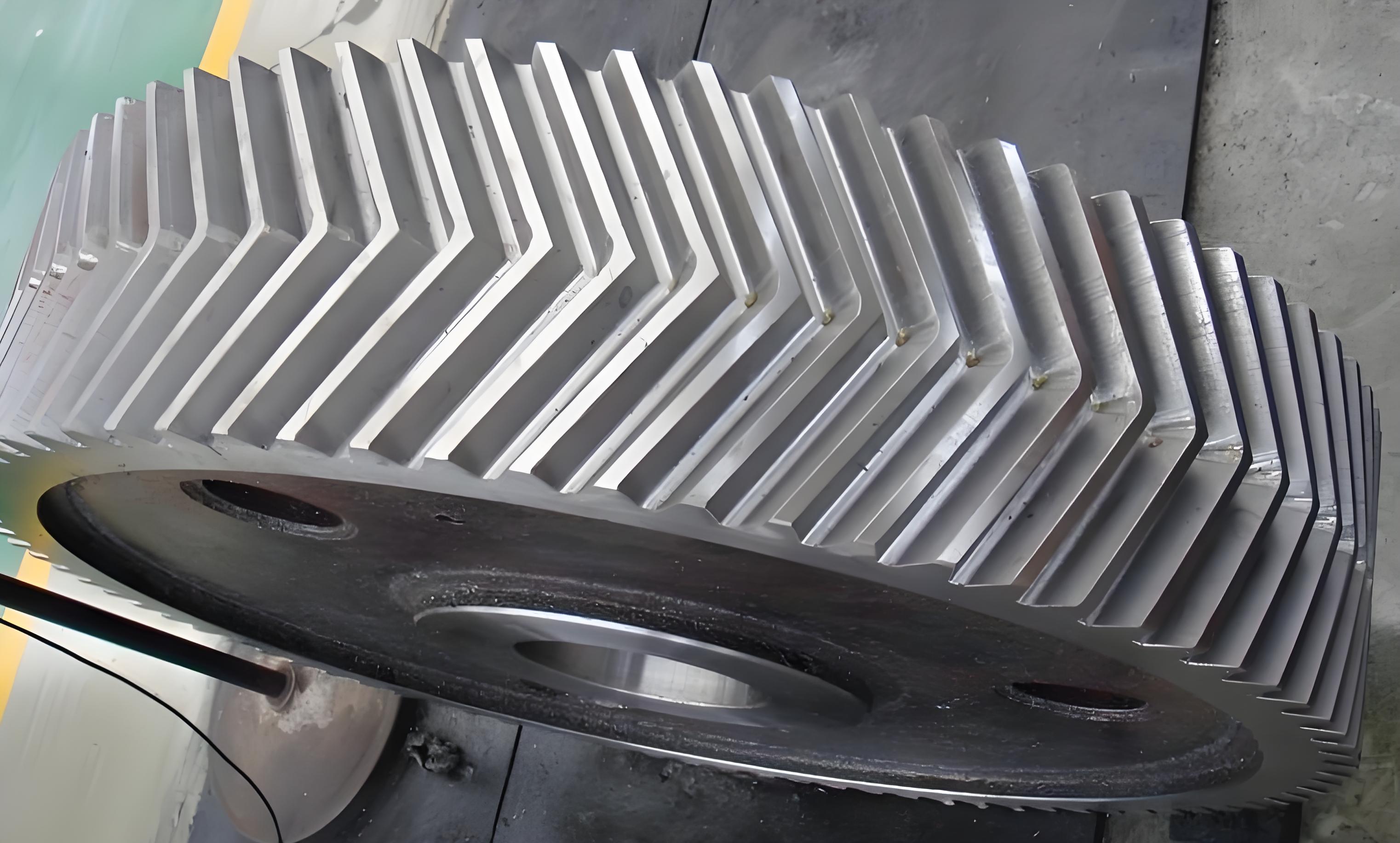
Two-stage herringbone gear transmission systems are primarily utilized in high-torque engines and other gear transmission systems. However, due to inevitable manufacturing and installation errors, harsh operating environments, and other factors, gear cracks, pitting, and other faults may arise, affecting the normal operation of the gear system. Therefore, it is essential to conduct research on two-stage herringbone gear systems with crack-pitting coupling.
Keywords: herringbone gear; crack; pitting; time-varying mesh stiffness; vibration characteristics
1. Introduction
The dynamic vibration characteristics of gear systems have been extensively studied in recent years. Gear failures, such as cracks and pitting, can significantly impact the performance and lifespan of gear transmission systems. In particular, herringbone gears, known for their high load capacity and stability, are prone to such failures under adverse conditions. This study focuses on the vibration characteristics of a two-stage herringbone gear transmission system with crack-pitting coupling.
Table 1: Key Research Areas
| Research Area | Description |
|---|---|
| Crack Formation | The process and causes of crack formation in herringbone gears |
| Pitting Corrosion | The mechanisms and effects of pitting corrosion on gear surfaces |
| Crack-Pitting Coupling | The combined effects of cracks and pitting on gear performance |
| Time-Varying Mesh Stiffness | Changes in mesh stiffness due to cracks and pitting |
| Vibration Characteristics | Analysis of vibration responses in a two-stage herringbone gear system |
2. Literature Review
Many scholars have investigated the impact of gear failures on gear transmission systems. However, gear failures often do not occur in isolation. In particular, under insufficient lubrication and high-speed, heavy-load conditions, herringbone gears are susceptible to pitting, which can lead to insufficient meshing, stress concentration, and eventually cracks. Therefore, herringbone gears in harsh environments often experience crack-pitting coupling.
Table 2: Summary of Previous Studies
| Author | Research Focus | Key Findings |
|---|---|---|
| Wang Cheng et al. | Nonlinear dynamics of herringbone gears | Studied the effects of various excitations on herringbone gear dynamics |
| Cui Shoufan et al. | Dynamics of cracked gear systems | Established a concentrated parameter model for a spur gear transmission system |
| Wang Shengnan et al. | Two-stage parallel-axis spur gear systems | Analyzed the natural characteristics and dynamic loads of the transmission system |
| Liu Jie et al. | Dynamics of gear systems with cracked tooth roots | Investigated vibration responses under different crack depths |
3. Methodology
This study proposes a new method for calculating the time-varying mesh stiffness of herringbone gears with crack-pitting coupling. A 48-degree-of-freedom (DOF) coupling dynamic model for a two-stage herringbone gear transmission system is established, and the vibration characteristics of the system under crack-pitting coupling are analyzed.
Table 3: Model Parameters
| Parameter | Description | Value |
|---|---|---|
| Number of Teeth (Primary Driver) | 25 | |
| Number of Teeth (Primary Driven) | 60 | |
| Number of Teeth (Secondary Driver) | 25 | |
| Number of Teeth (Secondary Driven) | 75 | |
| Module (mm) | 2 | |
| Helix Angle | 15° | |
| Pressure Angle | 20° | |
| Mass (kg) | 2-5 kg (depending on gear) | |
| Support Stiffness (N·m⁻¹) | 1×10⁹ |
3.1 Time-Varying Mesh Stiffness Calculation
The potential energy method is used to calculate the time-varying mesh stiffness of herringbone gears with crack-pitting coupling. This involves establishing analytical models for bending stiffness, shear stiffness, matrix stiffness, Hertzian stiffness, and axial compression stiffness under the coupling effects of different crack depths and pitting influence degrees.
3.2 Dynamic Model Establishment
Using the lumped mass parameter method, a 48-DOF bending-torsion-axis-pendulum coupling dynamic model for the two-stage herringbone gear transmission system is established. This model considers factors such as time-varying mesh stiffness, errors, torsional stiffness, support stiffness, friction force, and undercut parameters.
3.3 Vibration Response Analysis
The stiffness with crack-pitting coupling failure is introduced into the 48-DOF model to obtain the time-domain and frequency-domain responses of the system under different crack-pitting coupling degrees. The variation rules of each parameter on the system’s vibration response are analyzed.
4. Results and Discussion
4.1 Vibration Characteristics of Healthy Gears
The vibration signals of healthy gears in both stages are analyzed in the frequency domain. The frequency domain signals mainly include the meshing frequency (f_m) and its harmonics (2f_m, 3f_m, etc.), with insignificant sidebands.
4.2 Impact of Crack-Pitting Coupling
To facilitate vibration analysis, crack-pitting conditions are defined as follows: mild (10% crack-pitting degree), transitional (30% crack-pitting degree), moderate (50% crack-pitting degree), and severe (70% crack-pitting degree).
With increasing crack-pitting coupling, sidebands near 2f_m become more prominent, indicating increased vibration impact due to severe gear meshing disruptions. The sideband interval (Δf) is 30 Hz, equal to the rotational frequency of the cracked-pitted gear, which can be used to analyze the crack-pitting coupling degree.
4.3 Comparison of Vibration Responses
The maximum vibration displacements of the herringbone gear pairs under the same crack-pitting coupling degrees are compared. The vibration response of the secondary gear pair is significantly stronger than that of the primary gear pair, with equivalently translated as “the same degree of crack-pitting coupling” having a greater impact on the secondary gear pair.
5. Experimental Verification
5.1 Experimental Setup
To conduct vibration tests, large-tooth-width helical gears are procured and cut into smaller-tooth-width herringbone gears. An experimental platform is built to test the vibration signals of the gearbox using acceleration sensors.
5.2 Test Results and Analysis
The vibration signals obtained from the experimental setup are analyzed using Fourier transform to study the effects of crack-pitting on the amplitude fluctuations and frequency components of the transmission system. The test data align with the theoretical trends, validating the proposed dynamic model and analysis method.
6. Conclusion
This study proposes a crack-pitting coupling model for herringbone gears and derives stiffness equations considering crack-pitting coupling and undercut parameter changes. The correctness of the model is proven by substituting the stiffness with crack-pitting coupling failure into a 48-DOF two-stage herringbone gear transmission system and analyzing the system’s vibration responses. The results provide a theoretical basis for fault diagnosis, maintenance, and optimization of two-stage herringbone gear transmission systems.
In summary, this research contributes to the understanding and improvement of two-stage herringbone gear transmission systems, with significant implications for system reliability and performance.