
In the pursuit of high-performance mechanical transmissions, the mitigation of vibration and noise in gear systems remains a critical challenge. As a researcher focused on dynamic analysis and structural optimization, I have long been intrigued by the inherent limitations of traditional methods like tooth profile modification, which often encounter manufacturing bottlenecks. This study proposes a novel, structurally integrated approach to vibration suppression for spur gears—a gear type particularly susceptible to impact due to its lower contact ratio. I introduce a slot hole damping structure integrated directly into the spur gear teeth. This design leverages a combination of a longitudinal slot and a through-hole to introduce controlled flexibility and energy dissipation mechanisms. The core of my investigation involves a comprehensive virtual prototyping campaign using multi-body dynamics software, followed by a rigorous experimental validation. The goal is to understand the parametric influence of this structure and demonstrate its efficacy in reducing meshing-induced vibrations in spur gears.
The fundamental principle behind gear vibration stems from the periodic fluctuation of meshing stiffness and the inevitable presence of backlash. For spur gears, the single line of contact along the face width makes the transmission particularly sensitive to these excitations. While profile modifications aim to smooth the transmission error, they modify the active tooth surface. My approach is different. I aim to modify the tooth’s inherent dynamic response by altering its local stiffness and damping characteristics through material removal in a strategic pattern. This method does not change the active flank geometry and is potentially simpler to implement for certain applications. The proposed slot hole structure is envisioned to serve multiple functions: acting as a mechanical fuse to prevent jamming under negligible or negative backlash conditions, decoupling deformation between adjacent teeth, and relaxing stress concentration at the tooth root. This paper details my journey from concept simulation and parametric optimization to physical testing, presenting a viable path for enhancing the dynamic performance of spur gears.
My design, as conceptualized, features a slot machined longitudinally from the tip towards the root of the spur gear tooth, connected to a through-hole located closer to the tooth center. The schematic cross-section reveals the geometry: a slot of width \(a_1\), a hole of diameter \(a_3\), and the operational gear pair backlash \(a_2\). The interaction of these three parameters—slot width, backlash, and hole diameter—forms the basis of my parametric study. To visualize a typical spur gear pair that could incorporate such features, consider the following representation:
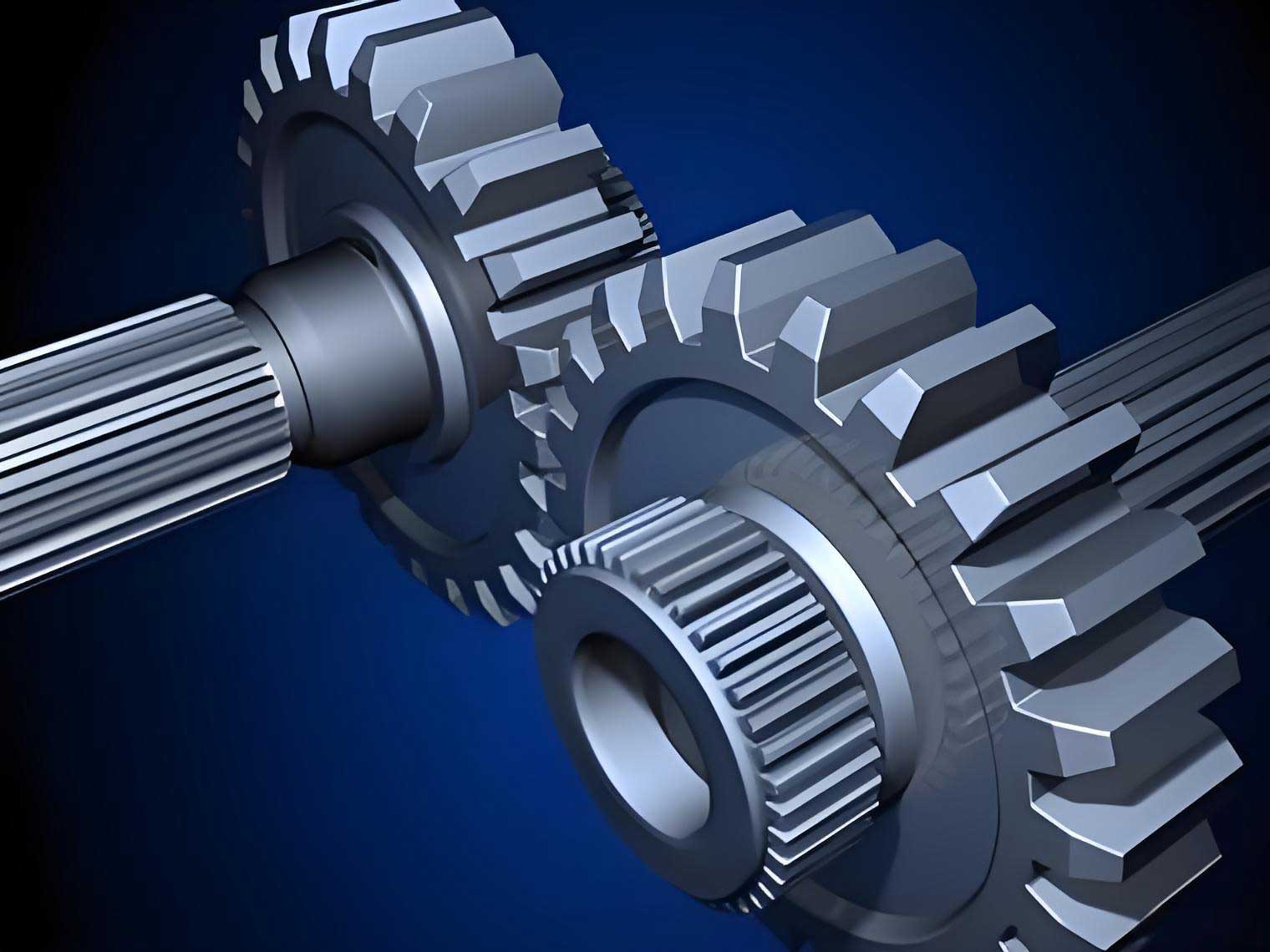
The primary geometric parameters for the spur gear pair used throughout this study are standardized to isolate the effects of the damping structure. The specifications are summarized in Table 1.
| Parameter | Symbol | Pinion (Gear 1) | Gear (Gear 2) |
|---|---|---|---|
| Number of Teeth | \(z\) | 34 | 34 |
| Module | \(m_n\) (mm) | 6 | 6 |
| Pressure Angle | \(\alpha\) (°) | 20 | 20 |
| Addendum Coefficient | \(h_a^*\) | 1 | 1 |
| Dedendum Coefficient | \(c^*\) | 0.25 | 0.25 |
| Profile Shift Coefficient | \(x\) | 0.3945 | 0.3945 |
| Face Width | \(b\) (mm) | 60 | 60 |
| Center Distance | \(a\) (mm) | 208.4 | |
The core of my analytical work relies on dynamic simulation. I employed a commercial multi-body dynamics software, Adams, to model the transient behavior of the spur gear pair. The process began with creating a precise 3D solid model of the spur gears, which was then imported into the simulation environment. The material was defined as 20CrMnTi alloy steel, with standard density and modulus. To accurately capture the tooth contact dynamics, I implemented a nonlinear impact contact force model between the gear teeth. The normal force \(F_n\) is commonly modeled as a combination of a spring and a damper:
$$ F_n = K \delta^e + C \dot{\delta} $$
where \(K\) is the mesh stiffness coefficient, \(\delta\) is the penetration depth between contacting geometries, \(e\) is the force exponent (typically 1.5 for metal contact), \(C\) is the damping coefficient, and \(\dot{\delta}\) is the penetration velocity. The values for \(K\) and \(C\) were derived from established empirical relations for spur gears, ensuring a realistic simulation of the contact impact. The input spur gear was driven by a step function to reach a steady-state speed, while a constant load torque was applied to the output spur gear. After running the dynamic simulation, I extracted the angular acceleration of the output spur gear shaft as the primary vibration response signal. A standard Fast Fourier Transform (FFT) was applied to this time-domain signal to obtain its frequency spectrum, revealing the amplitude at the fundamental meshing frequency \(f_m\) and its harmonics. For a more robust analysis of the vibration energy, I also employed the correlation power spectrum estimation method (Wiener-Khinchin theorem). The power spectral density \(S(\omega)\) was estimated from the autocorrelation function \(r(m)\) of the discrete angular acceleration signal \(u_N(n)\):
$$ r(m) = \frac{1}{N} \sum_{n=0}^{N-1} u_N(n) u_N^*(n-m), \quad |m| \le N-1 $$
$$ S(\omega) = \sum_{m=-M}^{M} r(m) e^{-j\omega m} $$
where \(N\) is the total number of data points, \(M\) is the lag length, and \(\omega\) is the angular frequency. The total power, calculated as the integral of \(S(\omega)\) over frequency, serves as a scalar metric for overall vibration energy. The simulation results for the baseline spur gear pair (without any slot hole structure) under a load of 150 N·m and an input speed of 1470 rpm (154 rad/s) established a reference. The meshing frequency is calculated as:
$$ f_m = \frac{n \cdot z}{60} = \frac{1470 \cdot 34}{60} \approx 833 \text{ Hz} $$
The baseline spur gear pair showed an angular acceleration amplitude of 194 rad/s² at 833 Hz and a total vibration power of \(2.515 \times 10^8 \text{ rad}^2/\text{s}^4\).
To systematically investigate the effect of the slot hole structure, I designed a three-factor, three-level orthogonal experiment. The factors were the slot width \(A\) (\(a_1\)), the operational backlash \(B\) (\(a_2\)), and the damping hole diameter \(C\) (\(a_3\)). The levels were chosen based on practical machining limits and gear design standards, particularly for backlash which included a negative value to simulate a pre-loaded condition made possible by the slot’s flexibility. The factor levels are listed in Table 2.
| Factor | Symbol | Level 1 | Level 2 | Level 3 |
|---|---|---|---|---|
| Slot Width (mm) | A (\(a_1\)) | 0.2 | 0.3 | 0.4 |
| Backlash (mm) | B (\(a_2\)) | 0.20 | 0.07 | -0.03 |
| Hole Diameter (mm) | C (\(a_3\)) | 4 | 6 | 8 |
Using an \(L_9(3^4)\) orthogonal array, I configured nine distinct virtual prototypes of the spur gear pair, each with a different combination of \(A\), \(B\), and \(C\). The specific test matrix is shown in Table 3. For each configuration, I performed the same dynamic simulation procedure and recorded the angular acceleration amplitude at the meshing frequency (\(A_{fm}\)) and the total vibration power (\(P_{total}\)).
| Test Run | Factor A: Slot Width (mm) | Factor B: Backlash (mm) | Factor C: Hole Diameter (mm) | Angular Accel. Amplitude at \(f_m\), \(A_{fm}\) (rad/s²) | Total Vibration Power, \(P_{total}\) (×10⁸ rad²/s⁴) |
|---|---|---|---|---|---|
| 1 | 0.2 | 0.20 | 4 | 201 | 2.683 |
| 2 | 0.2 | 0.07 | 8 | 195 | 2.590 |
| 3 | 0.2 | -0.03 | 6 | 162 | 1.984 |
| 4 | 0.3 | 0.20 | 8 | 224 | 3.247 |
| 5 | 0.3 | 0.07 | 6 | 184 | 2.338 |
| 6 | 0.3 | -0.03 | 4 | 156 | 1.859 |
| 7 | 0.4 | 0.20 | 6 | 211 | 2.921 |
| 8 | 0.4 | 0.07 | 4 | 177 | 2.244 |
| 9 | 0.4 | -0.03 | 8 | 173 | 2.185 |
The results immediately indicated that several configurations, notably runs 3, 5, 6, 8, and 9, produced vibration levels lower than the baseline spur gear. This confirmed the potential of the slot hole structure. To objectively determine the influence ranking of each factor and find the optimal level combination, I conducted a range analysis and an Analysis of Variance (ANOVA) using \(A_{fm}\) as the evaluation index (smaller-is-better). For range analysis, I calculated the mean response \(K_{ij}\) for factor \(i\) at level \(j\). The range \(R_i\) for each factor is the difference between the maximum and minimum \(K_{ij}\). The calculations are summarized in Table 4.
| Factor | Mean Response \(K_{i1}\) (rad/s²) | Mean Response \(K_{i2}\) (rad/s²) | Mean Response \(K_{i3}\) (rad/s²) | Range \(R_i\) (rad/s²) | Rank |
|---|---|---|---|---|---|
| A (Slot Width) | 186.0 | 188.0 | 187.0 | 2.0 | 3 |
| B (Backlash) | 212.0 | 185.3 | 163.7 | 48.3 | 1 |
| C (Hole Diameter) | 178.0 | 185.7 | 197.3 | 19.3 | 2 |
The range analysis clearly showed that backlash (Factor B) has the most profound effect on the vibration of these modified spur gears, followed by hole diameter (Factor C), while slot width (Factor A) has a negligible influence. The trend suggests that reducing backlash—even into a negative domain—significantly suppresses vibration in spur gears equipped with the slot structure. For a smaller-is-better characteristic, the optimal level for each factor is the one with the smallest \(K_{ij}\): \(A_1\) (0.2 mm), \(B_3\) (-0.03 mm), and \(C_1\) (4 mm). To confirm this statistically and quantify each factor’s contribution, I performed an ANOVA. The total sum of squares (\(SS_T\)) is partitioned into sums of squares for each factor (\(SS_A, SS_B, SS_C\)) and error (\(SS_e\)). The mean square (\(MS\)) is \(SS\) divided by degrees of freedom (\(df\)). The F-ratio is calculated as \(MS_{factor} / MS_{error}\). The results are in Table 5.
| Source of Variation | Degrees of Freedom (df) | Sum of Squares (SS) | Mean Square (MS) | F-value | Contribution ρ (%) |
|---|---|---|---|---|---|
| Factor A: Slot Width | 2 | 1.71 × 10⁴ | 8.55 × 10³ | 1.77 | 0.13 |
| Factor B: Backlash | 2 | 1.15 × 10⁷ | 5.75 × 10⁶ | 1189.4 | 85.84 |
| Factor C: Hole Diameter | 2 | 1.87 × 10⁶ | 9.35 × 10⁵ | 193.4 | 13.96 |
| Error | 2 | 9.67 × 10³ | 4.84 × 10³ | – | 0.07 |
| Total | 8 | 1.34 × 10⁷ | – | – | 100.00 |
Comparing the F-values with critical values (e.g., \(F_{0.05}(2,2)=19.0\)), Factor B (Backlash) and Factor C (Hole Diameter) are highly significant, while Factor A (Slot Width) is not significant. The contribution percentages solidify the conclusion: backlash accounts for 85.84% of the variation in vibration response, hole diameter for 13.96%, and slot width for a mere 0.13%. Therefore, the optimal parameter combination for the slot hole damping structure in spur gears is unequivocally \(A_1B_3C_1\): a slot width of 0.2 mm, a negative backlash of -0.03 mm, and a hole diameter of 4 mm.
I then created a detailed simulation model of the spur gear pair with this optimal slot hole configuration. The dynamic simulation under identical operating conditions (1470 rpm, 150 N·m) yielded compelling results. The angular acceleration amplitude at the meshing frequency dropped to 153 rad/s², a reduction of 21.1% compared to the baseline spur gear. Similarly, the total vibration power decreased to \(2.00 \times 10^8 \text{ rad}^2/\text{s}^4\), a reduction of approximately 20.4%. This confirmed the effectiveness of the optimized slot hole structure in damping vibrations for this specific spur gear application.
To move from virtual analysis to physical validation, I designed and conducted an experimental study. Four spur gears were manufactured according to the geometric parameters in Table 1. Their measured base circle tooth thicknesses (implied by measured over-pin or span measurement variations) were controlled to create three specific gear pairs with different nominal backlashes. One of the spur gears (Gear C) was machined with the optimal slot hole structure (0.2 mm slot, 4 mm hole). The pairing resulted in three test configurations: Pair 1 (Gears A & B) with 0.20 mm backlash and no slot, Pair 2 (Gears B & C) with 0.07 mm backlash and one slotted gear, and Pair 3 (Gears C & D) with -0.03 mm backlash and one slotted gear. This setup allowed me to isolate the effect of the slot structure under different backlash conditions. The tests were performed on a back-to-back gear test rig consisting of a driving motor, a test gearbox, a torque-speed sensor, and a magnetic powder brake for loading. Four piezoelectric accelerometers were mounted on the input and output bearing housings in both radial and axial directions to capture the vibration response. Data acquisition was handled by a commercial multi-channel analyzer. The test matrix covered two speeds (780 rpm and 1470 rpm) and three load torques (20, 100, and 150 N·m). The fundamental meshing frequencies for these speeds are \(f_{m,780} \approx 442 \text{ Hz}\) and \(f_{m,1470} \approx 833 \text{ Hz}\). The vibration acceleration amplitudes at these frequencies and their first harmonics from the axial sensors (typically most sensitive to gear mesh forces) were extracted. A summary of the key experimental results is presented in Tables 6 and 7.
| Gear Pair (Backlash) | Load (N·m) | Ch.2 (Input Axial) @ 442 Hz | Ch.2 (Input Axial) @ 884 Hz | Ch.4 (Output Axial) @ 442 Hz | Ch.4 (Output Axial) @ 884 Hz |
|---|---|---|---|---|---|
| Pair 1: A-B (0.20 mm) | 20 | 1.751 | 6.146 | 1.008 | 1.745 |
| 100 | 2.305 | 6.327 | 1.847 | 4.154 | |
| 150 | 3.277 | 4.776 | 0.483 | 4.352 | |
| Pair 2: B-C (0.07 mm) | 20 | 1.208 | 4.601 | 7.721 | 1.804 |
| 100 | 1.877 | 6.970 | 8.861 | 6.859 | |
| 150 | 3.792 | 2.625 | 3.591 | 5.197 | |
| Pair 3: C-D (-0.03 mm) | 20 | 1.159 | 1.272 | 0.816 | 0.165 |
| 100 | 1.821 | 0.358 | 1.316 | 0.202 | |
| 150 | 2.491 | 0.777 | 0.387 | 0.575 |
| Gear Pair (Backlash) | Load (N·m) | Ch.2 (Input Axial) @ 833 Hz | Ch.2 (Input Axial) @ 1666 Hz | Ch.4 (Output Axial) @ 833 Hz | Ch.4 (Output Axial) @ 1666 Hz |
|---|---|---|---|---|---|
| Pair 1: A-B (0.20 mm) | 20 | 1.686 | 2.462 | 2.969 | 2.873 |
| 100 | 0.194 | 1.007 | 0.161 | 4.502 | |
| 150 | 0.254 | 0.874 | 0.256 | 2.442 | |
| Pair 2: B-C (0.07 mm) | 20 | 3.029 | 1.925 | 2.030 | 6.138 |
| 100 | 0.286 | 0.747 | 0.225 | 3.131 | |
| 150 | 0.231 | 0.850 | 0.228 | 5.419 | |
| Pair 3: C-D (-0.03 mm) | 20 | 1.349 | 1.625 | 2.079 | 0.642 |
| 100 | 0.145 | 0.388 | 0.117 | 0.492 | |
| 150 | 0.196 | 0.470 | 0.180 | 0.469 |
The experimental data reveals several important trends consistent with the simulation findings. First, operational speed has a more pronounced effect on the absolute vibration levels of these spur gears than load torque. Second, and most importantly, under comparable conditions, Gear Pair 3 (featuring the optimized slot hole structure and negative backlash) consistently shows lower vibration acceleration amplitudes, especially at the higher harmonic (2× mesh frequency), which is often associated with impact events. Quantitatively, at the lower speed (780 rpm), the fundamental mesh frequency vibration at the input shaft (Ch.2) for Pair 3 is 20.9% to 33.8% lower than that of the baseline Pair 1 across the load range. At the higher speed (1470 rpm) and 150 N·m load—the condition directly comparable to the simulation—the fundamental frequency vibration for the optimal spur gear pair is 22.8% lower at the input and 29.7% lower at the output compared to the baseline. The reduction magnitudes are remarkably close to the 21.1% predicted by the simulation. This strong correlation between simulation and experiment validates the models and the optimization process. The synergy between the slot hole’s flexible constraint and negative backlash is clearly demonstrated to be a powerful mechanism for vibration damping in spur gears.
Through this integrated simulation and experimental study, I have successfully demonstrated a novel structural approach to damping vibrations in spur gears. The key conclusion is that a strategically designed slot hole structure, when combined with a controlled negative backlash enabled by the slot’s flexibility, can significantly reduce meshing-induced vibrations. My orthogonal experiment and subsequent ANOVA quantitatively revealed that for this spur gear application, operational backlash is the overwhelmingly dominant parameter (85.84% contribution), followed by the damping hole diameter (13.96%). The width of the slot itself has a negligible effect. The optimal parameter set identified—0.2 mm slot width, -0.03 mm backlash, and 4 mm hole diameter—reduced the simulated vibration acceleration by over 21% and the experimental vibration by 20-34% across various conditions. This work provides a practical and effective alternative to complex tooth flank modifications for vibration control in spur gears, particularly in applications requiring high precision, minimal noise, and near-zero backlash. Future work could explore the long-term durability and fatigue performance of spur gears with such slot hole structures, as well as extend the concept to helical and bevel gears.