
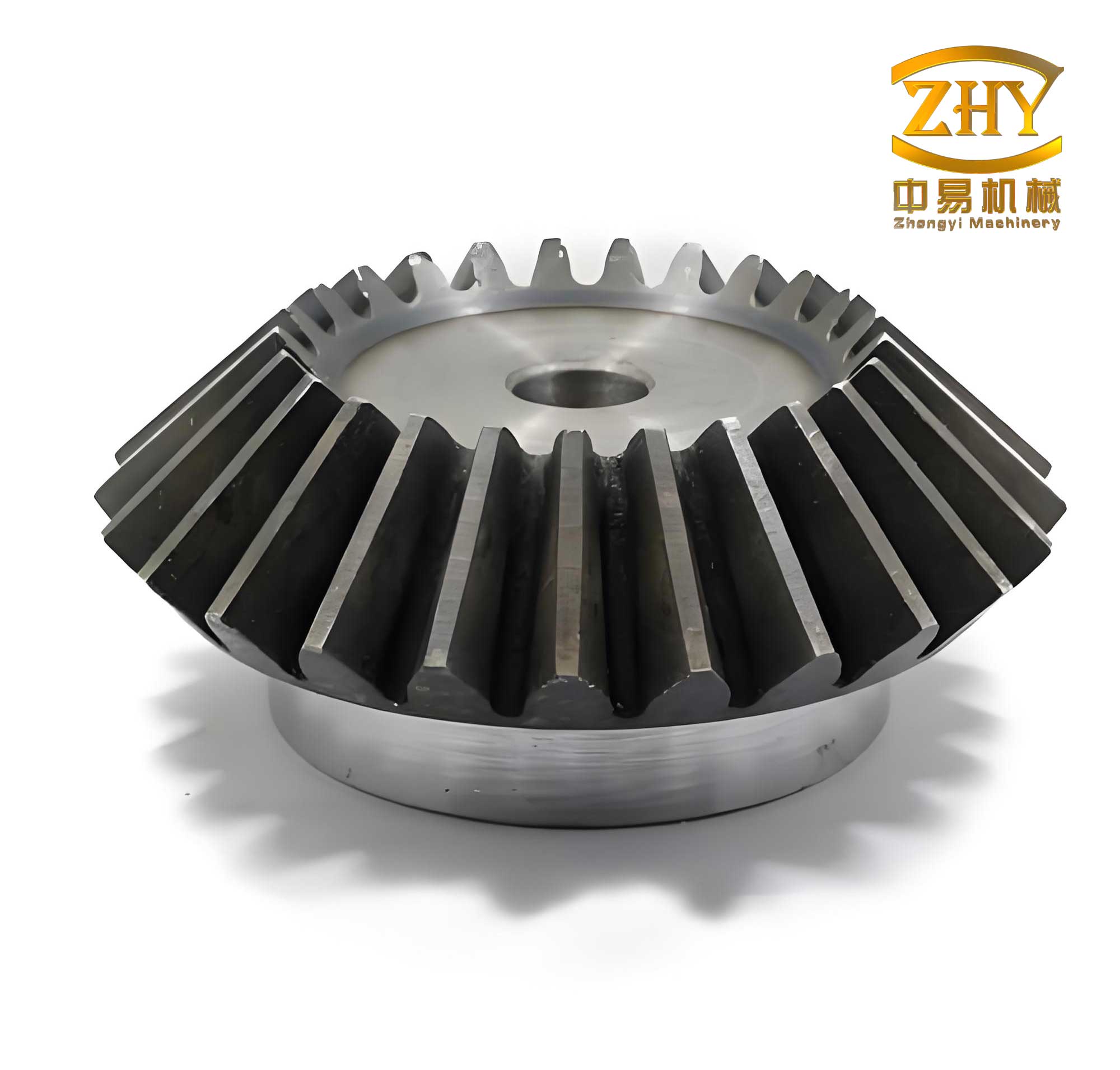
The main reducer is a core component within a helicopter’s powertrain, responsible for the critical task of efficiently transmitting engine power to the main and tail rotors. The bevel gear set within this assembly, essential for redirecting the power flow, is subjected to complex dynamic excitations during operation. The meshing process of the bevel gear pair generates time-varying mesh stiffness fluctuations due to factors such as tooth elastic deformation, manufacturing errors, and uneven load distribution. This periodical stiffness variation acts as a parametric excitation, inducing significant vibrations. Furthermore, internal friction damping forces at interfaces like floating splines and locating surfaces can lead to self-excited instability under certain conditions. This vibrational behavior is highly dynamic, with resonance points that drift according to operational states, making it challenging for traditional fixed-frequency vibration control methods to achieve consistent attenuation. Persistent shafting vibration not only compromises transmission reliability and service life by accelerating wear and structural fatigue but also increases noise levels and poses potential flight safety risks. Therefore, developing effective vibration control strategies for the shafting of helicopter main reduction bevel gear transmissions is of paramount importance.
1. Design of the Shafting Vibration Reduction Control Method
1.1 Acquisition of Self-Excited Instability Frequency for the Shafting System
In the helicopter’s main reduction bevel gear transmission, rotors can experience relative micro-motion at mating interfaces such as splined couplings and locating faces due to initial disturbances or operational loads. This relative sliding generates internal friction forces, which act as damping forces on the shaft system. When these internal friction damping forces reach a critical level, they can induce self-excited instability, a dangerous vibrational phenomenon detrimental to flight stability and safety. Analyzing this behavior begins with calculating the self-excited instability frequency.
Based on tribological principles, the friction force is related to the relative motion state. The internal friction force $$F_q$$ at the floating spline and locating surfaces can be expressed as:
$$ F_q = F(|\dot{\zeta}|) \frac{\dot{\zeta}}{|\dot{\zeta}|} $$
where $$\dot{\zeta}$$ is the relative sliding velocity, and $$F(|\dot{\zeta}|)$$ is the interfacial friction load as a function of the sliding speed’s magnitude.
Applying rotor dynamics principles in a rotating coordinate system and considering inertial, elastic, linear damping, and internal friction forces, the effective damping coefficient $$c$$ can be derived from force balance (Newton’s second law):
$$ c = \frac{m \epsilon \Omega^2 – k\zeta – m\ddot{\zeta} + 2m\Omega \dot{\zeta} – F_q}{\dot{\zeta}} $$
where $$m$$ is the rotor mass, $$\epsilon$$ is the eccentricity, $$k$$ is the rotor stiffness, and $$\Omega$$ is the rotational speed.
For a simplified single-degree-of-freedom linear system under rotational unbalance excitation, the system’s natural frequency is $$\omega_n = \sqrt{k/m}$$. The vibration response amplitude $$A$$ is given by:
$$ A = \frac{\epsilon \Omega^2}{|-\Omega^2 + \omega_n^2 + i c \Omega|} $$
When self-excited vibration occurs due to the internal friction, the perturbation of the shaft center trajectory can be described in complex exponential form, representing both growth and oscillation:
$$ z = A B e^{(\xi + i \omega_n_c) t} $$
Here, $$B$$ is the perturbation amplitude, $$\omega_n_c$$ is a frequency component, and $$\xi$$ is a stability parameter. The system is at the threshold of instability when $$\xi = 0$$.
Under instability conditions where internal damping dominates, the frequency of the self-excited unstable state, $$\omega’$$, can be characterized by:
$$ \omega’ = H_1 \cdot e^{\xi} \cdot z \cdot \omega_n_c $$
where $$H_1$$ is the perturbation response amplitude under typical instability conditions.
1.2 Calculation of Equivalent Dislocation at the Self-Excited Instability Resonance Point
The self-excited instability causes the system’s resonance frequency to drift dynamically. To enable effective control, it is crucial to quantify the instantaneous shift of the resonance point via an “equivalent dislocation” metric. This metric, accounting for axial offset, center distance error, and shaft angle error of the bevel gears, serves as the key input for tuning a torsional vibration damper.
The equivalent dislocation is calculated within the helicopter airframe’s global coordinate system. For a measured point $$P_i(x_i, y_i, z_i)$$ on the bearing housing, the distance $$L$$ from this point to the theoretical gear axis (defined by direction parameters $$p, q$$ and position parameters $$a, b$$) is:
$$ L = \sqrt{ [x_i – (p z_i + a)]^2 + [y_i – (q z_i + b)]^2 } $$
The optimization goal for fitting the minimum circumscribed cylinder to the gear’s profile points, targeting the ideal radius $$r_0$$, is:
$$ J(a, b, p, q, r_0) = \min \left( \omega’ \cdot \sum (L – r_0)^2 \right) $$
The angle between the input and output shafts in the global coordinate system is:
$$ \cos(\theta) = \frac{x_1 x_2 + y_1 y_2 + z_1 z_2}{\sqrt{x_1^2 + y_1^2 + z_1^2} \sqrt{x_2^2 + y_2^2 + z_2^2}} $$
Finally, the equivalent dislocation $$n$$ for the self-excited instability resonance point is calculated as:
$$ n = \frac{L \cdot \cos(\theta) \cdot \omega’}{J(a, b, p, q, r_0)} $$
This calculated equivalent dislocation $$n$$ is used to parameterize a torsional vibration damper installed on the transmission shafting. The damper’s design aims to minimize shaft amplitude. Using the fixed-point theory for damper optimization, the damper’s natural frequency $$\omega_b$$, torsional stiffness $$C_d$$, and damping coefficient $$K$$ are determined:
$$ \omega_b = \frac{\omega_a}{1 + \chi} $$
$$ \begin{cases} K = 2 \zeta_p \omega_b G_d \\ C_d = \omega_b^2 G_d \end{cases} $$
where $$\omega_a$$ is the undamped resonance frequency of the shaft, $$\chi = (\omega’ \cdot G_d)/G_e$$ is the inertia ratio ($$G_d$$ is damper inertia, $$G_e$$ is shafting inertia), and $$\zeta_p$$ is the optimal damping ratio.
The final vibration control outcome, representing the minimized system response, is:
$$ \gamma = \frac{\omega’ \cdot \zeta_p}{n \cdot J(a, b, p, q, r_0) \cdot K \cdot C_d} $$
2. Case Study Analysis
To validate the proposed method’s performance in controlling shaft vibration for helicopter main reduction bevel gear transmissions, it was applied to a specific transmission unit. The primary parameters of the bevel gear set are summarized in the table below.
| Parameter | Pinion (Driving) | Gear (Driven) |
|---|---|---|
| Number of Teeth | 25 | 87 |
| Module | 5.945 mm | 5.945 mm |
| Shaft Angle | 53.15° | 53.15° |
| Pressure Angle | 18° | 18° |
| Spiral Angle | 32° | 32° |
| Face Width | 48.954 mm | 48.954 mm |
Using the described method, the equivalent dislocation quantities for the self-excited instability resonance point were calculated, as shown in the following table.
| Parameter | Result |
|---|---|
| Axial Dislocation (Pinion) | -0.0254 mm |
| Axial Dislocation (Gear) | 0.0316 mm |
| Shaft Angle Error | 0.1024° |
| Center Distance Error | 0.1158 mm |
The results confirm the method’s effectiveness in determining the critical equivalent dislocation parameters. These values were then used to configure the torsional damper for vibration control. The phase portraits of shaft vibration velocity before and after implementing the damper clearly demonstrate the control effect. Prior to damper installation, the phase portrait showed a large, irregular limit cycle, indicating significant unstable vibration. After applying the tuned damper based on the calculated equivalent dislocation, the phase portrait contracted dramatically into a small, tight ellipse near the origin, signifying a substantial reduction in vibration amplitude and the stabilization of the shafting system.
The time-domain vibration signals for the input and output shafts, measured in the horizontal direction, were compared before and after control. The waveforms before control exhibited large-amplitude, periodic oscillations with noticeable harmonic content. After implementing the proposed control method, the vibration amplitudes for both shafts were drastically reduced, with the time-domain signals showing a much smoother and lower-level profile.
Frequency domain analysis further quantified the improvement. The vibration amplitude spectra for both the input and output shafts showed prominent peaks across a wide frequency range before control. After applying the damper tuned with the equivalent dislocation input, these peaks were significantly attenuated across all measured frequencies. The proposed vibration reduction control method for the helicopter main reduction bevel gear transmission shafting demonstrates a pronounced vibration suppression effect, effectively lowering the operational vibration levels of both the driving and driven shafts.
3. Conclusion
Vibration in the shafting system of a helicopter’s main reduction bevel gear transmission critically impacts flight stability, safety, and the longevity of the drivetrain. This research presented a targeted control method that addresses the challenge of self-excited instability induced by internal friction damping in bevel gear pairs. The core innovation lies in calculating the instantaneous equivalent dislocation at the drifting resonance point and using this parameter to optimally tune a torsional vibration damper. Experimental validation on a transmission unit confirmed the method’s efficacy, showing a substantial reduction in shaft vibration amplitude and improved system stability.
However, certain limitations warrant consideration. The accuracy of the equivalent dislocation calculation may be influenced under extreme operating conditions (e.g., very high speed or heavy load) by factors such as material nonlinearity and varying lubrication states, suggesting a need for model refinement. Furthermore, the damper’s response might face challenges in coupling with transient vibrations during sudden, strong impact loads, indicating a potential area for improvement by integrating real-time monitoring and adaptive control algorithms. While validated on a specific transmission configuration, the method’s generality for systems with different layouts (e.g., multi-stage gear trains) or materials (e.g., composite bevel gears) requires further investigation. Future work should focus on high-fidelity multiphysics coupling models to enhance predictive accuracy across diverse operational envelopes and on developing intelligent, adaptive control strategies to bolster system robustness and reliability in all flight regimes.