
In mechanical transmission systems, spur gears play a critical role due to their ability to precisely transmit power and motion. However, these systems are often subjected to high-impact loads, material defects, manufacturing errors, and extreme operating conditions, which can lead to failures such as tooth root cracks, pitting, and fractures. These faults not only reduce transmission accuracy but can also cause system instability, potentially resulting in catastrophic events. The primary excitation source in spur gear systems is stiffness variation, which arises from the alternating engagement of single and double tooth pairs during operation. When a tooth fault, such as a crack, occurs, the time-varying mesh stiffness is affected, leading to abnormal vibrations and impacts. This study focuses on analyzing the dynamic characteristics of spur gear systems with parameter uncertainties and crack faults, employing an interval analysis method based on Chebyshev polynomials to account for bounded uncertainties in parameters like mass, support stiffness, and Young’s modulus.
The time-varying mesh stiffness of spur gears is a key factor influencing system dynamics. For healthy spur gears, the tooth is modeled as a variable-section cantilever beam fixed at the root circle. The tooth profile consists of three parts: the transition curve, the involute curve, and the tip curve. Using the potential energy method, the bending potential energy \( U_b \), axial compression potential energy \( U_a \), and shear potential energy \( U_s \) are calculated as follows:
$$ U_b = \frac{F^2}{2k_b} = \int_{x_A}^{x_F} \frac{[F_b(x_F – x) – F_a h]^2}{2E I_x} dx $$
$$ U_a = \frac{F^2}{2k_a} = \int_{x_A}^{x_F} \frac{F_a^2}{2E A_x} dx $$
$$ U_s = \frac{F^2}{2k_s} = \int_{x_A}^{x_F} \frac{1.2 F_b^2}{2G A_x} dx $$
where \( k_b \), \( k_a \), and \( k_s \) represent the bending, axial compression, and shear stiffnesses, respectively; \( F_a \) and \( F_b \) are the radial and tangential components of the meshing force \( F \); \( E \) and \( G \) are the Young’s modulus and shear modulus; \( I_x \) and \( A_x \) are the moment of inertia and cross-sectional area at a distance \( x \) from point O. The transition curve and involute curve equations are derived based on gear geometry, and the Hertzian contact stiffness \( k_h \) and fillet foundation stiffness \( k_f \) are incorporated to compute the total mesh stiffness for single and double tooth engagement.
For cracked spur gears, a root crack with depth \( q \) and angle \( v \) is considered. The crack reduces the effective sectional moment of inertia and area, affecting the bending and shear stiffness. Depending on the crack depth relative to the tooth height, three cases are analyzed to compute the modified \( I_x \) and \( A_x \). The axial compression, Hertzian contact, and fillet foundation stiffnesses remain unchanged. The time-varying mesh stiffness for cracked spur gears is then determined by integrating these modifications into the potential energy equations.
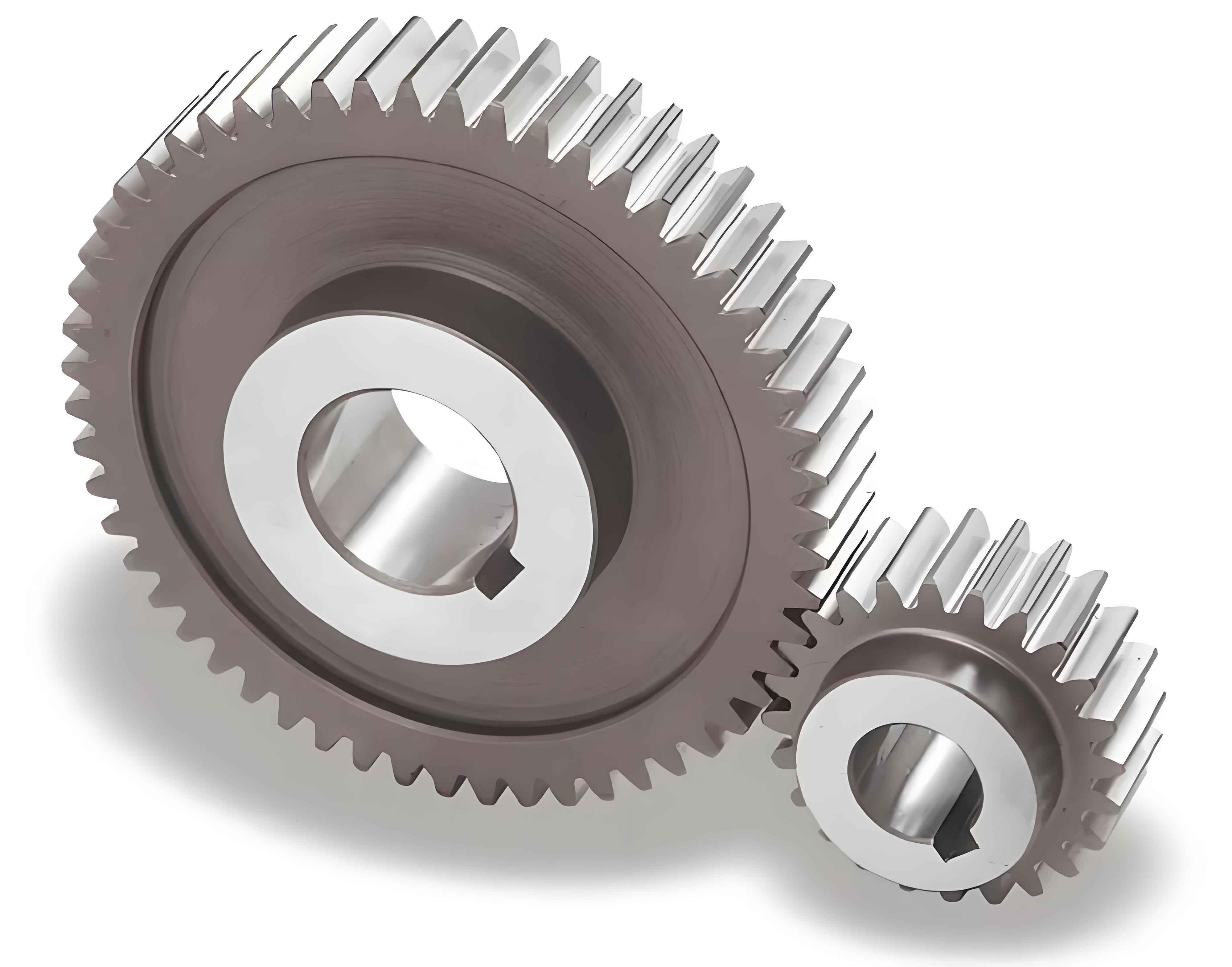
The dynamic behavior of spur gear systems is modeled using a 6-degree-of-freedom lumped-parameter approach. The system includes translational and rotational motions for both the driving and driven spur gears, with bearing support represented by springs and dampers. The equations of motion are expressed as:
$$ m_1 \ddot{x}_1 + c_{1x} \dot{x}_1 + k_{1x} x_1 + F_t \sin\alpha_0 = 0 $$
$$ m_1 \ddot{y}_1 + c_{1y} \dot{y}_1 + k_{1y} y_1 + F_t \cos\alpha_0 = 0 $$
$$ I_1 \ddot{\theta}_1 + F_t R_{b1} = T_1 $$
$$ m_2 \ddot{x}_2 + c_{2x} \dot{x}_2 + k_{2x} x_2 – F_t \sin\alpha_0 = 0 $$
$$ m_2 \ddot{y}_2 + c_{2y} \dot{y}_2 + k_{2y} y_2 – F_t \cos\alpha_0 = 0 $$
$$ I_2 \ddot{\theta}_2 – F_t R_{b2} = -T_2 $$
Here, \( m_1 \), \( m_2 \), \( I_1 \), and \( I_2 \) are the masses and moments of inertia; \( k_{1x} \), \( k_{1y} \), \( k_{2x} \), \( k_{2y} \) are the bearing support stiffnesses; \( c_{1x} \), \( c_{1y} \), \( c_{2x} \), \( c_{2y} \) are the damping coefficients; \( F_t \) is the meshing force given by \( F_t = c_t \dot{\delta} + k_t \delta \), where \( \delta \) is the transmission error and \( c_t \) is the time-varying mesh damping.
Parameter uncertainties in spur gear systems are inherent and can arise from material properties, manufacturing tolerances, and operational conditions. These uncertainties are modeled as interval variables, defined as:
$$ \chi^I = [\underline{\chi}, \overline{\chi}] = [\chi^c – \beta \chi^c, \chi^c + \beta \chi^c] $$
where \( \chi^I \) is the interval parameter, \( \underline{\chi} \) and \( \overline{\chi} \) are the lower and upper bounds, \( \chi^c \) is the midpoint, and \( \beta \) is the uncertainty coefficient. The dynamic equation of the uncertain spur gear system is:
$$ \mathbf{M}(\chi^I) \ddot{\mathbf{z}} + \mathbf{C}(\chi^I) \dot{\mathbf{z}} + \mathbf{K}(\chi^I) \mathbf{z} = \mathbf{F}(\chi^I) $$
To analyze this, a Chebyshev polynomial-based interval method is employed. For a one-dimensional uncertainty, the Chebyshev polynomial \( A_k(x) \) is defined as \( A_k(x) = \cos[k \arccos(x)] \) for \( x \in [-1, 1] \), with recurrence relations:
$$ A_0(x) = 1 $$
$$ A_1(x) = x $$
$$ A_k(x) = 2x A_{k-1}(x) – A_{k-2}(x) \quad \text{for} \quad k = 2, 3, \ldots $$
Any function \( f(x) \) can be approximated by a k-th order Chebyshev series:
$$ f(x) \approx g_k(x) = \frac{f_0}{2} + \sum_{i=1}^k f_i A_i(x) $$
where the coefficients \( f_i \) are computed using Gauss-Chebyshev quadrature. For multi-dimensional uncertainties, tensor products of one-dimensional polynomials are used. This approach allows efficient computation of the response bounds for uncertain spur gear systems by evaluating deterministic responses at interpolation points.
The impact of parameter uncertainties on the vibration response of spur gear systems is investigated through numerical simulations. Key parameters, such as gear mass, bearing support stiffness, and Young’s modulus, are treated as interval variables. The vertical displacement \( y_2 \) of the driven spur gear is analyzed under different uncertainty levels. For instance, with a 5% uncertainty in mass, the amplitude-frequency response shows an envelope form, where the deterministic response lies within the uncertainty bounds. As the uncertainty coefficient increases to 10%, the response interval widens, particularly near resonance regions, leading to phenomena such as frequency shift and resonance bands. This indicates that mass uncertainty alters the natural frequencies of spur gear systems, reducing stability.
Similarly, uncertainties in support stiffness and Young’s modulus affect the dynamic response. Support stiffness uncertainty causes resonance bands to appear at frequencies lower than the deterministic resonance, while Young’s modulus uncertainty primarily influences the resonance peak without significant frequency shift. The table below summarizes the effects of different uncertain parameters on the amplitude-frequency response of healthy spur gear systems:
| Uncertain Parameter | Effect on Response | Phenomena Observed |
|---|---|---|
| Mass | Broadened resonance peaks | Frequency shift, resonance bands |
| Support Stiffness | Shifted resonance to lower frequencies | Resonance bands, amplitude enlargement |
| Young’s Modulus | Increased resonance amplitude | Minimal frequency shift |
When tooth root cracks are introduced in spur gears, the time-varying mesh stiffness decreases with increasing crack depth. For example, with a crack angle of 45° and depths of 1.5 mm, 2.5 mm, and 3.5 mm, the stiffness reduction becomes more pronounced as the crack propagates. Under parameter uncertainties, the vibration response of cracked spur gear systems is amplified, with the lower bound of the uncertain response often exceeding the upper bound of the healthy system’s response. This exacerbates dynamic impacts during each rotation, compromising the reliability and safety of spur gear systems.
Multi-source uncertainties, where multiple parameters vary simultaneously, result in complex response envelopes that are not mere linear combinations of individual effects. The amplitude-frequency response under combined uncertainties exhibits characteristics from all contributing parameters, including frequency shifts and resonance bands. For cracked spur gears, multi-source uncertainties lead to even larger response intervals, highlighting the importance of comprehensive uncertainty analysis in the design and maintenance of spur gear systems.
In conclusion, the integration of Chebyshev interval analysis with dynamic modeling provides a robust framework for evaluating the vibration response of spur gear systems with parameter uncertainties and crack faults. The results demonstrate that uncertainties in mass, support stiffness, and Young’s modulus significantly influence the dynamic behavior, causing resonance broadening and frequency shifts. Crack faults further amplify these effects, emphasizing the need for uncertainty-aware design strategies to enhance the stability and durability of spur gears in practical applications.