
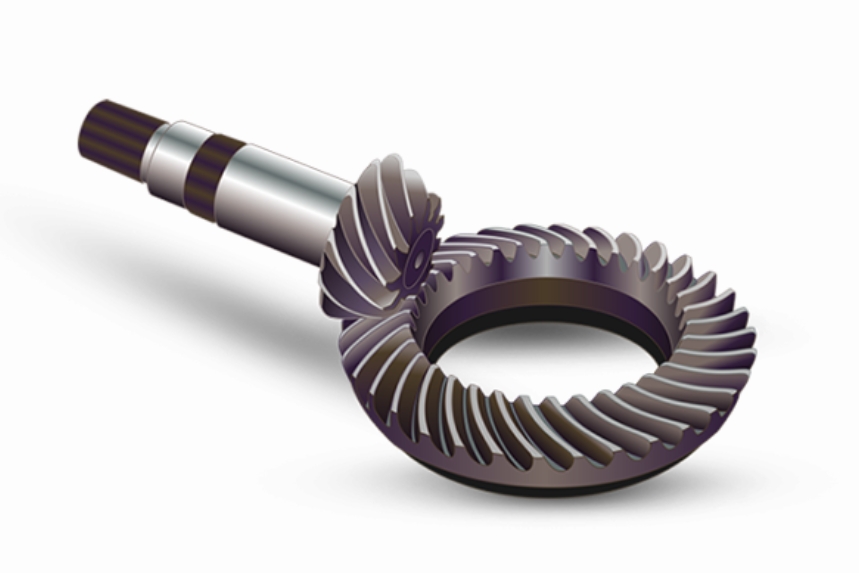
In modern mechanical transmission systems, spiral bevel gears play a critical role due to their ability to transmit power between non-parallel shafts with high efficiency and load capacity. However, the complex geometry and dynamic behavior of spiral bevel gears often lead to significant vibration and noise issues, which can compromise system stability and reliability. Traditional inspection methods, such as manual noise assessment on rolling testers, are largely subjective and prone to environmental interference. This highlights the need for a digitalized approach to vibration signal analysis for spiral bevel gears. In this article, I will delve into the vibration signal generation mechanisms of spiral bevel gears and present a comprehensive design for a digital testing system based on hybrid programming. The goal is to provide a robust framework for real-time monitoring and analysis, enhancing the quality control processes in gear manufacturing.
The vibration in spiral bevel gears arises from a combination of design imperfections, manufacturing errors, and operational dynamics. During meshing, factors like variations in the number of contacting tooth pairs, changes in contact positions, and fluctuations in instantaneous transmission ratios cause periodic impacts that excite vibrations. Additionally, external influences such as insufficient support stiffness, rotor unbalance, and load variations contribute to the overall vibration spectrum. The signal from spiral bevel gears can be modeled as an ergodic stationary random process, allowing statistical properties to be derived from time-averaged samples. In an ideal scenario, the vibration and noise signals are dominated by the meshing frequency and its harmonics, expressed as:
$$x(t) = \sum_{m=1}^{M} A_m \cos(2\pi f t + \phi_m)$$
where \(A_m\) represents the harmonic amplitude, \(\phi_m\) is the phase, \(f\) is the meshing frequency, \(m\) is a natural number (1, 2, 3, …, M), and M denotes the maximum harmonic order. The meshing frequency is given by:
$$f = \frac{m n Z}{60}$$
with \(n\) as the rotational speed in rpm and \(Z\) as the number of teeth. In practical conditions, modulations due to load, stiffness, and speed variations introduce amplitude and frequency modulations, leading to a more complex signal:
$$x(t) = \sum_{m=1}^{M} A_m [1 + a_m(t)] \cos[2\pi f t + \phi_m + b_m(t)]$$
Here, \(a_m(t)\) and \(b_m(t)\) are the amplitude and phase modulation functions, respectively. During testing on rolling checkers, the vibration signal of spiral bevel gears comprises several frequency components, as summarized in the table below.
| Frequency Component | Description | Typical Source |
|---|---|---|
| Meshing Fundamental Frequency | Primary frequency from gear tooth engagement | Gear geometry and rotation |
| Meshing Harmonics | Integer multiples of the meshing frequency | Non-linear dynamics |
| Sidebands | Modulation around meshing frequencies | Amplitude/frequency modulations from shaft rotations |
| Other Influences | Noise from bearings, environmental factors | External system components |
To analyze these components effectively, a digital testing system must capture and process vibration signals with high fidelity. The hardware platform is built around a virtual instrument (VI) concept, integrating sensors, signal conditioning, and data acquisition cards. For spiral bevel gears, I selected a piezoelectric accelerometer due to its high sensitivity and broad frequency range. The sensor outputs weak signals, often in the millivolt range, which require amplification and filtering. A charge amplifier with adjustable gain and low-pass filtering capabilities serves as the signal conditioner, converting the raw signal into a standardized form. To prevent aliasing, an analog anti-aliasing filter is incorporated before digitization. The data acquisition is handled by a PCI2000 card from Beijing Art Technology, featuring a 12-bit ADC with a 100 kHz sampling rate, 16 differential input channels, and programmable gains. The interface circuit uses a double-ended input configuration to suppress common-mode noise, as shown in the design where each input channel includes a 200 kΩ pull-down resistor to ground for bias stabilization.
The software architecture employs a hybrid programming approach, leveraging the strengths of Visual C++ (VC++) and MATLAB. VC++ is used for real-time data acquisition and user interface development, while MATLAB handles advanced signal processing tasks. This combination enhances efficiency and flexibility, particularly for spiral bevel gear applications where rapid analysis is crucial. In VC++, a multi-document interface (MDI) application was created using MFC AppWizard, enabling data acquisition through query-based or interrupt-driven methods. The program links to the PCI2000 driver via included libraries and header files, facilitating seamless hardware communication. For signal processing, MATLAB scripts are modularized into functions for time-domain filtering and frequency-domain analysis. The time-domain module implements IIR digital filters with options for low-pass, high-pass, band-pass, and band-stop configurations, using designs like Butterworth, Chebyshev I, Chebyshev II, and elliptic filters. The frequency-domain module performs Fast Fourier Transform (FFT) and power spectrum analysis. The FFT is computed using a radix-2 decimation-in-time algorithm:
$$Y(k) = \sum_{n=0}^{N-1} x(n) e^{-j 2\pi k n / N}$$
where \(x(n)\) is the discrete input signal, \(N\) is the FFT length, and \(Y(k)\) represents the transformed output. Power spectrum analysis involves calculating the auto-power spectrum \(P_{xx}\) and cross-power spectrum \(P_{xy}\):
$$P_{xx}(f) = \frac{1}{N} \left| \sum_{n=0}^{N-1} x(n) e^{-j 2\pi f n} \right|^2$$
$$P_{xy}(f) = \frac{1}{N} \left( \sum_{n=0}^{N-1} x(n) e^{-j 2\pi f n} \right) \left( \sum_{n=0}^{N-1} y(n) e^{-j 2\pi f n} \right)^*$$
These functions are integrated into a dialog-based MATLAB application, with data exchange between VC++ and MATLAB achieved through COM components. The MATLAB COM Builder compiles M-files into DLLs, which are then imported into VC++ for parameter passing and graphical display. This hybrid setup ensures robust performance for spiral bevel gear vibration analysis.
To validate the system, experiments were conducted on a pair of hypoid spiral bevel gears with a tooth ratio of 7:37, tested on a rolling checker at low speed (710 rpm). A sound level meter was positioned 300 mm above the meshing point, while the piezoelectric sensor was attached 100 mm from the meshing point on the large gear shaft. The data acquisition card was configured with a ±5 V range, unity gain, and a sampling frequency of 2560 Hz, using a Hanning window and anti-aliasing filters. The vibration signals were normalized for clarity. The measured sound level was 75 dB(A), and the time-domain and auto-power spectrum plots revealed distinct meshing frequencies and modulations. For instance, the time-domain signal showed periodic impulses corresponding to gear engagements, while the power spectrum highlighted peaks at the meshing frequency and its harmonics. The system’s accuracy was verified by comparing results with a Tektronix TDS3000 digital phosphor oscilloscope, confirming its effectiveness for spiral bevel gear applications.
The digital testing system offers several advantages for spiral bevel gears. By automating vibration signal capture and analysis, it reduces reliance on subjective noise assessments and minimizes environmental interference. The hybrid programming approach optimizes computational speed and signal processing capabilities, making it suitable for real-time monitoring in industrial settings. Furthermore, the modular design allows for easy customization, such as adding new filter types or analysis algorithms tailored to specific spiral bevel gear configurations. However, potential errors must be addressed, including systematic errors from sensor calibration and random errors from measurement variability. Calibration procedures and statistical averaging techniques can mitigate these issues, enhancing system reliability.
In conclusion, the vibration signal analysis and digital testing system for spiral bevel gears presented here provides a comprehensive solution for dynamic performance evaluation. By integrating hardware and software components through hybrid programming, it enables precise, real-time monitoring of vibration characteristics, facilitating improved quality control and predictive maintenance. Future work could focus on expanding the system to include machine learning algorithms for fault diagnosis or integrating wireless sensors for remote monitoring of spiral bevel gears in harsh environments. This advancement underscores the importance of digitalization in gear manufacturing, paving the way for smarter, more efficient transmission systems.