
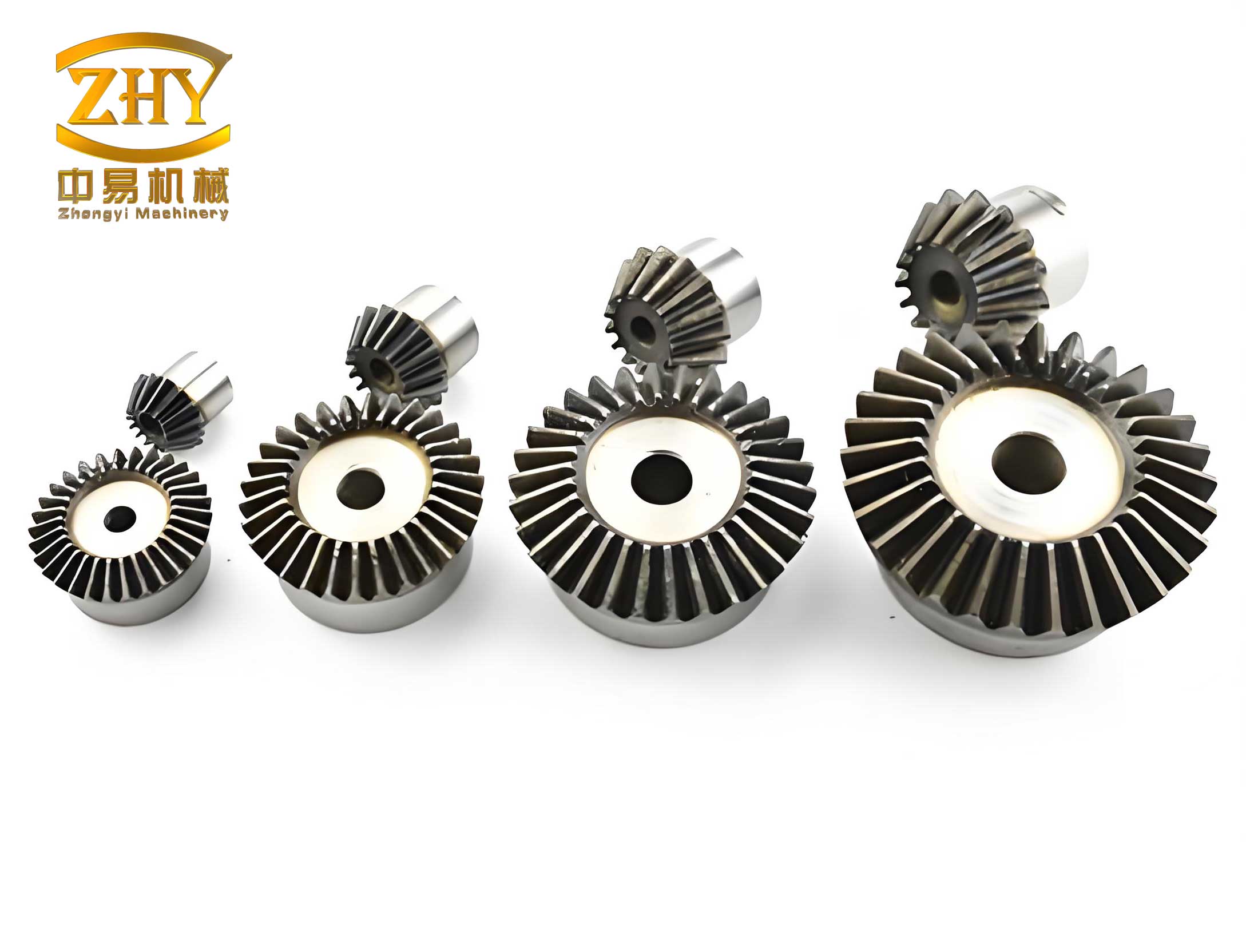
The pursuit of higher power density in modern aero-engines necessitates the use of high-speed, lightweight transmission components. Among these, spiral bevel gears are critical for transmitting power between non-parallel shafts. However, lightweight design inherently increases gear flexibility, lowers natural frequencies, and introduces more resonance risks within the operational speed range. For bevel gears, it is particularly challenging to tune all diameter-mode vibrations below the fourth order outside the working range. Passive vibration control methods are therefore essential. Damping rings, known for their simplicity, effectiveness, and reliability, offer a proven solution for mitigating vibration and noise in rotating structures like bevel gears. This article presents a first-person account of a complete methodology for designing, analyzing, and experimentally validating damping rings for an aero-engine spiral bevel gear system, with the specific aim of reducing resonant amplitudes.
1. Modal Analysis and Resonance Identification
Damping rings are primarily effective against resonant vibrations occurring in diameter modes. Therefore, accurate identification of these modes and prediction of their corresponding critical speeds are fundamental prerequisites for any damping ring design. The decision to employ a damping ring is twofold: first, a dangerous resonance must fall within the operational envelope; second, the vibration amplitude at this resonance must be unacceptably high, warranting suppression.
1.1 Contact Modal Analysis
Since spiral bevel gears operate in constant mesh, a free-free modal analysis is insufficient. A contact modal analysis that accounts for the gear mesh interface is essential. The study object is an aero-engine gearbox test rig comprising a spiral bevel gear pair, two shafts, and four bearings. For the finite element model, detailed 3D solid models of the gear pair and pinion shaft are created. The support stiffness from the housing and bearings is applied at the bearing locations via stiffness matrices. The primary design parameters of the gear pair are summarized in Table 1.
| Parameter | Pinion (Driven) | Gear (Driver) |
|---|---|---|
| Number of Teeth | 43 | 47 |
| Module (mm) | 3.75 | 3.75 |
| Mean Spiral Angle (°) | 35 | 35 |
| Normal Pressure Angle (°) | 20 | 20 |
| Shaft Angle (°) | 78.3 | 78.3 |
| Hand of Spiral | Right Hand | Left Hand |
The extracted natural frequencies for the lower-order diameter modes are listed in Table 2. The corresponding mode shapes reveal that due to the strong coupling through mesh, diameter modes often appear as coupled vibrations. For instance, a 3-nodal-diameter (3D) mode on the pinion may couple with a local deformation on the gear. Within the operating range, the pinion’s diameter modes are often the dominant response. However, one specific mode was identified as a 3D mode on the gear coupled with a 4D mode on the pinion, indicating that resonance related to the gear must also be considered.
| Mode Shape (Nodal Diameters) | Frequency (Hz) |
|---|---|
| 2D | 2617.3, 2754.8 |
| 3D | 5190.4, 5715.4, 6553.9, 7934.8 |
| 4D | 9083.9, 11346 |
1.2 Critical Speed Prediction
Predicting the exact rotational speed at which resonance occurs requires consideration of the traveling wave phenomenon in rotating bevel gears. Resonance happens when the gear mesh excitation frequency equals the frequency of a forward or backward traveling wave. The excitation frequency from the gear mesh is given by:
$$ f_e = \frac{n}{60} z_1 $$
where \( n \) is the rotational speed in rpm, and \( z_1 \) is the number of teeth on the driving gear. The frequency of the traveling wave for a mode with \( m \) nodal diameters is:
$$ f_{f,d} = f_d \mp m \frac{n}{60} $$
where \( f_d \) is the natural frequency from modal analysis (fixed in the stationary frame), and \( f_f \) and \( f_d \) represent forward and backward wave frequencies, respectively. Setting \( f_e = f_{f,d} \) and solving for the critical speed \( n \) yields:
$$ n = \frac{60 f_d}{z_1 / z_2 (z_2 \mp m)} $$
where \( z_2 \) is the number of teeth on the driven gear (pinion). The minus sign corresponds to forward wave resonance, and the plus sign to backward wave resonance. Using the natural frequencies from Table 2, the predicted critical speeds for both the pinion and gear are calculated and summarized in Table 3.
| Mode Freq (Hz) | Pinion Critical Speed, n (rpm) (Backward, Forward) |
Gear Critical Speed, n (rpm) (Backward, Forward) |
Primary Associated Mode |
|---|---|---|---|
| 6553.9 | 7821, 8994 | – | Pinion 3D |
| 7934.8 | 9469, 10889 | – | Pinion 3D |
| 9083.9 | 10610, 12786 | 10901, 12387 | Gear 3D + Pinion 4D (Coupled) |
| 11346 | 13252, 15970 | – | Pinion 4D |
1.3 Test Correlation and Dangerous Mode Identification
Vibration sweep tests were conducted on the gearbox test rig under torque loads of 80 N·m and 120 N·m, measuring acceleration on the pinion housing. The vibration response without a damping ring revealed several distinct resonance peaks. The measured critical speeds showed good consistency between the two load cases, confirming their origin in the system’s intrinsic dynamics. A comparison between the test results and theoretical predictions is shown in Table 4.
| Torque (N·m) | Experimental Critical Speed (rpm) | Theoretical Critical Speed (rpm) | Corresponding Predicted Mode | Relative Error (%) |
|---|---|---|---|---|
| 80 | 8640 | 8994 | Pinion 3D (Forward) | 4.10 |
| 120 | 8604 | 8994 | Pinion 3D (Forward) | 4.53 |
| 80 / 120 | 12200 | 12786 / 12387 | Pinion 4D (Fwd) / Gear 3D (Fwd)* | ~4.80 / ~1.53 |
| 80 | 14680 / 14690 | 15970 | Pinion 4D (Forward) | ~8.75 |
| 120 | 14680 / 14880 | 15970 | Pinion 4D (Forward) | ~8.79 / ~7.33 |
*The 12200 rpm resonance is likely a superposition or interaction of the two closely spaced predicted resonances from the coupled mode.
The correlation confirms that the resonances at approximately 8600 rpm and 14700 rpm are primarily linked to the pinion’s 3D and 4D forward traveling wave modes, respectively. The resonance near 12200 rpm involves the coupled Gear-3D/Pinion-4D mode. Since the gear lacks the physical space for a damping ring and all significant resonances involve the pinion’s diameter modes, the subsequent damping ring design is focused on the pinion.
2. Damping Ring Design and Vibration Reduction Analysis
Based on the available design space and strength margins on the pinion shaft, a C-shaped open-ended damping ring with a rectangular cross-section was designed for installation at the pinion’s small end.
2.1 Damping Ring Geometry
The key dimensional parameters of the damping ring and its mating groove on the pinion shaft are as follows: width K = 4.4 mm, thickness L = 3.6 mm, fillet radius R = 0.7 mm, chamfer M = 0.9 mm, shaft shoulder diameter = 109.6 mm, groove diameter = 114.2 mm, and ring gap = 3 mm.
The modal displacement at the damping groove location and the neutral axis radius of the shaft are critical inputs for the subsequent energy dissipation analysis. These values, extracted from the finite element modal analysis for the targeted pinion modes, are presented in Table 5.
| Target Pinion Mode | Radial Modal Displacement, B_fe_ra (mm) | Axial Modal Displacement, B_fe_ax (mm) | Shaft Neutral Axis Radius, R_0 (mm) |
|---|---|---|---|
| 3 Nodal Diameters (3D) | 15.24 | 26.23 | 60 |
| 4 Nodal Diameters (4D) | 22.05 | 29.79 | 60 |
2.2 Vibration Reduction Mechanism and Performance Assessment
The fundamental principle of a damping ring is energy dissipation via dry friction. During resonance, the vibrating gear induces relative motion between the ring and the groove. The resulting friction force converts a portion of the system’s vibrational kinetic energy into heat. The effectiveness of the damping ring is quantified by the energy dissipated per cycle.
A key metric is the amplification factor, or Q-factor, which relates the energy stored in the system to the energy dissipated per radian:
$$ Q = \frac{2\pi E_s}{E_d} = \frac{1}{2 \pi \xi} = \frac{\pi}{\delta} $$
where \( E_s \) is the maximum stored energy (from mesh and centrifugal forces), \( E_d \) is the energy dissipated per cycle, \( \xi \) is the damping ratio, and \( \delta \) is the logarithmic decrement. A lower Q-factor indicates higher damping and better vibration suppression.
The analysis proceeds by relating the system’s vibration amplitude to the frictional work done by the ring. Assuming a known or target axial vibration displacement \( d_{ax} \) at resonance, the corresponding radial displacement \( d_{ra} \) is scaled from the modal displacements:
$$ d_{ra} = d_{ax} \frac{B_{fe\_ra}}{B_{fe\_ax}} $$
The centrifugal contact force \( F_c \) pressing the ring against the groove is:
$$ F_c = \rho A R_c \omega^2 $$
where \( \rho \) is the ring material density, \( A \) is its cross-sectional area, \( R_c \) is the radius to the ring’s centroid, and \( \omega \) is the angular velocity in rad/s.
The initial radial displacement \( B_{i\_ra} \) required to overcome static friction and initiate macro-slip is derived from ring elasticity and contact mechanics:
$$ B_{i\_ra} = \frac{\mu F_c R_g^3}{n A E} \cdot \frac{1}{\left[ \left( \frac{c_0}{c} \right) \left( \frac{R_g}{R_0} \right)^2 + 1 \right] (n^2 – 1)} $$
where \( \mu \) is the coefficient of friction, \( R_g \) is the groove bottom radius, \( c = R_g – R_c \), \( c_0 = R_0 – R_g \), \( E \) is the Young’s modulus, and \( n \) is a form factor for the ring cross-section.
For a given vibration displacement level \( B_{i\_ra}(j) \), the instantaneous contact pressure \( P_P(j) \) and the angle \( \theta(j) \) defining the slip region can be calculated:
$$ P_P(j) = \frac{B_{i\_ra}(j) n A E}{\mu R_g^3} \left[ \frac{c_0}{c} \left( \frac{R_g}{R_0} \right)^2 + 1 \right] (n^2 – 1) $$
$$ \theta(j) = \arcsin\left( \frac{F_c}{P_P(j)} \right) $$
The energy dissipated per cycle \( D_{ra}(j) \) in radial motion is then a function of this geometry and pressure. Similarly, the energy dissipated \( D_{ax}(j) \) for axial motion can be modeled. The corresponding Q-factors for radial (\( Q_{RA} \)) and axial (\( Q_{AX} \)) motion are:
$$ Q_{RA}(j) = \frac{2\pi f K_e(j)}{D_{ra}(j)} , \quad Q_{AX}(j) = \operatorname{real}\left[ \frac{2\pi K_e}{D_{ax}(j)} \right] $$
where \( K_e \) is the equivalent kinetic energy of the mode, proportional to the square of the vibration displacement. Plotting \( Q \) against vibration displacement for the pinion’s 3D and 4D modes reveals the damping performance. Assuming initial resonant axial displacements of 0.035 mm (3D) and 0.03 mm (4D) without a ring, the analysis shows a dramatic reduction with the designed ring installed.
| Pinion Mode | Initial Axial Q / Displacement (No Ring) | Final Axial Q / Displacement (With Ring) | Reduction in Q-factor | Reduction in Axial Displacement |
|---|---|---|---|---|
| 3 Nodal Diameters | 690 / 0.035 mm | 107.7 / 0.0032 mm | 84.4% | 90.9% |
| 4 Nodal Diameters | 436 / 0.030 mm | 83.5 / 0.0032 mm | 80.8% | 89.3% |
The analysis indicates a substantial increase in system damping and a corresponding drop in vibration amplitude. The relationship between displacement \( x \) and acceleration \( a \) at a frequency \( \omega \) is \( a = \omega^2 x \). Therefore, the percentage reduction in vibration acceleration amplitude \( \eta_a \) is equivalent to the percentage reduction in vibration displacement amplitude \( \eta_x \):
$$ \eta_a = \frac{a_1 – a_2}{a_1} = \frac{\omega^2 x_1 – \omega^2 x_2}{\omega^2 x_1} = \frac{x_1 – x_2}{x_1} = \eta_x $$
This allows the theoretically predicted displacement reduction to be compared with experimentally measured acceleration reductions on the housing.
3. Experimental Validation and Results
The same vibration sweep tests were performed with the designed damping ring installed on the pinion. The results were then compared with the baseline tests (without the ring). The presence of the damping ring caused slight shifts in the measured critical speeds (up to ~3.75%), which is expected as it adds mass and stiffness. More importantly, the vibration amplitude at the key resonances was significantly attenuated. The comparative test data is summarized in Table 7.
| Torque (N·m) | Critical Speed Region (rpm) | Vibration Amplitude Without Ring (g) | Vibration Amplitude With Ring (g) | Amplitude Reduction | Notes |
|---|---|---|---|---|---|
| 80 | ~8640 | 96.34 | 121.9 | -26.5% (Increase) | 3D mode; minimal/low effect. |
| 120 | ~8604 | 116.7 | 112.0 | 4.0% | 3D mode; minimal effect. |
| 80 | ~12200 | 84.81 | 37.91 | 55.3% | Coupled 3D-4D mode; strong effect. |
| 120 | ~12200 | 90.88 | 41.67 | 54.2% | |
| 80 | ~14680 | 62.95 | 67.05 | -6.5% (Increase) | 4D mode; effect load-dependent. |
| 120 | ~14880 | 99.87 | 52.64 | 47.3% |
The experimental findings lead to several key conclusions: (1) The damping ring provides superior vibration reduction under higher torque loads. (2) Its effect is most pronounced and consistent for the coupled Gear-3D/Pinion-4D mode resonance near 12200 rpm, with reductions exceeding 54%. (3) The effect on the pure pinion 3D mode (~8600 rpm) was negligible or slightly negative in one case. (4) For the pinion 4D mode (~14700 rpm), significant reduction (47.3%) was achieved only under the higher 120 N·m load.
While the theoretical analysis predicted displacement reductions over 85%, the experimental acceleration reductions on the housing peaked around 55%. This discrepancy is rational. The theoretical model estimates dissipation at the ring-groove interface, while the test measures response at the housing, which is influenced by complex force transmission paths. Furthermore, practical factors like system unbalance, manufacturing tolerances, and non-ideal friction conditions can reduce optimal performance. Nevertheless, the strong correlation in trend and the substantial amplitude reductions validate the overall design and analysis methodology. The damping ring successfully mitigated critical resonances, particularly the most problematic one, achieving the primary goal.
4. Conclusion
This work has detailed a systematic, first-principles approach to damping ring design for vibration control in aero-engine spiral bevel gears. The process integrates contact modal analysis for accurate resonance identification, physics-based design of the ring geometry, analytical assessment of frictional energy dissipation, and rigorous experimental validation. For the specific case study, the designed damping ring achieved a substantial reduction (up to 55%) in the resonant vibration amplitude of the most critical diameter-mode, particularly under high operational load. The methodology bridges theoretical modeling and practical engineering application, providing a valuable and validated reference framework for tackling vibration challenges in high-performance spiral bevel gear transmissions. Future work could focus on direct measurement of vibration displacement at the damping groove to further refine the correlation between analytical predictions and experimental outcomes.