
The manufacturing and analysis of spiral bevel gears represent a significant area of research and development within mechanical engineering. These components are critical for power transmission in applications requiring efficient torque transfer between non-parallel, intersecting axes, such as in automotive differentials, aerospace systems, and heavy machinery. The complexity of their geometry, characterized by curved tooth flanks and varying cross-sections, poses substantial challenges for design, manufacturing, and quality control. Achieving high precision in the tooth surface is paramount for ensuring low noise, high efficiency, and long service life. This work details a comprehensive methodology for the fully automated virtual machining of spiral bevel gears within a commercial CAD environment and establishes a robust framework for assessing the geometric accuracy of the simulated tooth surfaces against a theoretical datum.
Traditional approaches to creating digital models of spiral bevel gears often involve direct mathematical surface reconstruction. These methods require deriving complex theoretical coordinate points or explicit mathematical equations for the tooth flank, a process that can be intricate and may not fully encapsulate the kinematics and potential error states of the physical machining process. Alternatively, some methods simulate the cutting trace (swarf marks) and then fit a surface to these traces, reconstructing a single tooth which is then patterned. While effective, this reconstructed-surface approach might not seamlessly capture continuous error information across the entire gear or the nuanced interaction between the tool and blank throughout a complete machining cycle. The methodology presented herein builds upon the foundation of virtual manufacturing simulation but advances it by automating the complete gear generation process in a single, integrated workflow. This approach directly yields a solid model of the entire gear, including both the active tooth flanks and the fillet (transition) surfaces, as a direct outcome of simulating the material removal process. The significance of this method is multifold: it not only generates high-fidelity three-dimensional models but also provides a versatile platform. This platform can be used to simulate the impact of various machine tool errors (e.g., setup misalignments, static/dynamic deflections, thermal distortions) on the final tooth geometry, study the root cause of errors like base pitch deviation, and facilitate finite element analysis of gears with simulated or compensated error surfaces.
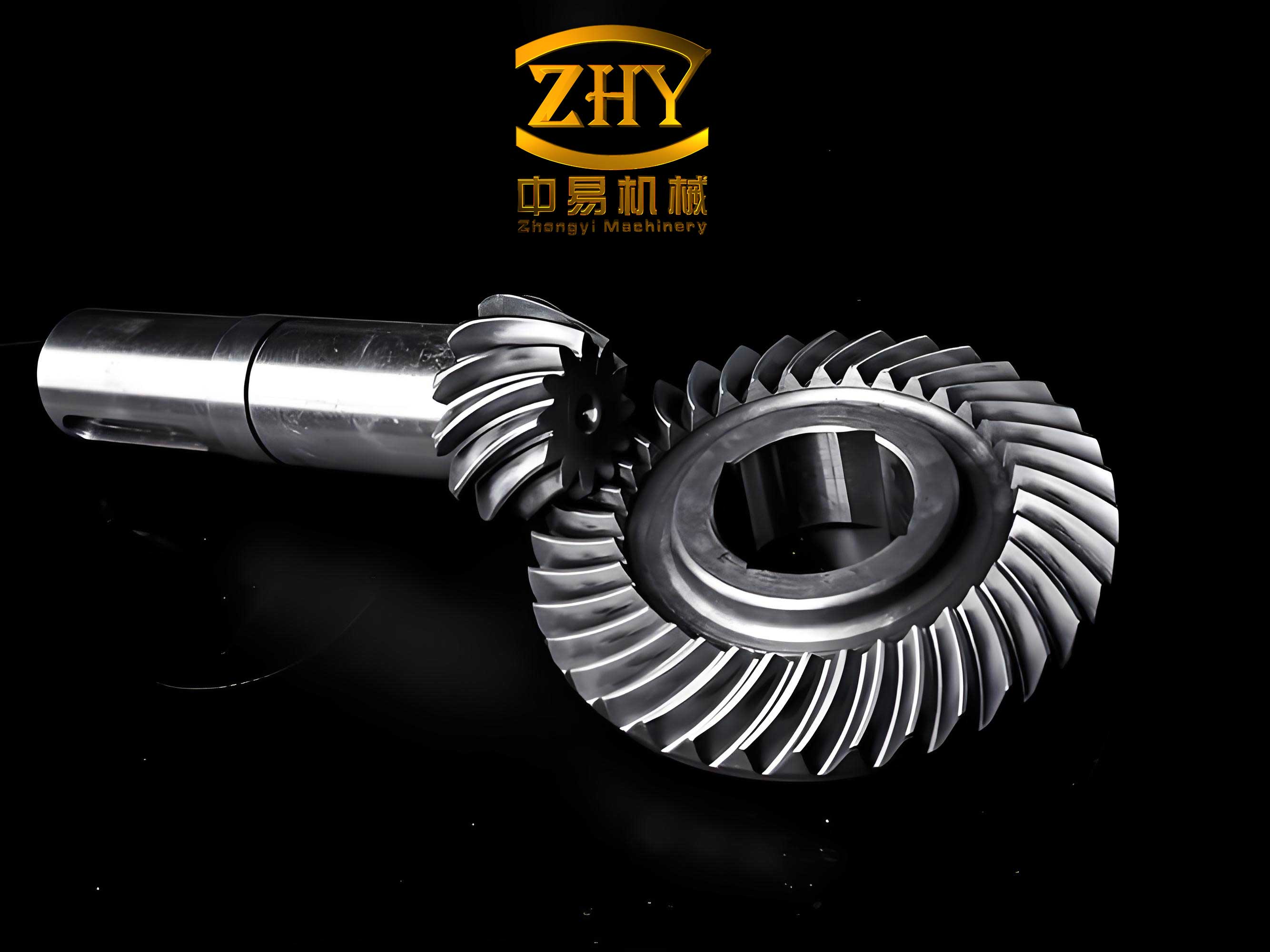
The core principle of machining simulation for spiral bevel gears is based on simulating the relative motion between a cutting tool (cutter head) and a gear blank, governed by the kinematic chain of a specific machine tool configuration. The process emulates the action of a hypothetical generating gear, often referred to as the “cradle” or “imaginary crown gear.” The cutting blades mounted on the cutter head represent a tooth of this imaginary gear. As the workpiece (gear blank) and the imaginary gear rotate about their respective axes with a precisely defined ratio (the rolling ratio), the envelope of successive positions of the cutting tool surfaces generates the desired tooth slot on the workpiece. Therefore, the tooth surface of a spiral bevel gear is essentially the envelope surface formed by the family of surfaces representing the cutting tool in its prescribed motion relative to the blank. The mathematical foundation for generating such an envelope surface is described by the equation of meshing. For a cutter surface defined by parameters $(u, \theta)$ in its own coordinate system $S_c$, its family of surfaces in the workpiece coordinate system $S_w$, generated by the machine kinematics parameterized by $\phi$, is given by:
$$ \mathbf{r}_w(u, \theta, \phi) = \mathbf{M}_{wc}(\phi) \cdot \mathbf{r}_c(u, \theta) $$
where $\mathbf{M}_{wc}(\phi)$ is the coordinate transformation matrix from the cutter system $S_c$ to the workpiece system $S_w$, which is a function of the motion parameter $\phi$ (often the rotation angle of the cradle or workpiece). The equation of meshing defines the necessary contact condition between the tool and the generated surface:
$$ f(u, \theta, \phi) = \mathbf{n}_c \cdot \mathbf{v}_c^{(cw)} = 0 $$
Here, $\mathbf{n}_c$ is the unit normal to the cutter surface, and $\mathbf{v}_c^{(cw)}$ is the relative velocity vector of the cutter with respect to the workpiece, expressed in the cutter coordinate system. The generated tooth surface is the set of points satisfying both the surface family equation and the equation of meshing.
The virtual machining process for spiral bevel gears, specifically focusing on face-hobbed or face-milled types, follows a structured sequence. First, the basic geometric parameters of the gear pair are used to calculate the precise dimensions of the gear blank and the cutting tool (cutter head diameter, blade profiles, pressure angles, etc.). These calculations are based on established gear design methodologies. Subsequently, the initial positional relationship and the kinematic relationship between the blank and the tool are derived according to the specific machine tool settings. These settings, often called “machine adjustments,” control the simulated machine’s axes. For a spiral bevel gear generated on a simulated hypoid generator, the key adjustments include:
| Machine Adjustment Parameter | Symbol | Description |
|---|---|---|
| Radial Setting | $S_R$ | Distance from the machine center to the cutter axis. |
| Angular Setting (Tilt) | $q$ | Inclination angle of the cutter axis relative to the plane of the imaginary gear. |
| Sliding Base Setting | $X_B$ | Feed motion along the cradle axis to control tooth depth. |
| Machine Root Angle | $\Sigma_m$ | Angle between the workpiece axis and the cradle axis. |
| Horizontal Work Offset | $X_P$ | Offset of the workpiece along its axis. |
| Vertical Work Offset | $E$ | Offset of the workpiece perpendicular to its axis (related to hypoid offset). |
| Ratio of Roll | $R_{roll}$ | Velocity ratio between cradle rotation and workpiece rotation. |
Within the CAD software, the blank and cutter models are created based on the calculated dimensions. The initial position is set by applying the positional adjustments ($S_R$, $q$, $X_P$, $E$, $\Sigma_m$). The machining simulation is then automated through programming (e.g., using VBA). The core algorithm involves discretizing the generating motion. The cradle rotation (or equivalent motion parameter $\phi$) is divided into small increments $\Delta \phi$. For each increment, the cutter is repositioned relative to the stationary blank according to the kinematic transformation $\mathbf{M}_{wc}(\phi_i)$, and a Boolean subtraction operation is performed. The union of all material removed during these discrete steps approximates the envelope surface—the tooth slot. The transition surface (fillet) is naturally generated as the tool tip sweeps past the blank root. After one tooth slot is completed, the workpiece is indexed by $360^\circ / Z$ (where $Z$ is the number of teeth), and the process repeats until all teeth are machined. This fully automated loop yields a complete, solid model of the spiral bevel gear.
The practical application of this method is demonstrated using a sample spiral bevel gear pair. The basic design parameters for the gear pair are as follows:
| Parameter | Gear (Pinion) | Pinion (Gear) | Units |
|---|---|---|---|
| Number of Teeth | 43 | 11 | – |
| Module (Transverse) | 4.650 | 4.650 | mm |
| Face Width | 31.00 | 35.85 | mm |
| Shaft Angle | 90 | deg | |
| Offset | 30 | mm | |
| Hand of Spiral | Right | Left | – |
For this example, the gear (larger wheel) is simulated using a continuous indexing (Generating) method with a single cutter head cutting both convex and concave sides simultaneously. The pinion is simulated using a modified-roll (Formate) or similar non-generating method, which requires separate cuts for the convex and concave flanks using an inner and outer blade group. The derived machine adjustment parameters for positioning the cutter relative to the blank in the simulation environment are summarized below. Note these are transformed values assuming a stationary blank.
| Workpiece & Method | Radial $S_R$ (mm) | Angular $q$ (deg) | Sliding $X_B$ (mm) | Root Angle $\Sigma_m$ (deg) | Horiz. Offset $X_P$ (mm) | Vert. Offset $E$ (mm) | Roll Ratio $R_{roll}$ |
|---|---|---|---|---|---|---|---|
| Gear (Generating) | 75.254 | 51.375 | -4.624 | 65.867 | 3.703 | 5.186 | -0.99747 |
| Pinion Concave (Formate) | 76.257 | -74.217 | -0.633 | 18.650 | 1.537 | 24.584 | -4.02346 |
| Pinion Convex (Formate) | 74.250 | -71.500 | -1.029 | 18.650 | 2.776 | 24.601 | -3.75331 |
Executing the programmed simulation with these parameters results in a solid model of the spiral bevel gears. The model inherently contains the active tooth surfaces and the root fillets generated by the tool tip trajectory.
Assessing the geometric accuracy of the virtually machined spiral bevel gears is crucial for validating the simulation fidelity. The benchmark for comparison is a set of theoretical tooth flank points calculated using a proven numerical method, such as the Tooth Contact Analysis (TCA) algorithm commonly employed in spiral bevel gear design software (e.g., Gleason’s G-AGE or similar). For a given tooth flank (e.g., the concave side of the pinion), the TCA software calculates the coordinates of points on the ideal, theoretically perfect surface based on the same machine settings and basic gear geometry. A grid of points is typically defined across the tooth flank, for instance, 9 points along the profile (from toe to heel) and 5 points along the face (from tip to root), resulting in 45 evaluation points.
The validation procedure within the CAD environment involves several steps. First, the cloud of 45 theoretical points is imported. This point cloud is then aligned with the simulated gear model by making their coordinate systems coincident, specifically aligning the gear axes. The point cloud can be rotated as a rigid body about this common axis. The alignment is refined by rotating the point cloud until its central point (or a best-fit centroid) lies precisely on the simulated tooth surface, minimizing the overall deviation. Finally, the normal distance from each of the 45 theoretical points to the simulated CAD surface is measured. The set of these distances represents the surface error map. The maximum absolute value of these normal deviations is a key indicator of simulation accuracy. For the pinion concave flank in our case study, after optimal alignment, the maximum observed normal error was on the order of 0.1 micrometers ($\mu m$), demonstrating extremely high congruence between the simulated and theoretical spiral bevel gear surfaces.
A critical factor influencing the accuracy and feasibility of the simulation is the discretization step size, $\Delta \phi$, used in the generating motion. This step size determines the angular increment by which the cutter is rotated (or the cradle is indexed) between consecutive Boolean operations. A smaller step size results in a denser pattern of “swarf marks” and a closer approximation to the true continuous envelope, generally leading to higher accuracy. However, there is a practical limit. Excessively small steps can cause consecutive tool positions to overlap significantly within the CAD kernel’s precision, leading to geometric interference errors during Boolean operations. These erroneous steps must be detected and omitted from the simulation, potentially creating gaps in the generated surface if too many are skipped. Therefore, an optimal step size must be found that balances high accuracy with robust, uninterrupted simulation.
The impact of step size on surface quality and maximum error for the spiral bevel gear pair is illustrated in the table below. The error is measured as the maximum normal deviation from the TCA theoretical points after alignment.
| Workpiece | Step Size $\Delta \phi$ (deg) | Max. Normal Error ($\mu m$) | Notes |
|---|---|---|---|
| Gear | 1.000 | 0.700 | Baseline, coarser surface. |
| 0.500 | 0.576 | ~17.7% improvement. | |
| 0.250 | 0.413 | ~28.3% improvement from 0.5° step. Selected as optimal. | |
| Pinion (Concave) | 0.500 | 1.779 | Baseline. |
| 0.250 | 0.884 | ~50.3% improvement. | |
| 0.125 | ~0.107 | ~81.1% improvement. High accuracy achieved. Selected as optimal. |
The data shows that the pinion simulation achieves higher ultimate accuracy than the gear simulation for comparable step reductions. This discrepancy is attributed to the different machining methods simulated. The gear was cut using a generating process with a dual-sided cutter head performing simultaneous Boolean operations on both flanks. This increases the likelihood of internal geometric interference within the CAD kernel as steps become very small, forcing the omission of more steps and introducing localized errors. The pinion, being cut with a single-flank (Formate) method for each surface, presents a simpler Boolean scenario, allowing for finer discretization with fewer conflicts. This underscores the importance of tailoring the simulation parameters to the specific machining process of the spiral bevel gear.
In conclusion, this work presents a robust and automated methodology for the virtual machining of complete spiral bevel gears within a standard CAD environment. By directly simulating the material removal process based on the kinematic principles of gear generation machines, it produces high-fidelity solid models that include both the active tooth flanks and the transition fillet surfaces. The integration of a precision assessment protocol, using theoretical TCA points as a benchmark, allows for quantitative verification of the simulation’s geometric accuracy, which in this study reached sub-micron levels. This integrated virtual platform holds significant value beyond mere model creation. It enables the systematic study of manufacturing error propagation by simulating various machine tool inaccuracies (setup errors, structural deflections, thermal effects) and observing their direct impact on the tooth surface geometry of spiral bevel gears. Furthermore, it provides a reliable source of geometrically accurate models—both nominal and error-affected—for subsequent finite element analysis to study contact patterns, transmission error, and stress distributions. Future work will focus on extending the simulation to explicitly model dynamic error sources in machine tool axes, developing automated compensation algorithms to correct simulated errors, and further optimizing the discretization algorithms to improve computational efficiency for complex spiral bevel gear designs.