
In the field of mechanical engineering, the optimization of gear systems, particularly helical gears, is crucial for enhancing transmission efficiency, reducing weight, and minimizing material costs. Traditional design methods often rely on empirical formulas and simplified assumptions, which may lead to suboptimal solutions. As a researcher focused on mechanical transmission dynamics, I have investigated the volume optimization of helical gears, emphasizing accurate modeling techniques. This article presents a comprehensive study on volume modeling for helical gears, addressing gaps in existing literature, such as neglecting clearance volumes, lacking verification of derived formulas, and oversimplifying gear structures. The goal is to develop a robust framework for minimizing the total volume of helical gear systems while meeting design constraints, using advanced optimization algorithms and precise mathematical formulations.
Helical gears are widely used in various applications due to their smooth operation and high load capacity. However, their complex geometry poses challenges in volume calculation, especially when considering factors like tip clearance and gear modification. In this work, I propose a detailed modeling approach that accounts for these factors and derives volume formulas for different gear structures. The derived formulas are validated using 3D modeling software, and optimization is performed using genetic algorithms in MATLAB. The results demonstrate significant volume reduction, highlighting the importance of accurate modeling in helical gear design.
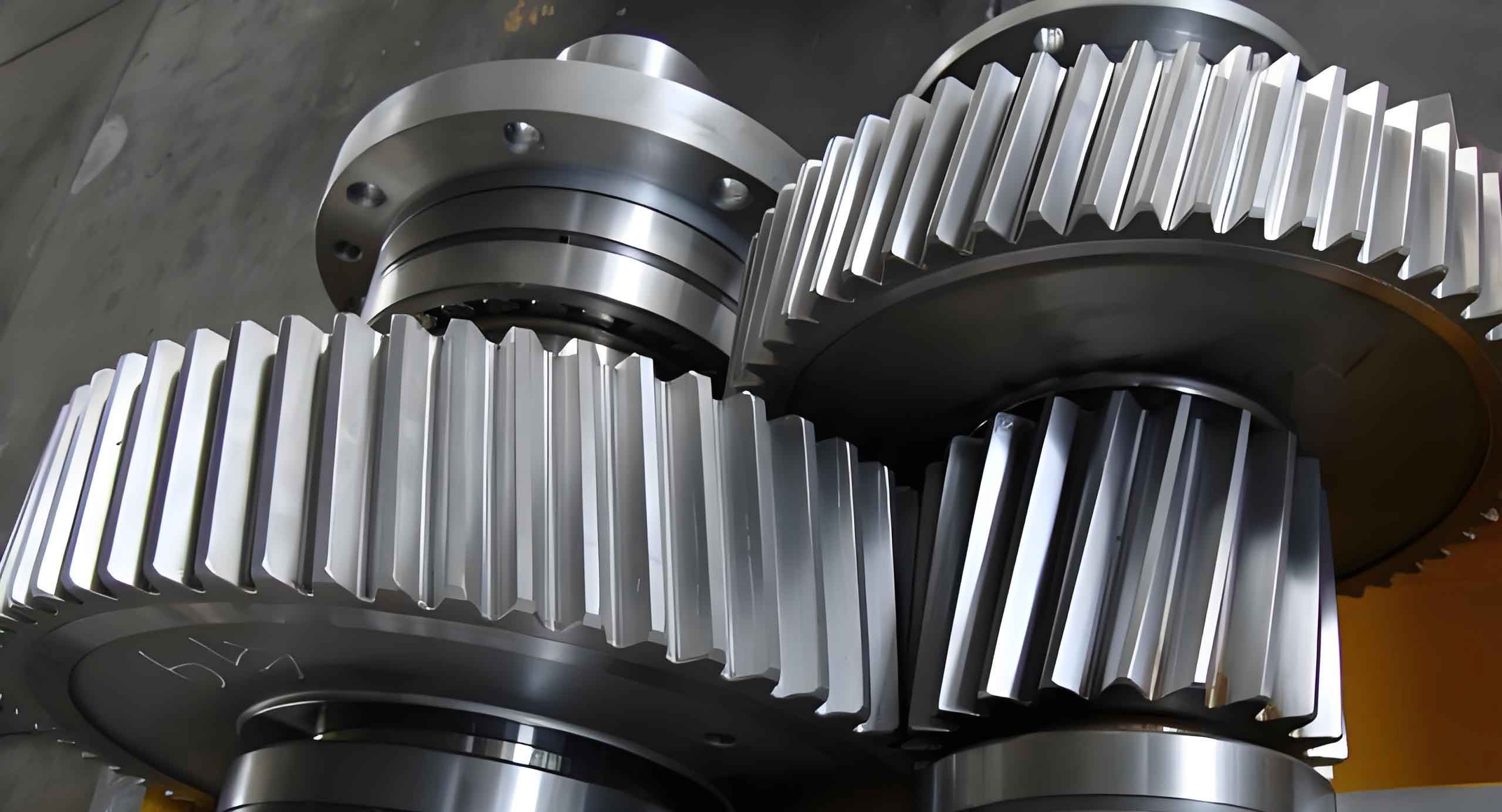
The optimization of helical gears often targets minimizing volume or mass to improve efficiency and reduce costs. Previous studies have focused on optimization algorithms, such as genetic algorithms and particle swarm optimization, but have paid less attention to the accuracy of volume modeling. For helical gears, volume calculation typically involves simplifying the gear tooth geometry, which can introduce errors. My research addresses this by incorporating the effects of tip clearance and gear modification into the volume formulas. Additionally, I consider different gear structures—solid, web-type, and spoke-type—based on gear diameter, as the structure affects volume and must be adaptively modeled during optimization.
Influence of Tip Clearance and Gear Modification on Helical Gear Volume
When calculating the volume of helical gears, a common simplification is to treat the gear as a cylinder with a diameter equal to the pitch diameter, assuming the tooth volume above the pitch circle fills the space below it. However, this ignores the tip clearance (or top land) and the effects of gear modification, such as profile shifting. In helical gears, the tip clearance is necessary to prevent interference and ensure proper lubrication, while modification coefficients adjust tooth geometry for performance improvements. Neglecting these factors can lead to inaccuracies, especially in precision applications or when helical gears have significant modification.
To address this, I derived a formula for the clearance volume, which arises from the gap between the tip of one gear tooth and the root of another due to tip clearance and modification. For helical gears, the tooth trace is a helix, but for volume approximation, the clearance volume can be modeled as a rectangular prism along the tooth direction. The key parameters include the tooth thickness at the tip circle, the clearance height, and the tooth length. The formula is as follows:
$$ V” = s_a \cdot h \cdot l \cdot z $$
where \( V” \) is the total clearance volume for the gear, \( s_a \) is the tooth thickness at the tip circle, \( h \) is the clearance height, \( l \) is the tooth length along the helix, and \( z \) is the number of teeth. For helical gears, these parameters depend on geometric factors such as the normal module \( m_n \), helix angle \( \beta \), normal pressure angle \( \alpha_n \), and modification coefficients \( x_n \). Specifically:
- The tooth thickness at the tip circle \( s_a \) is given by:
$$ s_a = s \frac{r_a}{r} – 2r_a (\text{inv} \alpha_{at} – \text{inv} \alpha_t) $$
where \( s \) is the circular pitch, \( r_a \) is the tip radius, \( r \) is the pitch radius, \( \alpha_{at} \) is the pressure angle at the tip circle, and \( \alpha_t \) is the transverse pressure angle. The involute function \( \text{inv} \alpha = \tan \alpha – \alpha \). - The clearance height \( h \) is:
$$ h = c_n^* m_n – 2 x_n m_n $$
where \( c_n^* \) is the normal tip clearance coefficient and \( x_n \) is the normal modification coefficient (positive for addendum modification, negative for dedendum modification). - The tooth length \( l \) accounts for the helix angle:
$$ l = \frac{b}{\cos \beta} $$
where \( b \) is the face width.
This clearance volume \( V” \) can be positive or negative depending on the modification. For standard or negative modification helical gears, \( V” \) is positive, indicating a gap. For positive modification helical gears, \( V” \) may become negative if the tooth tip extends into the root circle, though this is rare in practice. To illustrate the impact, I calculated the clearance volume for a sample helical gear with parameters: \( m_n = 2 \, \text{mm} \), \( z = 25 \), \( x_n = -0.1 \), \( \beta = 14^\circ \), \( b = 50 \, \text{mm} \), and \( d_{zh} = 20 \, \text{mm} \). The results are summarized in Table 1.
| Gear Parameters | Solid Gear Volume (mm³) | Clearance Volume \( V” \) (mm³) | Percentage of Total Volume |
|---|---|---|---|
| \( m_n = 2 \, \text{mm}, z = 25, x_n = -0.1, \beta = 14^\circ, b = 50 \, \text{mm}, d_{zh} = 20 \, \text{mm} \), normal pressure angle \( \alpha_n = 20^\circ \) | 86,758 | 1,811.4 | 2.09% |
As shown, the clearance volume accounts for over 2% of the total volume, which is significant in optimization contexts where even small reductions matter. Therefore, in precise volume calculations for helical gears, especially when minimizing volume, the clearance volume should not be ignored. This is particularly relevant for helical gears with large modification coefficients or small sizes.
Volume Formulas for Different Helical Gear Structures
Helical gears can be manufactured in various structures depending on their size and application. The common structures include solid, web-type (or腹板式), and spoke-type (轮辐式) gears. The spoke-type is further divided into cross-shaped and H-shaped sections based on the gear diameter. Each structure has distinct volume characteristics, and the choice affects the overall volume and weight. In optimization, the gear structure may change as design parameters vary, so it is essential to derive volume formulas for each structure. Below, I present the derivations for solid, web-type, and spoke-type helical gears.
Solid Helical Gears
Solid helical gears are used for small diameters, typically when the tip diameter \( d_a \leq 160 \, \text{mm} \). They have no internal cavities, so the volume is simply the volume of the cylinder from the root circle to the hub, minus the clearance volume. The formula is:
$$ V_s = \frac{\pi b}{4} \left( \frac{m_n z}{\cos \beta} \right)^2 – \frac{\pi b}{4} d_{zh}^2 – V” $$
where \( V_s \) is the volume of the solid helical gear, \( b \) is the face width, \( m_n \) is the normal module, \( z \) is the number of teeth, \( \beta \) is the helix angle, \( d_{zh} \) is the shaft diameter (hub bore), and \( V” \) is the clearance volume derived earlier. The term \( \frac{m_n z}{\cos \beta} \) is the pitch diameter for helical gears. This formula assumes the gear is a solid cylinder with teeth; the subtraction of the hub volume accounts for the bore.
Web-Type Helical Gears
Web-type helical gears are used for medium diameters, typically \( 160 < d_a \leq 500 \, \text{mm} \). They feature a web or plate between the rim and hub to reduce weight while maintaining strength. The volume consists of three parts: the tooth rim volume, the web volume, and the hub volume. The total volume \( V_w \) is:
$$ V_w = V_1 + V_2 + V_3 – V” $$
where \( V_1 \) is the tooth rim volume, \( V_2 \) is the web volume, and \( V_3 \) is the hub volume. The formulas are:
- Tooth rim volume:
$$ V_1 = \frac{\pi b}{4} \left[ \left( \frac{m_n z}{\cos \beta} \right)^2 – d_v^2 \right] $$
where \( d_v \) is the inner diameter of the rim, approximately \( d_v \approx d_a – (10 \sim 14)m_n \), with \( d_a \) as the tip diameter. - Web volume:
$$ V_2 = \frac{\pi c}{4} (d_v^2 – d_n^2) – n \frac{\pi c}{4} d_p^2 $$
where \( c \) is the web thickness (typically \( 0.2 \sim 0.3 b \)), \( d_n \) is the outer diameter of the hub (approximately \( d_n \approx 1.7 d_{zh} \)), \( n \) is the number of holes in the web, and \( d_p \) is the hole diameter (typically \( 0.25 \sim 0.35 (d_v – d_n) \)). - Hub volume:
$$ V_3 = \frac{\pi b}{4} (d_n^2 – d_{zh}^2) $$
These formulas account for the material removed by web holes, which is common in web-type helical gears to further reduce weight.
Spoke-Type Helical Gears
Spoke-type helical gears are used for large diameters, typically \( d_a > 400 \, \text{mm} \). They have spokes connecting the rim to the hub, and the spoke cross-section can be cross-shaped (for \( 400 < d_a < 1000 \, \text{mm} \)) or H-shaped (for \( d_a \geq 1000 \, \text{mm} \)). The volume formulas are more complex due to the spoke geometry.
Cross-Shaped Spoke Helical Gears
For cross-shaped spokes, the volume \( V_+ \) is:
$$ V_+ = V_1 + V_2 + V_3 – V” $$
where \( V_1 \) is the tooth rim volume, \( V_2 \) is the spoke volume, and \( V_3 \) is the hub volume. The formulas are:
- Tooth rim volume:
$$ V_1 = \frac{\pi b}{4} \left[ \left( \frac{m_n z}{\cos \beta} \right)^2 – d_v^2 \right] $$
with \( d_v = d – 2(h_{an}^* + c_n^* – y_n)m_n – 2\Delta \), where \( d \) is the pitch diameter, \( h_{an}^* \) is the normal addendum coefficient, \( y_n \) is the normal modification coefficient, and \( \Delta \) is the rim thickness (approximately \( (3 \sim 4)m_n \)). - Spoke volume for cross-shaped section:
$$ V_2 = 3c_1 h (d_v – d_n) + 3(c b_1 – c c_1)(d_v – d_n – 4\Delta_2) + \pi \Delta_2 (d_v + d_n) c – 12 \Delta_2 c_1 c $$
where \( c_1 \), \( b_1 \), \( h \), \( c \), and \( \Delta_2 \) are spoke dimensions: \( \Delta_2 \approx (1 \sim 1.2)\Delta \), \( c \approx 0.8 d_{zh} / 5 \), \( c_1 \approx 0.8 d_{zh} / 6 \), \( b_1 \approx 0.9 d_{zh} \), and \( h = b – 0.8 d_{zh} / 3 \). - Hub volume:
$$ V_3 = \frac{\pi b}{4} (d_n^2 – d_{zh}^2) $$
H-Shaped Spoke Helical Gears
For H-shaped spokes, the volume \( V_H \) is:
$$ V_H = V_1 + V_2 + V_3 – V” $$
with similar components but different spoke volume formula:
- Tooth rim volume \( V_1 \) as above.
- Spoke volume for H-shaped section:
$$ V_2 = 6c b_1 (d_v – d_n – 4\Delta_2) + 3c (h – 2c)(d_v – d_n – 4\Delta_2) + \pi \Delta_2 (d_v + d_n) h $$
where dimensions are defined similarly to cross-shaped spokes. - Hub volume \( V_3 \) as above.
These formulas provide a detailed way to calculate the volume of helical gears based on their structure, which is essential for accurate optimization.
Validation of Volume Formulas Using 3D Modeling
To verify the accuracy of the derived volume formulas for helical gears, I created 3D models in SolidWorks for each gear structure and compared the volumes from SolidWorks with those calculated using the formulas. The models were built with specific parameters, and the volume was extracted using SolidWorks’ mass properties tool. The results are summarized in Table 2.
| Gear Type | Parameters | 3D Model Volume (mm³) | Formula Volume (mm³) | Error |
|---|---|---|---|---|
| Solid Helical Gear | \( m_n = 2 \, \text{mm}, z = 25, y_n = 0, b = 50 \, \text{mm}, d_{zh} = 20 \, \text{mm}, \beta = 14^\circ \) | 87,612 | 87,597 | 0.0171% |
| Web-Type Helical Gear | \( m_n = 5 \, \text{mm}, z = 80, y_n = 0, b = 400 \, \text{mm}, d_{zh} = 120 \, \text{mm}, \beta = 14^\circ \) | 25,474,457 | 25,326,000 | 0.583% |
| Spoke-Type (Cross) Helical Gear | \( m_n = 8 \, \text{mm}, z = 100, y_n = 0, b = 1600 \, \text{mm}, d_{zh} = 200 \, \text{mm}, \beta = 14^\circ \) | 308,354,633 | 307,850,000 | 0.164% |
| Spoke-Type (H) Helical Gear | \( m_n = 25 \, \text{mm}, z = 107, y_n = 0, b = 2600 \, \text{mm}, d_{zh} = 900 \, \text{mm}, \beta = 14^\circ \) | 9,784,835,030 | 9,762,500,000 | 0.2283% |
The errors are all below 1%, indicating good agreement. To further assess the impact of modification, I analyzed the solid helical gear with different modification coefficients. The results in Table 3 show that the error remains under 5%, which is acceptable for optimization purposes, especially since helical gears in optimization often use equal modification for both gears.
| Modification Coefficient \( y_n \) | 3D Model Volume (mm³) | Formula Volume (mm³) | Error |
|---|---|---|---|
| 0 | 87,612 | 87,597 | 0.0171% |
| 0.1 | 89,654.27 | 88,383 | 1.42% |
| -0.1 | 86,291.93 | 86,758 | -0.54% |
The slight discrepancies arise from approximations in the clearance volume formula and rounding in SolidWorks parameters. Nonetheless, the formulas are sufficiently accurate for optimization, where relative volume changes are more important than absolute values.
Optimization Framework for Helical Gear Volume Minimization
Based on the volume formulas, I developed an optimization framework to minimize the total volume of a helical gear system. Consider a single-stage helical gear pair, as shown in Figure 9 of the background material. The goal is to find the optimal design parameters that minimize the sum of the volumes of both helical gears while satisfying design constraints. The optimization problem is formulated as follows.
Objective Function
The objective function is the total volume of the helical gear pair:
$$ f(\mathbf{x}) = V_{\text{I}} + V_{\text{II}} $$
where \( V_{\text{I}} \) and \( V_{\text{II}} \) are the volumes of the driving and driven helical gears, respectively. Each volume is calculated using the appropriate formula based on the gear structure, which depends on the tip diameter \( d_a \). During optimization, the structure may change as parameters evolve, so the formulas are applied conditionally.
Design Variables
For helical gears, the design variables include key geometric and operational parameters. I selected eight variables to represent a typical helical gear design:
$$ \mathbf{x} = \{ x_1, x_2, x_3, x_4, x_5, x_6, x_7, x_8 \} = \{ m_n, z_1, y_{n1}, y_{n2}, b, d_{zh1}, d_{zh2}, \beta \} $$
where:
- \( m_n \): Normal module (a discrete variable often standardized).
- \( z_1 \): Number of teeth on the driving helical gear.
- \( y_{n1}, y_{n2} \): Normal modification coefficients for the driving and driven helical gears, respectively.
- \( b \): Face width (assumed equal for both helical gears).
- \( d_{zh1}, d_{zh2} \): Shaft diameters for the driving and driven helical gears, respectively.
- \( \beta \): Helix angle.
The number of teeth on the driven helical gear \( z_2 \) is derived from the transmission ratio \( i \), i.e., \( z_2 = i z_1 \). Other parameters, such as normal pressure angle \( \alpha_n \), normal addendum coefficient \( h_{an}^* \), and normal tip clearance coefficient \( c_n^* \), are set to standard values (e.g., \( \alpha_n = 20^\circ \), \( h_{an}^* = 1 \), \( c_n^* = 0.25 \)).
Constraints
The optimization must satisfy various design and performance constraints for helical gears. I formulated the following constraints:
- No undercutting: To prevent tooth root undercutting in helical gears, the minimum number of teeth must be maintained. For helical gears with modification, the constraint is:
$$ z_1 \geq \frac{2 h_{an}^*}{\sin^2 \alpha_t} – 2 y_{n1} $$
where \( \alpha_t \) is the transverse pressure angle, \( \alpha_t = \arctan(\tan \alpha_n / \cos \beta) \). - Face width coefficient: The face width coefficient \( \phi_d = b / d_1 \) should be within a practical range for helical gears, typically \( 0.9 \leq \phi_d \leq 1.4 \).
- Equal modification: To balance wear and strength, I assume equal modification for both helical gears, so \( y_{n1} = y_{n2} \).
- Helix angle range: The helix angle \( \beta \) is constrained to common values for helical gears, usually \( 8^\circ \leq \beta \leq 20^\circ \).
- Oil immersion requirement: For lubrication, the gear should be sufficiently immersed in oil. This can be expressed as a constraint on the tip diameter relative to the housing size, but for simplicity, I assume it is satisfied by design.
- Contact fatigue strength: The helical gears must withstand contact stresses. The constraint is:
$$ \sigma_H \leq [\sigma_H] $$
where \( \sigma_H \) is the contact stress calculated using the Hertzian formula for helical gears, and \( [\sigma_H] \) is the allowable contact stress. The formula involves parameters like torque, material properties, and geometry. - Bending fatigue strength: The tooth root bending stress must be within limits:
$$ \sigma_F \leq [\sigma_F] $$
where \( \sigma_F \) is the bending stress from Lewis formula modified for helical gears, and \( [\sigma_F] \) is the allowable bending stress. - Shaft strength: The shaft diameters \( d_{zh1} \) and \( d_{zh2} \) must satisfy torsional strength requirements based on transmitted torque.
Additionally, I converted parameters that are typically obtained from charts (e.g., stress concentration factors) into empirical formulas to automate the optimization. For example, the tooth form factor \( Y_F \) for helical gears can be approximated as a function of the virtual number of teeth \( z_v = z / \cos^3 \beta \).
Optimization Algorithm and Example
I implemented the optimization using the genetic algorithm toolbox in MATLAB, which is suitable for handling mixed-integer variables (e.g., discrete \( m_n \)) and nonlinear constraints. The algorithm evaluates the objective function and constraints at each iteration, adjusting the design variables to minimize volume. After optimization, the results are standardized (e.g., rounding \( m_n \) to standard values) and rounded for practical use.
As an example, I applied this framework to a single-stage helical gear transmission from a textbook problem. The initial design had parameters: \( m_n = 2 \, \text{mm} \), \( z_1 = 31 \), \( y_{n1} = y_{n2} = 0 \), \( b = 65 \, \text{mm} \), \( d_{zh1} = 20 \, \text{mm} \) (assumed), \( d_{zh2} = 50 \, \text{mm} \), \( \beta = 14^\circ \), and transmission ratio \( i = 3.2 \). The initial total volume was 1,032,900 mm³. After optimization, the optimal parameters were found as shown in Table 4.
| Parameter | Initial Design | Optimized Design |
|---|---|---|
| Normal module \( m_n \) (mm) | 2 | 2 |
| Number of teeth \( z_1 \) | 31 | 27 |
| Modification coefficients \( y_{n1}, y_{n2} \) | 0 | 0 |
| Face width \( b \) (mm) | 65 | 65 |
| Shaft diameter \( d_{zh1} \) (mm) | 20 (assumed) | 20 |
| Shaft diameter \( d_{zh2} \) (mm) | 50 | 50 |
| Helix angle \( \beta \) (degrees) | 14 | 8 |
| Total volume (mm³) | 1,032,900 | 844,560 |
The optimized total volume is 844,560 mm³, which is an 18.23% reduction from the initial design. The clearance volume for this optimized helical gear pair was calculated as 5,910.5 mm³, accounting for about 0.7% of the total volume. This demonstrates the effectiveness of the modeling and optimization approach for helical gears.
Discussion and Implications
The proposed volume modeling method for helical gears offers several advantages. First, by including clearance volume, it improves accuracy, which is critical for weight-sensitive applications like aerospace or automotive transmissions. Second, the adaptive volume formulas for different structures ensure that optimization accounts for practical manufacturing constraints. Third, the use of genetic algorithms allows for global optimization, avoiding local minima that might occur with gradient-based methods.
However, there are limitations. The clearance volume formula is an approximation; for helical gears with extreme modification, more precise modeling might be needed. Additionally, the optimization assumes steady-state conditions and does not consider dynamic effects like vibrations or thermal expansion, which could influence gear design. Future work could integrate these factors and extend the approach to multi-stage helical gear systems or other gear types like bevel or worm gears.
In practice, helical gear optimization must also consider cost, manufacturability, and noise. For instance, smaller helix angles might reduce axial forces but increase noise. These trade-offs can be incorporated as multi-objective optimization problems, where volume minimization is balanced with other criteria.
Conclusion
In this study, I have developed a comprehensive volume modeling approach for helical gear optimization. The key contributions are:
- Derivation of a clearance volume formula that accounts for tip clearance and modification effects in helical gears, showing that it can constitute a significant portion of total volume and should not be ignored.
- Development of volume formulas for different helical gear structures—solid, web-type, and spoke-type—with validation via 3D modeling, confirming accuracy within 1% error for typical cases.
- Formulation of an optimization framework that minimizes the total volume of helical gear pairs using genetic algorithms, with design variables and constraints tailored to helical gear requirements.
- Application to a case study, resulting in an 18.23% volume reduction, demonstrating the practical value of the method.
This work emphasizes the importance of accurate modeling in gear optimization and provides a foundation for further research on helical gears. By integrating detailed volume calculations with advanced optimization techniques, designers can achieve more efficient and lightweight helical gear transmissions, contributing to energy savings and performance improvements in mechanical systems.
For engineers working with helical gears, I recommend adopting such modeling practices, especially when volume or weight is critical. The formulas and methods presented here can be implemented in CAD or CAE software to automate the design process, enabling rapid prototyping and innovation in gear technology.