
In the field of aerospace engineering, spiral bevel gears play a critical role in power transmission systems, such as those found in helicopters, due to their ability to transmit motion between intersecting shafts with high efficiency and load capacity. However, the dynamic performance of spiral bevel gears is often compromised by vibration and noise, primarily driven by loaded transmission error (LTE). Traditional design methods, like the Gleason technique based on “local conjugation,” have limitations in controlling higher-order contact parameters, leading to suboptimal meshing performance. In this paper, I propose a novel wave tooth surface design method for high contact ratio spiral bevel gears, leveraging ease-off technology to minimize LTE. This approach involves creating a concave transmission error curve tailored for high contact ratios, optimizing pinion processing parameters, and validating the design through extensive analysis. The goal is to enhance the meshing performance of spiral bevel gears, reducing vibration and noise in aerospace applications.
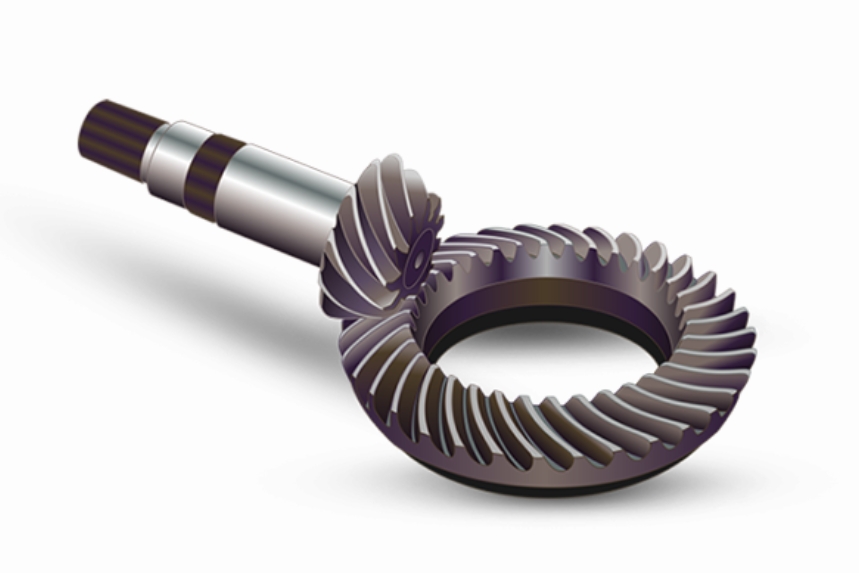
The design of spiral bevel gears has evolved from passive methods, where machining parameters are iteratively adjusted based on experience, to active design techniques that directly target performance metrics. Ease-off technology represents a significant advancement, allowing for the precise control of tooth surface topography to achieve desired contact patterns and transmission error. For spiral bevel gears with high contact ratios (typically greater than 2), the conventional second-order parabolic transmission error curve is insufficient to compensate for LTE fluctuations due to the cyclic variation in mesh stiffness across multiple tooth pairs. Instead, a wave-like or concave transmission error curve is needed to align with the engagement sequence of high contact ratio spiral bevel gears. This paper details the development of such a curve, the optimization framework, and the validation through case studies, demonstrating substantial improvements in LTE reduction for spiral bevel gears.
Foundations of Ease-Off Technology and Wave Tooth Surface Modeling
Ease-off technology involves defining a target tooth surface that incorporates modifications to compensate for deformations under load. For spiral bevel gears, this starts with the generation of an auxiliary pinion surface based on a predefined geometric transmission error (GTE) curve. The GTE curve for high contact ratio spiral bevel gears is modeled as a 7th-order polynomial to achieve a concave shape, which better accommodates the stiffness variations in multi-tooth engagement. The mathematical representation is given by:
$$ \varphi_2 = \varphi^{(0)}_2 + \frac{Z_1}{Z_2} (\varphi_1 – \varphi^{(0)}_1) + \delta\varphi_2 $$
$$ \delta\varphi_2 = a_0 + a_1 (\varphi_1 – \varphi^{(0)}_1) + a_2 (\varphi_1 – \varphi^{(0)}_1)^2 + \cdots + a_7 (\varphi_1 – \varphi^{(0)}_1)^7 $$
Here, $\varphi_1$ and $\varphi_2$ are the rotational angles of the pinion and gear, respectively, $Z_1$ and $Z_2$ are the tooth numbers, $\varphi^{(0)}_1$ and $\varphi^{(0)}_2$ are initial engagement angles, and $a_i$ are coefficients defining the concave curve. This curve ensures symmetric modification, critical for high contact ratio spiral bevel gears to minimize LTE.
The auxiliary pinion surface is derived from the gear tooth surface, treated as a cutting tool, using coordinate transformations. The position vector $\mathbf{r}’_1$ and unit normal vector $\mathbf{n}’_1$ of the auxiliary surface are expressed as:
$$ \mathbf{r}’_1 = \mathbf{M}_{1h}(\varphi_1) \mathbf{M}_{h2}(\varphi_2) \mathbf{r}_2 $$
$$ \mathbf{n}’_1 = \mathbf{L}_{1h}(\varphi_1) \mathbf{L}_{h2}(\varphi_2) \mathbf{n}_2 $$
where $\mathbf{M}$ and $\mathbf{L}$ are transformation matrices, and $\mathbf{r}_2$ and $\mathbf{n}_2$ are the gear surface vectors. The engagement condition $f_{12}(s_g, \theta_g, \phi_g, \varphi_1) = 0$ ensures line contact between the surfaces. To achieve the target ease-off surface, the auxiliary surface is discretized into grid points, and modifications are applied along the instantaneous contact line. The ease-off target surface points $\mathbf{p}^*_i$ are computed by adding a modification amount $\zeta_i$ along the normal direction:
$$ \mathbf{p}^*_i = \mathbf{p}^0_i + \zeta_i \mathbf{n}^0_i \quad (i=1,\ldots,k) $$
where $\mathbf{p}^0_i$ and $\mathbf{n}^0_i$ are the position and normal vectors of the auxiliary surface points. This process creates a wave-like topology on the pinion tooth surface, designed to reduce LTE in spiral bevel gears.
Optimization Model for Spiral Bevel Gear Design
To realize the wave tooth surface design, an optimization model is established with pinion machining parameters as variables. The objective is to minimize both the LTE amplitude and the deviation between the manufactured pinion surface and the ease-off target surface. The design variables include key machining parameters such as radial tool position, initial cradle angle, ratio of roll, vertical wheel position, axial wheel position, machine center to back, and higher-order modification coefficients. These variables are crucial for controlling the tooth geometry of spiral bevel gears.
The optimization problem is formulated as a multi-objective model:
$$ \min f_1(\mathbf{d}) = \max(T_e) – \min(T_e) $$
$$ \min f_2(\mathbf{d}) = \mathbf{h}(\mathbf{d})^T \mathbf{h}(\mathbf{d}) $$
subject to $\mathbf{d} \in [\mathbf{x}_1, \mathbf{x}_2]$, where $\mathbf{d}$ is the vector of machining parameters, $T_e$ is the LTE, and $\mathbf{h}(\mathbf{d})$ is the vector of normal deviations between the pinion surface and ease-off target surface at discrete points. The first objective targets LTE reduction, while the second ensures accurate surface realization. Constraints include maintaining a contact ratio between 2 and 3 to avoid edge contact and ensuring intersection between GTE and LTE curves.
A non-dominated sorting genetic algorithm (NSGA-II) is employed to solve this optimization due to its efficiency in handling complex, non-linear problems without requiring explicit analytical expressions. This algorithm effectively explores the parameter space for spiral bevel gears, balancing the trade-offs between objectives.
Case Study: Application to Aerospace Spiral Bevel Gears
A case study is conducted on an aerospace spiral bevel gear pair with a pinion of 27 teeth and a gear of 74 teeth, module of 3.85 mm, face width of 40 mm, and shaft angle of 87°. The operating conditions include a load of 950 N·m and an input speed of 8000 r/min. Initial machining parameters for a second-order parabolic design are optimized using the proposed wave tooth surface method. The table below summarizes the initial and optimized machining parameters for the pinion, highlighting changes in key variables.
| Parameter | Initial Second-Order Design | Optimized Wave Design |
|---|---|---|
| Radial Tool Position (mm) | 113.435 | 112.547 |
| Initial Cradle Angle (°) | -43.276 | 43.098 |
| Ratio of Roll | 2.841 | 2.820 |
| Vertical Wheel Position (mm) | -5.210 | -6.024 |
| Axial Wheel Position (mm) | -3.110 | -3.594 |
| Machine Center to Back (mm) | 0.409 | 0.565 |
| Second-Order Modification Coefficient | 0.044 | -0.006 |
| Third-Order Modification Coefficient | 0.113 | 0.037 |
| Fourth-Order Modification Coefficient | 0 | 2.390 |
| Fifth-Order Modification Coefficient | 0 | -5.651 |
| Sixth-Order Modification Coefficient | 0 | -60.197 |
| Seventh-Order Modification Coefficient | 0 | 280.570 |
The optimization results show significant adjustments in higher-order coefficients, enabling the wave tooth surface profile for spiral bevel gears. The surface deviation between the manufactured pinion and ease-off target is minimized, as shown in subsequent analyses.
Performance Analysis of Spiral Bevel Gears
The geometric transmission error curves for the initial second-order design and the optimized wave design are compared. The second-order design yields a parabolic GTE curve, while the wave design produces a concave 7th-order curve. The LTE is evaluated using loaded tooth contact analysis (LTCA), which accounts for mesh stiffness and deformations. For the second-order design, optimization reduces LTE amplitude from 3.502 arcseconds to 2.306 arcseconds, a 34.152% improvement. The wave design further reduces LTE amplitude to 0.888 arcseconds, a 61.492% reduction compared to the optimized second-order design. This demonstrates the efficacy of the wave tooth surface method for spiral bevel gears.
The dynamic performance is assessed through a lumped-parameter model with 8 degrees of freedom, considering torsional and translational vibrations. The dynamic load factor $K_v$ is computed to quantify vibration levels. For the second-order design, $K_v$ decreases from 1.117 to 1.081 after optimization. The wave design achieves a $K_v$ of 1.019, indicating lower vibration and better dynamic behavior for spiral bevel gears.
Finite element analysis (FEA) is conducted to validate the LTCA results. A high-precision mesh model of the spiral bevel gear pair is generated using tooth surface equations, ensuring accurate geometry and assembly. The FEA model applies boundary conditions and loads to simulate engagement, and the LTE is extracted. The FEA results corroborate the LTCA findings, showing consistent LTE trends and amplitude reductions for the wave design. The table below summarizes the performance metrics.
| Design Type | LTE Amplitude (arcseconds) | Dynamic Load Factor $K_v$ | Contact Ratio |
|---|---|---|---|
| Initial Second-Order | 3.502 | 1.117 | 2.5 |
| Optimized Second-Order | 2.306 | 1.081 | 2.5 |
| Wave Tooth Surface | 0.888 | 1.019 | 2.5 |
Multi-condition analyses under varying loads confirm the robustness of the wave design. Across different torque levels, the wave tooth surface design maintains lower LTE amplitudes and dynamic load factors compared to traditional designs, highlighting its suitability for aerospace spiral bevel gears operating in diverse regimes.
Mathematical Formulations for Spiral Bevel Gear Analysis
The tooth surface geometry of spiral bevel gears is described using differential geometry and coordinate transformations. The gear surface $\mathbf{r}_2$ is generated via machining simulations, and the pinion surface $\mathbf{r}_1$ is derived through conjugate action. The ease-off surface is defined as the deviation between the target and actual surfaces, computed using normal vectors. For optimization, the sensitivity of LTE to machining parameters is analyzed through partial derivatives. The mesh stiffness $k_n$ varies with engagement position and is modeled as a periodic function:
$$ k_n(\varphi_1) = k_0 + \sum_{m=1}^{M} k_m \cos(m\omega \varphi_1 + \phi_m) $$
where $k_0$ is the mean stiffness, $k_m$ are harmonics, $\omega$ is the mesh frequency, and $\phi_m$ are phase angles. This stiffness variation drives LTE fluctuations in spiral bevel gears.
The dynamic equations of motion for the spiral bevel gear system are:
$$ I_1 \ddot{\theta}_1 + c_n (\dot{\theta}_1 – \dot{\theta}_2) + k_n (\theta_1 – \theta_2 – T_e) = T_1 $$
$$ I_2 \ddot{\theta}_2 – c_n (\dot{\theta}_1 – \dot{\theta}_2) – k_n (\theta_1 – \theta_2 – T_e) = -T_2 $$
where $I_1$ and $I_2$ are moments of inertia, $c_n$ is damping, $\theta_1$ and $\theta_2$ are angular displacements, and $T_1$ and $T_2$ are torques. The transmission error $T_e$ is incorporated as a displacement excitation. Solving these equations numerically yields the dynamic response, including $K_v$.
Conclusions and Implications for Spiral Bevel Gear Design
This paper presents a comprehensive wave tooth surface design method for high contact ratio spiral bevel gears, aimed at minimizing loaded transmission error. By integrating ease-off technology with a concave transmission error curve and multi-objective optimization, significant improvements in LTE reduction and dynamic performance are achieved. The case study demonstrates that the wave design outperforms traditional second-order parabolic designs, with LTE amplitude reductions exceeding 60% and lower vibration levels. The method is validated through LTCA, FEA, and dynamic analysis, ensuring reliability for aerospace applications.
The implications extend beyond spiral bevel gears to other gear types, such as hypoid gears or helical gears, where similar principles can be applied. Future work could explore real-time manufacturing adjustments or incorporate additional factors like thermal effects or wear. Overall, this research provides a foundation for designing high-performance spiral bevel gears with enhanced meshing quietness and durability, contributing to advancements in power transmission systems.