
In my extensive experience with mechanical transmission systems, I have found worm gear reducers to be indispensable components across numerous industries. These devices, characterized by their compact design and high reduction ratios, play a pivotal role in converting speed into torque. The unique geometry of worm gears, where a threaded worm engages with a toothed wheel, allows for smooth and quiet operation. One of the most remarkable features of certain worm gear sets is their potential for self-locking, a trait that enhances safety in applications where back-driving must be prevented. Throughout my career, I have specified, maintained, and troubleshot countless worm gear drives, and their reliability when properly applied is unmatched. The core principle hinges on the sliding contact between the worm and the wheel, which, while enabling high reduction ratios, also introduces specific thermal and wear considerations that must be meticulously managed.
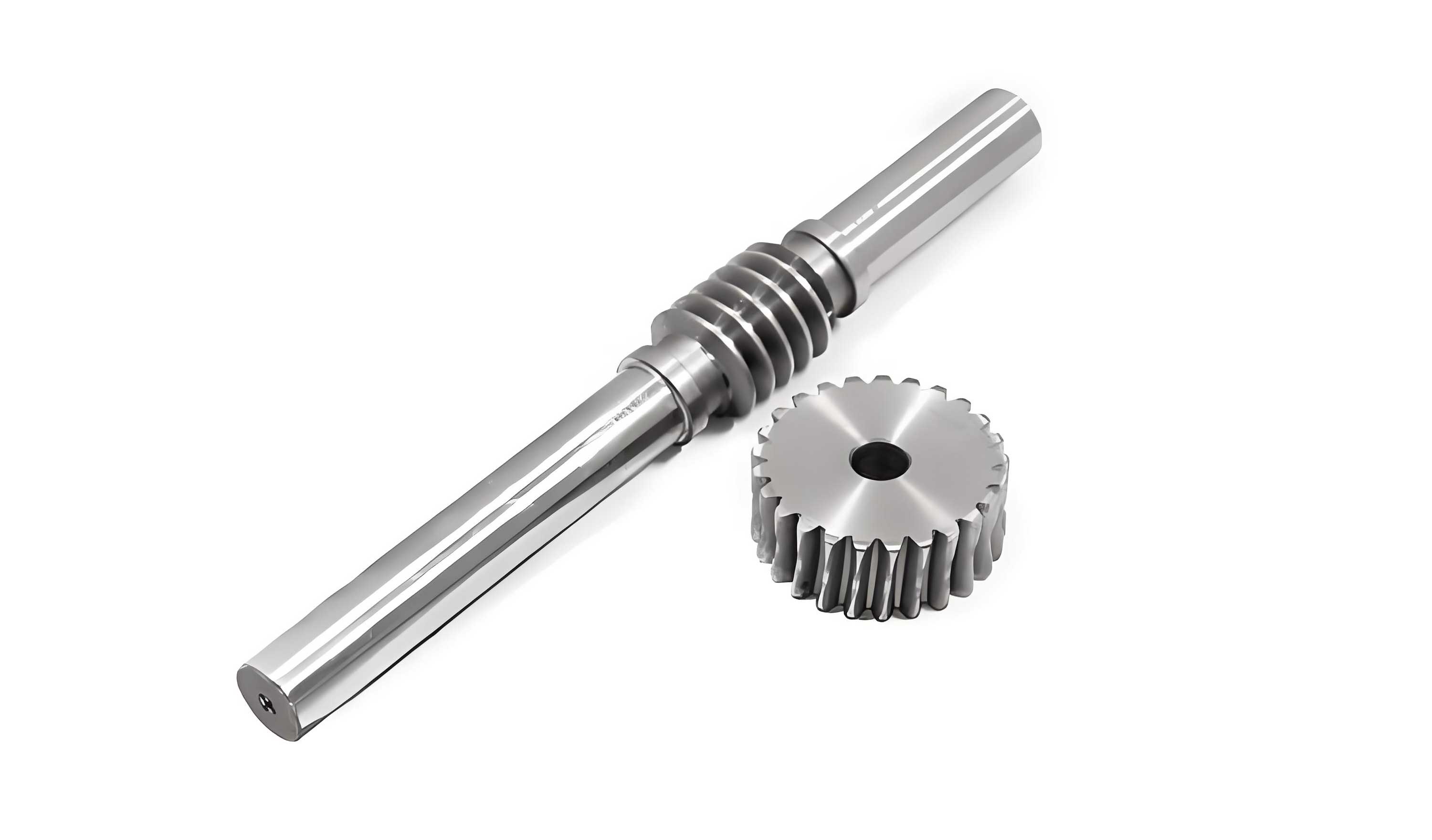
The fundamental kinematic relationship in a worm gear drive is defined by the transmission ratio. For a single-start worm, the ratio is profoundly high. The basic formula for the speed reduction ratio, \( i \), is given by:
$$ i = \frac{\omega_{in}}{\omega_{out}} = \frac{N_2}{N_1} $$
where \( \omega_{in} \) and \( \omega_{out} \) are the input and output angular velocities, \( N_2 \) is the number of teeth on the worm wheel, and \( N_1 \) is the number of starts or threads on the worm. This simple equation belies the complexity of the forces at play. The torque multiplication is equally critical, though it is diminished by the efficiency of the system. The output torque \( T_{out} \) can be related to the input torque \( T_{in} \) by:
$$ T_{out} = i \cdot \eta \cdot T_{in} $$
Here, \( \eta \) represents the mechanical efficiency of the worm gear set. The efficiency itself is a function of the lead angle \( \lambda \) and the coefficient of friction. A standard approximation for efficiency is:
$$ \eta \approx \frac{\tan(\lambda)}{\tan(\lambda + \phi)} $$
where \( \phi = \arctan(\mu) \) is the friction angle and \( \mu \) is the coefficient of friction. This relationship clearly shows why worm gears with a small lead angle can exhibit self-locking (when \( \lambda \le \phi \)), as reverse driving becomes impossible. In my applications, calculating and verifying this efficiency is paramount for selecting the correct motor and ensuring system longevity.
The primary functions of worm gear reducers in any system I’ve designed or maintained are threefold, as summarized in the table below:
| Function | Description | Key Formula/Principle |
|---|---|---|
| Speed Reduction & Torque Multiplication | Decreases rotational speed while increasing output torque proportionally to the reduction ratio and efficiency. | \( T_{out} = i \cdot \eta \cdot T_{in} \) |
| Load Inertia Reduction | The reflected inertia of the load on the motor side is reduced by the square of the reduction ratio, simplifying control. | \( J_{reflected} = J_{load} / i^2 \) |
| Direction Change of Torque | The input and output shafts are typically oriented at 90 degrees to each other, allowing for compact spatial arrangements. | Spatial geometry of worm and wheel. |
I cannot overstate the importance of the inertia reduction. In servo systems, for instance, matching the motor inertia to the load inertia is crucial for responsive control. The use of worm gears makes this task significantly easier, as the high \( i^2 \) term drastically lowers the effective inertia. This is why worm gear drives are so prevalent in indexing tables, conveyor drives, and precision positioning systems I’ve worked on.
The applications for worm gear reducers are virtually limitless. In industrial settings, from the steel plants I’ve been involved with to food processing lines, they are the workhorses of heavy-duty mixing, lifting, and conveying. Specifically, in electroslag remelting furnace lifting systems, which I have direct experience maintaining, worm gear reducers provide the precise, reliable, and lockable motion control required for safely raising and lowering massive electrodes. Their ability to hold position without an external brake is a critical safety feature. Beyond industry, worm gears find homes in agricultural machinery for adjusting implements, in aerospace for actuator systems, and even in medical devices where compact, right-angle power transmission is needed. The versatility of worm gear drives is a testament to their fundamental design.
However, the very design that grants worm gears their advantages also presents distinct operational challenges. Through years of maintenance, I have cataloged common failure modes. The primary issue is heat generation and subsequent oil leakage. The sliding action in worm gears generates considerable friction, leading to elevated operating temperatures. This thermal expansion can compromise sealing surfaces. The choice of materials is critical; typically, the worm is made from hardened steel (e.g., case-hardened 45 steel or 40Cr with a hardness of HRC 45-55) and the wheel from a softer, bronze alloy (like tin bronze) to manage wear. The table below outlines common problems, their root causes, and the solutions I’ve implemented successfully.
| Problem | Primary Causes | Analysis & Solutions |
|---|---|---|
| Overheating & Oil Leakage | High sliding friction, thermal expansion differences, inappropriate lubricant viscosity, overfilling. | Use high-quality synthetic lubricants with high thermal stability. Ensure proper breathers are installed. Apply sealants designed for thermal cycling. Calculate optimal oil volume. |
| Worm Wheel Wear | Abrasive wear from the hard worm, improper load rating, contaminated lubricant, misalignment. | Ensure correct material pairing (e.g., phosphor bronze vs. hardened steel). Implement predictive maintenance with oil analysis. Use filters. Verify alignment with laser tools. |
| Input/Output Bearing Failure | Lubricant breakdown (water ingress, oxidation), improper preload, excessive axial loads from misalignment. | Establish a strict lubrication schedule. Use lubricants with anti-rust and anti-wear additives. For vertical mounts, consider specialty greases or oil mist systems. |
| Gear Whine or Vibration | Poor surface finish on gear teeth, improper backlash, mounting surface unevenness. | Specify high-precision ground worms. Set backlash according to manufacturer specs (often 0.05-0.10 mm). Use mounting bases machined to fine tolerances. |
The wear of the worm wheel is a particularly slow but inevitable process. The wear rate \( W \) can be modeled heuristically as a function of pressure \( p \), velocity \( v \), and material constant \( K \):
$$ W \propto K \cdot p \cdot v $$
In practice, keeping \( p \) and \( v \) within the manufacturer’s PV rating limits is essential. For worm gears, the sliding velocity \( v_s \) at the mesh is crucial and is given by:
$$ v_s = \frac{\pi d_1 n_1}{60000 \cos(\lambda)} \text{ m/s} $$
where \( d_1 \) is the worm pitch diameter in mm and \( n_1 \) is the worm speed in rpm. Monitoring this velocity helps in selecting the appropriate lubricant grade.
Lubrication is the lifeblood of any worm gear reducer. My standard practice involves using a high-performance ISO VG 220 or 320 grade gear oil with extreme pressure (EP) and anti-wear additives. For severe applications, I incorporate solid lubricant additives like molybdenum disulfide. The correct oil level is vital; too little causes starvation and overheating, while too much leads to churning and heat generation. For a horizontal unit, the oil level should be at the center of the lowest rolling element on the output shaft when stopped. The required volume \( V \) can be estimated from the housing geometry, but a good rule of thumb for a worm gearbox is:
$$ V \approx 0.25 \cdot L \cdot W \cdot H $$
where L, W, and H are internal length, width, and height dimensions at the oil sump.
Installation orientation profoundly affects performance. While horizontal mounting is preferred, vertical mounting is often necessary. In vertical installations, I always take extra precautions. The lubrication challenge is significant, as oil tends to drain away from the upper bearings and the worm mesh. For vertical shaft-down mounts, I specify reducers with built-in oil flingers or pumps, or I use circulating oil systems. The axial load capacity of the bearings must be recalculated. The equivalent dynamic load \( P \) on the bearing in a vertical mount is influenced by the weight of the output shaft and load:
$$ P = X F_r + Y F_a $$
where \( F_r \) is the radial load, \( F_a \) is the axial load (now including the gravitational component), and X and Y are bearing factors. Getting this wrong is a common source of premature bearing failure in vertically mounted worm gear drives.
Preventive maintenance is non-negotiable. I adhere to a rigorous “Five Rights” principle for lubrication: right type, right amount, right place, right time, and right method. This involves scheduled oil changes—typically every 2500-5000 operating hours or annually, whichever comes first. Oil analysis is a powerful tool; tracking ferrous wear debris, viscosity change, and water content allows me to predict failures. For instance, a sudden rise in copper particles indicates accelerated worm wheel wear. Vibration analysis on the input and output shafts can detect misalignment or bearing defects early. I maintain logs for every worm gear reducer, noting baseline noise levels, temperature rises (ΔT above ambient), and any changes over time. A normal temperature rise for a worm gearbox under load might be 40-50°C above ambient. If I observe a rise exceeding 60°C or an absolute temperature above 90°C, it triggers an immediate inspection.
Assembly and repair of worm gear units require precision. I always use dedicated pullers and induction heaters for bearing installation, never a hammer. When replacing a worm or wheel, they must be replaced as a matched set to maintain the correct contact pattern and backlash. The backlash setting is critical for smooth operation and longevity. The theoretical circumferential backlash \( j_t \) relates to the center distance \( a \) and module \( m \):
$$ j_t \approx 0.04 \cdot m + 0.025 \sqrt{a} \text{ (mm)} $$
This is adjusted via shims or adjustable housings. For the output shaft fit, I follow ISO tolerance guidelines: for shaft diameters \( D \leq 50 \) mm, I use an H7/k6 fit (light interference for bearings), and for \( D > 50 \) mm, an H7/m6 fit. Applying an anti-seize compound to the shaft before assembly prevents fretting and corrosion, making future disassembly far easier.
In conclusion, the worm gear reducer remains a cornerstone of mechanical power transmission. Its unique combination of high ratio, compact right-angle design, and potential self-locking ensures its continued relevance in an era of advanced technologies. From my perspective, the key to unlocking the full potential and longevity of worm gears lies in a deep understanding of their thermal and tribological characteristics, meticulous installation, and a disciplined, data-driven maintenance regimen. While newer technologies like harmonic drives or high-ratio planetary gearboxes offer alternatives, for many applications requiring robustness, simplicity, and cost-effectiveness, the worm gear drive is, in my professional judgment, irreplaceable. The continuous development of new materials, coatings, and synthetic lubricants only expands the envelope of what these versatile drives can achieve, promising their use in my projects and across global industry for decades to come.