
In modern mechanical engineering, the design of worm gears plays a critical role in power transmission systems, especially for applications requiring high reduction ratios, smooth operation, and self-locking capabilities. Traditional methods for designing worm gears are often tedious, involving manual calculations and iterative adjustments, which can lead to prolonged development cycles and potential errors. To address these challenges, I have developed a parametric design system for worm gears using SolidWorks as the primary platform. This system leverages advanced features such as parameterized modeling and feature-based design to automate the entire process, from initial parameter selection to three-dimensional modeling. In this article, I will detail the principles, implementation, and benefits of this system, emphasizing the use of tables and formulas to summarize key aspects. The goal is to provide a comprehensive guide that enhances efficiency and accuracy in worm gears design, while integrating seamlessly with modern CAD environments.
The core of this system is based on the secondary development capabilities of SolidWorks, which allows for customization through its Application Programming Interface (API). SolidWorks API is built on Object Linking and Embedding (OLE) technology, providing a vast library of functions that can be accessed using programming languages like Visual Basic 6.0 (VB6.0). By utilizing these API functions, I have created a user-friendly interface that facilitates the design and validation of worm gears. This approach not only streamlines the workflow but also ensures that all design parameters adhere to standard mechanical engineering principles. Throughout this discussion, I will repeatedly focus on worm gears to underscore their importance in传动 systems.
To begin, let’s explore the secondary development原理 of SolidWorks. The API includes numerous objects, methods, properties, and events, collectively known as API functions, which enable developers to extend SolidWorks’ functionality. For instance, these functions allow for the creation and editing of sketches, construction of solid models, and analysis of surface properties. In my system, I used VB6.0 as the development tool, calling API functions to automate tasks such as parameter calculation and 3D modeling. A key resource in this process is the swconst.bas module, which contains predefined constants for API functions, located in the SolidWorks installation directory under samples/appComm. This module simplifies coding by providing standardized values for common operations. By integrating this with a custom VB interface, I have built a system that reduces manual intervention and minimizes errors in worm gears design.
The system architecture is divided into two main modules: the parameter design and calculation module, and the 3D modeling module. Each module is designed to handle specific aspects of the worm gears design process, ensuring a logical and efficient workflow.
In the parameter design and calculation module, users input initial working parameters through a graphical interface. These parameters include load conditions, transmission form, efficiency, input power, worm shaft speed, transmission ratio, expected service life, and engagement frequency. Additionally, material properties for both the worm and worm gear are selected, such as hardness and strength values. The system then computes design parameters like pressure angle, number of worm threads, pitch diameter, and diameter factor. A critical step is the strength and stiffness validation, where the system performs calculations to verify if the selected parameters meet operational requirements. If validation fails, users can adjust parameters iteratively until a satisfactory design is achieved. The interface for this module is shown below, though I will not reference specific images by number. Instead, I will insert the provided hyperlink at an appropriate point later in the article.
To summarize the parameter design process, I have compiled key formulas and tables. The design of worm gears typically involves calculations based on contact fatigue strength and bending fatigue strength, as these are common failure modes. The fundamental equations include:
For the worm pitch diameter: $$d_1 = m \cdot z_1$$ where \(m\) is the module and \(z_1\) is the number of worm threads.
For the worm gear pitch diameter: $$d_2 = m \cdot z_2$$ where \(z_2\) is the number of worm gear teeth.
The center distance is given by: $$a = \frac{d_1 + d_2}{2}$$
Contact stress validation uses the formula: $$\sigma_H = Z_E \cdot \sqrt{\frac{K \cdot T_2}{d_1 \cdot d_2^2}} \leq [\sigma_H]$$ where \(Z_E\) is the elasticity coefficient, \(K\) is the load factor, \(T_2\) is the torque on the worm gear, and \([\sigma_H]\) is the allowable contact stress.
Bending stress validation is: $$\sigma_F = \frac{K \cdot T_2}{b \cdot m \cdot Y_F} \leq [\sigma_F]$$ where \(b\) is the face width of the worm gear, \(Y_F\) is the form factor, and \([\sigma_F]\) is the allowable bending stress.
To organize material properties, here is a table summarizing common materials used for worm gears:
| Material Type | Hardness (HB) | Allowable Contact Stress [σ_H] (MPa) | Allowable Bending Stress [σ_F] (MPa) |
|---|---|---|---|
| Bronze (Worm Gear) | 80-120 | 150-200 | 40-60 |
| Steel (Worm) | 200-300 | 300-400 | 80-100 |
| Cast Iron | 150-250 | 100-150 | 30-50 |
Another table outlines the design parameters and their typical ranges for worm gears:
| Parameter | Symbol | Typical Range | Description |
|---|---|---|---|
| Module | m | 1-20 mm | Determines tooth size |
| Worm Threads | z1 | 1-4 | Number of starts on worm |
| Worm Gear Teeth | z2 | 20-80 | Number of teeth on worm gear |
| Pressure Angle | α | 20° | Angle between tooth profile and radial line |
| Lead Angle | γ | 5°-30° | Angle of worm thread helix |
The design flowchart for this system is as follows: start with parameter input, proceed to material selection, compute initial design values, perform strength and stiffness checks, and if checks fail, iterate back to parameter adjustment. Once validated, the system outputs the final parameters for 3D modeling. This iterative process ensures robustness in worm gears design.
Moving to the 3D modeling module, this part automates the creation of worm and worm gear models in SolidWorks based on the calculated parameters. The process utilizes parameterized design, where essential dimensions are defined as variables that update the model dynamically. For worm gears, key parameters include module, number of teeth, pressure angle, lead angle, addendum coefficient, and dedendum coefficient. The modeling steps for the worm and worm gear are detailed below.
For the worm, the modeling involves creating an Archimedean spiral profile. The steps include: drawing the worm blank by extruding a circle with diameter equal to the tip diameter \(d_{a1} = m(z_1 + 2h_a^*)\), where \(h_a^*\) is the addendum coefficient; generating an Archimedean spiral on the pitch cylinder with lead equal to the worm lead \(P_z = \pi m z_1\); defining the tooth槽 section profile using coordinates based on pressure angle and diameters; and performing a sweep cut along the spiral to create the tooth space. The coordinates for the tooth profile points A, B, C, D are calculated as:
$$x_A = \frac{P_x}{4} + \tan(\alpha) \cdot \frac{d_{a1} – d_1}{2}, \quad y_A = \frac{d_{a1}}{2}$$
$$x_B = \frac{P_x}{4} + \tan(\alpha) \cdot \frac{d_1 – d_{f1}}{2}, \quad y_B = \frac{d_{f1}}{2}$$
$$x_C = -x_B – \tan(\alpha) \cdot \frac{d_1 – d_{f1}}{2} – \frac{P_x}{4}, \quad y_C = y_B$$
$$x_D = -x_A – \tan(\alpha) \cdot \frac{d_{a1} – d_1}{2} – \frac{P_x}{4}, \quad y_D = y_A$$
where \(P_x\) is the axial pitch, \(d_{f1}\) is the root diameter, and other symbols are as defined earlier. After creating one tooth space, a circular pattern is applied to generate multiple threads for the worm. This parametric approach allows for quick modifications to worm gears design.
For the worm gear, the modeling process is similar but adapted for the gear’s geometry. The steps include: extruding the gear blank using the tip diameter \(d_{a2} = m(z_2 + 2h_a^*)\); drawing an Archimedean spiral on the pitch circle with pitch equal to the module; creating the tooth profile using an involute curve approximated by points from parametric equations; and performing a sweep cut to form the tooth space. The involute curve for worm gears is defined in Cartesian coordinates as:
$$x(\theta_k) = r_k \cdot \sin(\phi_0 + \theta_k)$$
$$y(\theta_k) = r_k \cdot \cos(\phi_0 + \theta_k)$$
where \(r_k\) is the radius at point k, \(\theta_k = \tan(\alpha_k) – \alpha_k\), \(\alpha_k = \arccos(r_b / r_k)\), \(r_b\) is the base circle radius, and \(\phi_0\) is an initial angle offset. These points are connected to form the tooth profile. After creating one tooth space, a circular pattern with \(z_2\) instances completes the worm gear model. To enhance realism, the worm gear’s pitch cylinder is often modified with a crowned surface to better mesh with the worm, but for simplicity, this system assumes standard cylindrical geometry. The integration of these steps into SolidWorks via VB code ensures that changes in design parameters automatically update the 3D models, significantly speeding up the design process for worm gears.
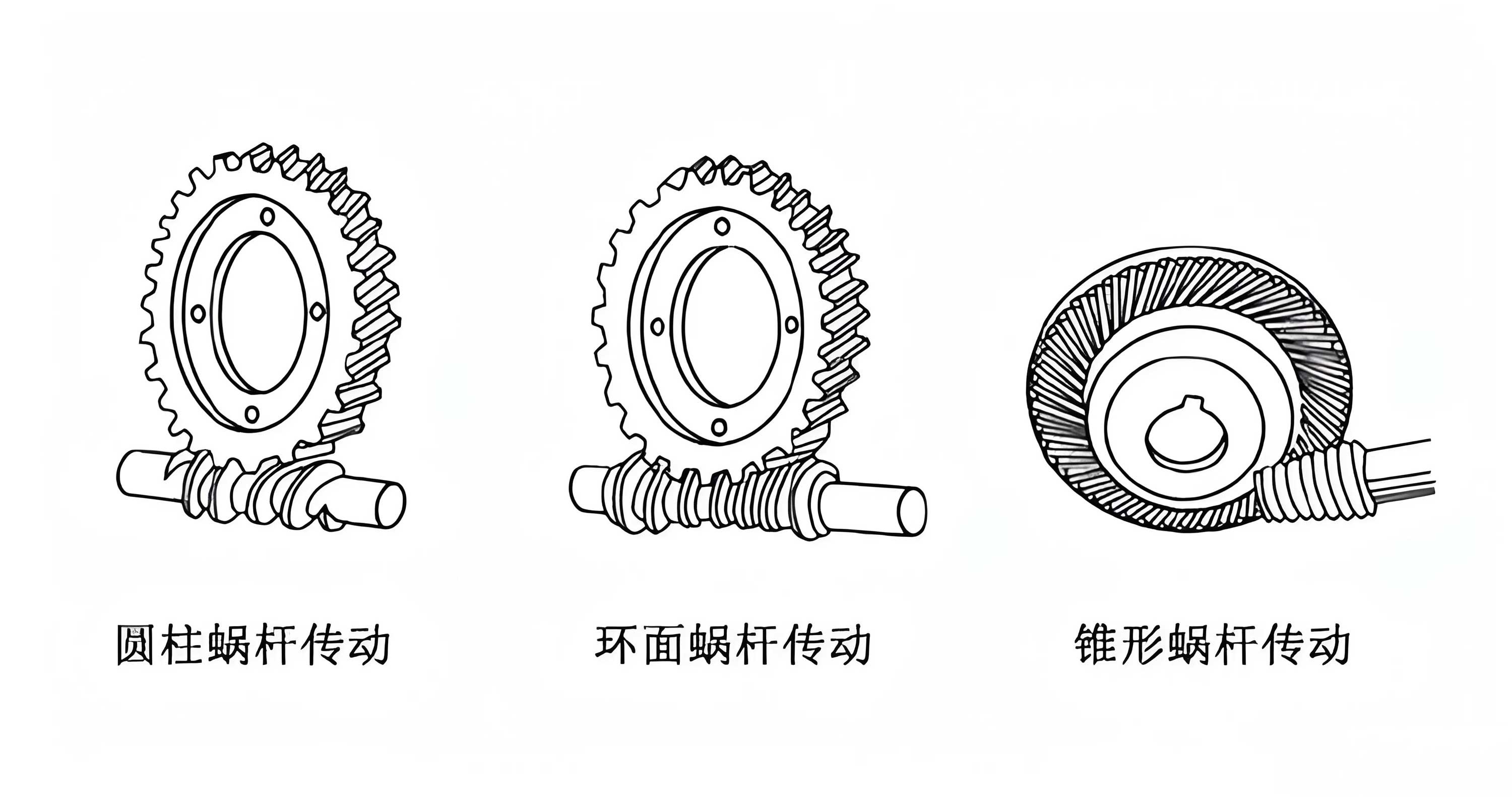
To illustrate the modeling output, here is a visual representation of worm gears. I will now insert the provided image hyperlink at this point to show an example of worm gears, which helps in understanding the geometric features discussed.
The automation of these modeling steps is achieved through VB scripts that call SolidWorks API functions. For instance, to create a sketch, the code might use Part.CreateSketch methods, and for extrusion, Part.FeatureExtrusion functions. This not only reduces manual effort but also ensures precision, as all dimensions are derived from validated calculations. The system’s interface allows users to click buttons like “Calculate Parameters” or “Draw Worm Gear” to trigger these operations, making it accessible even to those with limited CAD experience. By focusing on worm gears, this system addresses a common need in industries such as automotive, aerospace, and machinery, where efficient power transmission is vital.
In terms of validation, the system includes comprehensive checks for strength and stiffness. For worm gears, contact fatigue is a primary concern due to the sliding action between teeth. The contact stress formula mentioned earlier is computed using material properties from the table, and the system compares it to allowable values. If the stress exceeds the limit, users are prompted to adjust parameters like module or material choice. Similarly, bending stress is evaluated to prevent tooth breakage. These checks are embedded in the VB code, with results displayed in the interface. To further summarize, here is a table of common failure modes and validation criteria for worm gears:
| Failure Mode | Validation Criterion | Typical Threshold |
|---|---|---|
| Contact Fatigue | \(\sigma_H \leq [\sigma_H]\) | 150-400 MPa based on material |
| Bending Fatigue | \(\sigma_F \leq [\sigma_F]\) | 30-100 MPa based on material |
| Wear | Lubrication and surface hardness | Dependent on application |
The benefits of this parametric design system for worm gears are manifold. It reduces design time from days to hours by automating calculations and modeling. Accuracy is improved since all parameters are computed programmatically, minimizing human error. Additionally, the system supports iterative design, allowing engineers to explore multiple configurations quickly. This is particularly useful for optimizing worm gears for specific applications, such as high-torque or high-speed scenarios. The use of SolidWorks as a platform ensures compatibility with other CAD tools and facilitates further steps like assembly simulation, motion analysis, and finite element analysis (FEA). For example, once the worm gears models are created, they can be assembled virtually to check for interference or to simulate kinematic behavior, providing insights before physical prototyping.
To delve deeper into the formulas, let’s consider the efficiency calculation for worm gears, which is crucial for energy-saving designs. The efficiency \(\eta\) can be estimated as:
$$\eta = \frac{\tan(\gamma)}{\tan(\gamma + \rho)}$$ where \(\gamma\) is the lead angle and \(\rho\) is the friction angle, dependent on material pairing and lubrication. This formula highlights the importance of lead angle optimization in worm gears design. In my system, users can input desired efficiency, and the code adjusts parameters accordingly.
Another aspect is the thermal rating, as worm gears often generate heat due to sliding friction. The system can include basic thermal checks using power loss formulas: $$P_{loss} = (1 – \eta) \cdot P_{in}$$ where \(P_{in}\) is input power. If the loss exceeds cooling capacity, parameters like module or lubrication type may need revision. While not fully detailed in the initial system, this can be extended for comprehensive worm gears design.
In conclusion, the development of a parametric design system for worm gears based on SolidWorks represents a significant advancement in mechanical engineering tools. By integrating parameter calculation, strength validation, and automated 3D modeling, this system streamlines the entire design process. The use of tables and formulas, as shown throughout this article, helps summarize key data and equations, making it easier for engineers to apply in practice. The repeated focus on worm gears underscores their relevance in transmission systems. Future enhancements could include integration with simulation modules for dynamic analysis or cloud-based collaboration features. Overall, this system not only saves time and reduces errors but also empowers designers to create more reliable and efficient worm gears, contributing to innovation in various industries.
To further illustrate the system’s capabilities, here is a summary table of the VB functions used for common operations in worm gears design:
| VB Function | SolidWorks API Call | Purpose in Worm Gears Design |
|---|---|---|
| CalculateParameters | Part.GetParameter | Retrieves and computes design values |
| DrawWorm | FeatureManager.CreateExtrusion | Generates worm 3D model |
| DrawWormGear | FeatureManager.CreateSweep | Generates worm gear 3D model |
| ValidateStrength | MathTool.Evaluate | Performs stress calculations |
This system exemplifies how modern CAD tools can be customized to meet specific engineering needs, particularly for complex components like worm gears. As technology evolves, such parametric approaches will become increasingly vital for rapid prototyping and digital manufacturing. I hope this detailed exploration provides valuable insights for those involved in the design and application of worm gears.