
1. Introduction
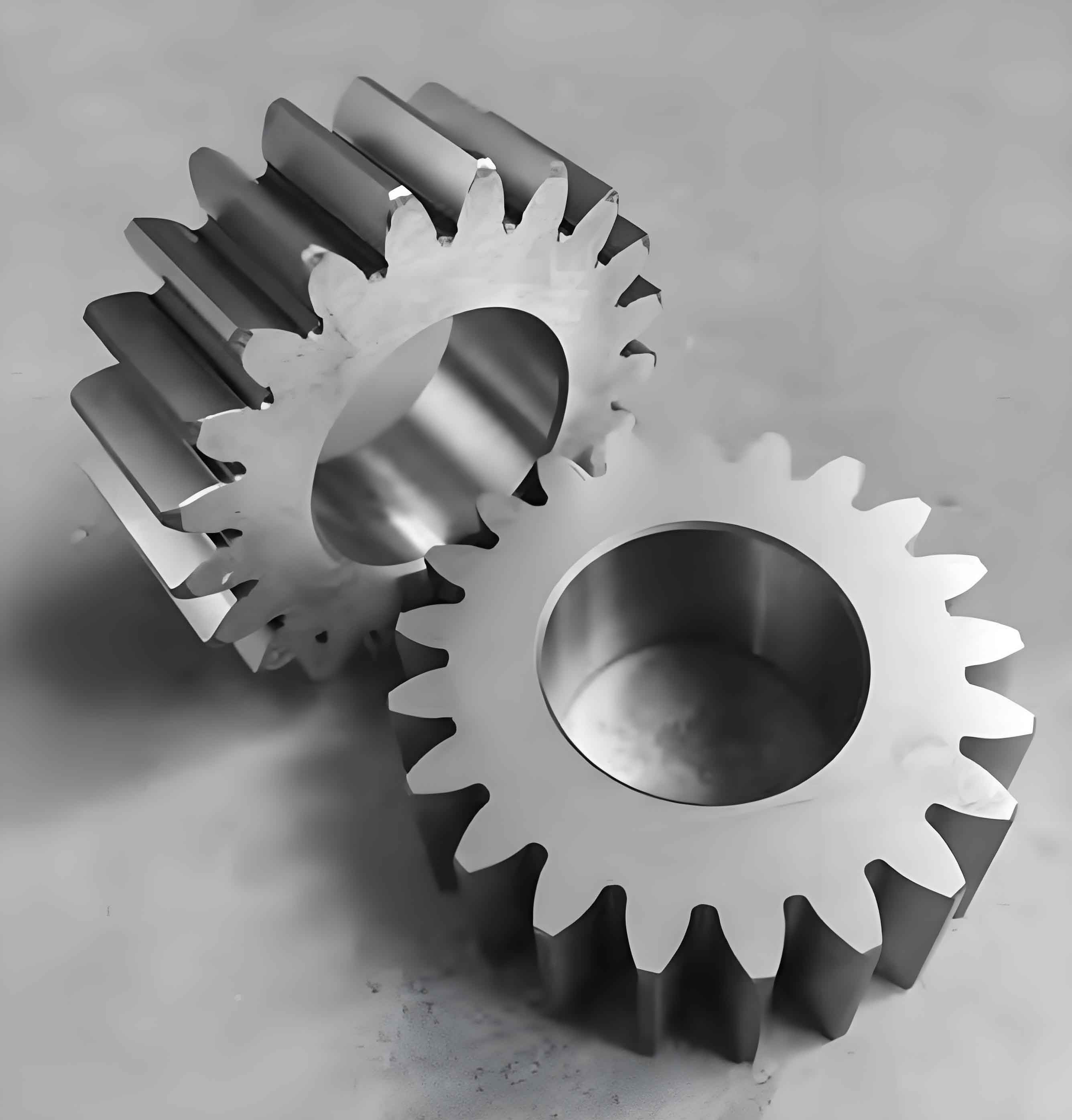
As one of the most widely used transmission mechanisms in mechanical systems, spur gears are renowned for their high efficiency, compact structure, and precise transmission ratio. However, during operation, the cyclic alternation of single and double tooth engagement, combined with variations in meshing positions, leads to periodic fluctuations in time-varying mesh stiffness (TVMS). Tooth pitting, a common surface fatigue failure, directly alters the TVMS of spur gear pairs, thereby modifying the system’s dynamic characteristics. In this study, we propose a novel pitting model to investigate how pitting geometry, location, and severity influence TVMS and vibration responses. Our goal is to establish a theoretical framework for detecting and diagnosing pitting faults in spur gears through stiffness prediction and spectral analysis.
2. Modeling of Tooth Pitting and TVMS Calculation
2.1 Pitting Geometry and Damage Levels
To simulate realistic pitting morphology observed in experiments or operational gears, we approximate each pit as a segment of an elliptical cylinder. Three damage levels are defined based on pitting distribution and quantity:
- Slight pitting: Limited to localized regions near the pitch line.
- Moderate pitting: Expanded coverage toward the tooth tip.
- Severe pitting: Extensive pitting clusters spanning the active profile.
The elliptical cylinder parameters include:
- Major axis length (2a2a): Governs pitting width.
- Minor axis length (2b2b): Governs pitting depth.
- Depth (δδ): Defines material loss.
2.2 TVMS Calculation Using Potential Energy Method
The total deformation energy of a spur gear tooth is decomposed into five components:
- Hertzian contact energy
- Bending deformation energy
- Shear deformation energy
- Axial compression energy
- Gear body flexibility energy
For a healthy tooth, the TVMS (ktkt) is calculated as:1kt=1kh+1kb+1ks+1ka+1kfkt1=kh1+kb1+ks1+ka1+kf1
where khkh, kbkb, ksks, kaka, and kfkf denote Hertzian contact, bending, shear, axial compression, and gear body flexibility stiffness, respectively.
For pitted teeth, the effective tooth width (LeffLeff), cross-sectional area (AeffAeff), and moment of inertia (IeffIeff) are reduced due to material loss. These modifications are expressed as:Aeff=Ax−ΔAxandIeff=Ix−ΔIxAeff=Ax−ΔAxandIeff=Ix−ΔIx
where:ΔAx=ΔL⋅δandΔIx=112ΔL⋅δ3+Ax⋅ΔAx⋅(hx−δ/2)2Ax−ΔAxΔAx=ΔL⋅δandΔIx=121ΔL⋅δ3+Ax−ΔAxAx⋅ΔAx⋅(hx−δ/2)2
Here, ΔLΔL represents the effective width reduction, which varies with pitting severity (Table 1).
Table 1: Effective Width Reduction for Pitting Levels
| Pitting Level | ΔLΔL Formula |
|---|---|
| Slight | 2ΔL−+7ΔL∼2ΔL−+7ΔL∼ |
| Moderate | 2ΔL−+16ΔL∼2ΔL−+16ΔL∼ |
| Severe | ΔL1+ΔL2ΔL1+ΔL2 |
3. Parametric Analysis of Pitting Effects
3.1 Influence of Pitting Position
The distance (uu) from the pitting center to the base circle significantly impacts TVMS. As uu increases, pitting shifts from the base circle toward the tooth tip, altering the engagement sequence. Figure 1 illustrates how TVMS reduction intensifies when pitting occurs near high-stress regions (e.g., the pitch line).
Table 2: TVMS Reduction vs. Pitting Position (uu)
| uu (mm) | TVMS Reduction (%) |
|---|---|
| 1.5 | 12.3 |
| 1.9 | 18.7 |
| 2.3 | 24.5 |
3.2 Influence of Pitting Size
- Major Axis (2a2a): Longer major axes amplify widthwise material loss, leading to greater TVMS reduction.
- Minor Axis (2b2b): Changes in 2b2b affect pitting depth but do not alter TVMS reduction magnitude within the same angular displacement range.
The relationship between major axis length and TVMS is quantified as:Δkt=kt,healthy−kt,pitted=β⋅a2Δkt=kt,healthy−kt,pitted=β⋅a2
where ββ is a proportionality constant dependent on gear geometry.
Table 3: TVMS Reduction vs. Major Axis Length
| 2a2a (mm) | TVMS Reduction (%) |
|---|---|
| 0.3 | 15.2 |
| 0.5 | 28.6 |
| 0.7 | 41.9 |
4. Dynamic Response Analysis
4.1 Vibration Model
A four-degree-of-freedom (4-DOF) dynamic model is employed to study torsional and translational vibrations in spur gear pairs:{I1θ¨1+ct(θ˙1−θ˙2)+kt(θ1−θ2)=T1I2θ¨2+ct(θ˙2−θ˙1)+kt(θ2−θ1)=−T2m1x¨1+cxx˙1+kxx1=Fxm2x¨2+cxx˙2+kxx2=−Fx⎩⎨⎧I1θ¨1+ct(θ˙1−θ˙2)+kt(θ1−θ2)=T1I2θ¨2+ct(θ˙2−θ˙1)+kt(θ2−θ1)=−T2m1x¨1+cxx˙1+kxx1=Fxm2x¨2+cxx˙2+kxx2=−Fx
where II, mm, cc, and kk represent inertia, mass, damping, and stiffness, respectively.
4.2 Spectral Characteristics
Pitting-induced TVMS variations excite sideband frequencies around the meshing frequency (fmfm). The amplitude of these sidebands escalates with pitting severity:Asideband=γ⋅Δkt⋅fmAsideband=γ⋅Δkt⋅fm
where γγ is a system-dependent coefficient.
Table 4: Sideband Amplitude vs. Pitting Level
| Pitting Level | Sideband Amplitude (m/s²) |
|---|---|
| Healthy | 0.5 |
| Slight | 1.8 |
| Moderate | 3.4 |
| Severe | 6.1 |
5. Experimental Validation
A drivetrain dynamics simulator (DDS) was used to validate theoretical predictions. Accelerometers mounted on bearing housings captured vibration signals under 30 Hz input rotation. Key findings include:
- Frequency Domain: Pitting introduces sidebands at fm±nfrfm±nfr (n=1,2,…n=1,2,…), where frfr is the input shaft frequency.
- Time Domain: Pitting increases vibration amplitudes at engagement/disengagement instants.
Table 5: Experimental vs. Simulated TVMS Reduction
| Pitting Level | Simulation (%) | Experiment (%) | Error (%) |
|---|---|---|---|
| Slight | 18.7 | 17.9 | 4.3 |
| Moderate | 28.6 | 27.1 | 5.2 |
| Severe | 41.9 | 39.8 | 5.0 |
6. Conclusion
This study establishes a comprehensive framework for analyzing pitting effects in spur gear pairs. Key contributions include:
- Pitting Model: Elliptical cylinder-based geometry accounting for overlapping pits.
- TVMS Prediction: Quantified relationships between pitting parameters (position, size) and stiffness reduction.
- Dynamic Response: Identified spectral signatures (sidebands) for pitting diagnosis.
The proposed methodology enables accurate prediction of spur gear behavior under pitting faults, providing a foundation for condition monitoring and predictive maintenance strategies. Future work will explore multi-pit interactions and nonlinear damping effects.