
This study investigates the thermal characteristics of high contact ratio (HCR) spur gears under oil jet lubrication conditions through computational fluid dynamics (CFD) simulations and experimental validation. The analysis focuses on temperature distribution patterns, convective heat transfer mechanisms, and parametric influences on gear thermal performance.
1. Fundamental Equations and Numerical Modeling
The governing equations for fluid-thermal coupling analysis include:
Continuity Equation:
$$
\frac{\partial \rho_f}{\partial t} + \nabla (\rho_f \mathbf{u}) = 0
$$
Momentum Conservation:
$$
\frac{\partial (\rho_f u_i)}{\partial t} + \nabla (\rho_f u_i \mathbf{u}) = \nabla (\mu \nabla u_i) – \frac{\partial p}{\partial x_i} + S_i
$$
Energy Conservation:
$$
\frac{\partial (\rho_f T)}{\partial t} + \nabla (\rho_f \mathbf{u} T) = \nabla \left( \frac{k_f}{C_p} \nabla T \right) + S_T
$$
The VOF model tracks oil-air interfaces using:
$$
\alpha_{air} + \alpha_{oil} = 1
$$
2. Heat Generation Mechanism
Power losses in spur gear systems comprise three components:
Rolling Power Loss:
$$
P_r = 90{,}000 \cdot \overline{V}_t \cdot h \cdot b \cdot e_p
$$
Sliding Power Loss:
$$
P_s = f \cdot F_n \cdot \overline{V}_s / 1{,}000
$$
Windage Loss:
$$
P_w = C \left(1 + 2.3 \frac{b}{R}\right) \rho_{eq}^{0.8} n^{2.8} R^{4.6} \mu_{eq}^{0.2}
$$
| Parameter | Driver Gear | Driven Gear |
|---|---|---|
| Module (mm) | 3.25 | 3.25 |
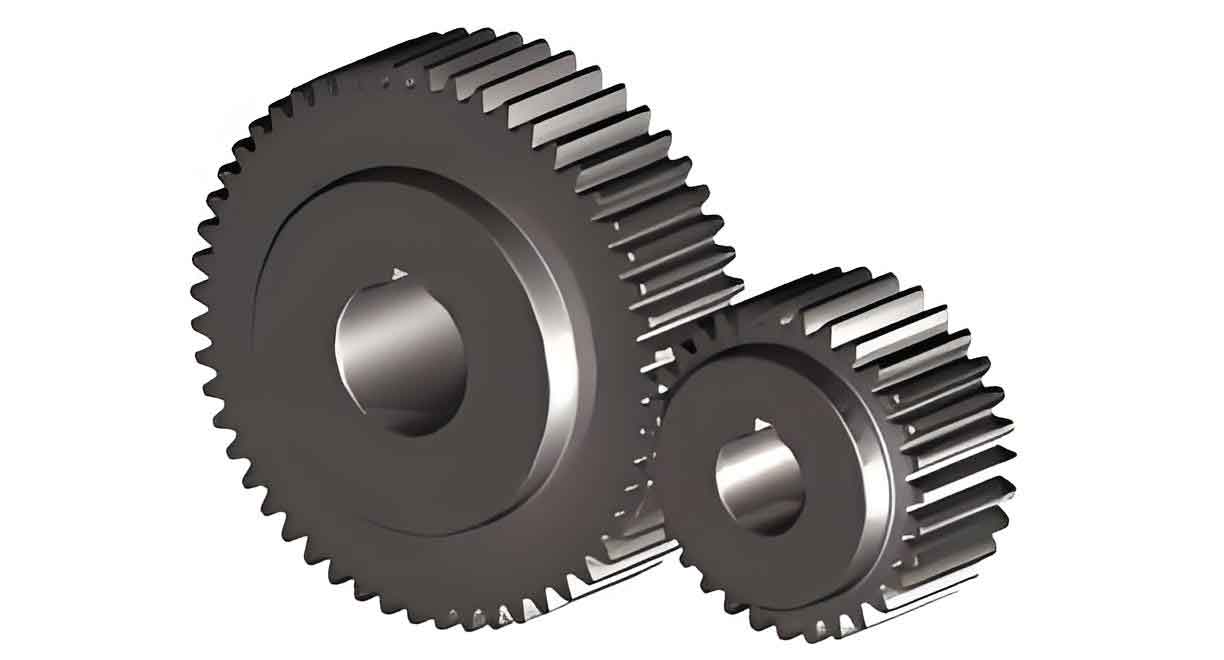
| Teeth Count | 32 | 25 |
| Face Width (mm) | 16 | 16.5 |
| Contact Ratio | 2.2 | |
3. Thermal Boundary Conditions
Critical thermal parameters for spur gear analysis:
| Property | Value |
|---|---|
| Density (kg/m³) | 7,850 |
| Thermal Conductivity (W/m·K) | 46 |
| Specific Heat (J/kg·K) | 470 |
| Parameter | Value |
|---|---|
| Density @15.6°C (kg/m³) | 993 |
| Viscosity @37.8°C (cSt) | 29 |
| Viscosity @98.9°C (cSt) | 5.4 |
4. Parametric Sensitivity Analysis
The thermal behavior of spur gears demonstrates significant dependence on operational and geometric parameters:
4.1 Lubrication Parameters
$$
\Delta T_{gear} = 0.78(\Delta T_{oil})^{1.02} \quad (R^2=0.96)
$$
$$
h_{conv} = 1250 \cdot Q_{oil}^{0.33} \quad (20^{\circ}\text{C} \leq T_{oil} \leq 90^{\circ}\text{C})
$$
| Flow Rate (L/min) | Driver Temp (°C) | Driven Temp (°C) |
|---|---|---|
| 0.44 | 142 | 138 |
| 1.76 | 118 | 114 |
| 2.64 | 112 | 109 |
4.2 Operational Parameters
$$
T_{max} = 85 + 0.12n + 0.25F_n \quad (n\ \text{in rpm}, F_n\ \text{in kN})
$$
| Speed (rpm) | Temperature Rise (°C) |
|---|---|
| 1,000 | 28 |
| 2,000 | 43 |
| 3,000 | 57 |
5. Experimental Validation
The CL-100 gear test rig measurements confirm CFD predictions with <5% deviation. Key findings include:
| Condition | Experimental (°C) | CFD (°C) |
|---|---|---|
| 60°C Oil, 9级 Load | 121 | 118 |
| 90°C Oil, 9级 Load | 135 | 131 |
The thermal behavior of spur gears exhibits distinct characteristics compared to standard gears:
$$
\Delta T_{HCR} = 1.15\Delta T_{Standard} \quad (F_n > 5\ \text{kN})
$$
6. Conclusion
This comprehensive analysis establishes that high contact ratio spur gears under oil jet lubrication exhibit:
- Maximum temperatures at tooth tip regions (15-20% higher than root zones)
- Convective coefficients 18-22% greater on driven gears versus drivers
- Non-linear thermal sensitivity to lubricant flow rates beyond 1.76 L/min
The developed CFD methodology demonstrates strong correlation (R²=0.93) with experimental measurements, validating its effectiveness for spur gear thermal analysis.