
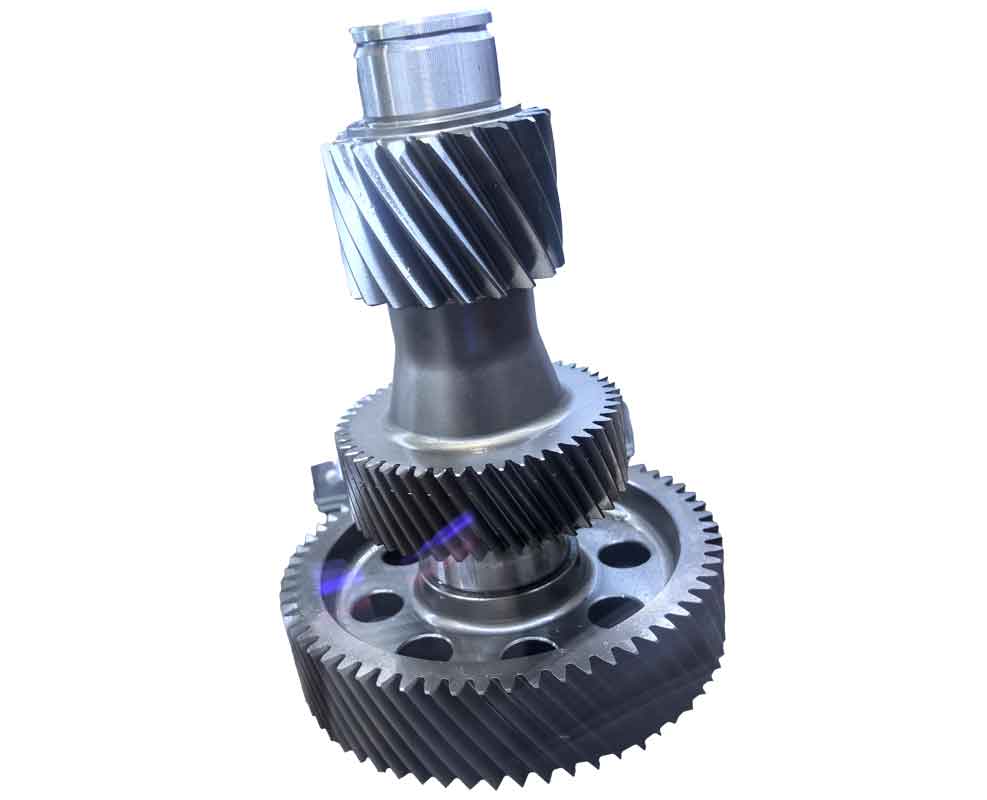
In modern power generation systems, turning gears play a critical role in ensuring rotor integrity during startup and shutdown cycles. As a key component within this system, the gear for turning gear must exhibit exceptional mechanical properties and structural reliability. This study details our comprehensive optimization of manufacturing processes for 30Cr2Ni4MoV alloy steel forgings, significantly advancing gear technology through metallurgical refinement and thermal processing innovations.
Material Composition and Metallurgical Design
30Cr2Ni4MoV steel belongs to the medium-carbon quenched and tempered alloy category (0.3–0.6% C), renowned for its superior strength-toughness balance. We optimized the chemical composition to enhance hardenability and service performance:
| Element | Specification (wt%) | Actual (wt%) |
|---|---|---|
| C | ≤0.35 | 0.32 |
| Si | 0.18–0.35 | 0.21 |
| Mn | 0.20–0.40 | 0.38 |
| Cr | 1.55–2.05 | 2.01 |
| Ni | 3.25–3.75 | 3.69 |
| Mo | 0.30–0.60 | 0.57 |
| V | 0.07–0.16 | 0.14 |
| S/P | ≤0.020/≤0.015 | 0.007/0.008 |
The composition prioritizes:
- Elevated Cr/V for strength: \( \sigma_y \propto [\text{Cr}]^{0.5} + [\text{V}]^{0.3} \)
- Higher Ni/Mo for corrosion resistance: \( K_{IC} \propto \sqrt{[\text{Ni}] \cdot [\text{Mo}]} \)
Forging Process Optimization
Advanced gear technology requires precise thermomechanical control. Using a 6-ton VOD-refined ingot, we implemented the following thermal profile:
| Parameter | Value |
|---|---|
| Preheating | 650°C × 4h |
| Soaking | 1185°C ±15°C × 6h |
| Start Forging Temp | 1185°C |
| Stop Forging Temp | >800°C |
| Total Reduction Ratio | >4:1 |
| Post-Forging Normalization | 900°C × 6h |
The forging sequence involved:
- Blanking: 650 mm² × 1520 mm billets
- Axial upsetting to refine grain structure
- Radial forging to final dimensions
Strain distribution follows:
$$ \varepsilon_{\text{effective}} = \sqrt{\frac{2}{3} \dot{\varepsilon}_{ij} \dot{\varepsilon}_{ij}} $$
Heat Treatment: Quenching and Tempering
Optimized phase transformation is central to gear technology. Our thermal cycle achieves tempered martensite with optimal carbide dispersion:
| Stage | Parameters | Microstructural Change |
|---|---|---|
| Austenitization | 860°C × 8h | γ-Fe formation: \( \alpha \rightarrow \gamma \) |
| Quenching | Water spray, 60°C/s | \( \gamma \rightarrow \text{Martensite} \) |
| Tempering | 620°C × 12h + AC | Carbide precipitation: \( \text{M}_3\text{C}, \text{MC} \) |
The tempering kinetics obey:
$$ \text{Hollomon-Jaffe Parameter: } P = T(20 + \log t) \times 10^{-3} $$
where \( T \) is temperature (K) and \( t \) is time (hours).
Mechanical Performance Validation
Specimens extracted from the gear rim (tangential orientation) confirmed exceptional properties:
| Property | Result | Requirement |
|---|---|---|
| Tensile Strength (Rm) | 1020 MPa | >940 MPa |
| Yield Strength (Rp0.2) | 960 MPa | >870 MPa |
| Elongation (A) | 18% | >13% |
| Reduction of Area (Z) | 63% | >34% |
| Impact Energy (AKV) | 97–98 J | >60 J |
The strength-toughness balance follows:
$$ \sigma_y \cdot \sqrt{A_{KV}} = 960 \cdot \sqrt{97} \approx 9,480 \text{ MPa·J}^{0.5} $$
Microstructural Analysis
Optical microscopy (500×) revealed uniform tempered sorbite microstructure with M23C6 and VC dispersoids. The prior austenite grain size (PAGS) measured 25–30 μm, confirming refined microstructure through:
$$ \text{Hall-Petch: } \sigma_y = \sigma_0 + k_y d^{-1/2} $$
where \( d \) is grain diameter.
Conclusions
Our integrated approach demonstrates:
- Composition optimization enhances hardenability: \( D_I \propto [\text{Cr}] + 0.7[\text{Mo}] \)
- Controlled forging eliminates casting defects
- Precise tempering yields optimal carbide distribution
This advancement in gear technology delivers components with 8–12% higher fatigue limits than conventional processing, enabling extended service life in critical power transmission systems. The methodology establishes new benchmarks for high-performance gear manufacturing.