
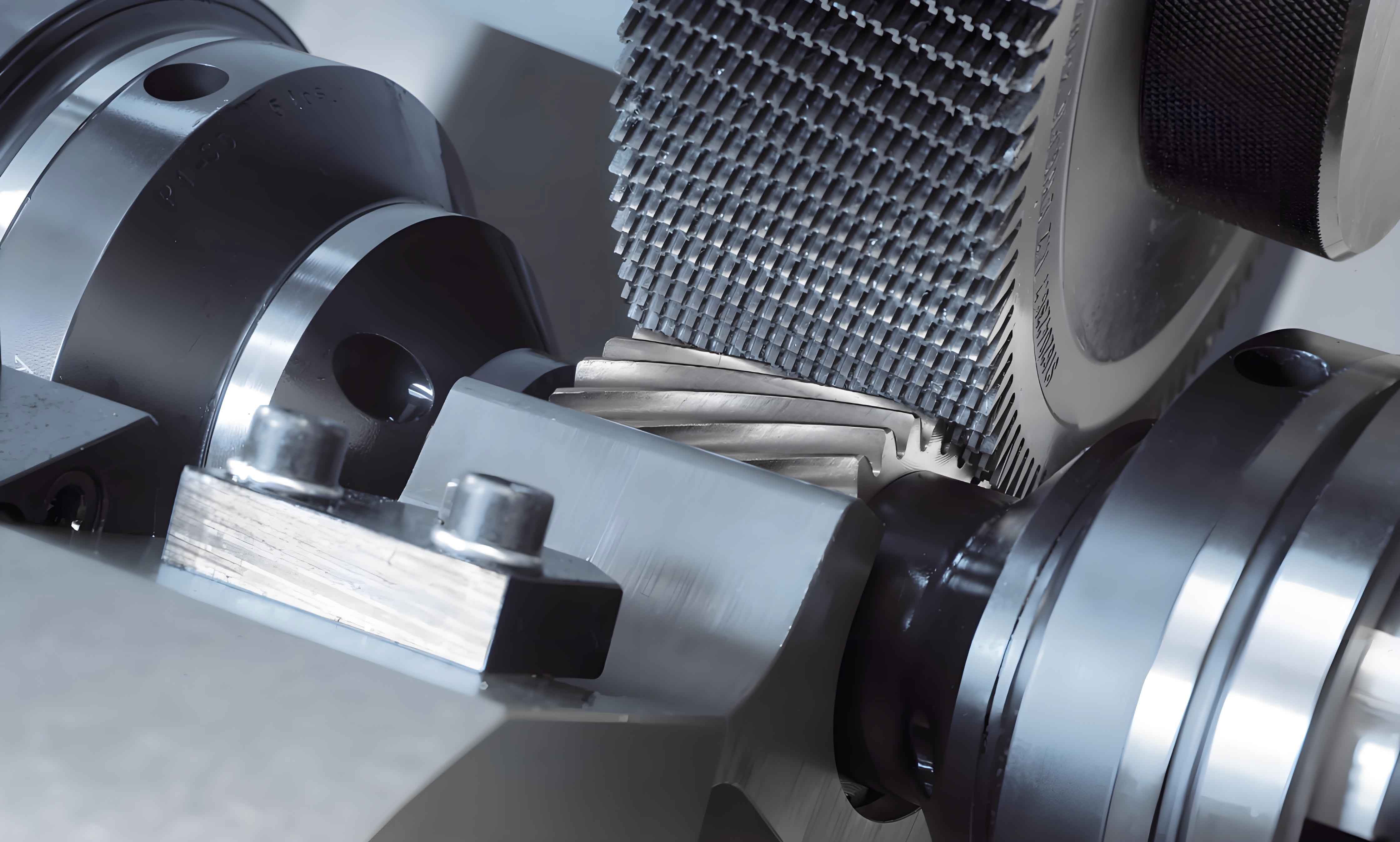
Gear shaving is a critical finishing process applied before final heat treatment in gear manufacturing, renowned for its high precision, efficiency, and adaptability. As the dominant method for producing high-quality gears through the hobbing-shaving sequence, it involves complex interactions between the cutter and workpiece. The cutting mechanics during gear shaving can be expressed as:
$$v_c = \pi \cdot d \cdot n \cdot \cos\Sigma$$
Where \(v_c\) is the cutting speed (m/min), \(d\) is the cutter diameter (mm), \(n\) is the cutter rotational speed (rpm), and \(\Sigma\) is the shaft angle. Despite its advantages, gear shaving faces challenges from multiple variables including gear blank accuracy, machine-fixture alignment, cutter design, crowning quality, and cutting parameters. These factors collectively influence critical quality metrics:
$$\Delta F_\alpha = k_1 \cdot F_t + k_2 \cdot \delta_r$$
$$\Delta F_\beta = k_3 \cdot F_a + k_4 \cdot \delta_a$$
Where \(\Delta F_\alpha\) and \(\Delta F_\beta\) represent tooth profile and helix deviations, \(F_t\) and \(F_a\) are tangential and axial forces, \(\delta_r\) and \(\delta_a\) are radial and axial runouts, and \(k_n\) are influence coefficients.
S-Shaped Tooth Profile
During gear shaving, the variable contact points between cutter and gear create uneven material removal. The contact force distribution follows:
$$F_c = \frac{F_{total}}{n_c} \cdot \cos\left(\frac{2\pi t}{T}\right)$$
Where \(F_c\) is the instantaneous cutting force, \(n_c\) is the number of simultaneous contact points, and \(T\) is the meshing cycle period. This force variation causes the characteristic S-shaped profile error:
| Problem Cause | Solution | Technical Parameters |
|---|---|---|
| Uneven contact force distribution | Optimize cutter design for longer even-contact zones | Even/Odd contact length ratio ≥1.2 |
| Mismatched cutter diameter/tooth thickness | Corrective cutter crowning | Crowning depth = (0.67–1) × deformation |
| Excessive cutter tip interference | Multi-point crowning for severe cases | 3-5 crowning points per flank |
Tooth Surface Scoring
Scoring manifests as radial scratches, axial grooves, or general roughness. The radial velocity component causing scratches is calculated as:
$$v_r = v_c \cdot \sin\Sigma \cdot \sin\phi$$
Where \(\phi\) is the pressure angle. Optimal shaft angle (\(\Sigma\)) selection balances cutting efficiency and surface quality:
| Scoring Type | Primary Causes | Corrective Actions |
|---|---|---|
| Radial scratches | Insufficient shaft angle (Σ <10°) | Maintain Σ=10°–15° (12° ideal) |
| Axial grooves | Feed/slot pitch resonance | Adjust feed: \(f_z \neq p_s \cdot n\) |
| General roughness | Cutter wear or chip adhesion | Maintain Ra <0.4 µm after grinding |
Optimal cutting parameters for medium-module gears:
$$n = 145–175 \text{ rpm}, v_f = 100–150 \text{ mm/min}, f_r = 0.02–0.04 \text{ mm/pass}$$
Root Step Formation
Root steps occur due to interference at the tooth root transition zone. The non-interference condition is governed by:
$$\Delta s = \frac{\pi m}{2} – 2 \cdot x \cdot m \cdot \tan\alpha – \rho_f \geq 0.1m$$
Where \(x\) is cutter profile shift coefficient, \(m\) is module, and \(\rho_f\) is root fillet radius. Prevention strategies:
| Cause | Solution | Control Parameters |
|---|---|---|
| Negative profile shift | Apply positive shift (x>0) | Shift coefficient: +0.3–0.5 |
| Excessive pre-shave allowance | Limit stock removal | Radial stock: 0.05–0.15mm |
| Hob tip wear | Maintain hob relief angle | αrelief ≥12° |
Cutter Tooth Breakage
Sudden cutter failure follows the stress intensity relationship:
$$\sigma_{max} = \frac{F_{cutting}}{A_{edge}} \cdot K_t \geq \sigma_{ult}$$
Where \(K_t\) is the stress concentration factor at chip grooves. Prevention requires integrated approaches:
| Contributing Factor | Control Measure | Critical Values |
|---|---|---|
| Pre-shave burrs | Deburring before gear shaving | Burr height <0.02mm |
| Excessive stock | Radial feed control | Max fr = 0.04mm/pass |
| High cutting speed | Optimize vc | vc ≤110 m/min |
Pitch Error Accumulation
Gear shaving has limited pitch error correction capability expressed as:
$$\Delta F_p^{shaved} = \Delta F_p^{hobbed} – 0.3 \Delta F_r + \epsilon_m$$
Where \(\Delta F_r\) is radial runout and \(\epsilon_m\) is machine error. Fixture accuracy requirements:
| Error Source | Tolerance | Compensation Method |
|---|---|---|
| Fixture runout | <0.008mm TIR | Hydrostatic fixtures |
| Center misalignment | <0.005mm | Laser alignment |
| Hobbing pitch error | <0.025mm | CNC hob correction |
Fundamentals of Metal Cutting in Gear Shaving
Material machinability significantly impacts gear shaving performance. The machinability index \(K_v\) relates tool life to cutting conditions:
$$K_v = \frac{v_{60}}{v_{60}^{ref}} = f\left( HB, \sigma_{uts}, \delta\% \right)$$
Where \(v_{60}\) is cutting speed for 60-minute tool life. Optimal results require matching tool materials to gear alloys:
| Gear Material | Hardness (HB) | Recommended Tool Grade | Max vc (m/min) |
|---|---|---|---|
| Low-C Steel | 140-180 | M35 HSS-Co | 85 |
| Case-Hardened Steel | 180-240 | Powder Metallurgy HSS | 75 |
| Alloy Steel | 200-280 | Cemented Carbide | 110 |
Effective gear shaving requires comprehensive parameter optimization. The process capability index \(C_{pk}\) for shaved gears demonstrates its precision potential:
$$C_{pk} = \min\left( \frac{\text{USL} – \mu}{3\sigma}, \frac{\mu – \text{LSL}}{3\sigma} \right) \geq 1.33$$
Through systematic control of cutter geometry, machine parameters, and cutting mechanics, gear shaving remains indispensable for high-volume precision gear production. Continuous monitoring of the relationship between cutting forces and dimensional accuracy ensures stable quality:
$$\Delta Q = k \cdot \int (F_t \cdot \delta_t + F_r \cdot \delta_r) dt$$
Where \(\Delta Q\) represents accumulated quality deviation, and \(k\) is the process sensitivity coefficient. This integrated approach maximizes the advantages of gear shaving while mitigating its inherent challenges.