
In the automotive industry, helical bevel gears are critical components known for their complex machining requirements and high performance demands. Traditionally, these helical bevel gears are manufactured from high-quality alloy steels such as 20CrMnTi, which necessitate expensive imported equipment for gear cutting. However, this approach poses challenges for small and medium-sized factories due to cost and technical barriers. Even with imported machinery, the average service life of such helical bevel gears is around 100,000 kilometers, and with domestic equipment, issues like abnormal wear, noise, and tooth breakage are common, leading to shorter lifespans. This often results in vehicle downtime due to gear shortages. To address these problems in local vehicle manufacturing and repair in regions like Sichuan, we have developed an alternative material: vanadium-titanium nodular cast iron for producing helical bevel gears through precision casting and heat treatment processes.
Our methodology involves using vanadium-titanium pig iron from local sources, treated with rare-earth magnesium nodularizing agents to produce nodular cast iron. The molten metal is poured into precision resin sand shell molds to cast the tooth profiles of helical bevel gears. After casting, the gears undergo machining processes such as cutting off gates and risers, turning inner and outer circles, threading, and spline milling. Finally, they are subjected to isothermal quenching and electrical running-in pairing to become finished helical bevel gears. Over the years, we have produced more than 1,000 sets of helical bevel gears for various vehicle models, including Beijing BJ130 trucks and Dongfeng 5-ton trucks, with some gears exceeding 100,000 kilometers in service without failure. Bench tests at major automotive plants have confirmed that these helical bevel gears meet domestic steel gear standards, demonstrating the feasibility of this approach.
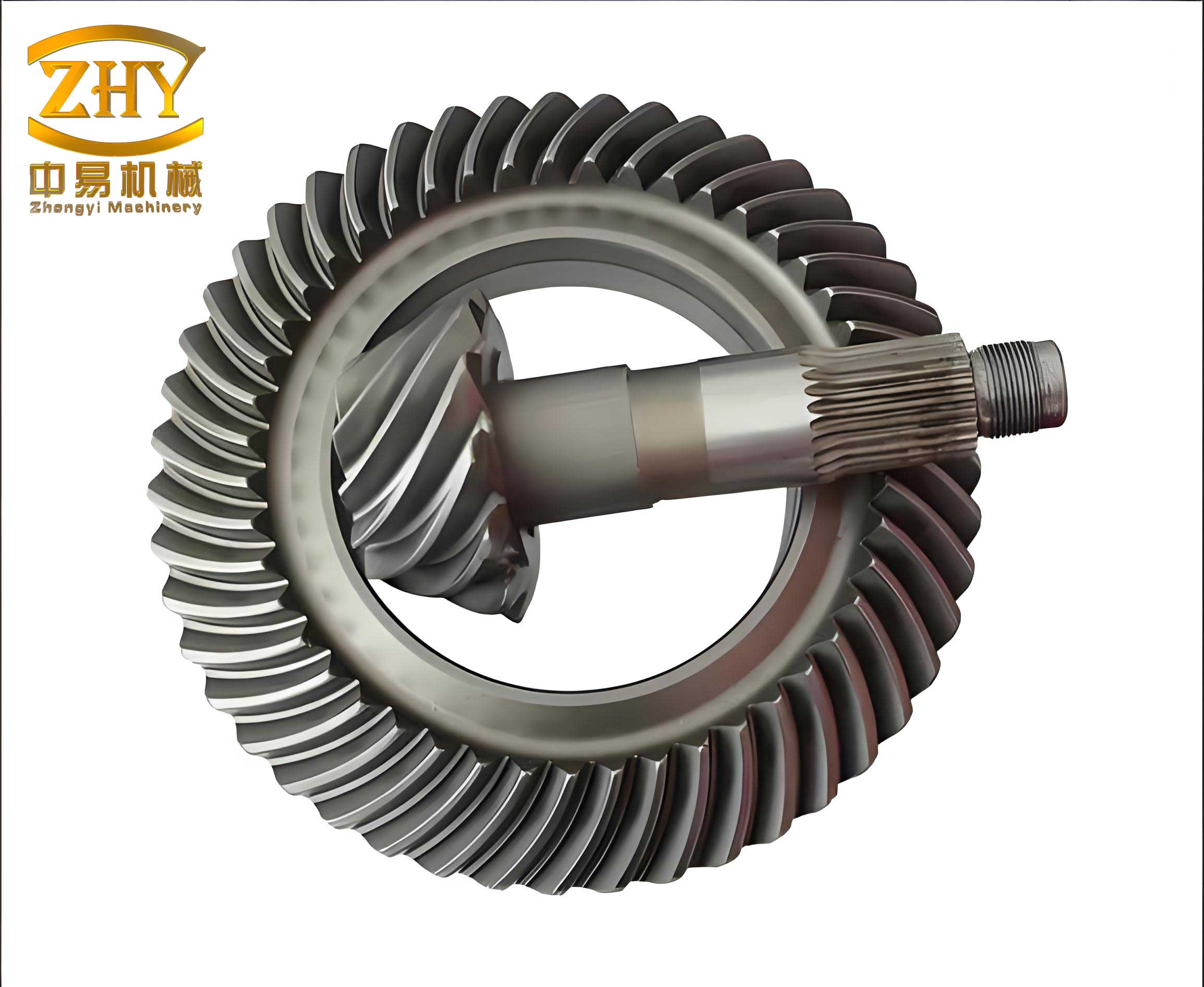
The core of our research lies in the material analysis of vanadium-titanium nodular cast iron for helical bevel gears. Compared to traditional 20CrMnTi steel gears, which require carburizing and quenching to achieve a hard surface (HRC 58-62) and a softer core (HRC 33-48), our vanadium-titanium nodular cast iron gears undergo isothermal quenching, resulting in uniform hardness throughout the gear teeth. This uniformity, combined with the presence of graphite nodules and vanadium-titanium carbides, enhances wear resistance, anti-crushing, and anti-pitting capabilities. The mechanical properties of our helical bevel gears exceed those of steel gears in terms of tensile strength and impact value, although the surface hardness is lower (HRC 45-55). This raises questions about wear performance, but field tests and bench analyses have shown superior durability for helical bevel gears made from this material.
To quantify the material characteristics, we conducted extensive experiments on microstructure, hardness, and wear resistance. The chemical composition of the vanadium-titanium nodular cast iron used in our helical bevel gears is summarized in Table 1. This composition is critical for achieving the desired properties in helical bevel gears after isothermal quenching.
| Element | Content (%) | Role in Material |
|---|---|---|
| C | 3.2-3.8 | Forms graphite nodules and carbides |
| Si | 2.0-2.5 | Promotes graphitization and strength |
| Mn | 0.5-0.8 | Enhances hardenability |
| P | < 0.1 | Minimized to reduce brittleness |
| S | < 0.03 | Low to improve nodularization |
| V | 0.2-0.4 | Forms hard vanadium carbides |
| Ti | 0.1-0.3 | Forms hard titanium carbides |
| Mg | 0.03-0.05 | Nodularizing agent |
| RE | 0.02-0.04 | Rare-earth elements for nodularization |
The mechanical properties after isothermal quenching are presented in Table 2. For helical bevel gears, tensile strength and impact values are crucial to prevent tooth breakage, while hardness dictates wear resistance. Our helical bevel gears achieve a balance that ensures reliability in service.
| Property | Value | Comparison to 20CrMnTi Steel Gears |
|---|---|---|
| Tensile Strength (MPa) | ≥ 900 | Higher than steel (≥ 800 MPa) |
| Impact Value (J/cm²) | ≥ 80 | Higher than steel (≥ 60 J/cm²) | Surface Hardness (HRC) | 45-55 | Lower than steel (HRC 58-62) |
| Core Hardness (HRC) | 40-50 | Similar to surface, unlike steel |
The microstructure of helical bevel gears made from vanadium-titanium nodular cast iron plays a pivotal role in their performance. Through electron probe microanalysis and scanning electron microscopy, we observed that vanadium and titanium elements exist in various forms: solid solution in the matrix, dispersed precipitates, and blocky inclusions of vanadium-titanium carbides. These carbides, such as VC and TiC, have high hardness (HV 2000-3000) and melting points (around 3000°C), acting as hard support points in the gear teeth. The presence of graphite nodules provides self-lubrication, and when脱落, they create oil reservoirs akin to porous bearings. This unique microstructure contributes to the enhanced wear resistance of helical bevel gears.
To analyze the relationship between hardness, microstructure, and fracture behavior, we performed experiments using wedge-shaped test blocks from the same melt. The samples were subjected to isothermal quenching at different temperatures, and their impact values, hardness, and fracture surfaces were examined. The results are summarized in Table 3. For helical bevel gears, understanding this relationship is essential to optimize heat treatment and avoid tooth failure.
| Sample ID | Quenching Temp (°C) | Hardness (HRC) | Microstructure | Impact Value (J/cm²) | Fracture Type |
|---|---|---|---|---|---|
| A1 | 250 | 58-60 | Lower bainite + martensite + ledeburite | 20 | Brittle, large blocks |
| A2 | 280 | 55-57 | Lower bainite + upper bainite | 40 | Brittle, stepped |
| A3 | 300 | 50-52 | Lower bainite + upper bainite | 60 | Ductile, fibrous |
| A4 | 320 | 48-50 | Lower bainite + undissolved ferrite | 80 | Ductile, dimpled |
| A5 | 350 | 45-47 | Lower bainite + undissolved ferrite | 85 | Ductile, dimpled |
From this data, we derive a key formula to describe the transition from brittle to ductile fracture in helical bevel gears based on hardness and microstructure. The critical hardness \( H_c \) for avoiding brittle fracture can be expressed as:
$$ H_c = k_1 \cdot T_q + k_2 $$
where \( T_q \) is the isothermal quenching temperature in °C, and \( k_1 \) and \( k_2 \) are material constants. For our vanadium-titanium nodular cast iron used in helical bevel gears, empirical data suggests that when hardness exceeds HRC 55, the fracture tends to be brittle, whereas below HRC 50, it is predominantly ductile. This is crucial for helical bevel gears to prevent tooth breakage under operational stresses.
Bench test results for helical bevel gears made from our material are compared with traditional steel gears in Table 4. These tests simulate real-world conditions and validate the performance of helical bevel gears in automotive applications.
| Gear Type | Material | Test Conditions | Result | Performance Rating |
|---|---|---|---|---|
| Spiral bevel gear for truck | Vanadium-Titanium Nodular Cast Iron | 2nd gear 100k cycles, 1st gear 200k cycles | No failure, good wear | Excellent |
| Double reduction gear | 20CrMnTi Steel (Domestic) | Standard bench test | Tooth breakage, severe wear | Poor |
| Hypoid gear | 20CrMnTi Steel (Imported) | Standard bench test | Moderate wear, some pitting | Good |
| Helical bevel gear for passenger car | Vanadium-Titanium Nodular Cast Iron | Long-term durability test | No pitting or crushing | Excellent |
The wear resistance of helical bevel gears can be modeled using the Archard wear equation, adapted for our material. The wear volume \( W \) is given by:
$$ W = \frac{K \cdot L \cdot H^{-n}}{A} $$
where \( K \) is a wear coefficient, \( L \) is the load, \( H \) is the hardness (in HRC), \( n \) is an exponent typically around 2 for metals, and \( A \) is the contact area. For helical bevel gears made from vanadium-titanium nodular cast iron, the presence of vanadium-titanium carbides increases the effective hardness, reducing wear. Experimental data from field tests on helical bevel gears show that even with lower surface hardness, the wear rate is comparable to or better than steel gears due to these carbides and graphite effects.
To further analyze the anti-crushing and anti-pitting capabilities of helical bevel gears, we examined gears that had served over 200,000 kilometers. Microhardness measurements across the tooth profile—from tip to root—revealed uniform hardness distribution, as shown in Table 5. This uniformity prevents the layered failure seen in steel gears, where a hard surface shell separates from a softer core under cyclic loading.
| Tooth Region | Microhardness (HV) | Equivalent HRC | Microstructure |
|---|---|---|---|
| Tip | 500-520 | 49-51 | Lower bainite +少量 martensite |
| Center | 480-500 | 47-49 | Lower bainite + undissolved ferrite |
| Root | 470-490 | 46-48 | Lower bainite + upper bainite |
The pitting resistance of helical bevel gears is enhanced by the vanadium-titanium carbides, which inhibit crack propagation. When a fatigue crack initiates, these hard carbides prevent the crack from closing under oil pressure, reducing the risk of pitting. This can be described by a stress intensity factor modification:
$$ K_{eff} = K_I \cdot \left(1 – \frac{V_c}{V_t}\right) $$
where \( K_{eff} \) is the effective stress intensity factor, \( K_I \) is the mode I stress intensity, \( V_c \) is the volume fraction of carbides, and \( V_t \) is the total volume. For helical bevel gears with high carbide content, \( K_{eff} \) decreases, delaying pitting failure.
Based on our findings, we recommend optimized isothermal quenching parameters for helical bevel gears of different vehicle models. These parameters ensure the right balance of hardness and toughness for helical bevel gears, as summarized in Table 6.
| Gear Type (Vehicle Model) | High Temp (°C) | Holding Time (min) | Isothermal Temp (°C) | Isothermal Time (min) | Target Hardness (HRC) |
|---|---|---|---|---|---|
| Pinion (BJ130) | 880-900 | 20-30 | 280-300 | 60 | 48-52 |
| Ring gear (BJ130) | 870-890 | 20-30 | 300-320 | 60 | 45-50 |
| Pinion (Dongfeng 5-ton) | 890-910 | 25-35 | 270-290 | 90 | 50-55 |
| Ring gear (Dongfeng 5-ton) | 880-900 | 25-35 | 290-310 | 90 | 48-53 |
| Pinion (Liberation truck) | 900-920 | 30-40 | 260-280 | 120 | 52-56 |
| Ring gear (Liberation truck) | 890-910 | 30-40 | 280-300 | 120 | 50-54 |
In practice, helical bevel gears should be preheated to around 500°C before isothermal quenching to minimize thermal stresses. The control of hardness is paramount; for most helical bevel gears, surface hardness should be maintained between HRC 45 and 55 to avoid brittle fracture while ensuring wear resistance. Our field data from helical bevel gears in service supports this range, with gears below HRC 50 showing no tooth breakage even after extended use.
The economic and technical advantages of using vanadium-titanium nodular cast iron for helical bevel gears are significant. It reduces reliance on imported materials and equipment, lowers production costs, and extends gear life. Future work could focus on refining the alloy composition for even better performance in helical bevel gears, such as by adjusting vanadium and titanium ratios or incorporating other microalloying elements.
In conclusion, vanadium-titanium nodular cast iron offers a viable alternative to traditional steel for automotive helical bevel gears. Its unique microstructure, characterized by uniform hardness, graphite nodules, and hard vanadium-titanium carbides, provides excellent wear resistance, anti-crushing, and anti-pitting capabilities. Through optimized isothermal quenching, helical bevel gears made from this material can achieve a balance of strength and toughness, ensuring reliable service in demanding applications. We believe that with continued development, helical bevel gears from vanadium-titanium nodular cast iron will become a staple in the automotive industry, offering noise reduction, longer lifespan, and cost-effectiveness. The integration of precision casting and heat treatment processes paves the way for broader adoption of helical bevel gears in various vehicle models, contributing to sustainable manufacturing practices.