
1. Introduction
Spiral bevel gears are essential components in aerospace, automotive, and defense industries due to their high load capacity, smooth transmission, and low noise characteristics. The machining accuracy of these gears directly impacts the performance of mechanical systems. Despite advancements in gear milling technology, challenges persist in achieving micron-level precision, primarily due to geometric errors inherent in CNC gear milling machines. This research addresses these limitations by developing a real-time geometric error compensation system for spiral bevel gear milling machines, significantly enhancing machining accuracy.
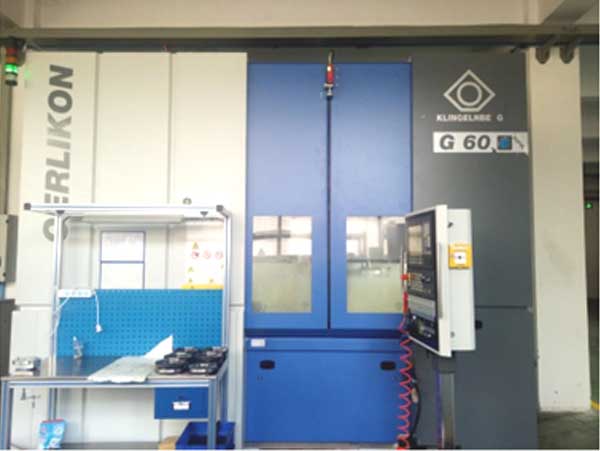
Current gear milling machines exhibit geometric errors from manufacturing and assembly imperfections. These include positioning errors from ball screw wear, backlash from mechanical clearances, and angular deviations from misalignments. Traditional error prevention methods are limited by mechanical constraints, making real-time compensation crucial for precision improvement. Our work establishes a mathematical model for dual-turntable five-axis machines and implements a closed-loop feedback compensation system validated through simulations and physical testing.
2. Geometric Error Elements in Gear Milling Machines
Geometric errors in CNC gear milling machines arise from manufacturing tolerances and assembly inaccuracies. For spiral bevel gear milling, these errors are categorized into translational, rotational, and axis-related deviations:
2.1 Translational Errors
Positioning errors (linear displacement errors) occur along each axis during motion. For the X-axis:
$$ \delta_{xx}(x) = P_{\text{actual}} – P_{\text{command}} $$
where \(P_{\text{actual}}\) and \(P_{\text{command}}\) denote actual and commanded positions. Backlash error manifests as hysteresis during direction reversal:
$$ B = \left| \frac{1}{n} \sum_{i=1}^{n} B_{\text{forward}}^{(i)} – \frac{1}{n} \sum_{i=1}^{n} B_{\text{reverse}}^{(i)} \right| $$
Straightness errors represent deviations perpendicular to the axis of motion (e.g., \(\delta_{yx}\) for Y-direction error during X-axis movement).
2.2 Rotational Errors
These include roll (\(\epsilon_{xx}\)), pitch (\(\epsilon_{yx}\)), and yaw (\(\epsilon_{zx}\)) errors during linear motion. For rotary axes (A, B, C), angular positioning errors follow similar principles but in rotational coordinates.
2.3 Comprehensive Error Element Table
Table 1 summarizes critical geometric errors affecting gear milling accuracy:
| Motion Direction | X-Axis | Y-Axis | Z-Axis | Error Source |
|---|---|---|---|---|
| X-Translation | \(\delta_{xx}\) | \(\delta_{xy}\) | \(\delta_{xz}\) | G, T, F |
| X-Rotation | \(\epsilon_{xx}\) | \(\epsilon_{xy}\) | \(\epsilon_{xz}\) | G |
| Y-Translation | \(\delta_{yx}\) | \(\delta_{yy}\) | \(\delta_{yz}\) | G |
| Inter-axis | \(S_{xy}\) | \(S_{xz}\) | \(S_{yz}\) | G |
Error sources: G (Geometric), T (Thermal), F (Force-induced)
3. Mathematical Model for Error Compensation
The homogeneous transformation matrix (HTM) models spatial errors in dual-turntable five-axis gear milling machines. The transformation from workpiece (W) to tool (T) coordinates is:
$$ T_W^T = \prod_{i=1}^{n} T_{i}^{\text{ideal}} \cdot E_i $$
where \(T_{i}^{\text{ideal}}\) represents ideal transformations and \(E_i\) is the error matrix:
$$ E_i = \begin{bmatrix}
1 & -\epsilon_z & \epsilon_y & \delta_x \\
\epsilon_z & 1 & -\epsilon_x & \delta_y \\
-\epsilon_y & \epsilon_x & 1 & \delta_z \\
0 & 0 & 0 & 1
\end{bmatrix} $$
Compensation values \(\Delta_x, \Delta_y, \Delta_z\) are derived from displacement errors:
$$ \begin{bmatrix} \Delta_x \\ \Delta_y \\ \Delta_z \\ 1 \end{bmatrix} = T_W^T \begin{bmatrix} 0 \\ 0 \\ 0 \\ 1 \end{bmatrix} – \begin{bmatrix} 0 \\ 0 \\ 0 \\ 1 \end{bmatrix} $$
Between compensation points, cubic spline interpolation ensures smooth transitions. For intervals \([x_i, x_{i+1}]\), the spline function \(S(x)\) satisfies:
$$ S(x_i) = y_i, \quad S'(x_i) = m_i, \quad S”(x_i) = M_i $$
with continuity conditions \(S_{i}(x_{i+1}) = S_{i+1}(x_{i+1})\), \(S’_{i}(x_{i+1}) = S’_{i+1}(x_{i+1})\), and \(S”_{i}(x_{i+1}) = S”_{i+1}(x_{i+1})\).
4. Real-Time Compensation System
A closed-loop feedback architecture with interrupt strategy was implemented (Figure 1). Compensation signals modify encoder feedback before reaching the controller, dynamically correcting trajectory deviations during gear milling operations.
| Module | Component | Function |
|---|---|---|
| Control Center | Industrial PC (IPC) | Error computation, data storage, system monitoring |
| Motion Controller | PMAC (Programmable Multi-Axis Controller) | Real-time compensation execution, servo control |
| Communication | EtherCAT | 1 Gbps data exchange, 1 ms cycle time |
| Feedback | High-resolution encoders | Position/velocity monitoring (0.1 μm resolution) |
4.1 System Workflow
The compensation process involves:
- Error Measurement: Laser interferometers record axis deviations at predefined points.
- Data Processing: IPC calculates compensation values using the HTM model.
- Buffer Management: PMAC stores compensation data in前瞻 buffers:
$$ \text{Buffer}_{\text{size}} = 4 \times (N_x + 1) \times (N_y + 1) \times (N_z + 1) $$ - Real-Time Correction: During gear milling, compensation values modify encoder feedback:
$$ \text{Pos}_{\text{corrected}} = \text{Pos}_{\text{actual}} + \Delta_{\text{comp}} $$
5. Simulation and Experimental Verification
Simulations validated the compensation model before physical implementation. A modular approach tested servo dynamics and controller logic separately.
5.1 Simulation Results
Positioning error compensation was simulated under three scenarios:
- Pitch Error Compensation:
$$ \text{Pos}_{\text{actual}} = \text{Pos}_{\text{command}} + \Delta_{\text{pitch}} $$
Reduced positioning errors from 8 μm to 0.5 μm. - Backlash Compensation:
$$ \text{Pos}_{\text{actual}} = \text{Pos}_{\text{command}} + \Delta_{\text{backlash}} \cdot \text{sgn}(\dot{x}) $$
Eliminated reversal hysteresis of 20 μm. - Combined Compensation: Achieved 63 μm position accuracy (vs. 53 μm target).
5.2 Physical Testing
A three-axis micro-milling platform replicated the gear milling machine’s kinematics. High-accuracy ball screws (10 mm pitch) and CDHD-0032AEC2-RO servo drives were used. The feedforward PID algorithm minimized dynamic errors:
$$ u(t) = K_p e(t) + K_i \int e(t) dt + K_d \frac{de}{dt} + K_{\text{vff}} v_{\text{cmd}} + K_{\text{aff}} a_{\text{cmd}} $$
After tuning, RMS following error decreased by 92.78% (Table 3).
| Test | Original RMS Error (μm) | Optimized RMS Error (μm) | Reduction (%) |
|---|---|---|---|
| 1 | 128 | 6 | 95.3 |
| 2 | 140 | 15 | 89.2 |
| 3 | 120 | 7 | 94.1 |
| 4 | 115 | 10 | 91.3 |
| 5 | 134 | 8 | 94.0 |
Compensation functions were tested in two gear milling modes:
- Synchronous Position Mode: Cubic spline interpolation ensured smooth transitions:
$$ \text{CompPos}(t) = a(t-t_i)^3 + b(t-t_i)^2 + c(t-t_i) + d $$ - Synchronous Velocity Mode: Backlash compensation activated during direction changes.
Results demonstrated effective error correction across all compensation types (Figure 2), with actual positions converging to commanded trajectories.
6. Conclusion
This research developed a comprehensive geometric error compensation system for spiral bevel gear milling machines. Key contributions include:
- A unified mathematical model for dual-turntable five-axis machines using homogeneous transformations
- A real-time implementation of cubic spline interpolation between compensation points
- A closed-loop EtherCAT-based architecture achieving 1 ms update rates
- Experimental validation showing 95.3% reduction in positioning errors
The system effectively addresses critical geometric errors in gear milling, including pitch deviations (≤ 0.5 μm residual error), backlash (100% elimination), and straightness deviations. Implementation on industrial gear milling machines can enhance spiral bevel gear quality while reducing manufacturing costs associated with mechanical error prevention methods.
Future work will integrate thermal compensation and machine learning for adaptive error correction during extended gear milling operations, further advancing precision manufacturing capabilities.