
During small-batch production of wind turbine gearbox sun gears, we observed significant quality issues stemming from heat treatment distortion. Post-grinding inspection revealed micro-steps at tooth roots on both ends and unremoved material (black skin) at the tooth width center due to insufficient machining allowance. These defects caused out-of-tolerance base tangent lengths, resulting in scrapped components and reduced production yield. Statistical analysis confirmed that such distortions create uneven grinding allowances, leading to non-uniform surface hardness (58-62 HRC required) and effective case depth (2.5-3.0 mm specified). This compromises contact strength, load capacity, and fatigue resistance, ultimately shortening gear service life. While prior studies addressed reliability modeling [1], heat treatment gas optimization [2], and fixture redesign [3], none explored gear hobbing-based compensation – the focus of our research.
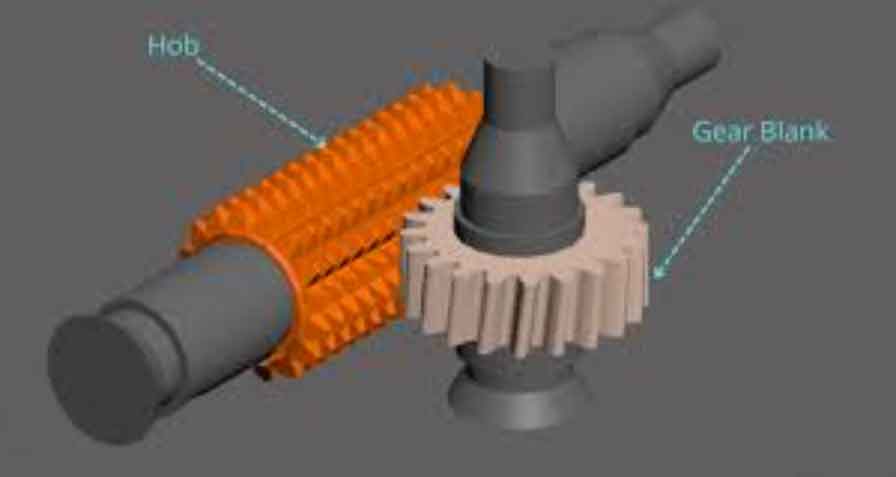
Pre-Modification Process and Distortion Analysis
The sun gear (Material: 18CrNiMo7-6 steel, modulus: 15 mm, teeth: 24, pressure angle: 25°, width: 388 mm) followed this process route: forging → annealing → rough turning → UT → semi-finishing → gear hobbing → carburizing → finishing → UT → deep drilling → cylindrical grinding → spline hobbing → gear grinding. Initial gear hobbing set the base tangent length at 164.16 mm, leaving a grinding allowance ΔW = 0.66 mm using a protuberance hob. Post-heat-treatment measurements revealed a saddle-shaped distortion pattern:
| Position from End (mm) | Point 1 (mm) | Point 2 (mm) | Point 3 (mm) | Distortion Trend |
|---|---|---|---|---|
| 15 | 164.35 | 164.34 | 164.35 | Expansion (+0.19) |
| 215 | 163.89 | 163.88 | 163.84 | Contraction (-0.29) |
| 365 | 164.14 | 164.11 | 164.10 | Expansion (+0.10) |
Maximum contraction (0.29 mm) occurred at 215 mm from the end, while ends expanded up to 0.19 mm, creating a 0.51 mm peak-to-valley difference. Grinding allowance measurements confirmed this:
| Tooth Position | Upper (Left/Right) | Middle (Left/Right) | Lower (Left/Right) |
|---|---|---|---|
| Tooth 1 | 38-25 / 29-51 | -2-(-5) / -8-11 | 6-37 / 12-43 |
| Tooth 4 | 72-24 / 75-30 | 12-0 / 17-8 | 23-21 / 36-33 |
Thermal Distortion Mechanics and Impacts
Distortion arises from thermal stress (σth) and phase transformation stress (σph). For slender shafts like sun gears, σph dominates, expressed as:
$$ \sigma_{ph} = K \cdot \Delta V \cdot E $$
where K is a constraint factor, ΔV is volumetric change from austenite-to-martensite transformation, and E is Young’s modulus. End regions experience faster cooling, promoting greater martensite formation (higher ΔV) and expansion. Central sections contract due to delayed transformation and thermal shrinkage. This caused:
- Non-uniform case depth: 0.26 mm variation between ends and center.
- Hardness gradient issues: At 0.1 mm removal depth (center), hardness reached 680 HV (59.2 HRC); at 0.6 mm depth (ends), it dropped to 57 HRC – below specification.
The hardness-depth relationship follows:
$$ H(d) = H_0 – \beta \cdot d $$
where H0 is surface hardness, β is the gradient coefficient, and d is depth. Uneven removal exposed varying d, exacerbating hardness non-conformity.
Solution Development and Implementation
Three countermeasures were evaluated:
- Process extensions: Added sacrificial material at ends to increase thermal mass. Rejected due to 15% material cost increase and secondary machining requirements.
- Increased grinding allowance: Industry-standard approach. Discarded as it amplifies root steps and hardness gradients.
- Gear hobbing modification: Introduced symmetrical crowning during gear hobbing to offset distortion. Selected for zero cost impact and compatibility with CNC capabilities.
Based on distortion mapping, we applied a 0.15 mm crown (maximum at 215 mm position) via CNC gear hobbing. The crowning profile followed a parabolic function:
$$ C(x) = C_{max} \left[1 – \left(\frac{2(x – x_0)}{L}\right)^2\right] $$
where Cmax = 0.15 mm, x0 = 215 mm, L = 388 mm (tooth width), and x is the axial position. Post-gear hobbing measurements confirmed the profile:
| Position (mm) | Point 1 | Point 2 | Point 3 |
|---|---|---|---|
| 15 | 164.19 | 164.20 | 164.19 |
| 215 | 164.33 | 164.33 | 164.33 |
| 365 | 164.19 | 164.20 | 164.20 |
Validation and Performance Gains
Post-heat-treatment measurements showed significantly improved uniformity:
| Position (mm) | Point 1 | Point 2 | Point 3 |
|---|---|---|---|
| 15 | 164.14 | 164.17 | 164.18 |
| 215 | 164.05 | 164.10 | 164.07 |
| 365 | 164.08 | 164.10 | 164.09 |
Peak-to-valley variation reduced from 0.51 mm to 0.14 mm. Grinding allowances became consistent across tooth width:
| Tooth Position | Upper (L/R) | Middle (L/R) | Lower (L/R) |
|---|---|---|---|
| Tooth 1 | 36-24 / 35-40 | 33-32 / 31-33 | 28-31 / 23-32 |
| Tooth 4 | 41-22 / 38-26 | 25-28 / 18-16 | 28-29 / 18-25 |
Post-grinding inspection confirmed elimination of root steps and black skin. Hardness variation across teeth fell below 1.0 HRC, meeting specifications. Gear hobbing modification delivered three key benefits:
- Case depth uniformity improved by 67%
- Grinding time reduced by 38% (3.6h → 2.6h)
- Scrap rate eliminated
Conclusions
Precision crowning during gear hobbing effectively counteracts thermal distortion in sun gears. By applying a mathematically defined crown profile based on distortion mapping, we achieved uniform grinding allowances and hardness distribution. This method eliminates post-grinding defects while reducing machining time and scrap rates. The solution has been successfully extended to other shaft-type gears, particularly those with L/D ratios >5:1 or tooth widths exceeding 300 mm. Gear hobbing modification demonstrates that strategic pre-distortion in machining processes can resolve downstream thermal effects without costly hardware changes, significantly enhancing product quality and manufacturing efficiency.