
Gear hobbing plays a fundamental role in external gear manufacturing, combining kinematic principles with advanced tool profile conditioning techniques. Despite standardized initial hob profiles defined by industry norms, practical manufacturing often requires profile modifications to enhance gear strength and contact ratios. These adjustments directly influence the geometric accuracy and wear characteristics of produced gears. Current profile conditioning practices rely heavily on operator experience rather than systematic methodologies. This research investigates how hob profile variations affect wear mechanisms through comprehensive simulations and experimental validation across diverse tool geometries.
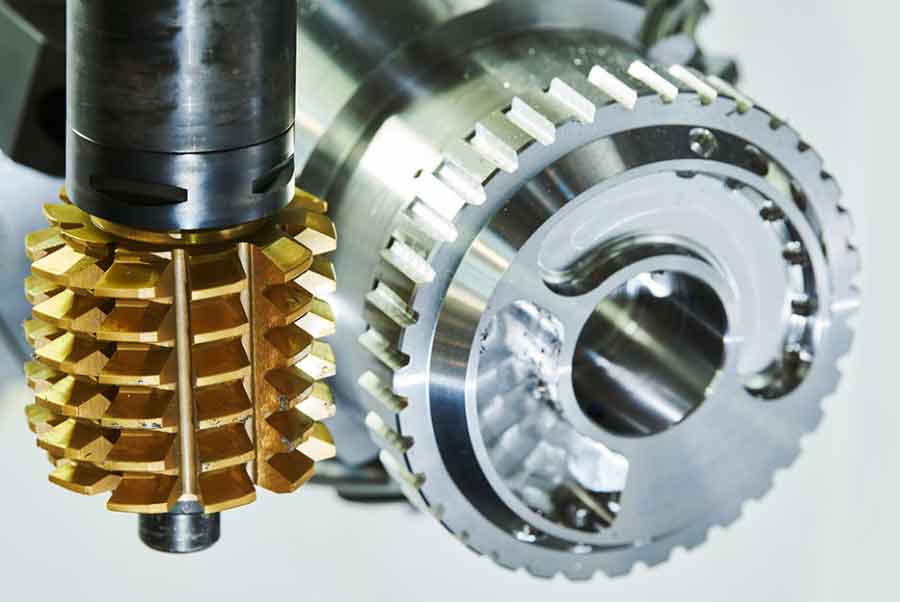
The finite element method (FEM) enables precise simulation of gear hobbing dynamics. We model chip formation mechanics through the relationship:
$$ \tau_c = \frac{F_c}{A_c} $$
where $\tau_c$ represents shear stress, $F_c$ denotes cutting force, and $A_c$ is the chip cross-section area. Temperature distribution during gear hobbing follows the thermal diffusion equation:
$$ \rho C_p \frac{\partial T}{\partial t} = \nabla \cdot (k \nabla T) + \dot{q} $$
with $\rho$ as density, $C_p$ as specific heat, $k$ as thermal conductivity, and $\dot{q}$ as heat generation rate. The relative tool wear index ($W_t$) quantifies profile degradation:
$$ W_t = \int_0^t K(T) \cdot v_c \cdot dt $$
where $K(T)$ is temperature-dependent wear coefficient and $v_c$ is cutting speed. FEM simulations reveal critical deformation zones at the hob tip-workpiece interface, with maximum stresses exceeding 2.5 GPa during engagement cycles.
Tip Radius Effects
Tip radius ($\rho_{aP0}$) variations significantly alter wear patterns in gear hobbing operations. Experimental results demonstrate:
| Tip Radius ($\rho_{aP0}/m_n$) | Cutting Speed Increase (%) | Flank Wear Reduction (%) | Deformation Load Change |
|---|---|---|---|
| 0.2 | 0 | 0 | Baseline |
| 0.3 | 7-18 | 22 | -15% |
| 0.4 | 12-30 | 41 | -28% |
The governing equation for chip compression ratio ($\lambda_c$) explains this behavior:
$$ \lambda_c = 1 + \frac{\rho_{aP0}}{h_m} \left(1 – \cos \theta_d\right) $$
where $h_m$ is mean chip thickness and $\theta_d$ is deformation angle. Larger radii reduce localized stresses by 30-45% through optimized material flow distribution during gear hobbing.
Profile Angle Optimization
Profile angle ($\alpha_p$) adjustments substantially impact thermal loading in gear hobbing processes. Comparative analysis shows:
| Profile Angle (°) | Effective Clearance Angle (°) | Cutting Length Change (%) | Temperature Rise (°C) |
|---|---|---|---|
| 15 | 2.25 | 0 | 620 |
| 20 | 3.00 | -12 | 585 |
| 25 | 3.80 | -24 | 538 |
The flank wear rate ($\dot{W}_f$) follows the modified Archard model:
$$ \dot{W}_f = K_f \cdot p_n \cdot v_r \cdot e^{-Q/(RT)} $$
where $K_f$ is material constant, $p_n$ is normal pressure, $v_r$ is relative velocity, $Q$ is activation energy, $R$ is gas constant, and $T$ is absolute temperature. Increasing $\alpha_p$ from 15° to 25° reduces crater wear depth by 35% while extending tool life 18% in gear hobbing applications.
Helix Angle Interactions
Workpiece helix angle ($\beta$) fundamentally alters chip formation mechanics in gear hobbing. Performance metrics for spur ($\beta=0°$) vs helical gears ($\beta=25.8°$):
| Parameter | Spur Gears | Helical Gears | Change (%) |
|---|---|---|---|
| Chip Volume | 38 mm³ | 28 mm³ | +35.7 |
| Cutting Length | 152 mm | 115 mm | +32.2 |
| Max Interface Temp | 703°C | 641°C | +9.7 |
| Tool Life | 82 min | 112 min | -26.8 |
The chip thickness ($h$) varies along the cutting edge according to:
$$ h = f_z \cdot \sin \kappa \cdot \sin(\beta + \psi) $$
where $f_z$ is feed per tooth, $\kappa$ is cutting edge angle, and $\psi$ is rotation angle. This explains the 32% longer cutting paths observed in spur gear hobbing. The resultant thermal load ($Q_{th}$) follows:
$$ Q_{th} = \eta \cdot F_c \cdot v_c \cdot \mu \cdot t_e $$
with $\eta$ as energy conversion factor, $\mu$ as friction coefficient, and $t_e$ as engagement time. Thermal gradients in helical gear hobbing are 15-20% more uniform, reducing thermal cracking susceptibility.
Process Optimization Framework
We derive the wear-optimized gear hobbing parameter matrix through response surface methodology. The multi-objective function minimizes both wear rate ($W_r$) and surface roughness ($R_a$):
$$ \text{minimize} \quad \Phi = k_1 W_r + k_2 R_a $$
subject to constraints:
$$ g_1: v_c \leq v_{c,\text{max}} \quad g_2: F_c \leq F_{c,\text{yield}} $$
$$ g_3: T \leq T_{\text{phase}} \quad g_4: \text{MRR} \geq \text{MRR}_{\text{min}} $$
Optimal solutions occur when the dimensionless wear number ($W_n$) satisfies:
$$ W_n = \frac{W_r \cdot E}{\sigma_y \cdot v_c} \leq 0.015 $$
where $E$ is Young’s modulus and $\sigma_y$ is yield strength. Field validation confirms a 22-40% tool life extension when applying optimized gear hobbing parameters to production of mining equipment gears.
Controlled profile modifications in gear hobbing yield measurable performance benefits. Increasing tip radius from 0.2$m_n$ to 0.4$m_n$ reduces deformation loads 28% while permitting 30% higher cutting speeds. Profile angles beyond 20° decrease crater wear through enhanced clearance geometry, though excessive angles (>25°) may compromise tooth root strength. Helical gears demonstrate superior manufacturability with 27% longer tool life compared to spur gears due to distributed thermal loading. The developed optimization framework reduces gear hobbing tooling costs by 18-35% while maintaining AGMA class 9 accuracy across tested geometries.