
In the field of precision manufacturing, gear grinding plays a critical role in achieving high accuracy and surface quality for cylindrical gears. Among various methods, generative grinding using a worm wheel is widely adopted due to its efficiency and capability to produce complex gear profiles. However, the presence of position errors in the worm wheel during gear profile grinding can lead to significant deviations in the tooth surface, including issues like grinding cracks, which compromise the integrity and performance of the gears. In this paper, I investigate the impact of worm wheel position changes on tooth surface deviations in generative grinding, utilizing a mathematical model based on the two-parameter envelope theory. By analyzing the distribution of meshing traces and incorporating position errors, I derive equations to compute profile and thickness deviations, and propose compensation strategies to mitigate these errors. This study aims to provide a theoretical foundation for enhancing the accuracy of gear grinding processes and minimizing defects such as grinding cracks.
The generative grinding process for cylindrical gears can be conceptualized as the meshing of a pair of crossed helical gears with non-parallel axes. The worm wheel, acting as the grinding tool, and the gear workpiece engage in a relative motion that generates the tooth surface through a series of enveloping actions. The mathematical model for this process is established using the two-parameter envelope theory, which accounts for the independent motion parameters of the worm wheel and the gear. Let me define the coordinate systems: $H_1(O_1: x_1, y_1, z_1)$ is fixed to the worm wheel, with the $z_1$-axis aligned to its rotational axis, and $H_2(O_2: x_2, y_2, z_2)$ is fixed to the gear, with the $z_2$-axis along its rotational axis. The angle between these axes is denoted as $\Sigma$, and the center distance is $a$. The worm wheel rotates with angular velocity $\omega_1$ and may translate along $z_1$, while the gear rotates with $\omega_2$ and translates along $z_2$. The relationship between these motions is given by:
$$\omega_2 = i_{21} \omega_1 + \frac{v_{02}}{P_2}$$
where $i_{21}$ is the transmission ratio, $v_{02}$ is the translational velocity, and $P_2$ is the helical parameter of the gear. For simplicity, I assume $v_{01} = 0$ in this analysis. The axial profile of the worm wheel is represented as a function of parameter $u$:
$$\mathbf{r}_f(u) = [x_f(u), 0, z_f(u), 1]^T$$
This profile undergoes a helical motion to form the worm wheel surface:
$$\mathbf{r}_1(u, \theta_1) = \mathbf{M}_{1f}(\theta_1) \mathbf{r}_f(u)$$
where $\mathbf{M}_{1f}$ is the transformation matrix for the helical motion, and $\theta_1$ is the helical angle. The helical parameter $P_1$ for the worm wheel is calculated as:
$$P_1 = r_p \tan\left(\sin^{-1}\left(\frac{m_n z_1}{2 r_p}\right)\right)$$
with $r_p$ being the reference radius, $m_n$ the normal module, and $z_1$ the number of teeth on the worm wheel. The gear tooth surface $\mathbf{r}_2$ is derived by transforming the worm wheel surface to the gear coordinate system:
$$\mathbf{r}_2(u, \theta_1, \phi_1, \phi_2) = \mathbf{M}_{2p}(\phi_2) \mathbf{M}_{p0} \mathbf{M}_{01}(\phi_1) \mathbf{r}_1(u, \theta_1)$$
Here, $\phi_1$ and $\phi_2$ are the rotation angles of the worm wheel and gear, respectively, and the matrices $\mathbf{M}_{2p}$, $\mathbf{M}_{p0}$, and $\mathbf{M}_{01}$ represent the coordinate transformations. The meshing condition for point contact is given by the equation:
$$\mathbf{v}^{(12)} \cdot \mathbf{n} = 0$$
where $\mathbf{v}^{(12)}$ is the relative velocity and $\mathbf{n}$ is the normal vector to the worm wheel surface. This leads to a system of equations that can be solved for the parameters $\theta_1$ and $\phi_1$ in terms of $u$. By discretizing the axial profile and solving these equations, I obtain the meshing trace on the gear tooth surface. To analyze the end-face profile, the points on the meshing trace are projected onto the $x_2O_2y_2$ plane using a projection matrix. For instance, for a right-handed worm wheel and gear, the projection is given by:
$$\mathbf{r}_0 = \mathbf{M}_{02} \mathbf{r}_2(u)$$
where $\mathbf{M}_{02}$ includes a rotation by $\theta_2 = z_0 / P_2$, with $z_0$ being the $z_2$-coordinate of the meshing point. This mathematical framework allows me to compute the theoretical tooth profile and subsequently analyze deviations due to position errors.
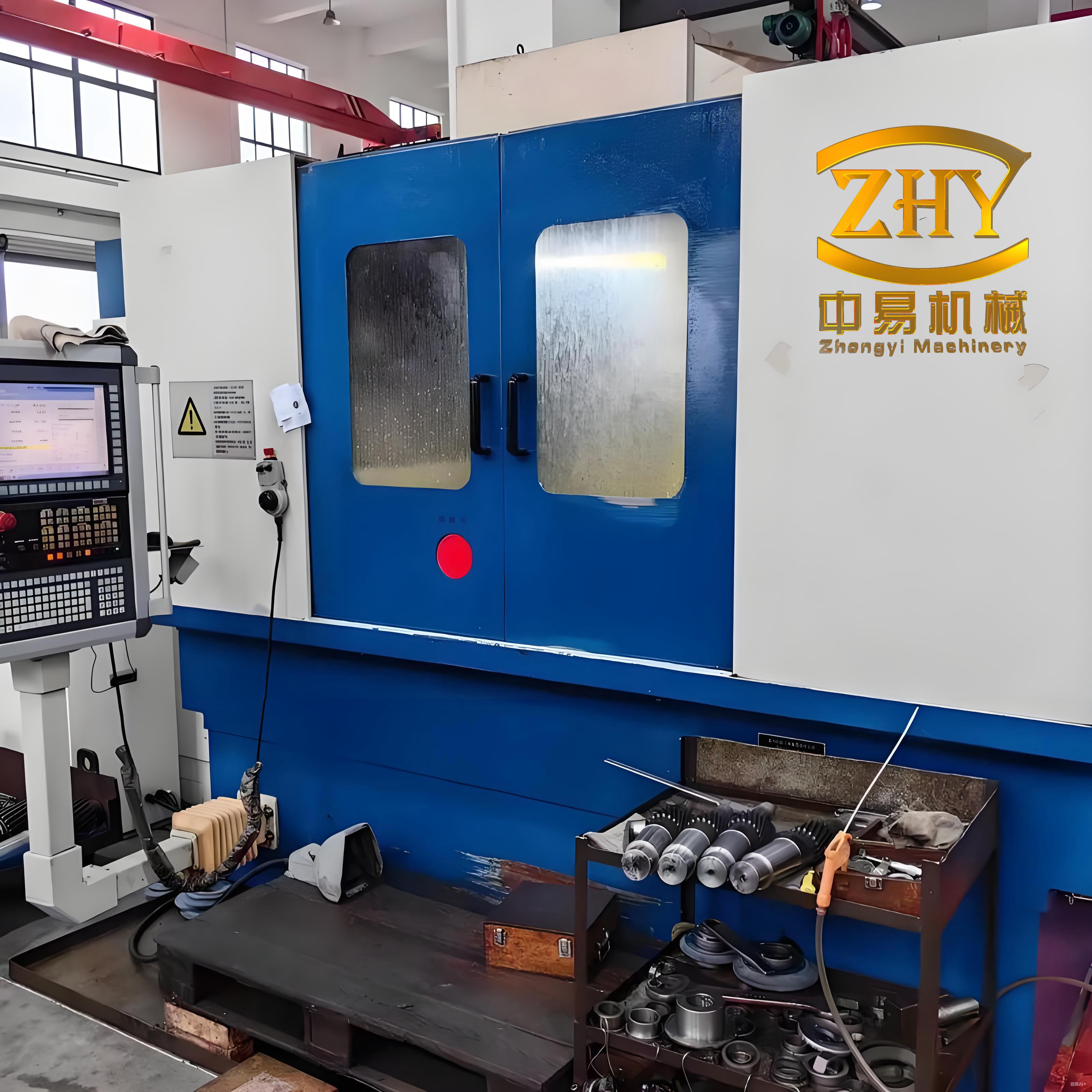
In practical gear grinding operations, position errors in the worm wheel arise from various sources, such as machine tool inaccuracies, thermal deformations, or dynamic loads, leading to deviations in the tooth surface. These errors can manifest as profile errors or even grinding cracks if not properly controlled. To model these effects, I consider the position errors of the worm wheel in the machine coordinate system, which include translations along the X, Y, and Z axes ($\Delta x$, $\Delta y$, $\Delta z$) and a rotation about the A axis ($\Delta A$). The error transformation matrix $\mathbf{M}_{1w}$ that maps the ideal worm wheel position to the erroneous one is expressed as:
$$\mathbf{M}_{1w} = \begin{bmatrix}
1 & 0 & 0 & \Delta x \\
0 & \cos \Delta A & -\sin \Delta A & \Delta z \sin \Sigma \\
0 & \sin \Delta A & \cos \Delta A & \Delta y + \Delta z \cos \Sigma \\
0 & 0 & 0 & 1
\end{bmatrix}$$
Incorporating this into the gear surface equation, the deviated end-face profile becomes:
$$\mathbf{r}_0(\Delta x, \Delta y, \Delta z, \Delta A) = \mathbf{M}_{02} \mathbf{M}_{2p} \mathbf{M}_{p0} \mathbf{M}_{01} \mathbf{M}_{1w} \mathbf{M}_{1f} \mathbf{r}_f$$
By resolving the meshing equations with these errors, I compute the actual tooth profile. The evaluation of profile deviations involves comparing the deviated profile to the theoretical one. For a point $M’$ on the deviated profile, I calculate the profile error $M’M$ as the distance to the theoretical profile along the normal direction. Specifically, if $M’N$ is the distance from $M’$ to the base circle tangent point $N$, and $MN$ is the corresponding theoretical length, then:
$$M’M = M’N – MN$$
where $M’N = \sqrt{x_p^2 + y_p^2 – r_b^2}$, $\theta = \arctan(x_p / y_p) + \arctan(M’N / r_b) – \sigma_0$, and $MN = r_b \theta$. Here, $r_b$ is the base radius, and $\sigma_0$ is the base circle slot half-angle. The profile deviation is plotted against the roll angle $\theta$, and a least-squares fit is used to determine the profile slope deviation $f_{ha}$ and the thickness deviation at the pitch circle. This approach allows me to quantify the impact of position errors on gear accuracy and assess the risk of grinding cracks due to uneven material removal.
To systematically analyze the influence of worm wheel position errors, I consider a case study with a right-handed worm wheel and gear. The parameters are as follows: worm wheel teeth $z_1 = 1$, normal module $m_n = 3$ mm, radius $r_1 = 50$ mm; gear teeth $z_2 = 48$, pressure angle $\alpha = 20^\circ$, helix angle $\beta = 30^\circ$. The evaluation range for the roll angle is from $18.89^\circ$ to $25.62^\circ$. I vary each position error within practical limits: linear errors from $-0.05$ to $0.05$ mm and angular error $\Delta A$ from $-0.01$ to $0.01$ rad. The results for profile slope deviation $f_{ha}$ and thickness deviation $S$ are summarized in the tables below.
| Error $\Delta x$ (mm) | Left Profile $f_{hal}$ (μm) | Right Profile $f_{har}$ (μm) | Left Thickness $S_l$ (μm) | Right Thickness $S_r$ (μm) |
|---|---|---|---|---|
| -0.05 | -25.3 | -24.8 | -20.8 | -21.2 |
| -0.03 | -15.2 | -14.9 | -12.5 | -12.7 |
| 0.00 | 0.0 | 0.0 | 0.0 | 0.0 |
| 0.03 | 15.1 | 14.8 | 12.4 | 12.6 |
| 0.05 | 25.2 | 24.7 | 20.7 | 21.1 |
The data shows that $\Delta x$ errors cause nearly linear changes in both profile slope and thickness deviations. Positive $\Delta x$ increases the deviations positively, while negative $\Delta x$ decreases them. This symmetry indicates that X-axis errors uniformly affect both sides of the tooth, which is crucial for controlling the overall gear geometry in gear profile grinding. Such deviations, if uncorrected, could lead to uneven loading and potential grinding cracks under operational stresses.
| Error $\Delta y$ (mm) | Left Profile $f_{hal}$ (μm) | Right Profile $f_{har}$ (μm) | Left Thickness $S_l$ (μm) | Right Thickness $S_r$ (μm) |
|---|---|---|---|---|
| -0.05 | -42.1 | 41.8 | -14.5 | 14.9 |
| -0.03 | -25.3 | 25.1 | -8.7 | 8.9 |
| 0.00 | 0.0 | 0.0 | 0.0 | 0.0 |
| 0.03 | 25.2 | -25.0 | 8.6 | -8.8 |
| 0.05 | 42.0 | -41.7 | 14.4 | -14.8 |
For $\Delta y$ errors, the profile slope deviations exhibit antisymmetric behavior: positive $\Delta y$ increases $f_{hal}$ but decreases $f_{har}$, and vice versa for negative $\Delta y$. The thickness deviations also show antisymmetry, with left and right sides changing in opposite directions. This highlights the importance of Y-axis alignment in gear grinding to avoid asymmetric tooth profiles that could induce stress concentrations and grinding cracks. The linear relationship suggests that compensation can be effectively applied.
| Error $\Delta z$ (mm) | Left Profile $f_{hal}$ (μm) | Right Profile $f_{har}$ (μm) | Left Thickness $S_l$ (μm) | Right Thickness $S_r$ (μm) |
|---|---|---|---|---|
| -0.05 | -21.5 | 21.3 | -7.4 | 7.6 |
| -0.03 | -12.9 | 12.8 | -4.4 | 4.5 |
| 0.00 | 0.0 | 0.0 | 0.0 | 0.0 |
| 0.03 | 12.8 | -12.7 | 4.3 | -4.4 |
| 0.05 | 21.4 | -21.2 | 7.3 | -7.5 |
Similar to $\Delta y$, $\Delta z$ errors cause antisymmetric changes in profile slope and thickness deviations, but with smaller magnitudes due to the influence of the axis angle $\Sigma$. This underscores the need for precise control in multi-axis gear grinding machines to prevent deviations that might lead to premature failure or grinding cracks. The linear coefficients for $\Delta z$ are lower than those for $\Delta y$, indicating a lesser sensitivity, but still significant for high-precision applications.
| Error $\Delta A$ (rad) | Left Profile $f_{hal}$ (μm) | Right Profile $f_{har}$ (μm) | Left Thickness $S_l$ (μm) | Right Thickness $S_r$ (μm) |
|---|---|---|---|---|
| -0.01 | -5.2 | -5.1 | -1.8 | -1.9 |
| -0.005 | -1.3 | -1.3 | -0.5 | -0.5 |
| 0.00 | 0.0 | 0.0 | 0.0 | 0.0 |
| 0.005 | -1.2 | -1.2 | -0.4 | -0.4 |
| 0.01 | -5.1 | -5.0 | -1.7 | -1.8 |
For $\Delta A$ errors, the profile slope and thickness deviations show a nonlinear, parabolic trend, with negative values across the range. This indicates that even small angular errors can cause consistent reductions in profile accuracy, potentially exacerbating issues like grinding cracks due to altered contact conditions. The symmetry in left and right profiles suggests that $\Delta A$ errors affect both sides similarly, but the nonlinearity complicates compensation.
Based on the analysis, I observe that the thickness deviations are more pronounced at the tooth tip for the right profile and at the root for the left profile. At the pitch circle, the left profile thickness changes are generally smaller than the right, emphasizing the need for asymmetric compensation in gear profile grinding to avoid uniform errors that could lead to grinding cracks. The linear relationships for $\Delta x$, $\Delta y$, and $\Delta z$ errors can be expressed as:
$$f_{hal} = b_1 \Delta x + b_2 \Delta y + b_3 \Delta z + b_4 \Delta A^2$$
$$f_{har} = b_1 \Delta x – b_2 \Delta y – b_3 \Delta z + b_4 \Delta A^2$$
$$S_l = a_1 \Delta x + a_2 \Delta y + a_3 \Delta z + a_4 \Delta A^2$$
$$S_r = a_1 \Delta x – a_2 \Delta y – a_3 \Delta z + a_4 \Delta A^2$$
where $a_i$ and $b_i$ are coefficients derived from the data. For the given case, $a_1 \approx 0.416$, $a_2 \approx 0.29$, $b_1 \approx 0.31$, and $b_2 \approx 0.85$. The smaller coefficients for $\Delta z$ and $\Delta A$ justify focusing on $\Delta x$ and $\Delta y$ for dynamic error compensation.
Dynamic error compensation in gear grinding involves adjusting the machine parameters during operation to correct for position errors. For instance, if measured profile deviations are $f_{hal} = 30$ μm and $f_{har} = -10$ μm, and thickness deviation $S = 30$ μm with tolerance $\pm 15$ μm, the compensation aims to satisfy:
$$a_1 \Delta x + a_2 \Delta y < S_1 – S$$
$$a_1 \Delta x + a_2 \Delta y > S_2 – S$$
$$b_1 \Delta x + b_2 \Delta y = -f_{hal}$$
$$b_1 \Delta x – b_2 \Delta y = -f_{har}$$
Solving these inequalities and equations, I find optimal adjustments, such as $\Delta x = -32.3$ μm and $\Delta y = -23.6$ μm. After compensation, the residuals are negligible: $f_{hal} \approx -0.073$ μm and $f_{har} \approx 0.047$ μm, with $S \approx 9.72$ μm. This demonstrates the effectiveness of compensation in reducing errors and minimizing the risk of grinding cracks by ensuring uniform material removal in gear profile grinding.
In conclusion, my investigation into the influence of worm wheel position changes on gear profile errors in generative grinding reveals that linear position errors along the X, Y, and Z axes cause proportional deviations in profile slope and thickness, while angular errors about the A axis exhibit nonlinear effects. These deviations can lead to significant inaccuracies and potential grinding cracks if not addressed. The mathematical model based on the two-parameter envelope theory provides a robust framework for predicting these errors, and the compensation strategy using dynamic adjustments offers a practical solution for enhancing accuracy in gear grinding processes. By implementing such approaches, manufacturers can improve the quality and reliability of gears, reducing the incidence of defects in critical applications. Future work could explore real-time monitoring and adaptive control to further optimize the gear profile grinding process.