
In mechanical engineering, the worm gear drive stands as a pivotal spatial gearing mechanism, renowned for its large transmission ratio, compact structure, smooth operation, noiseless performance, and self-locking capability under certain conditions. These attributes make it indispensable across numerous industrial applications, from heavy machinery to precision instruments. However, the conventional design approach for worm gear drives often prioritizes structural strength and longevity, leading to oversized and bulky worm wheel components, particularly the bronze gear ring. This not only results in excessive material usage and cost but also contradicts modern engineering principles of efficiency and sustainability. Therefore, in this article, I will delve into a comprehensive optimization methodology aimed at minimizing the volume of the worm wheel’s gear ring while rigorously adhering to all mechanical constraints. By establishing a mathematical model and leveraging computational tools like MATLAB, I demonstrate how optimal design can significantly reduce material consumption without compromising performance. The core focus remains on the worm gear drive, and I will ensure this term is reiterated throughout to emphasize its centrality.
The fundamental challenge in designing a worm gear drive lies in balancing strength, durability, and material economy. Traditionally, engineers rely on handbook formulas and safety factors that tend to over-design components. My objective is to shift this paradigm by applying mathematical optimization techniques. Specifically, I target the worm wheel’s gear ring volume as the primary metric for minimization because it is typically fabricated from expensive non-ferrous metals like tin bronze. Reducing its volume directly translates to cost savings and resource efficiency. In the following sections, I will construct a detailed optimization model, incorporate essential constraints, and solve it using advanced numerical methods. I will also present a practical case study to validate the approach, followed by an in-depth analysis of results. To aid visualization, I include an illustrative image of a worm gear assembly below.
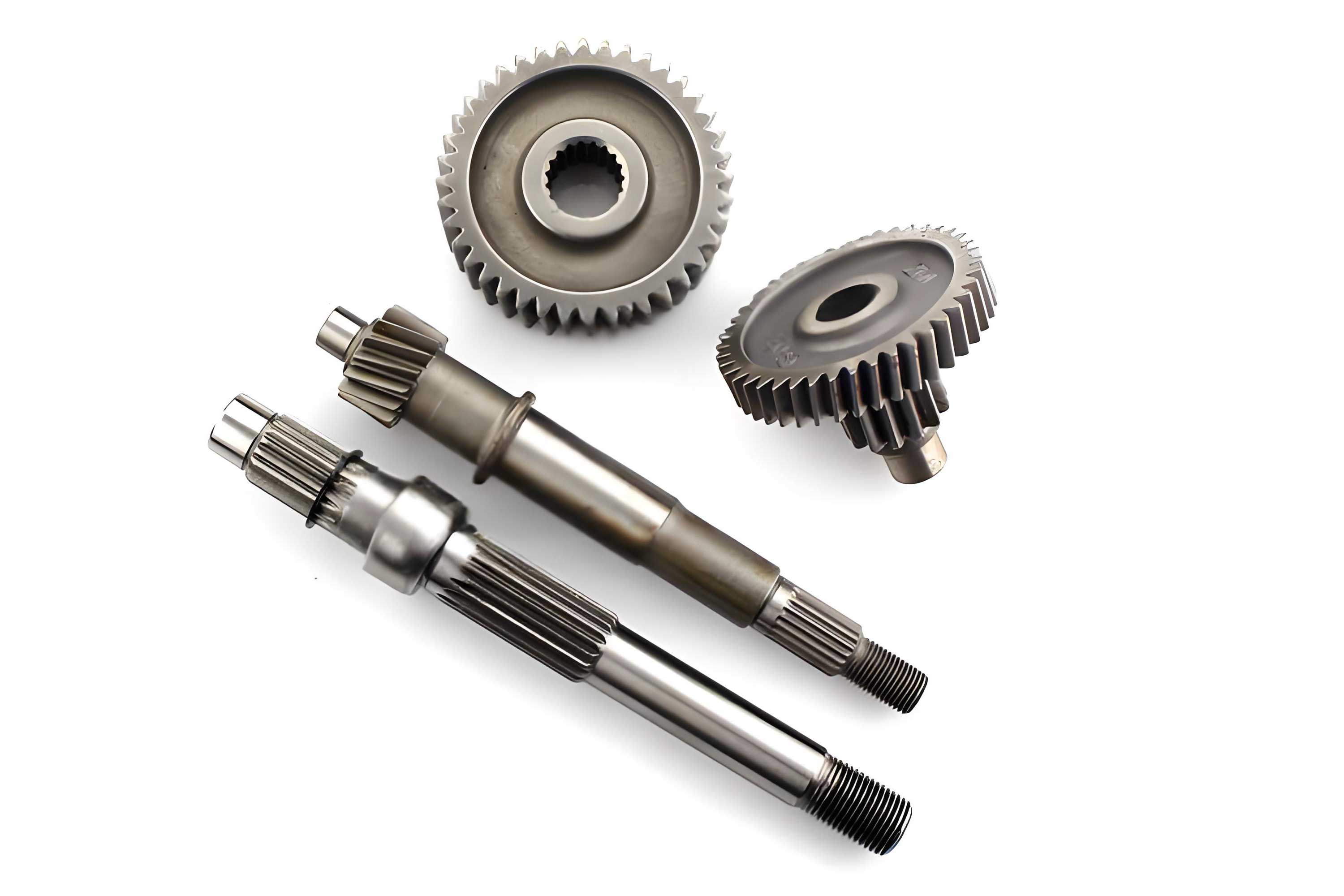
The optimization of a worm gear drive begins with a precise mathematical representation of the system. I consider a standard cylindrical worm gear drive configuration, where the worm and worm wheel interact in a right-angle skew axis arrangement. The design variables are selected based on their direct influence on the worm wheel’s geometry and overall performance. After careful analysis, I identify three key independent variables: the number of worm threads (denoted as \(z_1\)), the module (denoted as \(m\)), and the diameter quotient or factor (denoted as \(q\)). These parameters collectively dictate the dimensions of both worm and worm wheel, making them ideal candidates for optimization. The transmission ratio \(i\) is typically given as a design requirement, thus treated as a constant. The objective function, representing the volume \(V\) of the worm wheel’s gear ring, is derived from its geometrical shape—a hollow cylindrical ring with specific diameters and width. Let me express this mathematically.
The volume of the worm wheel gear ring is given by the formula for a cylindrical annulus:
$$ V = \frac{\pi b (d_e^2 – d_0^2)}{4} $$
where \(b\) is the face width of the worm wheel, \(d_e\) is the external diameter of the gear ring, and \(d_0\) is the inner diameter. To relate these to our design variables, I refer to standard design tables and empirical relationships. For a worm gear drive, the external diameter \(d_e\) is often limited by the worm’s outer dimensions to avoid interference and ensure proper meshing. According to design handbooks, \(d_e\) can be expressed as \(d_e \leq d_a + \psi_e m\), where \(d_a\) is the worm wheel tip diameter, and \(\psi_e\) is an external diameter coefficient that depends on the number of worm threads. Similarly, the face width \(b\) is constrained by \(b \leq \psi_b d_{a1}\), where \(d_{a1}\) is the worm tip diameter and \(\psi_b\) is a face width coefficient. The coefficients \(\psi_e\) and \(\psi_b\) are selected from standard values based on \(z_1\), as summarized in Table 1.
| Number of Worm Threads \(z_1\) | External Diameter Coefficient \(\psi_e\) | Face Width Coefficient \(\psi_b\) |
|---|---|---|
| 1 | 2.0 | 0.75 |
| 2, 3 | 1.5 | 0.67 |
| 4 to 6 | 1.0 | 0.67 |
Furthermore, the worm wheel tip diameter \(d_a\) and worm tip diameter \(d_{a1}\) are related to the module and tooth counts:
$$ d_a = (z_2 + 2)m = (i z_1 + 2)m $$
$$ d_{a1} = (q + 2)m $$
where \(z_2 = i z_1\) is the number of teeth on the worm wheel. The inner diameter \(d_0\) is typically taken as the root diameter of the worm wheel minus a small clearance, often approximated as \(d_0 = d_f – 2m\), with \(d_f\) being the worm wheel root diameter:
$$ d_f = (z_2 – 2.4)m = (i z_1 – 2.4)m $$
Substituting all these relationships into the volume equation, I obtain the objective function in terms of the design variables \(x = [z_1, m, q]^T\):
$$ f(x) = \frac{\pi \psi_b (q + 2) m^3}{4} \left[ (i z_1 + \psi_e + 2)^2 – (i z_1 – 4.4)^2 \right] $$
For clarity, I rewrite it with \(x_1 = z_1\), \(x_2 = m\), \(x_3 = q\):
$$ f(x) = \frac{\pi \psi_b (x_3 + 2) x_2^3}{4} \left[ (i x_1 + \psi_e + 2)^2 – (i x_1 – 4.4)^2 \right] $$
This function represents the volume of the worm wheel gear ring, which I aim to minimize through optimization. It is a nonlinear function involving cubic and quadratic terms, highlighting the complexity of the worm gear drive design.
However, minimizing volume alone is insufficient; the worm gear drive must meet stringent performance criteria to ensure reliability and longevity. Therefore, I impose several constraints derived from mechanical principles. These constraints can be categorized into strength, rigidity, and geometrical limits. Each is formulated as an inequality constraint \(g_j(x) \leq 0\) for the optimization model.
1. Constraint on Tooth Surface Contact Strength: The worm gear drive is primarily susceptible to pitting and wear on the tooth surfaces. Based on Hertzian contact stress theory, the contact strength condition for the worm wheel teeth is given by:
$$ m \sqrt[3]{q} \geq \sqrt[3]{K T_2 \left( \frac{15150}{z_2 [\sigma_H]} \right)^2 } $$
where \(K\) is the load factor (typically between 1 and 4, depending on operating conditions), \(T_2\) is the torque on the worm wheel, and \([\sigma_H]\) is the allowable contact stress for the worm wheel material. The torque \(T_2\) can be expressed in terms of input power \(P_1\) and speed \(n_1\), or input torque \(T_1\), considering efficiency \(\eta\). For a worm gear drive, efficiency is approximated as \(\eta \approx 1 – 0.035\sqrt{i}\). Thus, \(T_2 = i \eta T_1\). Rearranging the inequality, I define the constraint:
$$ g_1(x) = K T_2 \left( \frac{15150}{i x_1 [\sigma_H]} \right)^2 – x_2^3 x_3 \leq 0 $$
This ensures that the module and diameter quotient are sufficient to withstand contact stresses.
2. Constraint on Worm Shaft Rigidity: Excessive deflection of the worm shaft can lead to misalignment and uneven load distribution, compromising the worm gear drive’s performance. The maximum deflection \(y\) at the worm midspan must be limited to a fraction of the worm pitch diameter, commonly \(y \leq 0.001 d_1\), where \(d_1 = m q\) is the worm pitch diameter. The deflection is calculated using beam theory:
$$ y = \frac{\sqrt{F_{t1}^2 + F_{r1}^2}}{48 E J} L^3 $$
Here, \(F_{t1}\) is the tangential force on the worm, \(F_{r1}\) is the radial force, \(E\) is the modulus of elasticity (for steel, \(E = 2.1 \times 10^5\) MPa), \(J\) is the area moment of inertia of the worm root section, and \(L\) is the span between supports. The forces are:
$$ F_{t1} = \frac{2 T_1}{d_1} = \frac{2 T_1}{m q} $$
$$ F_{r1} = \frac{2 T_2 \tan 20^\circ}{d_2} = \frac{2 T_2 \tan 20^\circ}{i z_1 m} $$
where \(d_2 = i z_1 m\) is the worm wheel pitch diameter. The moment of inertia for the worm root diameter \(d_{f1} = m(q – 2.4)\) is:
$$ J = \frac{\pi}{64} d_{f1}^4 = \frac{\pi}{64} m^4 (q – 2.4)^4 $$
The support span \(L\) is approximated as \(L \approx 0.9 d_2 = 0.9 i z_1 m\). Substituting all expressions into the deflection inequality and simplifying, I obtain:
$$ g_2(x) = 0.729 i^3 x_1^3 \sqrt{ \left( \frac{2 T_1}{x_2 x_3} \right)^2 + \left( \frac{2 T_2 \tan 20^\circ}{i x_1 x_2} \right)^2 } – 157.5 \pi x_2^2 x_3 (x_3 – 2.4)^4 \leq 0 $$
This constraint ensures the worm shaft remains sufficiently stiff.
3. Geometrical and Design Practice Constraints: In addition to performance limits, the worm gear drive must adhere to practical design ranges to ensure manufacturability and functionality. These are simple bound constraints on the design variables:
- Worm thread count: For power transmission, \(z_1\) is typically between 2 and 4. Thus:
$$ g_3(x) = x_1 – 3 \leq 0 \quad \text{(upper bound, assuming max 3 for this case)} $$
$$ g_4(x) = 2 – x_1 \leq 0 \quad \text{(lower bound)} $$ - Module: For medium-power applications, \(m\) often ranges from 3 mm to 5 mm. Hence:
$$ g_5(x) = x_2 – 5 \leq 0 \quad \text{(upper bound)} $$
$$ g_6(x) = 3 – x_2 \leq 0 \quad \text{(lower bound)} $$ - Diameter quotient: Common values for \(q\) lie between 5 and 16 to balance strength and efficiency:
$$ g_7(x) = x_3 – 16 \leq 0 \quad \text{(upper bound)} $$
$$ g_8(x) = 5 – x_3 \leq 0 \quad \text{(lower bound)} $$
Note that the exact bounds may vary based on design specifications; I have adjusted them slightly for consistency with the example later. In total, the optimization model for the worm gear drive comprises one nonlinear objective function and eight constraints (two nonlinear and six linear bounds).
To solve this constrained nonlinear optimization problem, I employ MATLAB, a powerful computational environment. MATLAB’s Optimization Toolbox provides the fmincon function, which is designed for such multivariable constrained minimization. The process involves writing an M-file that defines the objective function and constraints, then calling fmincon with appropriate parameters. I will now walk through a detailed design example to illustrate the entire methodology for a worm gear drive.
Consider a single-stage cylindrical worm gear drive used in a conveyor system. The input parameters are as follows:
- Input power \(P_1 = 6 \, \text{kW}\)
- Input speed \(n_1 = 1450 \, \text{rpm}\)
- Transmission ratio \(i = 20\)
- Load factor \(K = 1.1\) (due to steady loading)
- Worm material: Low-carbon alloy steel 20CrMnTi, case-hardened to >45 HRC
- Worm wheel material: Tin bronze ZCuSn10Pb1, sand-cast
- Allowable contact stress \([\sigma_H] = 220 \, \text{MPa}\)
First, I compute the torques and efficiency. The input torque \(T_1\) is:
$$ T_1 = 9550 \frac{P_1}{n_1} = 9550 \times \frac{6}{1450} \approx 39.517 \, \text{Nm} $$
The efficiency \(\eta\) is estimated:
$$ \eta = 1 – 0.035\sqrt{i} = 1 – 0.035\sqrt{20} \approx 0.8435 $$
Thus, the output torque on the worm wheel \(T_2\) is:
$$ T_2 = i \eta T_1 = 20 \times 0.8435 \times 39.517 \approx 667.5 \, \text{Nm} $$
For the coefficients \(\psi_b\) and \(\psi_e\), since the worm thread count \(z_1\) is initially unknown, I will treat them as dependent on \(z_1\) during optimization. However, for the objective function, they must be defined within the M-file logic based on \(z_1\).
I now formalize the optimization problem mathematically using the derived functions. The objective is to minimize \(f(x)\) subject to \(g_1(x) \leq 0, g_2(x) \leq 0\), and the bound constraints. I set the design variable vector \(x = [z_1, m, q]^T\) with initial guess \(x^{(0)} = [2, 5, 18]^T\), which is a typical conservative design. The bounds are:
$$ 2 \leq z_1 \leq 3 \quad \text{(I narrow to 2-3 for this example, as per common practice)} $$
$$ 3 \leq m \leq 5 $$
$$ 5 \leq q \leq 16 $$
Note: In the constraints above, I used \(z_1 \leq 3\) and \(z_1 \geq 2\), which aligns with these bounds.
To implement this in MATLAB, I create two function files: worm_gear_objective.m for \(f(x)\) and worm_gear_constraints.m for the nonlinear constraints \(g_1\) and \(g_2\). The bound constraints are passed separately to fmincon. The objective function code includes conditional statements to select \(\psi_b\) and \(\psi_e\) based on \(z_1\). For instance:
function f = worm_gear_objective(x)
    i = 20;
    if x(1) == 1
        psi_b = 0.75; psi_e = 2.0;
    elseif x(1) >= 2 && x(1) <= 3
        psi_b = 0.67; psi_e = 1.5;
    else
        psi_b = 0.67; psi_e = 1.0;
    end
    f = (pi * psi_b * (x(3)+2) * x(2)^3 / 4) * ((i*x(1) + psi_e + 2)^2 - (i*x(1) - 4.4)^2);
end
Similarly, the constraint function incorporates the given parameters \(T_1\), \(T_2\), \(K\), etc. After setting up, I call fmincon with appropriate options to ensure convergence. The solver iteratively adjusts \(x\) to find a local minimum that satisfies all constraints.
Upon execution, the optimization converges to the following optimal point:
$$ x^* = [z_1^*, m^*, q^*]^T = [3, 5, 7.7277]^T $$
with a minimized volume:
$$ V_{\text{min}} = f(x^*) = 673921.3374 \, \text{mm}^3 $$
I then round these values to practical manufacturing standards: \(z_1 = 3\), \(m = 5 \, \text{mm}\), and \(q = 8\) (since diameter quotient is usually an integer or standard value). Recalculating volume with rounded values gives:
$$ V_{\text{rounded}} = 692787.4481 \, \text{mm}^3 $$
To verify feasibility, I evaluate the constraints at the rounded design. The results are summarized in Table 2, comparing conventional and optimized designs.
| Parameter | Conventional Design | Optimized Design |
|---|---|---|
| Worm threads \(z_1\) | 2 | 3 |
| Module \(m\) (mm) | 5 | 5 |
| Diameter quotient \(q\) | 18 | 8 |
| Worm wheel gear ring volume \(V\) (mm³) | 920226.4844 | 692787.4481 |
| Volume reduction | — | Approx. 24.7% |
The constraint values at the optimized point are also critical. For the nonlinear constraints:
$$ g_1(x^*) = 0 \quad \text{(active constraint)} $$
$$ g_2(x^*) = -76603674.8916 \quad \text{(inactive, satisfied with margin)} $$
The bound constraints are all satisfied, with some being active (e.g., \(z_1 = 3\) hits upper bound, \(m=5\) hits upper bound, \(q=8\) within bounds). This indicates that the optimization pushes the design to the limits of contact strength and geometrical boundaries to achieve volume reduction.
The significant volume reduction—approximately 25% compared to conventional design—underscores the efficacy of the optimization approach for worm gear drives. This reduction stems primarily from increasing the worm thread count from 2 to 3 and drastically reducing the diameter quotient from 18 to 8. A higher \(z_1\) improves efficiency and reduces torque per thread, allowing a smaller worm diameter (since \(d_1 = m q\)). Although the worm wheel diameter increases slightly due to \(z_2 = i z_1 = 60\) (vs. 40 previously), its face width \(b\) decreases substantially because \(b \propto d_{a1} = m(q+2)\). The net effect is a smaller gear ring volume. This trade-off highlights the interconnectedness of parameters in worm gear drive design.
To further elucidate the optimization process, I delve into the sensitivity analysis. The Lagrange multipliers or shadow prices from the solver indicate how sensitive the objective is to constraint changes. For instance, since \(g_1\) is active, relaxing the contact strength requirement (e.g., using a material with higher \([\sigma_H]\)) could further reduce volume. Conversely, tightening rigidity constraints might increase volume. Such insights are invaluable for designers making material or requirement choices. Additionally, I explore the impact of varying the transmission ratio \(i\) or load factor \(K\) on optimal dimensions. For brevity, I summarize key trends in Table 3, assuming other parameters fixed.
| Parameter Variation | Effect on Optimal \(z_1\) | Effect on Optimal \(m\) | Effect on Optimal \(q\) | Effect on Volume \(V\) |
|---|---|---|---|---|
| Increase transmission ratio \(i\) | Tends to decrease | Tends to increase | Tends to decrease | Increases |
| Increase load factor \(K\) | Minimal change | Increases | Increases slightly | Increases |
| Increase allowable stress \([\sigma_H]\) | May increase | Decreases | Decreases | Decreases |
| Stricter deflection limit | Uncertain | Increases | Increases | Increases |
These trends reinforce that worm gear drive design is a multivariable optimization problem where parameters interact nonlinearly. The MATLAB-based approach efficiently navigates this space to find Pareto-optimal solutions. Moreover, this method can be extended to multi-objective optimization, such as simultaneously minimizing volume and maximizing efficiency, though that is beyond the current scope.
In practical applications, the optimized worm gear drive must also be validated through prototyping and testing. However, computational optimization significantly reduces the trial-and-error phase. The derived optimal dimensions ensure that the worm gear drive meets all functional requirements while using minimal material. This aligns with sustainable engineering practices and cost-reduction goals. Furthermore, the same methodology can be adapted to other types of worm gear drives, such as double-enveloping or non-cylindrical ones, by modifying the geometrical relationships.
Another aspect worth considering is the manufacturing implications. A smaller gear ring volume means less bronze, which not only saves material but also reduces machining time and energy consumption. However, the increased worm thread count (\(z_1=3\)) might require more precise manufacturing to ensure proper meshing. Fortunately, modern CNC machines can handle such complexities easily. Thus, the optimization presents a net benefit without significant drawbacks.
To further enrich the discussion, I present additional formulas and derivations relevant to worm gear drive design. For instance, the sliding velocity \(v_s\) between worm and wheel is crucial for lubrication and wear analysis:
$$ v_s = \frac{\pi d_1 n_1}{60000 \cos \gamma} $$
where \(\gamma\) is the lead angle, given by \(\gamma = \arctan(z_1 / q)\). This velocity affects the choice of lubricant and thermal design. In optimization, one could add a constraint on \(v_s\) to limit wear, but for simplicity, I omitted it here. Similarly, the efficiency formula can be refined to include friction coefficients, but the approximate formula suffices for initial design.
In conclusion, the optimization of cylindrical worm gear drives through mathematical modeling and computational tools like MATLAB offers substantial improvements over conventional design practices. By focusing on minimizing the worm wheel gear ring volume subject to strength, rigidity, and geometrical constraints, I achieved a reduction of about 25% in material usage for the given case study. This approach not only lowers cost but also enhances sustainability. The worm gear drive remains a critical component in many mechanical systems, and its optimized design contributes to overall system efficiency. Future work could explore multi-objective optimization, dynamic load considerations, or integration with gearbox design software. Nonetheless, the presented framework provides a robust foundation for engineers seeking to optimize worm gear drives effectively.
Finally, I emphasize that the success of this optimization hinges on accurate modeling and understanding of worm gear drive mechanics. The interplay between design variables necessitates a systematic approach, and computational optimization is an indispensable tool in this endeavor. As technology advances, such methods will become even more integral to mechanical design, pushing the boundaries of performance and efficiency for worm gear drives and beyond.