
In the realm of precision manufacturing, the reliability and performance of CNC machine tools are paramount. As an engineer focused on mechanical transmission systems, I have observed that the turret components of CNC machines often become bottlenecks in achieving high machining accuracy. Specifically, the spiral bevel gears used in turret drives are critical for smooth tool indexing and cutting operations. However, vibration and noise induced by these bevel gears can severely degrade dynamic precision, part quality, and tool life. This study delves into the root causes of vibration noise in turret bevel gears, employing a combination of reverse engineering, tolerance measurement, and acoustic analysis. My goal is to propose a structural parameter optimization method to enhance meshing quality and reduce noise, thereby advancing domestic bevel gear technology for CNC applications.
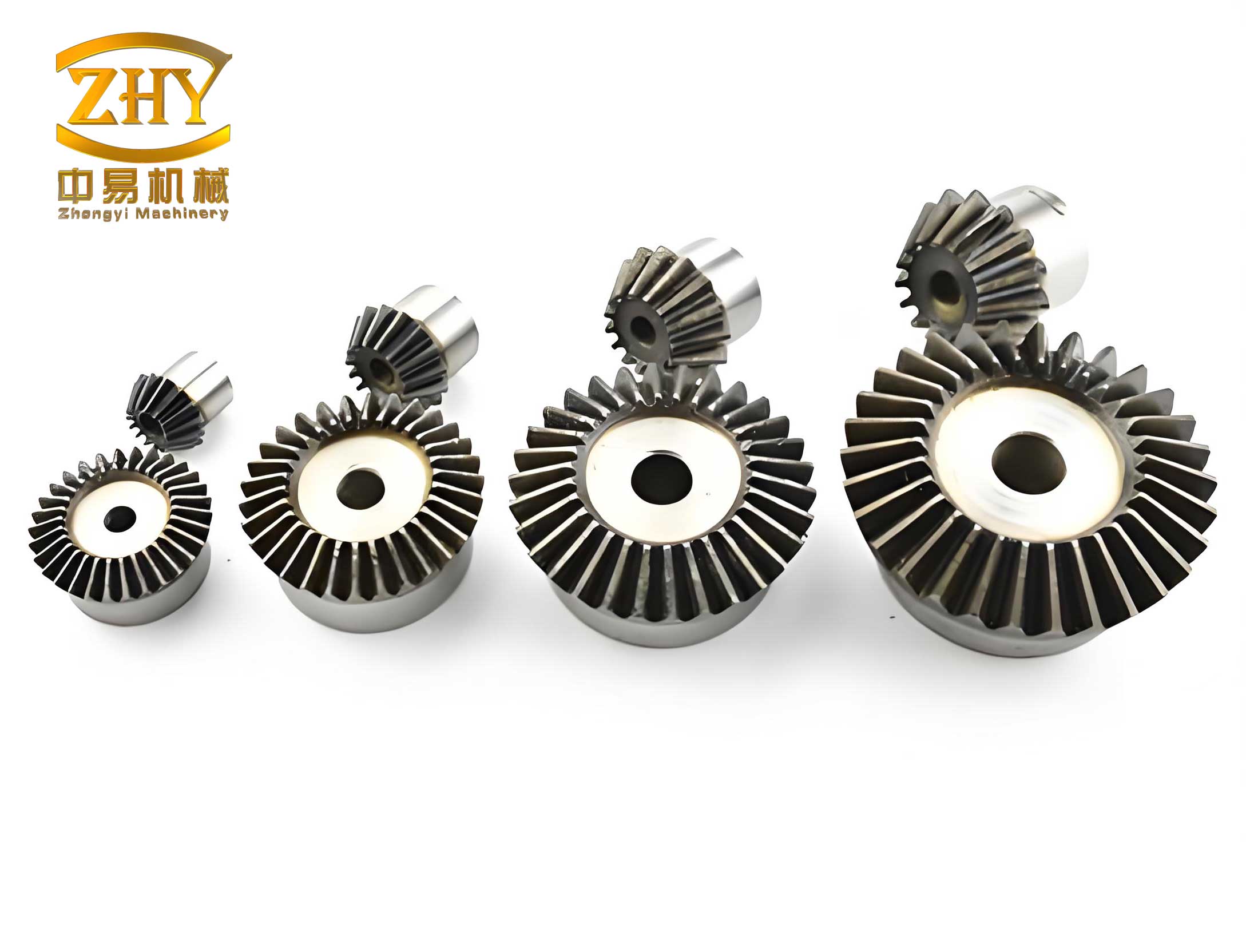
The use of spiral bevel gears in CNC turrets is widespread due to their ability to transmit power between intersecting shafts with high efficiency and smooth operation. However, in practice, these bevel gears frequently exhibit excessive vibration and noise during high-speed rotations, such as at 5,000 rpm. This issue stems from inherent design flaws, manufacturing inaccuracies, and assembly errors, which lead to meshing impacts, time-varying stiffness, and dynamic loads. From my perspective, addressing these problems requires a holistic approach that links gear geometry to acoustic emissions. In this investigation, I focus on a sample pair of spiral bevel gears from a domestic CNC turret, analyzing their parameters through digital techniques and validating improvements via experimental noise spectrum comparisons.
Vibration noise in bevel gears arises from multiple interrelated factors. Primarily, manufacturing tolerances like pitch errors and tooth profile deviations cause intermittent meshing shocks. Additionally, design parameters such as module, number of teeth, and spiral angle influence the contact pattern and load distribution. For spiral bevel gears, the重合度 (degree of overlap) is a key metric; a low重合度 results in fewer teeth in contact at any moment, increasing stress and excitation. The dynamic response is further exacerbated by system stiffness, rotor imbalance, and lubrication conditions. To quantify these effects, I utilize gear meshing theory and advanced measurement tools. The following sections detail my methodology, from reverse engineering of sample bevel gears to parameter recalculation and experimental verification.
Reverse engineering serves as the foundation for analyzing the sample bevel gears. Using a Creaform HandySCAN 700 laser scanner, I captured high-resolution point cloud data of both the driving and driven bevel gears. This process involves scanning the gear contours to obtain STL files, which are then imported into SolidWorks for 3D modeling. To refine the data, I extracted tooth profile curves at the large end, middle, and small end of the bevel gears, filtering out离散 points via PolyWorks software. The resulting coordinates were processed in MATLAB to calculate critical geometric parameters. For instance, the point cloud data allows computation of roundness errors, pitch deviations, and chordal tooth thickness. These metrics are essential for assessing the precision of the bevel gears and identifying sources of vibration.
The data processing begins with transforming scanned points into radial coordinates. Let \( (x_0, y_0) \) be the initial point coordinates; the distance to the center is given by \( r = \sqrt{x_0^2 + y_0^2} \). By applying a rotation transformation, I align the profiles for consistent analysis. The transformation formula is:
$$ x_1 = x_0 \cos(2\pi – \phi) + y_0 \sin(2\pi – \phi), $$
$$ y_1 = -x_0 \sin(2\pi – \phi) + y_0 \cos(2\pi – \phi), $$
where \( \phi \) is the偏转角. This yields corrected齿廓 plots for both bevel gears, as shown in the point cloud models. From these plots, I fit circles to the tip and root diameters to determine圆心 coordinates and radii. For the sample driven bevel gear, the fitted radius is 28.388 mm, while for the driving bevel gear, it is 28.095 mm. These values indicate slight deviations from ideal geometry, contributing to meshing inaccuracies.
Pitch error analysis is crucial for evaluating transmission smoothness. By connecting points on the fitted circle to the center, I compute the angular间距 between adjacent teeth. The pitch error \( \Delta p \) is defined as the difference between actual and theoretical pitch. For the sample bevel gears, significant pitch errors were detected across multiple teeth. The driving bevel gear exhibited a maximum pitch error of 0.3181 mm at tooth 13, with a standard deviation of 0.1290 mm. The driven bevel gear had a maximum error of 0.2036 mm at tooth 12, with a standard deviation of 0.1091 mm. Such errors reduce the effective重合度 during operation, causing冲击 and vibration. The pitch error distribution is summarized in Table 1, which compares sample and improved bevel gears.
| Gear Type | Maximum Pitch Error (mm) | Minimum Pitch Error (mm) | Standard Deviation (mm) |
|---|---|---|---|
| Sample Driving Bevel Gear | 0.3181 | -0.1679 | 0.1290 |
| Sample Driven Bevel Gear | 0.2036 | -0.0985 | 0.1091 |
| Improved Driving Bevel Gear | 0.2711 | -0.1620 | 0.0937 |
| Improved Driven Bevel Gear | 0.2874 | -0.1736 | 0.0994 |
Chordal tooth thickness is another vital parameter affecting backlash and meshing stability. Using the scanned data, I calculated the reference chordal thickness \( S_i \) for each tooth. The formula for chordal thickness at any radius is derived from gear geometry:
$$ S_i = 2r_i \left( \frac{\pi}{2Z_v} + \frac{2\xi \tan \alpha_f}{Z_v} + \text{inv} \alpha_i – \text{inv} \alpha_f \right), $$
where \( r_i \) is the任意圆 radius, \( Z_v \) is the virtual number of teeth, \( \xi \) is the profile shift coefficient, \( \alpha_f \) is the reference pressure angle, and \( \text{inv} \alpha = \tan \alpha – \alpha \). For the sample bevel gears, the average reference chordal thickness was 8.7967 mm for the driven gear and 9.2420 mm for the driving gear, with standard deviations of 0.1212 mm and 0.0684 mm, respectively. Deviations in tooth thickness lead to uneven backlash, exacerbating dynamic impacts during meshing of bevel gears. Table 2 summarizes the tooth thickness analysis.
| Parameter | Sample Driven Bevel Gear | Sample Driving Bevel Gear | Improved Driving Bevel Gear | Improved Driven Bevel Gear |
|---|---|---|---|---|
| Average Reference Thickness (mm) | 8.7967 | 9.2420 | 10.2224 | 16.2477 |
| Standard Deviation (mm) | 0.1212 | 0.0684 | 0.0982 | 0.0654 |
| Theoretical Thickness (mm) | 4.7100 | 4.7100 | 2.7500 | 2.7500 |
| Actual Thickness Deviation (mm) | 0.0048 | 0.0078 | ~0 | ~0 |
To understand the design shortcomings, I computed the key parameters of the sample bevel gears. The sample has 19 teeth, a module of 3 mm, a pressure angle of 20°, and a spiral angle of 35°. Using these, the theoretical circular tooth thickness \( s \) at the pitch circle is 4.71 mm, and the chordal thickness \( S’_{mn} \) at the midpoint is 3.857 mm. However, the重合度, which dictates smooth meshing, is calculated as follows. The transverse重合度 \( \varepsilon_\alpha \) is given by:
$$ \varepsilon_\alpha = \frac{g_{an}}{P_{mm} \cos \alpha_n \sqrt{\cos^2 \beta_m + \tan^2 \alpha_n}}, $$
where \( g_{an} \) is the length of action in the normal plane at the midpoint, \( P_{mm} \) is the normal circular pitch at the midpoint, \( \alpha_n \) is the normal pressure angle, and \( \beta_m \) is the spiral angle at the midpoint. The axial重合度 \( \varepsilon_\beta \) accounts for the helical overlap:
$$ \varepsilon_\beta = \frac{1}{\pi m_{et}} \left( K_z \tan \beta_m – \frac{K_z^3 \tan^2 \beta_{nm}}{3 R_e} \right), $$
with \( m_{et} \) as the transverse module at the reference point, \( \beta_{nm} \) as the spiral angle at an arbitrary point, \( R_e \) as the outer cone distance, and \( K_z \) as the ratio of tooth twist arc to circular pitch. The total重合度 \( \varepsilon_0 \) is the vector sum:
$$ \varepsilon_0 = \sqrt{\varepsilon_\alpha^2 + \varepsilon_\beta^2}. $$
For the sample bevel gears, \( \varepsilon_0 = 1.9563 \), which is relatively low for spiral bevel gears. This low重合度, combined with high module and low tooth count, explains the pronounced vibration and noise. In essence, fewer teeth sharing the load leads to higher stress concentrations and excitation frequencies. My analysis confirms that optimizing these parameters is essential for improving bevel gear performance.
Guided by this insight, I proceeded to redesign the bevel gears. The objective was to increase重合度 while maintaining the original pitch diameter to preserve the turret’s kinematic design. The pitch diameter \( d \) relates to module \( m \) and tooth count \( Z \) by \( d = mZ \). For the sample, \( d = 57 \) mm. By varying \( m \) and \( Z \) inversely, I evaluated several configurations to maximize \( \varepsilon_0 \). The calculations, performed in MATLAB, yielded the results in Table 3. The optimal design choice was \( m = 1.75 \) mm and \( Z = 29 \), achieving a重合度 of 3.8799, nearly double that of the sample. This significant increase promises smoother meshing and reduced vibration in bevel gears.
| Module \( m \) (mm) | Number of Teeth \( Z \) | Pitch Diameter \( d \) (mm) | Total重合度 \( \varepsilon_0 \) |
|---|---|---|---|
| 2.25 | 23 | 57 | 2.2605 |
| 1.75 | 29 | 57 | 3.8799 |
| 1.50 | 33 | 57 | 3.0067 |
Based on this selection, I defined the full parameter set for the improved bevel gears. The pressure angle remained 20°, and the spiral angle 35°, ensuring consistency in manufacturing. The theoretical circular tooth thickness \( s \) became 2.75 mm, and the cone angle \( \delta \) was set to 45° for the bevel pair. The chordal thickness \( S’_{mn} \) at the midpoint is 2.2275 mm. These parameters are summarized in Table 4, which contrasts the sample and improved bevel gears. The increased tooth count and reduced module enhance load distribution and reduce meshing impacts, addressing the core vibration issues in bevel gears.
| Parameter | Sample Bevel Gears | Improved Bevel Gears |
|---|---|---|
| Number of Teeth \( Z \) | 19 | 29 |
| Module \( m \) (mm) | 3 | 1.75 |
| Pressure Angle \( \alpha \) (°) | 20 | 20 |
| Spiral Angle \( \beta_m \) (°) | 35 | 35 |
| Pitch Diameter \( d \) (mm) | 57 | 57 |
| Theoretical Circular Tooth Thickness \( s \) (mm) | 4.71 | 2.75 |
| Cone Angle \( \delta \) (°) | 45 | 45 |
| Total重合度 \( \varepsilon_0 \) | 1.9563 | 3.8799 |
To validate the improved design, I manufactured the new bevel gears and subjected them to the same reverse engineering scrutiny. Laser scanning revealed that the pitch errors and tooth thickness deviations were reduced compared to the sample. For instance, the standard deviation of pitch error dropped to 0.0937 mm for the driving gear and 0.0994 mm for the driven gear. Similarly, chordal thickness standard deviations were lower, indicating better manufacturing consistency. These improvements directly contribute to enhanced meshing quality in bevel gears, as lower geometric errors minimize dynamic excitations.
The final step involved experimental noise analysis to quantify vibration reduction. I installed both the sample and improved bevel gears in a GTB150-300 CNC turret under identical conditions: no-load operation at 1,000 rpm spindle speed. Using Audacity software, I captured audio signals from the turret during rotation. The signals were processed with a Hann window function to reduce spectral leakage, expressed as:
$$ w(n) = 0.5 \left(1 – \cos\left(\frac{2\pi n}{N-1}\right)\right), \quad \text{for } n = 0, 1, \dots, N-1, $$
where \( N \) is the window length. This preprocessing ensures accurate frequency domain representation. I then computed standard autocorrelation and inverse logarithmic spectra to assess noise characteristics.
The autocorrelation analysis showed that the improved bevel gears exhibited a more regular meshing pattern. The sample bevel gears had a meshing rate of approximately 2,500 engagements per second, corresponding to their lower tooth count, while the improved bevel gears achieved about 4,300 engagements per second due to higher \( Z \). This higher frequency, combined with better重合度, distributes impacts more evenly, reducing amplitude peaks. The inverse logarithmic spectra further demonstrated that the improved bevel gears reached steady-state vibration faster and with lower magnitude, indicating damped dynamic responses.
Frequency spectrum comparison provided conclusive evidence. The sample bevel gears produced a peak noise level of -26 dB at 1,288 Hz, with additional harmonics at 2,846 Hz and 5,212 Hz. These multiple peaks reflect irregular meshing caused by pitch errors and low重合度. In contrast, the improved bevel gears peaked at -31 dB around 5,064 Hz, a reduction of 5 dB, and the spectrum was smoother with fewer spurious harmonics. The overall sound pressure level was 1–2 dB lower for the improved bevel gears across the audible range. This reduction, though seemingly modest, translates to significantly lower vibration energy and improved machining stability. The spectral data are encapsulated in Table 5, highlighting the acoustic benefits of optimized bevel gears.
| Metric | Sample Bevel Gears | Improved Bevel Gears |
|---|---|---|
| Peak Frequency (Hz) | 1,288 | 5,064 |
| Peak Sound Level (dB) | -26 | -31 |
| Notable Harmonics (Hz) | 2,846, 5,212 | None significant |
| Estimated Meshing Rate (engagements/s) | ~2,500 | ~4,300 |
| Overall Noise Reduction (dB) | Reference | 1–2 lower on average |
Through this comprehensive study, I have established a robust methodology for analyzing and mitigating vibration noise in CNC turret bevel gears. The integration of reverse engineering, parametric modeling, and acoustic diagnostics proves effective in pinpointing design flaws. Key findings indicate that excessive module, insufficient tooth count, and low重合度 are primary culprits for noise in sample bevel gears. By recalibrating these parameters—specifically, reducing module to 1.75 mm and increasing teeth to 29—the重合度 surges to 3.8799, dramatically improving meshing smoothness. Experimental validation confirms that such optimized bevel gears yield lower noise levels and more stable spectra, directly enhancing turret reliability.
Looking forward, this approach can be extended to other gear types and industrial applications. For instance, further research could explore the effects of lubrication, temperature, and load variations on bevel gear vibration. Additionally, advanced materials or surface treatments might complement geometric optimizations. In summary, the continuous refinement of bevel gear design is crucial for elevating domestic CNC machine tool performance. By prioritizing重合度 and manufacturing precision, engineers can develop quieter, more durable bevel gears that meet the demands of high-speed precision manufacturing, ultimately contributing to technological advancement in the global machinery sector.