
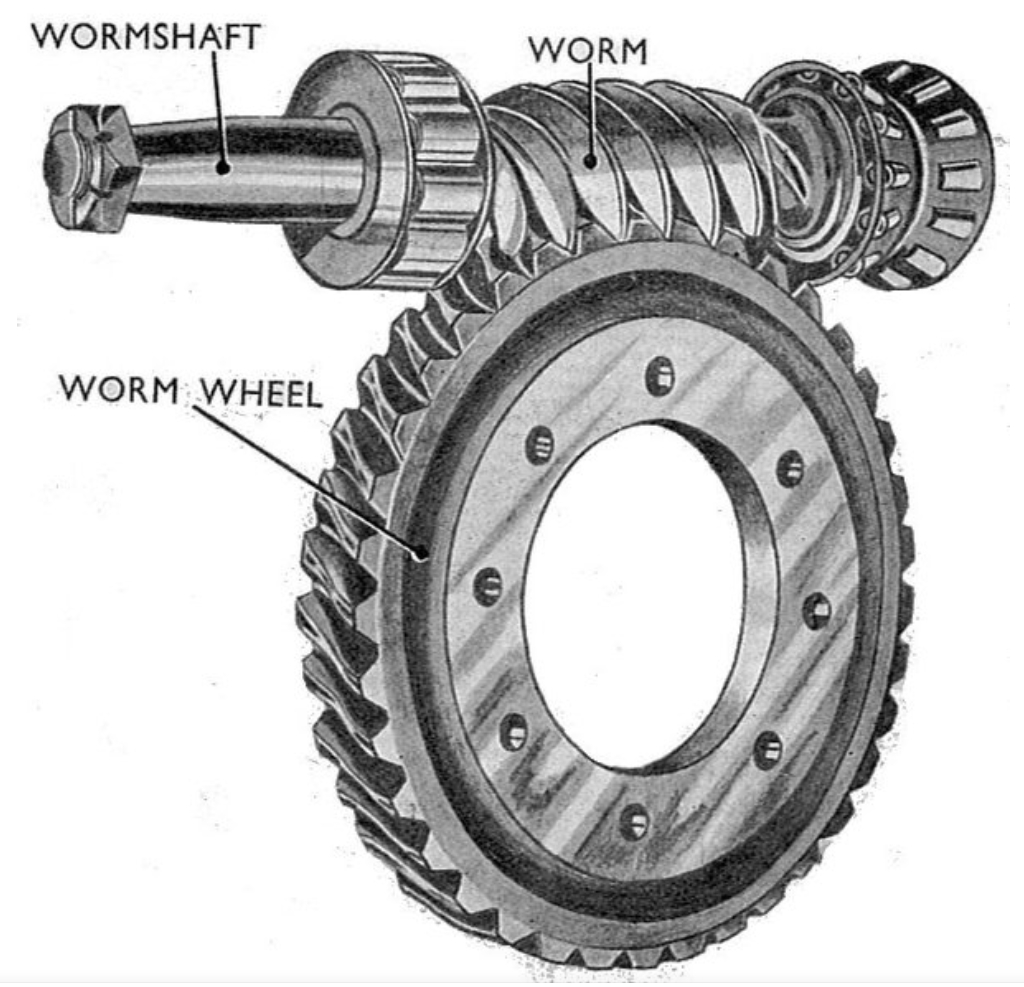
The pursuit of high-performance, efficient, and reliable power transmission systems is a constant endeavor in mechanical engineering. Among various gear systems, the worm gear drive occupies a unique niche, offering high reduction ratios, compact design, and self-locking capability in a single stage. However, conventional worm gear drives are inherently plagued by significant sliding friction between the worm and worm wheel teeth. This sliding action is the primary source of several critical drawbacks: excessive heat generation, low transmission efficiency, susceptibility to scuffing and wear, and the need for specialized, often expensive, lubricants and materials to mitigate these effects. The quest to overcome these limitations has led to innovative design philosophies, one of the most promising being the transformation of sliding friction into rolling friction. This is the fundamental principle behind the roller enveloping hourglass worm gear drive, an advanced configuration that represents a significant leap forward in worm gear technology.
The core innovation of this worm gear drive lies in its worm wheel design. Instead of traditional cut gear teeth, the worm wheel is fitted with cylindrical rollers (or pins) arranged circumferentially. These rollers are mounted on bearings, allowing them to rotate freely about their own axes. The worm itself is not a pre-defined helicoid but is generated through an enveloping process. The working surface of the worm is the conjugate surface enveloped by the cylindrical surfaces of these rotating rollers during a simulated meshing process. When the worm wheel rotates in one direction, the family of roller surfaces envelopes one flank of the worm; rotation in the opposite direction envelopes the other flank. Consequently, the contact between the worm and the wheel occurs between the generated worm thread and the cylindrical surface of the rollers. The dominant relative motion at the contact point becomes the rolling of the roller around its axis, supplemented by much smaller sliding components. This dramatic shift from sliding- to rolling-dominant contact fundamentally improves the tribological performance, leading to higher efficiency, reduced heat, and increased load capacity. The study of its lubrication regime, particularly under the high pressures typical of gear contacts, is therefore paramount for validating its advantages and guiding its optimal design.
Understanding the contact mechanics is the first step in lubrication analysis. In a roller enveloping hourglass worm gear drive, the contact between the worm thread and a single roller is theoretically a line contact. According to Hertzian contact theory, this contact can be modeled equivalently as the contact between an elastic cylinder of equivalent radius and a rigid plane for the purpose of elastohydrodynamic lubrication (EHL) analysis. The equivalent radius of curvature $R_v$ and the equivalent elastic modulus $E’$ are critical parameters defining this simplified contact. For the worm and roller contact, with $R_1$ being the radius of curvature of the worm surface at the contact point and $R_2$ being the radius of the roller, the equivalent radius is given by:
$$\frac{1}{R_v} = \frac{1}{R_1} + \frac{1}{R_2}$$
The equivalent elastic modulus combines the material properties of both contacting bodies (worm and roller), with $E_1$, $\mu_1$ and $E_2$, $\mu_2$ being their elastic moduli and Poisson’s ratios, respectively:
$$\frac{1}{E’} = \frac{1}{2} \left( \frac{1 – \mu_1^2}{E_1} + \frac{1 – \mu_2^2}{E_2} \right)$$
This simplification forms the basis of the physical EHL model for the worm gear drive, where the lubricant film is formed in the converging gap of this equivalent contact.
The heart of the quantitative analysis lies in the mathematical model of elastohydrodynamic lubrication. We consider an isothermal, steady-state, line-contact EHL model for this worm gear drive. The governing equations are the Reynolds equation, the film thickness equation, the viscosity-pressure relation, the density-pressure relation, and the force balance equation. To facilitate numerical solution and generalize the results, these equations are non-dimensionalized using characteristic parameters like the Hertzian half-width $b$ and maximum Hertzian pressure $p_h$. Defining non-dimensional variables: $X = x/b$, $P = p/p_h$, $\bar{\eta} = \eta/\eta_0$, $\bar{\rho} = \rho/\rho_0$, $H = h R_v / b^2$, where $\eta_0$ and $\rho_0$ are the ambient viscosity and density, the system of equations becomes:
1. Non-dimensional Reynolds Equation:
This equation governs the pressure generation within the lubricant film.
$$\frac{d}{dX}\left(\epsilon \frac{dP}{dX}\right) = \frac{d(\bar{\rho}H)}{dX}$$
where $\epsilon = \frac{\bar{\rho} P_h H^3 b^3}{12 v_{jx} \bar{\eta} \eta_0 R_v^2}$.
The boundary conditions are $P(X_{in}) = 0$ at the inlet and $P(X_{out}) = \frac{dP(X_{out})}{dX} = 0$ at the outlet.
2. Non-dimensional Film Thickness Equation:
This equation describes the shape of the gap between the surfaces, which includes both the geometric gap and the elastic deformation caused by pressure.
$$H(X) = H_0 + \frac{X^2}{2} – \frac{1}{\pi} \int_{X_{in}}^{X_{out}} \ln|X – X’| P(X’) dX’$$
Here, $H_0$ is the central offset film thickness.
3. Non-dimensional Viscosity-Pressure Equation (Roelands):
Lubricant viscosity increases exponentially with pressure, a critical effect in EHL.
$$\bar{\eta} = \exp\left\{ (\ln(\eta_0) + 9.67) \left[ -1 + (1 + p_h P / p_0)^z \right] \right\}$$
where $p_0$ is a reference pressure and $z$ is the viscosity-pressure index (e.g., 0.68 for many oils).
4. Non-dimensional Density-Pressure Equation:
Lubricant density also increases with pressure.
$$\bar{\rho} = \frac{1 + 0.6 p_h P}{1 + 1.7 p_h P}$$
5. Non-dimensional Load Balance Equation:
The integrated pressure must balance the applied external load.
$$\int_{X_{in}}^{X_{out}} P(X) dX – \frac{\pi}{2} = 0$$
A key parameter in the Reynolds equation is the entrainment velocity $v_{jx}$, which is the average speed of the two surfaces in the direction of rolling. For the roller enveloping worm gear drive, this velocity is derived from the kinematics of the conjugate pair. If $\vec{v}_1$ and $\vec{v}_2$ are the velocities of the worm and roller surfaces at the contact point, respectively, and $\vec{\sigma}$ is the unit vector along the contact line direction, the entrainment velocity is:
$$v_{jx} = \frac{1}{2} \left| \left( \vec{v}_1 + \vec{v}_2 \right) \cdot \vec{\sigma} \right|$$
The expressions for $\vec{v}_1$ and $\vec{v}_2$ are complex and depend on the specific geometry, rotational speeds ($\omega_1$, $\omega_2$), and the spatial coordinates of the instantaneous contact point derived from the meshing theory of this worm gear drive.
The load per unit length $w$ acting on the contact line is another vital input. It can be related to the input torque $T_1$ of the worm. Assuming the transmitted force is normal to the tooth flank, the normal force $F_n$ can be found from the tangential force on the worm. For a worm with pitch diameter $d_1$, normal pressure angle $\alpha_n$, and lead angle $\lambda$, the load per unit contact length $L$ is approximately:
$$w = \frac{F_n}{L} = \frac{2 T_1}{L d_1 \cos \alpha_n \cos \lambda}$$
This load, along with the entrainment velocity and material properties, drives the formation of the EHL film.
To solve the strongly coupled, non-linear system of EHL equations, numerical methods are essential. The direct iterative method is an effective approach for such isothermal line-contact problems. The solution domain $[X_{in}, X_{out}]$ is discretized into $n$ nodes. The differential Reynolds equation is discretized using a central finite difference scheme, resulting in a set of algebraic equations for the pressure $P_i$ at node $i$:
$$\frac{(\epsilon_{i-1}+\epsilon_i)P_{i-1} – (\epsilon_{i-1}+2\epsilon_i+\epsilon_{i+1})P_i + (\epsilon_i+\epsilon_{i+1})P_{i+1}}{2(\Delta X)^2} = \frac{\bar{\rho}_i H_i – \bar{\rho}_{i-1} H_{i-1}}{\Delta X}$$
The film thickness equation is discretized using an influence coefficient method:
$$H_i = H_0 + \frac{X_i^2}{2} – \frac{1}{\pi} \sum_{j=1}^{n} K_{ij} P_j$$
where $K_{ij}$ are the discrete influence coefficients derived from the elastic deformation integral. The load balance equation is also discretized:
$$\Delta X \sum_{i=1}^{n} P_i – \frac{\pi}{2} = 0$$
The solution algorithm iteratively adjusts the pressure distribution $P_i$ and the central film thickness $H_0$ until the Reynolds equation, film thickness equation, and load balance equation are all satisfied simultaneously within a specified tolerance. The negative pressures that can arise in the outlet region during calculation are set to zero (Reynolds boundary condition).
Now, let’s apply this model to analyze a specific roller enveloping hourglass worm gear drive. Consider a drive with the following key parameters: number of worm threads $z_1=1$, number of roller pins $z_2=25$, center distance $A=125$ mm, throat diameter coefficient $k=0.40$, roller radius $R=7$ mm. The input power is $P=5$ kW at a speed of $n=1500$ rpm. The worm is steel ($E_1=210$ GPa, $\mu_1=0.26$), and the rollers are also steel ($E_2=207$ GPa, $\mu_2=0.29$). The lubricant is a mineral oil with ambient dynamic viscosity $\eta_0 = 0.028$ Pa·s.
For a contact point at the pitch circle on the worm’s throat section, the numerical solution yields the characteristic pressure profile and film shape shown below (conceptually). The results exhibit the classic features of line-contact EHL: a Hertzian-like pressure distribution in the central region followed by a sharp secondary pressure spike just before the outlet, and a corresponding constriction or “necking” of the lubricant film at the same location. The minimum film thickness $h_{min}$ occurs at this neck. For the base case parameters, the calculated $h_{min}$ is approximately 0.5126 μm. This value is a crucial indicator of the lubrication quality; a sufficiently thick film is necessary to separate the surfaces and prevent wear and surface distress.
The performance of the worm gear drive is not uniform across the face width of the worm. The contact points shift from near the root to the tip of the worm thread as meshing proceeds. Analyzing the EHL characteristics at the dedendum (root), pitch, and addendum (tip) circles on the throat section reveals important trends. The table below summarizes typical findings from such an analysis:
| Contact Location | Secondary Pressure Peak | Minimum Film Thickness, $h_{min}$ | Position of Necking |
|---|---|---|---|
| Dedendum (Root) Circle | Highest (~1.16 GPa) | Largest (~0.66 μm) | Closest to Inlet |
| Pitch Circle | Intermediate | Intermediate (~0.51 μm) | Intermediate |
| Addendum (Tip) Circle | Lowest (~1.08 GPa) | Smallest (~0.34 μm) | Closest to Outlet |
The trend is clear: moving from the root to the tip, the secondary pressure peak decreases, the minimum oil film thickness decreases significantly, and the necking point moves towards the outlet. This implies that the contact conditions near the dedendum are more favorable from a lubrication perspective, generating thicker protective films. The contacts near the addendum are more critical, operating with thinner films and therefore being more vulnerable to lubrication failure if conditions deteriorate. This insight is vital for the design and alignment of this type of worm gear drive.
Design parameters play a significant role in shaping the EHL performance. Two key geometric parameters for the roller enveloping hourglass worm gear drive are the throat diameter coefficient ($k$) and the roller radius ($R$). Their influence on the pressure and film profile at the pitch circle contact is systematic. The throat diameter coefficient affects the size and curvature of the worm’s throat. Increasing $k$ generally increases the equivalent radius of curvature $R_v$ at the contact. The following table illustrates the effect of varying the throat diameter coefficient while holding other parameters constant:
| Throat Diameter Coefficient ($k$) | Secondary Pressure Peak Trend | Minimum Film Thickness ($h_{min}$) Trend | Remarks |
|---|---|---|---|
| Small (e.g., 0.35) | Lower, closer to Hertzian | Significantly Lower | Necking occurs later. |
| Base (0.40) | Intermediate | Intermediate | — |
| Large (e.g., 0.45) | Higher, more pronounced spike | Significantly Higher | Necking occurs earlier. |
A larger $k$ leads to a larger $R_v$, which, according to EHL theory, promotes the formation of a thicker lubricant film. This is clearly seen as an increase in $h_{min}$. The pressure spike also becomes more pronounced and shifts slightly towards the inlet. Conversely, a smaller $k$ results in a thinner, potentially riskier film. Therefore, within the constraints of other design requirements (like clearance and stiffness), increasing the throat diameter coefficient is a very effective way to enhance the lubricant film thickness and improve the overall EHL performance of this worm gear drive.
The roller radius $R$ is another direct influencer. It is a primary component of the equivalent radius $R_v$ (since $R_2 = R$). The effect of varying the roller radius is summarized below:
| Roller Radius ($R$) | Secondary Pressure Peak Trend | Minimum Film Thickness ($h_{min}$) Trend | Remarks |
|---|---|---|---|
| Small (e.g., 5 mm) | Lower | Lower | Pressure profile nearer to Hertzian. |
| Base (7 mm) | Intermediate | Intermediate | — |
| Large (e.g., 9 mm) | Higher, more pronounced | Higher | Necking is more distinct and earlier. |
Increasing the roller radius increases $R_v$, which again has a beneficial effect on film thickness, though the magnitude of this effect is often less dramatic than that of the throat diameter coefficient for typical design ranges. The pressure spike also increases with $R$. However, a larger roller radius may affect other aspects like the number of rollers that can fit around the wheel, the overall size, and the bending stress within the roller. Thus, the selection is a multi-objective optimization problem, but from a purely EHL perspective, a larger roller is preferable.
To validate the numerical approach, one can compare the results from the full numerical solution with predictions from well-established empirical formulas, such as the Dowson-Higginson formula for central or minimum film thickness in line contacts. For the worm gear drive analyzed, if one calculates the minimum film thickness $h_{min}$ across the entire active face width (from root to tip circles) using both methods, the numerical solution and the empirical formula show consistent trends: $h_{min}$ decreases from the root to the tip. However, the empirical formula often predicts a more conservative (smaller) film thickness compared to the detailed numerical solution. This discrepancy highlights the value of the numerical model, which can account for the specific geometry and kinematics of the roller enveloping worm gear drive more accurately than a generalized empirical formula. The agreement in trend confirms the physical soundness of the numerical model.
In conclusion, the elastohydrodynamic lubrication analysis of the roller enveloping hourglass worm gear drive reveals its superior tribological potential. By establishing a comprehensive isothermal line-contact EHL model and solving it numerically, we gain deep insights into its lubrication behavior. Key findings are: Firstly, this worm gear drive naturally operates in the elastohydrodynamic regime, forming protective lubricant films with characteristic pressure spikes and film necking. The calculated minimum film thicknesses suggest generally safe operating conditions from a lubrication standpoint. Secondly, the lubrication is not uniform; the contacts near the dedendum (root) region of the worm enjoy thicker films and are less critical than those near the addendum (tip), which should be carefully monitored in design. Thirdly, critical design parameters offer direct control over EHL performance. Increasing the throat diameter coefficient $k$ significantly enhances the minimum film thickness, making it a powerful design lever for improving lubrication. Increasing the roller radius $R$ also improves film thickness, though its effect may be more moderate. These analyses provide a solid theoretical foundation for optimizing the design of this advanced worm gear drive, predicting its failure modes related to lubrication, and conducting further studies such as thermal EHL analysis. The transition to rolling-dominant contact, validated by favorable EHL conditions, confirms that the roller enveloping hourglass worm gear drive is a compelling solution for applications demanding high efficiency, durability, and power density.