
In the field of industrial automation, particularly within thermal process control systems, the reliability and longevity of actuation equipment are paramount. Among these, electric actuators serve as critical components for valve operation. The mechanical core of these devices often lies in their power transmission system, with the worm gear drive being a prevalent choice due to its high reduction ratio and self-locking potential. However, the push towards miniaturization and higher power density places increasing stress on transmission components, demanding a more nuanced understanding of failure modes beyond traditional gear strength calculations. Through the analysis of field failures and theoretical modeling, this article explores a critical yet often overlooked aspect: the transverse bending stress on the worm shaft induced by operational dynamics and assembly tolerances. The discussion will focus on deriving load models, analyzing the impact of rotational speed on dynamic forces, and providing practical design guidelines for worm gear drive支承 systems to enhance overall durability.
The conventional design analysis for a worm gear drive primarily focuses on surface durability (pitting resistance) and tooth bending strength at the root. These calculations, governed by standards, ensure the gear teeth can withstand the transmitted torque. However, during operation, a significant force component acts perpendicular to the worm’s axis. This transverse load, if not properly managed by the支承 system, can lead to shaft bending. The problem is exacerbated during start-up or direction reversal, where dynamic effects come into play. The severity of these dynamic forces is not constant; it is profoundly influenced by the worm’s rotational speed and the clearance in its bearing supports. A simplified transverse force model for the worm is therefore essential for a complete strength assessment.
Transverse Load Analysis in Worm Gear Drives
To analyze the bending stress on the worm, we first must quantify the transverse force acting upon it. The forces in a worm gear drive can be resolved into three mutually perpendicular components: tangential, radial, and axial. For the worm, the force exerted by the worm wheel creates a resultant force lying in a plane perpendicular to the worm axis. This is the transverse bending load.
Consider a worm gear drive with the following parameters:
- Worm torque: $T_1$ (N·m)
- Worm tangential force: $F_{t1} = \frac{2 T_1}{d_1}$, where $d_1$ is the worm pitch diameter (m).
- Worm radial force: $F_{r1} = F_{t2} \tan \alpha$, where $F_{t2}$ is the worm wheel tangential force and $\alpha$ is the pressure angle.
- Worm wheel tangential force is related to output torque $T_2$ and efficiency $\eta_T$ by $T_1 \omega_1 \eta_T = T_2 \omega_2$, leading to $F_{t2} = \frac{2 T_2}{d_2}$.
The resultant transverse force $F_H$ acting on the worm is the vector sum of the tangential and radial components from its perspective:
$$F_H = \sqrt{F_{t1}^2 + F_{r1}^2}$$
This force $F_H$ acts as the primary driver for potential bending. Under static or very low-speed conditions, this calculated force is what the worm shaft and its支承 must resist elastically.
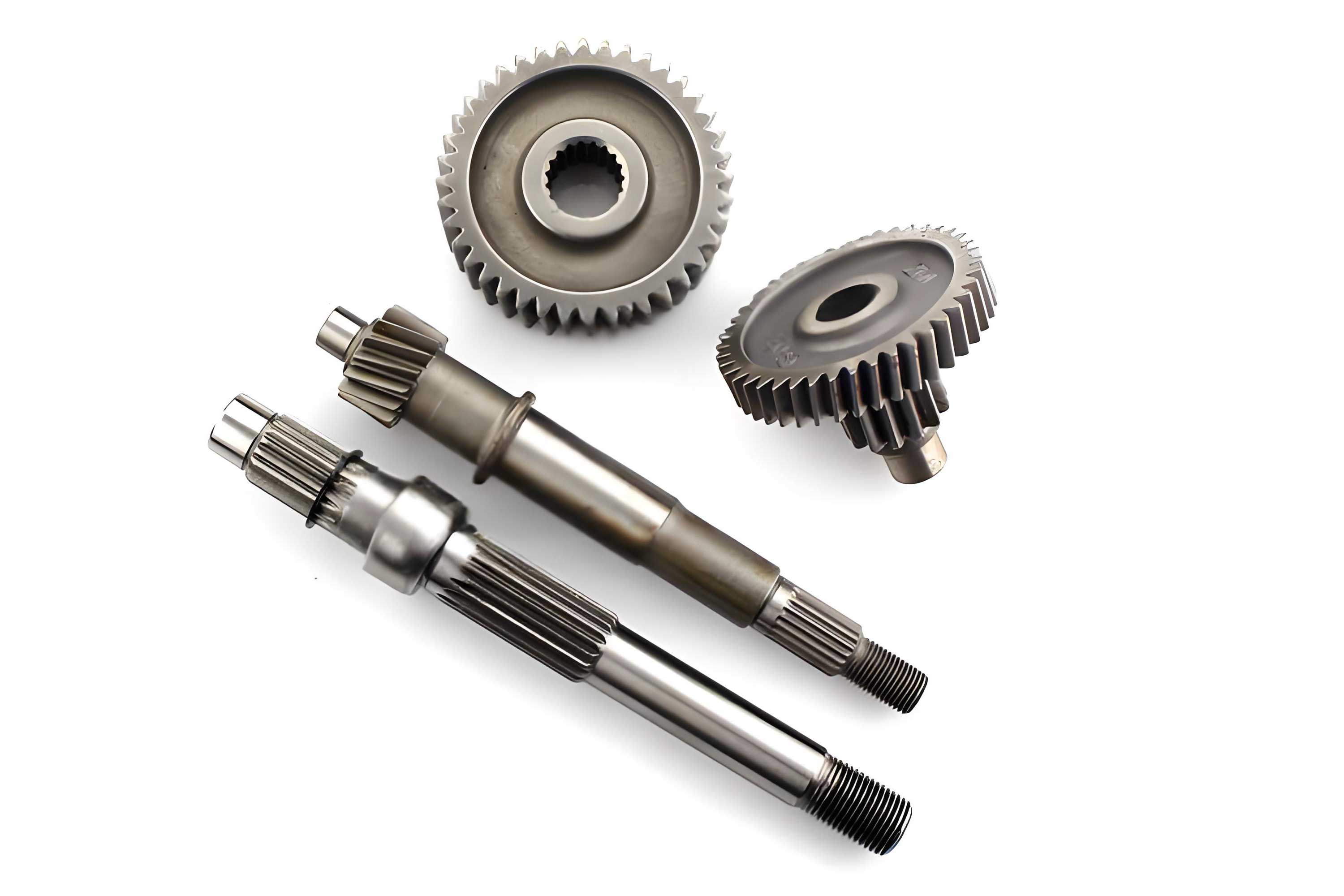
The bending stress on a simply supported worm shaft with a central point load (a simplification where the mesh force is applied at mid-span) can be estimated using beam theory. If the supports are a distance $l$ apart, the worm’s minor diameter is $d$, and the material’s Young’s Modulus is $E$, then for a static force $F_H$:
- Maximum Bending Moment: $M_{max} = \frac{F_H l}{4}$
- Maximum Bending Stress: $\sigma_b = \frac{M_{max}}{Z} = \frac{F_H l / 4}{\pi d^3 / 32} = \frac{8 F_H l}{\pi d^3}$
- Maximum Deflection at Center: $f_{max} = \frac{F_H l^3}{48 E I} = \frac{F_H l^3}{48 E (\pi d^4 / 64)} = \frac{4 F_H l^3}{3 \pi E d^4}$
The transverse stiffness $k$ of the worm shaft, defined as the force per unit deflection ($k = F_H / f$), is therefore:
$$k = \frac{3 \pi E d^4}{4 l^3}$$
This stiffness $k$ is a crucial parameter in analyzing dynamic impact, as will be shown in the next section. A stiffer shaft (larger $d$, shorter $l$, higher $E$) will deflect less for a given load but may experience different dynamic interactions.
Dynamic Impact Analysis: The Role of Speed and Clearance
The static analysis above assumes perfect alignment and immediate force transfer. In reality, assembly requires tolerances, leading to clearances in the bearing supports or the worm wheel mounting. When the worm gear drive starts or changes load direction, the worm must traverse this clearance before fully engaging the支承 and bearing the full transverse load. The kinetic energy involved in this motion converts into strain energy in the bent shaft, potentially creating an impact force $F_o$ significantly larger than the static drive force $F_H$. The magnitude of this overforce depends critically on two factors: the rotational speed (which governs the transverse velocity) and the initial clearance $S_1$.
We can model two distinct regimes:
1. High-Speed Impact Regime
For a worm gear drive operating at high input speed (e.g., >500 rpm), the transverse engagement occurs rapidly. The process can be idealized as an impact where the worm’s transverse kinetic energy is fully converted into the shaft’s elastic strain energy upon arresting the clearance. Let:
- $S_1$: Initial radial clearance between worm shaft and its支承 (m).
- $S_2$: Subsequent elastic deformation of the worm shaft upon impact (m).
- $k$: Transverse bending stiffness of the worm shaft (N/m).
- $F_d$: The driving transverse force ($F_H$ from the static analysis) (N).
Applying the principle of work and energy, the work done by the driving force $F_d$ over the total distance ($S_1 + S_2$) equals the stored elastic energy:
$$\frac{1}{2} k S_2^2 = F_d (S_1 + S_2)$$
This is a quadratic in $S_2$. Solving for the positive root:
$$S_2 = \frac{F_d + \sqrt{F_d^2 + 2 k F_d S_1}}{k}$$
By Hooke’s Law, the maximum dynamic reaction force $F_o$ experienced by the shaft is:
$$F_o = k S_2 = F_d + \sqrt{F_d^2 + 2 k F_d S_1}$$
The term $\sqrt{F_d^2 + 2 k F_d S_1}$ represents the dynamic overforce. If clearance $S_1 = 0$, the equation reduces to $F_o = 2F_d$, indicating a doubling of the load due to pure elastic impact even with perfect fits. Any clearance $S_1 > 0$ further increases $F_o$. The bending stress is then calculated using this dynamic force:
$$\sigma_{dyn} = \frac{8 F_o l}{\pi d^3}$$
| Parameter | Symbol | Role in High-Speed Impact |
|---|---|---|
| Bending Stiffness | $k$ | Higher stiffness increases the impact force $F_o$ for a given clearance. |
| Initial Clearance | $S_1$ | Larger clearance dramatically increases the impact force. |
| Drive Force | $F_d$ | The base static force; higher torque leads to proportionally higher impact. |
| Rotational Speed | $n$ | Implied in the model as “high enough” for full energy conversion. |
2. Low-Speed / Quasi-Static Regime
For a very slow-moving worm gear drive (e.g., < 50 rpm), the transverse engagement occurs gradually. The kinetic energy from the slow transverse motion is negligible. In this case, the driving force $F_d$ overcomes bearing friction and slowly bends the shaft. The force in the shaft essentially equilibrates with the driving force, with minimal dynamic amplification. Therefore, for low-speed design, the analysis can often rely on the static force $F_H$ with an appropriate safety factor. Assembly clearances are less critical for strength (though they affect positional accuracy) and can be relaxed for easier manufacturing.
There exists an intermediate regime where the transverse velocity $v$ is significant but not high enough for the full-impact model. Here, part of the work done by $F_d$ goes into increasing the kinetic energy of the worm’s transverse motion before it is fully arrested by the shaft’s elasticity. A more general energy balance from the start of engagement to the point of maximum shaft deflection includes this kinetic energy term $\frac{1}{2} m v^2$, where $m$ is the effective translatory mass of the worm. The final dynamic force can be expressed as:
$$F_o \approx F_d + \sqrt{2 k m v^2}$$
This shows a continuous transition: as speed (and thus $v$) decreases, the dynamic overforce diminishes, approaching the static force $F_d$.
Case Study Analysis and Parameter Effects
The theoretical framework can be illustrated by analyzing two distinct electric actuator产品 with worm gear drive failures. The key parameters are summarized below.
| Product Type | Worm Input Speed (rpm) | Output Torque (N·m) | Worm Material | Worm Minor Dia., $d$ (mm) | Support Span, $l$ (mm) | Initial Failure Mode |
|---|---|---|---|---|---|---|
| Multi-Turn Actuator (High-Speed Case) | 1500 | 400 | 40Cr Steel | 14.675 | 100 | Worm shaft fracture at center |
| Quarter-Turn Actuator (Low-Speed Case) | 37.5 | 500 | 40Cr Steel | 16.48 | 85 | Tooth surface spalling on worm wheel |
High-Speed Multi-Turn Actuator Analysis
Given the high speed (1500 rpm), the full-impact model applies. First, calculate the static transverse drive force $F_d$.
- Worm Torque: Assuming a mechanical efficiency $\eta_T = 0.65$, $T_1 = \frac{T_2}{i \eta_T} = \frac{400}{60 \times 0.65} \approx 10.26$ N·m.
- Worm Tangential Force: With pitch diameter $d_1=18.4$ mm, $F_{t1} = \frac{2 \times 10.26}{0.0184} \approx 1115$ N.
- Worm Radial Force: Requires worm wheel tangential force $F_{t2} = \frac{2 \times 400}{0.1016} \approx 7874$ N. With pressure angle $\alpha=20^\circ$, $F_{r1}=F_{t2} \tan 20^\circ \approx 2866$ N.
- Static Transverse Force: $F_d = F_H = \sqrt{1115^2 + 2866^2} \approx 3075$ N.
Now, assess the impact. The shaft stiffness $k$ is calculated with $E=211$ GPa:
$$k = \frac{3 \pi \times 211 \times 10^9 \times (0.014675)^4}{4 \times (0.1)^3} \approx 2.31 \times 10^7 \text{ N/m} = 23.1 \text{ kN/mm}$$
Assume an initial bearing clearance $S_1 = 0.08$ mm. The dynamic deformation $S_2$ and force $F_o$ are:
$$S_2 = \frac{3075 + \sqrt{3075^2 + 2 \times (2.31 \times 10^7) \times 3075 \times 0.00008}}{2.31 \times 10^7} \approx 0.000276 \text{ m}$$
$$F_o = k S_2 \approx 2.31 \times 10^7 \times 0.000276 \approx 6370 \text{ N}$$
The dynamic force $F_o \approx 6.37$ kN is about **2.07 times** the static force $F_d$. The resulting bending stress is:
$$\sigma_{dyn} = \frac{8 \times 6370 \times 0.1}{\pi \times (0.014675)^3} \approx 513 \text{ MPa}$$
This stress level, repeatedly applied during start-stop cycles, is sufficient to cause high-cycle fatigue failure in the heat-treated steel worm, explaining the shaft fracture. Solutions focused on reducing clearance $S_1$ (tighter bearing fits) and modifying the axial支承 to prevent a cantilever effect provided significant life improvement, validating the model.
Low-Speed Quarter-Turn Actuator Analysis
For this slow-speed (37.5 rpm) application, the dynamic overforce is minimal. Using the intermediate formula $F_o \approx F_d + \sqrt{2 k m v^2}$, the transverse velocity $v$ is very low, making the second term negligible. Therefore, $F_o \approx F_d$. The primary failure was tooth spalling on the worm wheel, a classic surface durability issue related to contact stress, not shaft bending. Improving the worm wheel material or heat treatment successfully increased load capacity, confirming that static tooth strength was the limiting factor, not dynamic shaft bending.
| Parameter | Multi-Turn (High-Speed) | Quarter-Turn (Low-Speed) |
|---|---|---|
| Static Force $F_d$ (kN) | 3.08 | ~5.78 (calculated similarly) |
| Shaft Stiffness $k$ (kN/mm) | 23.1 | 59.7 |
| Dynamic Force $F_o$ (kN) | 6.37 (Impact Model) | ~5.78 (Quasi-Static) |
| Dynamic/Static Force Ratio | 2.07 | ~1.0 |
| Dominant Failure Cause | Worm shaft bending fatigue due to impact. | Worm wheel tooth surface fatigue (pitting). |
Design Guidelines for Worm Gear Drive Fulcrum Bearings
Based on the analysis of transverse loads and dynamic effects, the following design recommendations are proposed for the支承 systems of electric actuator worm gear drives:
- Prioritize Speed Reduction at the Worm: The most effective way to mitigate dynamic impact is to reduce the input speed to the worm shaft. This lowers the transverse engagement velocity $v$, directly reducing the kinetic energy term in the impact equations. For low-speed final drives, dynamic analysis may be simplified or even unnecessary for bending stress calculations.
- High-Speed Design: Minimize Clearance and Increase Stiffness:
- Bearing Fits: Use interference or transition fits for bearing inner rings on the worm shaft and outer rings in the housing to minimize radial clearance $S_1$. The goal should be to approach $S_1 \approx 0$.
- Shaft Design: Maximize the worm’s minor diameter $d$ within space constraints to increase bending stiffness $k$ and strength. The support span $l$ should be as short as possible.
- Bearing Arrangement: Use a statically determinate, preloaded bearing arrangement (e.g., back-to-back angular contact ball bearings) to eliminate axial and radial play, ensuring stable支承 under reversing loads.
- Design Margin: Even with zero clearance, account for a dynamic load factor of at least 2.0 for bending stress calculations in high-speed applications.
- Low-Speed Design: Clarity on Priorities:
- Strength Focus: Design efforts should concentrate on traditional gear strength (bending and contact) and selection of appropriate materials/heat treatments.
- Assembly Tolerance: Clearances can be more relaxed (e.g., slip fits) to facilitate assembly and reduce cost, as their effect on dynamic bending stress is minimal.
- Comprehensive Stress Evaluation: Always perform a combined stress check on the worm shaft. This includes:
- Torsional shear stress from transmitting torque $T_1$.
- Bending stress from the dynamic transverse force $F_o$.
- Axial compressive stress (for non-self-locking designs).
Use an appropriate failure theory (e.g., Von Mises) to evaluate the combined stress state at critical sections, such as the root of the thread or at shoulder fillets.
Conclusion
The traditional approach to designing a worm gear drive often focuses exclusively on the gear mesh characteristics. This analysis demonstrates that for the complete and reliable design of an electric actuator transmission, the worm shaft must be treated as a structural beam subjected to dynamic transverse loads. The operational speed of the worm gear drive is a key discriminant: high-speed applications necessitate a focus on minimizing支承 clearance and mitigating impact loads to prevent shaft bending fatigue, while low-speed applications allow greater tolerance in assembly and shift the design focus to gear tooth strength. By integrating this transverse bending analysis based on fundamental mechanics with conventional gear design practices, engineers can develop more robust, durable, and compact worm gear drive systems for demanding automation applications.