
The reliable transmission of motion and torque is paramount in the precise positioning mechanisms of concentrated solar power systems, such as dish Stirling systems. Among various transmission solutions, worm gears are frequently employed in the azimuth (horizontal) and elevation (vertical) drive mechanisms due to their inherent advantages: a high single-stage reduction ratio, compact design, smooth and quiet operation, and the potential for self-locking which acts as a safety feature against back-driving under wind loads. The worm gears in these applications are subjected to significant static and dynamic loads originating from the inertia of the structure and, most critically, from wind forces acting on the large collector surface. Ensuring the structural integrity and contact strength of these worm gears is therefore a critical design consideration to guarantee the long-term, failure-free operation of the solar tracker.
This article presents a comprehensive methodology for analyzing the contact strength of a worm gear pair used in a dish solar system’s azimuth drive. The focus is on developing a high-fidelity finite element model within the ABAQUS/Standard environment to accurately predict stress distributions under worst-case operational loading. The results are validated against classical Hertzian contact theory, and parametric studies are conducted to explore design improvements. The entire workflow, from parametric geometric modeling to advanced nonlinear contact simulation, is detailed, emphasizing the analysis of worm gears.
Parametric Geometric Modeling of the Worm Gear Pair
The first step in any accurate finite element analysis is the creation of a precise geometric model. The drive system under consideration utilizes an Archimedes (ZA-type) worm gear set. The primary design parameters for the worm gears, calculated based on the input power, speed, required reduction ratio, and estimated loads, are summarized in Table 1.
| Parameter | Symbol | Worm Value | Worm Wheel Value |
|---|---|---|---|
| Number of Threads/Teeth | z | 1 | 104 |
| Module | m (mm) | 7 | |
| Centre Distance | a (mm) | 392 | |
| Pitch Diameter | d (mm) | 112 | 728 |
| Lead Angle | γ (°) | 7.125 | – |
| Addendum Modification Coefficient | x | – | +0.125 |
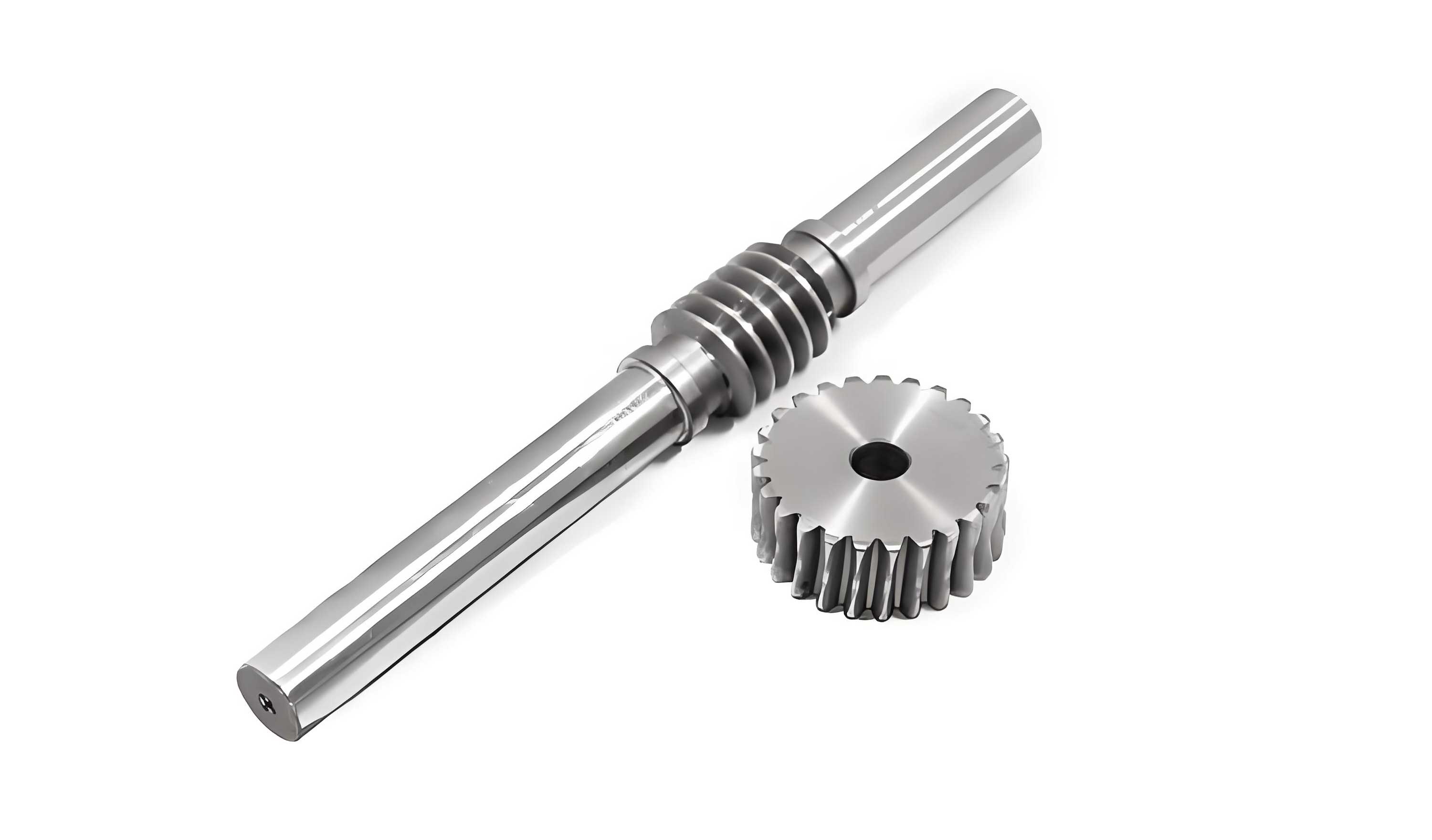
A three-dimensional solid model of the worm gear pair was created using a parametric CAD software. Parametric modeling is essential as it allows for easy modification of key gear geometry (e.g., module, pressure angle, root fillet radius) for subsequent design optimization studies. To reduce computational cost without sacrificing result accuracy for the contact analysis, minor features such as keyways, small chamfers, and bolt holes were omitted from the initial model. The core geometry of the meshing teeth was preserved with high fidelity. The generated solid model provides the foundation for the finite element analysis.
Development of the Finite Element Model in ABAQUS
Transferring the CAD geometry into ABAQUS initiates the finite element modeling phase. Several assumptions and simplifications are made to render the complex nonlinear contact problem tractable while maintaining engineering accuracy:
- The materials for both worm gears are assumed to be homogeneous, isotropic, and linearly elastic.
- The gear teeth are considered perfect, without manufacturing errors or wear.
- The analysis is quasi-static; dynamic effects are neglected.
- The influence of lubrication is simplified to a constant Coulomb friction coefficient at the contacting interfaces.
Model Simplification and Material Definition
Analyzing the entire worm gear assembly is computationally prohibitive. A sub-modeling approach is adopted where only the critical regions—several teeth of the worm and worm wheel in and around the mesh zone—are extracted for analysis. This significantly reduces the number of elements while concentrating computational resources on the area of interest. The material properties assigned to the worm gears are crucial inputs. The worm is typically made from a case-hardened steel for strength, while the worm wheel is often made from a bronze alloy to reduce friction and wear. The properties used are listed in Table 2.
| Component | Material | Density (kg/mm³) | Young’s Modulus, E (GPa) | Poisson’s Ratio, ν | Allowable Stress (MPa) |
|---|---|---|---|---|---|
| Worm | 20CrMnTi Steel | 7.85e-6 | 206 | 0.27 | 835 |
| Worm Wheel | QSn6.5-0.1 Bronze | 8.80e-6 | 113 | 0.34 | 470 |
Meshing Strategy for Worm Gears
The complex, spatially curved surfaces of worm gear teeth present a challenge for meshing. A structured hexahedral mesh is difficult to generate. Therefore, a free meshing technique with tetrahedral elements is employed. ABAQUS’s modified quadratic tetrahedron element (C3D10M) is specifically selected. This element type is designed for contact analyses, providing accurate contact pressure predictions—a significant improvement over standard quadratic tetrahedra which can yield poor contact force values at nodes. A global seed size is first applied, followed by local mesh refinement in the contact region where high stress gradients are expected. The contact tooth surfaces are finely discretized with an approximate element size of 3 mm, while coarser elements (8 mm) are used in non-critical regions. The final meshed model contains over 140,000 elements, ensuring a good balance between result accuracy and solution time.
Defining Contact Interactions and Boundary Conditions
Simulating the meshing action of the worm gears requires defining a surface-to-surface contact interaction. The harder, steel worm thread surface is designated as the master surface, and the softer, bronze worm wheel tooth surface as the slave surface. This is consistent with standard contact mechanics practice for deformable-deformable interactions where the stiffer body is the master. The interaction property is defined as “Finite Sliding,” which is appropriate for the large relative motion between the gear teeth. A Coulomb friction model with a coefficient of 0.1 is applied to account for sliding friction losses between the worm gears.
Realistic boundary conditions are applied to replicate the operational state. The worm shaft is constrained at its bearing locations using cylindrical supports, allowing rotation but restraining radial and axial movements. The torque is applied to the worm wheel. Since solid elements (C3D10M) have no rotational degrees of freedom, a reference point is created at the center of the worm wheel bore and coupled to the inner bore surface using a kinematic coupling constraint. This allows the application of a pure moment to the reference point, which is transmitted as a distributed force to the gear teeth. The applied torque, \( T_{wheel} \), is calculated from the worst-case wind load scenario for the dish collector. For this analysis, a torque of 16,899 N·m is used, representing a significant operational load on the worm gears.
Theoretical Contact Strength Calculation
Before proceeding with the FEA, it is instructive to calculate the theoretical contact stress using the Hertzian contact theory adapted for worm gears. The general form of the contact stress \( \sigma_H \) is given by:
$$ \sigma_H = \sqrt{ \frac{K F_n}{L_{min} \rho_{\Sigma}} } \cdot Z_E $$
Where \( F_n \) is the normal load, \( L_{min} \) is the minimum total length of contact lines, \( \rho_{\Sigma} \) is the equivalent curvature radius, \( K \) is the load factor, and \( Z_E \) is the elasticity factor. For worm gears, this is commonly transformed into a design formula based on the center distance \( a \) and the output torque \( T_2 \):
$$ \sigma_H = Z_E Z_\rho \sqrt{ \frac{K T_2}{a^3} } $$
The material elasticity factor \( Z_E \) is derived from the Young’s moduli and Poisson’s ratios of both materials:
$$ Z_E = \frac{1}{\sqrt{\pi \left( \frac{1-\nu_1^2}{E_1} + \frac{1-\nu_2^2}{E_2} \right)}} $$
Substituting the values from Table 2:
$$ Z_E = \frac{1}{\sqrt{\pi \left( \frac{1-0.27^2}{206000} + \frac{1-0.34^2}{113000} \right)}} \approx 159.8 \text{ MPa}^{1/2} $$
The contact coefficient \( Z_\rho \), which accounts for the geometry of the worm gears (contact line length and curvature), is taken as 3.085 for this specific ZA-type set. Assuming a load factor \( K = 1 \) for the static analysis and using \( T_2 = 16899 \text{ N·m} \) and \( a = 392 \text{ mm} \), the theoretical maximum Hertzian contact stress is calculated:
$$ \sigma_{H,theory} = 159.8 \times 3.085 \times \sqrt{ \frac{16899}{0.392^3} } \approx 261.1 \text{ MPa} $$
This value serves as a benchmark for validating the finite element analysis results of the worm gears.
Finite Element Analysis Results and Discussion
The nonlinear static analysis was performed in ABAQUS/Standard. The solver iteratively finds the equilibrium state where the contact conditions between the worm gears are satisfied under the applied load. The primary output of interest is the von Mises stress distribution, which is a good indicator of yield inception for ductile metals.
The resulting stress contours clearly illustrate the load transfer mechanism between the worm gears. The maximum stress is concentrated in the root region of the worm wheel tooth, precisely at the endpoint of the theoretical contact line. This is the most critically stressed location and aligns with common failure modes for worm gears, such as bending fatigue at the tooth root. The FEA-predicted maximum contact stress is 258.3 MPa. Comparing this to the theoretical Hertzian calculation (261.1 MPa) reveals an excellent agreement, with an error of only about 1.1%. This close correlation validates the accuracy of the finite element modeling methodology, including the mesh density, contact definition, and boundary conditions for the worm gears.
Both the theoretical and FEA stress values are well below the allowable stress for the bronze worm wheel material (470 MPa), indicating an adequate safety factor under this specific static load. However, the FEA provides significantly more detail than the theoretical formula. It vividly shows a localized stress concentration at the tooth root fillet. While the peak value is safe, this concentration is the initiation point for fatigue cracks under cyclic loading, which is the typical operational condition for tracking worm gears.
Parametric Study: Influence of Root Fillet Radius
To explore a potential design improvement for reducing the identified stress concentration, a parametric study was conducted. The radius of the root fillet on the worm wheel tooth was systematically increased, and the analysis was re-run for each configuration. The relationship between the fillet radius \( r_f \) and the maximum von Mises stress \( \sigma_{vm,max} \) is summarized in Table 3.
| Root Fillet Radius, \( r_f \) (mm) | Max. von Mises Stress, \( \sigma_{vm,max} \) (MPa) | Observation |
|---|---|---|
| 1.0 | 216.7 | Baseline design |
| 2.0 | 201.4 | Stress reduction |
| 3.0 | 194.3 | Stress reduction |
| 4.0 | 178.8 | Significant reduction |
| 5.0 | 167.9 | Optimal practical limit |
| 6.0 | N/A (Simulation Failed) | Meshing interference |
The results demonstrate a clear and beneficial trend: increasing the root fillet radius effectively reduces the maximum stress in the worm gears. A larger fillet smoothens the geometric discontinuity, distributing the stress more evenly and reducing the concentration factor. However, this geometric modification is not without limits. When the fillet radius was increased to 6 mm, the simulation failed to converge. This indicates that the enlarged fillet caused geometric interference with the tip of the worm thread, preventing proper meshing of the worm gears. Therefore, while a larger fillet radius (e.g., 4-5 mm) is recommended to enhance the bending strength and fatigue life of the worm gears, it must be carefully designed within the geometric constraints of the gear tooth profile to avoid undercutting and ensure correct engagement.
Extended Analysis: Bending Stress and Deformation
While contact stress is vital for surface durability (pitting resistance), bending stress at the tooth root is critical for preventing tooth breakage. The same FEA model readily provides this information. The bending stress distribution can be examined on the cross-section of the worm wheel tooth. The maximum tensile bending stress typically occurs at the root on the side of the tooth away from the loaded flank. For the baseline design of these worm gears, the FEA indicates a maximum bending stress of approximately 189 MPa. This should be compared to the bending fatigue strength of the bronze material. A safety factor can be calculated accordingly. The deformation of the teeth is also obtained. Under the applied torque, the loaded teeth exhibit elastic deflection, which contributes to the overall torsional wind-up of the drive and can affect positioning accuracy. The analysis shows a maximum elastic deformation on the order of 0.05 mm on the most loaded tooth of the worm gears. This level of deformation is acceptable for solar tracking but should be considered in high-precision applications.
Considerations for Dynamic and Fatigue Analysis
The static analysis presented forms the foundation. However, worm gears in solar trackers operate dynamically. A more complete assessment would involve:
- Dynamic Load Analysis: Incorporating time-varying wind loads and start-stop inertia forces to find the dynamic torque amplification factor, which would be higher than the static load factor \( K=1 \).
- Transient Dynamic FEA: Simulating the meshing cycle as multiple teeth engage and disengage to capture the variation in stress over time for each tooth.
- Fatigue Life Prediction: Using the stress results from a dynamic analysis (or a static analysis with a dynamic load factor) in conjunction with the material’s S-N (stress-life) curve to estimate the fatigue life of the worm gears. The stress concentration at the root fillet becomes the primary focus for a bending fatigue calculation.
- Thermal Analysis: Worm gears have relatively low efficiency, and the resulting power loss is converted to heat. A coupled thermal-stress analysis could be performed to assess the effect of operational temperature rise on material properties, clearances, and stress levels.
Conclusions and Design Implications
This detailed investigation into the contact mechanics of a solar tracker worm gear pair using ABAQUS has yielded several key insights and validated a robust analytical workflow. The high-fidelity finite element model successfully predicted the stress state, showing excellent agreement (within 1%) with classical Hertzian contact theory. The analysis confirmed that under the specified worst-case static wind load, the contact stresses in both the steel worm and bronze worm wheel are within the allowable limits of their respective materials, indicating a sufficient static safety factor.
More importantly, the FEA revealed the precise location and magnitude of stress concentrations that are not captured by analytical formulas. The root of the worm wheel tooth was identified as the most critically stressed region, with a clear concentration that serves as the likely initiation point for fatigue failure. The parametric study on the root fillet radius demonstrated a practical design optimization path: increasing the fillet radius from a nominal 1 mm to 4-5 mm can reduce the maximum stress by approximately 15-20%, thereby significantly enhancing the bending strength and potential fatigue life of the worm gears. Crucially, the study also identified the geometric limit to this optimization, as overly large fillets cause interference and prevent proper meshing of the worm gears.
The methodology established—combining parametric CAD modeling, advanced meshing techniques for complex gear geometries, rigorous definition of nonlinear contact interactions in ABAQUS, and validation against theory—provides a powerful toolset for the design and analysis of worm gears in demanding applications like solar tracking. It enables engineers to move beyond conservative analytical estimates and perform virtual testing and optimization, leading to more reliable, efficient, and potentially lightweight worm gear drives for renewable energy systems.