
In the field of precision motion control, harmonic drive gears have long been celebrated for their high reduction ratios, compactness, and zero-backlash characteristics. As robotics and aerospace applications demand ever-smaller and lighter components, the push towards minimizing the axial dimensions of harmonic drive gear systems has intensified. Among the various configurations, the harmonic drive gear with a short flexspline has emerged as a key technological trend, promising significant reductions in volume and mass. However, the reduction in axial length introduces critical challenges, primarily a substantial increase in the flexspline’s opening angle under wave generator loading. This increased deformation leads to a dramatic reduction in the effective contact area between the flexspline and circular spline teeth, subsequently compromising the transmission stiffness and load-carrying capacity of the harmonic drive gear. Traditional manufacturing methods also face hurdles in producing high-precision, small-modulus gears for such compact designs. In this article, we present a comprehensive new design methodology and an advanced manufacturing process specifically developed for short flexspline harmonic drive gears. Our approach centers on a novel tooth profile for the flexspline and a corresponding conjugate profile with axial inclination for the circular spline, coupled with a high-precision Wire Electrical Discharge Machining – Low Speed (WEDM-LS) fabrication technique. We detail the theoretical foundations, the manufacturing execution, and the experimental validation through prototype development and stiffness testing. The results demonstrate a significant enhancement in the transmission stiffness of the new harmonic drive gear design, validating its potential for high-performance applications where space and weight are at a premium.
The fundamental operating principle of a harmonic drive gear relies on the elastic deformation of a thin-walled flexspline by a wave generator, typically an elliptical cam. This deformation causes the teeth of the flexspline to engage with those of a rigid circular spline at two diametrically opposite regions. The difference in tooth count between the two splines, usually by two teeth for a double-wave generator, results in a high reduction ratio. The transmission stiffness of a harmonic drive gear is a paramount performance metric, directly influencing positioning accuracy, dynamic response, and resistance to load fluctuations. For a standard harmonic drive gear with a conventional length-to-diameter ratio, the flexspline’s deformation is manageable, and the tooth contact area is sufficient. However, when the flexspline’s axial length is drastically shortened—achieving length-to-diameter ratios of 1/2 or even 1/4—the mechanical behavior changes fundamentally.
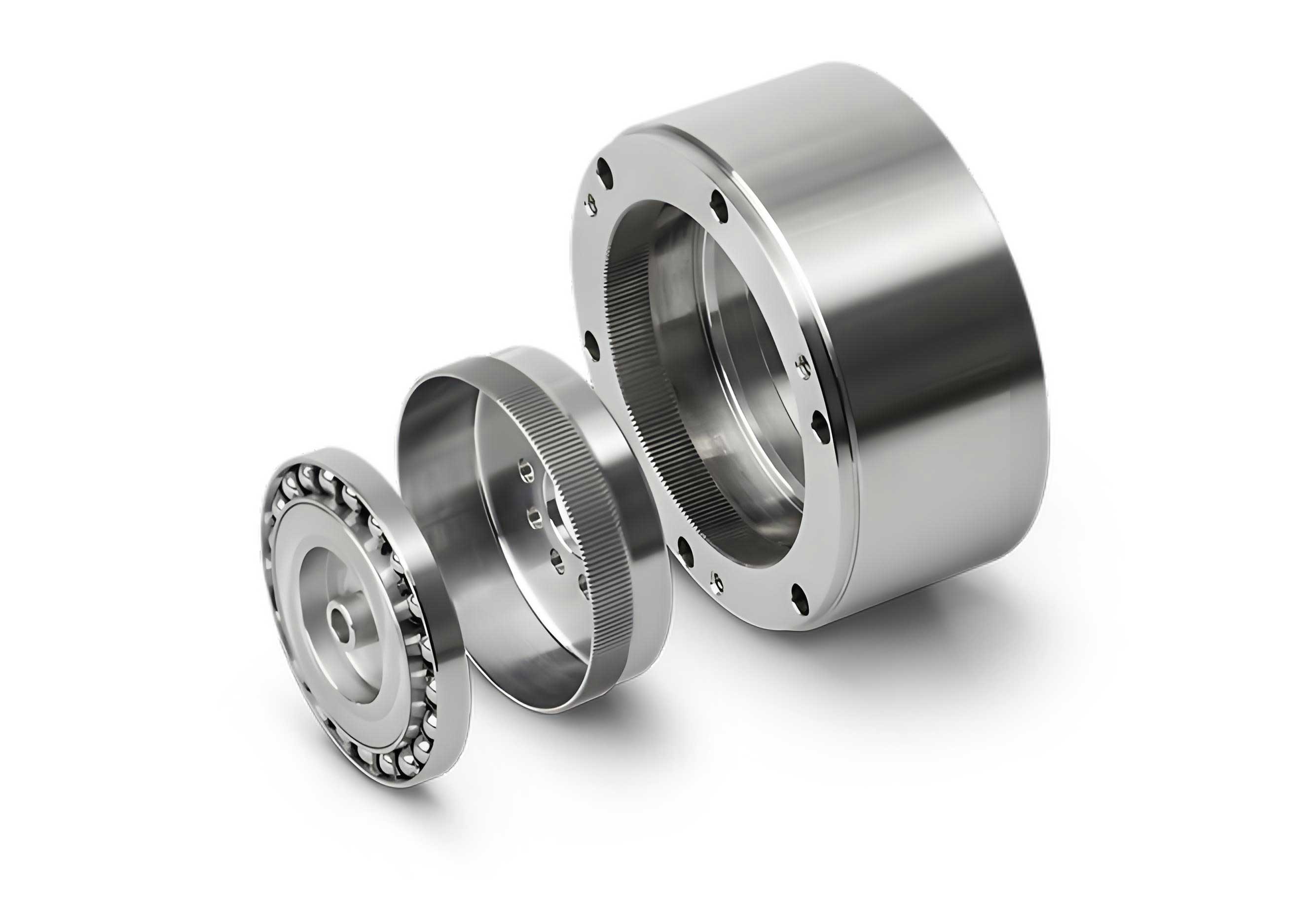
The primary issue is geometric. A shorter flexspline exhibits a much larger radial displacement, or opening angle, at the major axis of the wave generator compared to a longer one. This exaggerated deformation has a twofold negative effect. First, it induces significantly higher stress concentrations within the flexspline body, raising concerns about fatigue life and material limits. Second, and more critically for immediate performance, it drastically reduces the overlap and contact area between the engaging teeth of the flexspline and the circular spline. This reduction in contact area diminishes the number of tooth pairs sharing the load and increases the contact pressure on the engaged teeth, leading to a softer overall torsional stiffness. A harmonic drive gear with poor stiffness is susceptible to larger angular deflections under load, which is unacceptable in precision applications like robotic joints or satellite antenna drives. Therefore, our design objective was not merely to shorten the flexspline but to redesign the tooth engagement geometry to compensate for and overcome the inherent loss of contact area, thereby restoring and even enhancing the transmission stiffness of the short flexspline harmonic drive gear.
Our novel design commences with a re-evaluation of the tooth profile. For the flexspline, we adopted a double circular-arc tooth profile, which has been theoretically and experimentally proven to offer superior meshing characteristics, better load distribution, and reduced stress concentration compared to the traditional involute profile in harmonic drive gear applications. The geometry of this profile is defined by two tangent circular arcs forming the working flanks of the tooth. The parametric equations for the flexspline tooth profile in its local coordinate system are as follows.
For the upper arc (dedendum flank):
$$ \vec{R_1} = \left( \rho_a \cos(\alpha_1) – l_a \right) \vec{i} + \left( \rho_a \sin(\alpha_1) \right) \vec{j} $$
where $\rho_a$ is the radius of the upper arc, $\alpha_1$ is the angular parameter, $l_a$ is a linear offset, and $\vec{i}$ and $\vec{j}$ are the unit vectors along the x and y axes, respectively.
For the lower arc (addendum flank):
$$ \vec{R_2} = \left( l_f – \rho_f \cos(\alpha_2) \right) \vec{i} + \left( \rho_f \sin(\alpha_2) + b_f \right) \vec{j} $$
where $\rho_f$ is the radius of the lower arc, $\alpha_2$ is its angular parameter, and $l_f$ and $b_f$ are geometric offsets defining the tooth’s height and position. The parameters $\rho_a$, $\rho_f$, $l_a$, $l_f$, and $b_f$ are carefully determined based on the module, pressure angle, and desired tooth geometry to ensure proper clearance and strength. The double-arc profile promotes a more favorable “conformal” contact condition with its conjugate pair.
The true innovation lies in the design of the circular spline tooth profile. Instead of a standard straight-tooth conjugate profile, we introduce an axial inclination angle. The conjugate profile itself is derived rigorously using the envelope theory relative to the deformed state of the flexspline. To find the circular spline tooth shape that correctly mates with the deformed flexspline tooth, we model the motion of the flexspline tooth as it travels along the wave generator’s contour. Consider a fixed coordinate system ${O, x, y}$ attached to the wave generator. Let ${x_g, O_g, y_g}$ and ${x_r, O_r, y_r}$ be coordinate systems fixed to the circular spline and flexspline, respectively. Initially, their vertical axes are aligned. The $y_g$-axis coincides with the symmetry line of a circular spline tooth space, and the $y_r$-axis coincides with the symmetry line of a flexspline tooth. The origin $O_r$ lies on the neutral curve of the flexspline’s deformation.
When the wave generator, modeled as a cosine cam, deforms the flexspline, a point on the flexspline’s neutral curve undergoes radial displacement $w$, tangential displacement $v$, and a normal rotation $\mu$. For a double-wave cosine cam, these are given by:
$$ w(\phi) = w_0 \cos(2\phi), $$
$$ v(\phi) = -0.5 w_0 \sin(2\phi), $$
$$ \mu(\phi) = 1.5 \frac{w_0}{r_m} \sin(2\phi), $$
where $w_0$ is the maximum radial displacement, $\phi$ is the angular coordinate on the undeformed flexspline, and $r_m$ is the radius of the flexspline’s neutral curve before deformation. The rotation of the flexspline cross-section is $\phi_1 = \phi + v / r_m$.
The transformation matrix from the flexspline coordinate system to the circular spline system, $M_{gr}$, incorporates this motion:
$$ M_{gr} = \begin{bmatrix} \cos \phi_{12} & \sin \phi_{12} & \rho \sin \gamma \\ -\sin \phi_{12} & \cos \phi_{12} & \rho \cos \gamma \\ 0 & 0 & 1 \end{bmatrix}, $$
where $\phi_{12}$ is the angle between $y_r$ and $y_g$, $\rho = r_m + w(\phi)$ is the polar radius of the deformed neutral curve, and $\gamma$ is related to the kinematic relationship between the flexspline and circular spline rotations. A point on the flexspline tooth profile $\vec{R_r}(t) = (x_r(t), y_r(t))$ in its local coordinates transforms to the circular spline system as:
$$ x_{gr} = x_r \cos \phi_{12} + y_r \sin \phi_{12} + \rho \sin \gamma, $$
$$ y_{gr} = -x_r \sin \phi_{12} + y_r \cos \phi_{12} + \rho \cos \gamma. $$
As the parameter $\phi$ (representing the motion) varies, these equations generate a family of curves in the circular spline coordinate system. The envelope of this family, which represents the required circular spline tooth profile, is found by solving the equation:
$$ \frac{\partial x_{gr}}{\partial t} \cdot \frac{\partial y_{gr}}{\partial \phi} – \frac{\partial x_{gr}}{\partial \phi} \cdot \frac{\partial y_{gr}}{\partial t} = 0. $$
This partial differential equation is solved numerically due to its complexity. By discretizing the parameter $\phi$ over the range $[0, \pi]$ (for a double-wave symmetry), we obtain discrete points $(x_g, y_g)$ that define the envelope. The outer envelope corresponds to the conjugate tooth profile of the circular spline. These discrete points are then fitted with a smooth spline curve to define the final theoretical profile. Crucially, this derived profile is calculated for a straight tooth oriented along the axial direction.
Our key modification is to introduce a constant axial inclination angle $\beta$ to this profile. Instead of the tooth being parallel to the gear axis, it is subtly tilted. This means that the tooth profile coordinates $(x_g, y_g)$ are effectively calculated at different axial positions, creating a helical-like effect but with a very small lead, specifically designed to counteract the loss of contact due to the large flexspline opening angle. The inclination angle $\beta$ is defined such that the tooth is rotated around the circumferential direction. When the flexspline, with its large radial deformation, engages, the inclined teeth of the circular spline present a larger effective contact surface to the flexspline teeth, increasing the overlap and contact area. This concept is analogous to using helical gears to increase contact ratio in parallel-axis gearing, but here it is applied uniquely to the complex kinematics of a harmonic drive gear.
To determine the optimal inclination angle $\beta$, we conducted a series of finite element analysis (FEA) simulations. We modeled a quarter-section of a harmonic drive gear with a short flexspline (length-to-diameter ratio of 1/4) and different circular spline inclination angles: $\beta = 0^\circ$ (no inclination), $0.1^\circ$, $0.2^\circ$, and $0.3^\circ$. The contact analysis evaluated the percentage of nodes in contact on the tooth surfaces under load. The results are summarized in the table below.
| Circular Spline Tooth Inclination Angle ($\beta$) | Contact Area Percentage (%) | Number of Tooth Pairs in Mesh |
|---|---|---|
| $0^\circ$ (Standard) | 12.60 | 30 |
| $0.1^\circ$ | 13.71 | 30 |
| $0.2^\circ$ | 17.03 | 30 |
| $0.3^\circ$ | 12.93 | 30 |
The FEA results clearly indicate that an inclination angle of $0.2^\circ$ provides the maximum increase in contact area percentage—a 35.1% improvement over the standard design ($(17.03-12.60)/12.60 \times 100\%$). This angle was selected as optimal, offering the best compromise between increased contact area and other factors like manufacturing complexity and stress. Therefore, the final design for our short flexspline harmonic drive gear incorporates a flexspline with a double circular-arc tooth profile and a circular spline with its conjugate profile axially inclined by $0.2^\circ$.
The realization of this sophisticated design, especially the small-modulus gears (module $m=0.25$ mm) and the precise inclination angle, demanded an advanced manufacturing process. Traditional gear cutting methods like hobbing or shaping are challenging for such small modules, and creating a precise, consistent inclination on the circular spline teeth is non-trivial. We turned to Wire Electrical Discharge Machining – Low Speed (WEDM-LS). This process uses a continuously moving thin brass wire as an electrode to erode the workpiece material with high-frequency electrical discharges, guided by a computer numerical control (CNC) path. It offers exceptional precision (up to $\pm 0.002$ mm), excellent surface finish ($0.2$ to $1.6 \mu m$ Ra), and crucially, the capability to cut complex profiles and tapers. This makes it ideally suited for manufacturing both the flexspline and the inclined-tooth circular spline for our harmonic drive gear.
For the flexspline, material selection is critical due to the high cyclic stresses. We chose 30CrMnSiA alloy steel, heat-treated to a hardness of 55 HRC via quenching at $880^\circ$C (oil-cooled) and tempering at $180^\circ$C (air-cooled). This treatment yields high strength and fatigue resistance, as shown in the material properties table below.
| Material (Flexspline) | Hardness (HRC) | Tensile Strength $\sigma_b$ (MPa) | Yield Strength $\sigma_s$ (MPa) | Fatigue Limit $\sigma_{-1}$ (MPa) |
|---|---|---|---|---|
| 30CrMnSiA | 55 | 1800 | 1600 | 670 |
The flexspline blank was first machined by turning, grinding, and drilling to create the basic cylindrical form with mounting features. The external gear teeth were then cut using the WEDM-LS process. A key challenge in wire-cutting an external gear is that the wire cannot complete a full 360-degree cut without severing the workpiece from the fixture. To solve this, we designed and fabricated a special high-precision fixture. This fixture allows the flexspline blank to be rotated precisely by $180^\circ$ after cutting approximately half of the teeth. A reference plate on the fixture enables the WEDM machine’s touch probe to re-establish the exact coordinate system after rotation, ensuring seamless continuity and high positional accuracy across the two cutting sessions. All tooth profiles were cut using a two-pass cutting strategy (roughing and finishing) to achieve the desired surface quality and dimensional accuracy on the double-arc profile.
For the circular spline, we selected 45# carbon steel, heat-treated to a hardness of 30-36 HRC (quenched at $820^\circ$C and tempered at $200^\circ$C). Its properties are summarized below.
| Material (Circular Spline) | Hardness (HRC) | Tensile Strength $\sigma_b$ (MPa) | Yield Strength $\sigma_s$ (MPa) | Fatigue Limit $\sigma_{-1}$ (MPa) |
|---|---|---|---|---|
| 45# Steel | 30-36 | 700 | 500 | 340 |
The circular spline blank was similarly prepared. The internal gear teeth with the $0.2^\circ$ axial inclination were manufactured entirely by WEDM-LS using its taper-cutting functionality. In a WEDM-LS machine with taper-cutting capability, the upper wire guide can be independently positioned in the U and V axes relative to the lower guide, allowing the wire to be tilted. By programming the machine with the tooth profile coordinates for both the top and bottom faces of the circular spline, and setting the appropriate taper angle $\beta$, the machine performs a four-axis synchronized cut to generate the precisely inclined teeth. The required profile coordinates for the top and bottom were derived from the conjugate profile calculation, with a lateral offset determined by $\tan(\beta) \times \text{workpiece thickness}$. A custom VBA script was written to export the calculated profile points into CAD software, generating the exact CNC paths for the WEDM machine. This process successfully produced the circular spline with consistent, high-precision inclined teeth, overcoming the limitations of conventional gear cutting tools for such a specialized harmonic drive gear component.
To validate our design and manufacturing approach, we developed two prototype harmonic drive gear units based on a size 50 frame (referencing a nominal diameter). Both prototypes featured the new double-arc flexspline and the $0.2^\circ$ inclined-tooth circular spline. They differed in their flexspline’s length-to-diameter ratio: Prototype A had a ratio of $1/2$, and Prototype B had the more aggressive ratio of $1/4$. The wave generator was a classic double-wave cosine cam. The assembly configuration was circular spline fixed, wave generator as input, and flexspline as output, providing a high reduction ratio. For a gear ratio of $i=100$ and a double-wave generator ($u=2$), the tooth numbers are:
$$ Z_r = i \cdot u = 200 \quad \text{(flexspline)}, $$
$$ Z_g = Z_r \left(1 + \frac{1}{i}\right) = 202 \quad \text{(circular spline)}. $$
With a module $m=0.25$ mm, these tooth counts resulted in compact, high-ratio harmonic drive gear units.
The core performance metric we targeted was transmission stiffness. The experimental setup for stiffness measurement was designed to apply a controlled torque to the input and measure the resulting angular displacement at the output under locked output conditions. The input shaft, connected directly to the wave generator, was driven by a DC servo motor operating in torque control mode. This allowed us to command a specific input torque $T_1$ precisely, calculated from the motor’s current draw using its known torque constant. The output shaft of the harmonic drive gear was rigidly locked using a clamp mechanism that engaged with two parallel flats machined on the output shaft. An optical encoder integrated with the motor provided high-resolution measurement of the input angular position $\theta_1$. The output angular displacement $\theta_2$ was effectively zero due to the locked output, so the total torsional deflection $\phi$ of the harmonic drive gear system is the difference between the input rotation and the theoretical output rotation (which is $\theta_1 / i$), but since the output is fixed, the measured input rotation directly reflects the system’s elastic wind-up. For data presentation, we converted the input torque and angle to output-side equivalents:
$$ T_{out} = T_1 \cdot i \cdot \eta \quad \text{(assuming high efficiency $\eta \approx 1$ for stiffness calculation)}, $$
$$ \phi_{out} = \frac{\theta_1}{i}. $$
The stiffness coefficient $C$ is then the slope of the $T_{out}$ vs. $\phi_{out}$ curve:
$$ C = \frac{dT_{out}}{d\phi_{out}}. $$
The test procedure involved quasi-static loading. Starting from zero, the input torque was linearly increased to the rated torque of 28 N·m (referenced to the output), then linearly decreased back to zero. This was followed by linear loading in the reverse direction to -28 N·m and back to zero, and finally a small positive load to close the hysteresis loop. This cycle was repeated multiple times to ensure consistency and repeatability. The resulting plot of output torque versus output angular displacement forms a characteristic hysteresis loop, whose width represents lost motion or backlash, and whose slope represents the torsional stiffness.
We conducted extensive tests on Prototype B (the 1/4 ratio design), as it represented the most challenging case. The data from four consecutive test runs showed remarkable consistency, confirming the stability and reliability of the manufactured harmonic drive gear. A representative hysteresis loop from the testing is described by the data. The curve is not a single straight line but typically has two distinct slopes within the first quadrant (positive loading). There is an initial lower-stiffness region up to approximately half the rated torque, followed by a higher-stiffness region up to the full rated load. This behavior is common in harmonic drive gears and is attributed to the sequential engagement of tooth pairs and the taking up of internal clearances. We calculated the stiffness coefficients for these two phases. For comparison, we also tested a reference prototype of similar size and ratio but with a standard design (double-arc teeth but no inclination on the circular spline). The results are summarized in the following table.
| Circular Spline Design | Transmission Stiffness Phase 1 (N·m/arc-minute) | Transmission Stiffness Phase 2 (N·m/arc-minute) |
|---|---|---|
| With $0.2^\circ$ Inclined Teeth (New Design) | 98.72 | 182.78 |
| Without Inclination (Standard Design) | 55.64 | 131.48 |
The improvement is substantial. In the first phase, the new harmonic drive gear design exhibits a stiffness increase of 77.4% ($(98.72-55.64)/55.64 \times 100\%$). In the second, higher-load phase, the stiffness increase is 39.0% ($(182.78-131.48)/131.48 \times 100\%$). These results conclusively demonstrate that introducing an axial inclination to the circular spline teeth successfully mitigates the negative effects of the short flexspline’s large deformation. The increased contact area, as predicted by FEA, translates directly into a stiffer, more robust harmonic drive gear transmission. The prototypes also successfully withstood repeated loading to the rated torque without any signs of failure, indicating good static load capacity.
The successful implementation of this new harmonic drive gear design has broader implications. The WEDM-LS process proves to be a versatile and precise manufacturing solution for small-modulus, complex-profile gears, potentially liberating designers from dependencies on specialized gear cutters. The concept of axially inclined teeth for contact enhancement could be explored for other compact gearing systems or even for standard harmonic drive gears to push performance limits further. Future work will focus on dynamic testing, long-term fatigue life assessment, and optimization of the inclination angle for different sizes and load cases. Thermal behavior and efficiency under high-speed operation are also important areas for investigation.
In conclusion, we have presented a holistic solution to the challenge of maintaining high transmission stiffness in short flexspline harmonic drive gears. Our novel design, combining a double circular-arc flexspline tooth profile with a conjugate circular spline profile featuring a small, optimized axial inclination angle, directly addresses the root cause of stiffness loss—reduced tooth contact area. The advanced WEDM-LS manufacturing process enables the practical and precise fabrication of these complex components. Experimental validation on functional prototypes confirms a dramatic improvement in torsional stiffness, exceeding 39% in the main operating range compared to a non-inclined design. This advancement paves the way for the development of ultra-compact, high-performance harmonic drive gear units that meet the stringent demands of next-generation robotics, aerospace mechanisms, and other precision engineering fields where every gram and cubic millimeter counts. The harmonic drive gear, thus enhanced, reaffirms its position as a critical component in the realm of precision motion transmission.