
In my extensive work with precision motion systems, the harmonic drive gear consistently stands out as a pivotal technology. Its unique operating principle, relying on the controlled elastic deformation of a flexible component known as the flexspline, enables exceptional performance metrics. The core advantages—high single-stage reduction ratios, exceptional positional accuracy with minimal backlash, compact and lightweight construction, high torque capacity, and smooth, quiet operation—make the harmonic drive gear indispensable in fields ranging from aerospace robotics and semiconductor manufacturing to advanced medical devices.
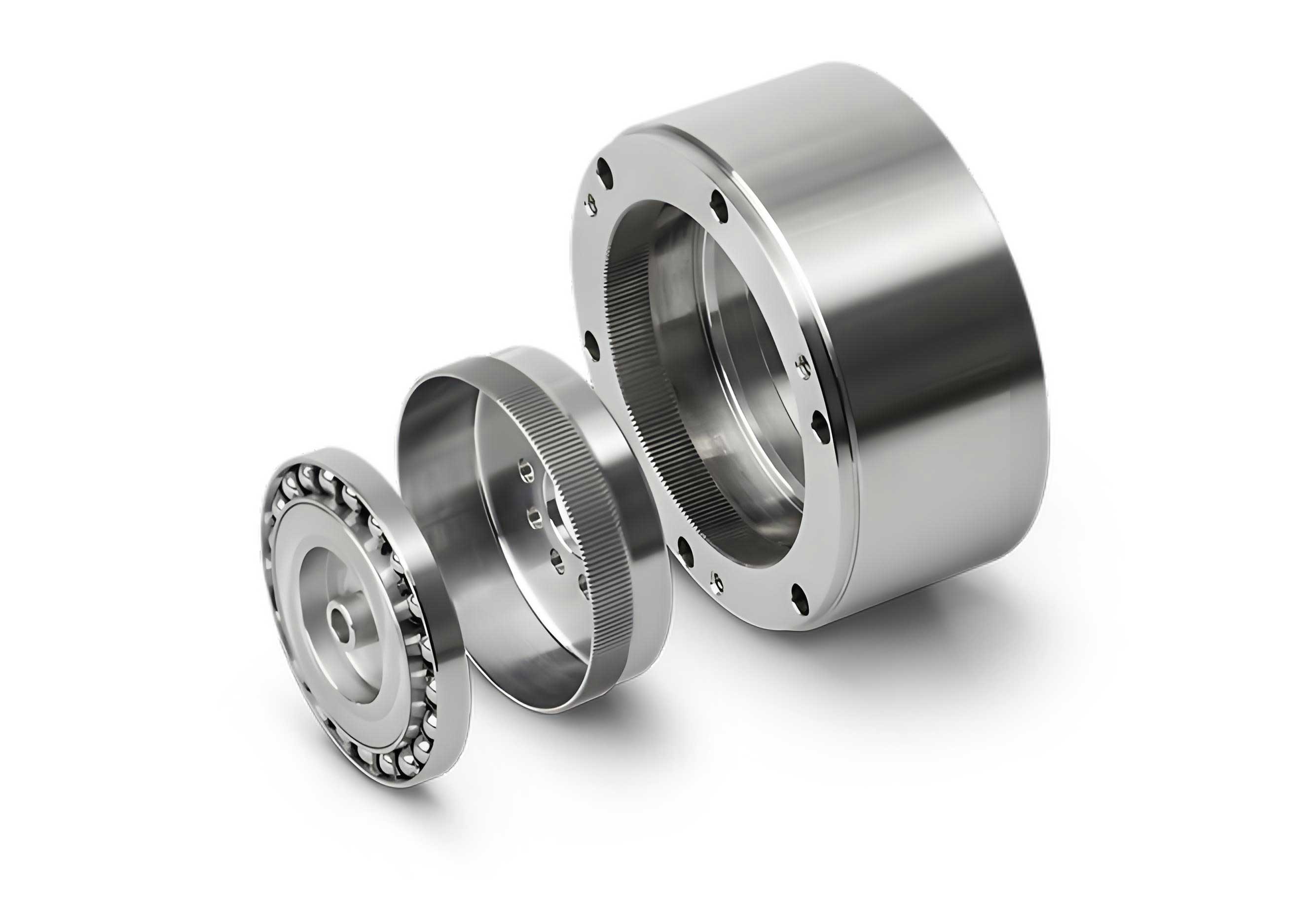
However, the very mechanism that grants the harmonic drive gear its advantages also presents its primary engineering challenge: the flexspline operates under cyclical stress, making fatigue fracture its dominant failure mode. This challenge is significantly amplified when pursuing designs with a lower length-to-diameter (L/D) ratio. While a smaller L/D ratio is highly desirable for increasing the torsional stiffness of the transmission—a critical factor for improving the dynamic response in servo applications—it inherently concentrates stresses, threatening the structural integrity and longevity of the harmonic drive gear assembly.
My investigation focuses specifically on a cup-type flexspline with an L/D ratio of 0.5. The prevailing design paradigm, often targeting L/D ratios between 0.8 and 1.0, requires re-evaluation for these more compact, stiffer configurations. Through systematic Finite Element Analysis (FEA), I have modeled the stress behavior under no-load assembly conditions—where the wave generator deforms the flexspline to engage with the circular spline—to identify critical stress concentrations and develop an optimized geometry for a low L/D ratio harmonic drive gear flexspline.
Finite Element Modeling and Baseline Analysis
The foundation of this study is a three-dimensional parametric model of the flexspline. I established a baseline configuration for a harmonic drive gear with a reduction ratio of i=100, using a module m=1 mm and a profile shift coefficient x=0.25. The initial geometric parameters for the flexspline body were derived from standard cup-type design formulas. For the FEA simulation, I applied a full constraint at the mounting flange on the cup’s base. The critical loading condition was simulated by applying a radial displacement load, equivalent to the module (ω₀ = m = 1 mm), to keypoints at the neutral line of the teeth, representing the deformation induced by the elliptical wave generator.
First, I analyzed a conventional flexspline with an L/D ratio of 0.9 to establish a reference point. The resulting Von Mises stress distribution confirmed that the maximum stress of 259.303 MPa occurred at the intermediate cross-section of the tooth ring, a well-documented critical zone in harmonic drive gear design.
Subsequently, I modified the model to achieve an L/D ratio of 0.5 by reducing the length of the cylindrical barrel while keeping all other initial parameters constant. The stress analysis of this “short-cup” design revealed a significant increase in peak stress. The maximum Von Mises stress escalated to 280.696 MPa, an increase of approximately 8% compared to the 0.9 L/D ratio model. More importantly, the stress distribution pattern shifted. While the tooth ring remained highly stressed, the magnitude of stress in the smooth barrel section and at the transition to the base increased noticeably, indicating a less favorable load distribution. This finding clearly underscores the inherent weakness of a non-optimized, low L/D ratio harmonic drive gear flexspline.
Parametric Study and Stress Influence Analysis
To mitigate the elevated stresses in the low L/D ratio harmonic drive gear, I conducted a detailed parametric study. The goal was to understand the individual and combined effects of key structural dimensions on the flexspline’s stress state. I systematically varied one parameter at a time within a practical range and observed the resulting changes in maximum Von Mises stress. This process is fundamental for the intelligent design of a reliable harmonic drive gear.
1. Influence of Barrel Wall Thickness (δ₁)
The thickness of the smooth cylindrical section, or barrel, is a primary design variable. I analyzed models with barrel thicknesses ranging from 1.5 mm to 2.5 mm. The results are summarized in the table below and graphically represented.
| Barrel Wall Thickness, δ₁ (mm) | Max. Flexspline Stress (MPa) | Max. Barrel Stress (MPa) | Max. Base Stress (MPa) |
|---|---|---|---|
| 1.5 | 256.286 | 151.912 | 61.118 |
| 1.7 | 266.167 | 167.269 | 59.575 |
| 1.9 | 275.490 | 175.231 | 58.168 |
| 2.0 (Baseline) | 280.696 | 181.072 | 57.761 |
| 2.1 | 286.301 | 180.865 | 57.147 |
| 2.3 | 296.188 | 192.994 | 55.998 |
| 2.5 | 307.889 | 197.565 | 55.214 |
The data reveals a strong, nearly linear positive correlation between barrel wall thickness and the overall maximum stress in the harmonic drive gear flexspline. The stress increase from the thinnest to the thickest barrel was over 50 MPa. This counterintuitive result—where a thicker, seemingly stronger wall leads to higher stress—can be explained by the increased bending stiffness. A thicker barrel resists the deformation imposed by the wave generator less compliantly, leading to higher local bending moments and stresses, particularly at the constrained end. Therefore, for a low L/D ratio harmonic drive gear, reducing the barrel wall thickness is an effective strategy to lower peak stresses.
2. Influence of Cup Base Thickness (δ_b)
The thickness of the diaphragm-like base connecting the barrel to the mounting flange also plays a crucial role. I varied this parameter similarly, with results presented below.
| Cup Base Thickness, δ_b (mm) | Max. Flexspline Stress (MPa) | Max. Barrel Stress (MPa) | Max. Base Stress (MPa) |
|---|---|---|---|
| 1.5 | 273.416 | 175.715 | 42.719 |
| 1.7 | 275.930 | 174.679 | 48.636 |
| 1.9 | 279.070 | 176.536 | 54.807 |
| 2.0 (Baseline) | 280.696 | 181.072 | 57.761 |
| 2.1 | 282.977 | 177.856 | 60.615 |
| 2.3 | 286.866 | 181.502 | 66.286 |
| 2.5 | 291.870 | 184.967 | 71.949 |
Again, a clear trend is visible: increasing the base thickness leads to an increase in the overall maximum stress of the harmonic drive gear flexspline. The base itself becomes significantly more stressed as it thickens, as shown in the “Max. Base Stress” column. A thicker base reduces its compliance, transferring more of the bending load into the barrel and tooth ring, and creating a sharper stiffness discontinuity. Thus, reducing the cup base thickness is another viable approach to stress reduction in a compact harmonic drive gear.
3. Influence of Flange Radius (R_f)
The radius of the mounting flange determines the leverage arm for the constraint reaction forces. I investigated a broader range for this parameter to clearly identify its effect.
| Flange Radius, R_f (mm) | Max. Flexspline Stress (MPa) | Max. Barrel Stress (MPa) | Max. Base Stress (MPa) |
|---|---|---|---|
| 43.0 | 279.971 | 176.705 | 49.270 |
| 45.0 | 280.293 | 173.657 | 49.311 |
| 47.0 | 280.602 | 177.846 | 52.595 |
| 47.9 | 280.990 | 178.057 | 56.150 |
| 48.0 (Baseline) | 280.696 | 181.072 | 57.761 |
| 48.5 | 281.356 | 179.536 | 60.073 |
| 51.0 | 282.366 | 180.210 | 73.652 |
| 53.0 | 283.609 | 180.998 | 78.595 |
The effect of the flange radius, while present, is subtler than that of the wall thicknesses. The maximum stress shows a gently increasing trend with a larger flange radius. This can be understood through the mechanics of a cantilevered shell: a larger flange radius increases the circumferential length of the constrained edge, which can slightly alter the boundary condition and the distribution of reaction moments. For stress minimization in this low L/D ratio harmonic drive gear, the data suggests that a smaller flange radius is preferable.
Synthesis and Proposed Optimized Design
Based on the insights from the parametric study, I formulated a coherent optimization strategy for the harmonic drive gear flexspline. The guiding principles are to reduce stiffness discontinuities and promote a more uniform stress distribution. The synergistic application of the individual parameter effects leads to a superior design.
Proposed Changes from Baseline (L/D=0.5):
- Reduce both barrel and base thickness (δ₁, δ_b): From 2.0 mm to 1.5 mm. This directly lowers bending stresses and improves compliance.
- Reduce flange radius (R_f): From 48 mm to 43 mm. This slightly relaxes the constraint condition.
- Increase fillet radius at the barrel-base junction: A larger transition radius (from 6 mm to 6.5 mm) mitigates local stress concentration, a critical factor in fatigue life. The stress at a fillet can be approximated by the theoretical stress concentration factor $K_t$, which for a shoulder fillet in bending decreases as the ratio (fillet radius / wall thickness) increases.
- Adjust tooth ring width: A minor increase (from 10 mm to 10.5 mm) provides a marginal increase in load-bearing capacity at the most critical section.
The finite element analysis of this optimized harmonic drive gear flexspline model yielded a significant improvement. The maximum Von Mises stress was reduced to 242.096 MPa. This represents a stress reduction of 38.6 MPa, or approximately 13.75%, compared to the baseline short-cup design. The stress distribution became more favorable, with lower and more uniform stress levels in the barrel and base sections.
The comparative results between the baseline and optimized harmonic drive gear flexspline are consolidated below:
| Parameter | Baseline (L/D=0.5) | Optimized Design |
|---|---|---|
| Total Cup Length, L (mm) | 96.5 | 96.5 |
| Nominal Wall Thickness, δ (mm) | 2.4 | 1.8 |
| Barrel Wall Thickness, δ₁ (mm) | 2.0 | 1.5 |
| Base Thickness, δ_b (mm) | 2.0 | 1.5 |
| Tooth Ring Width, b (mm) | 10.0 | 10.5 |
| Flange Diameter, d_fl (mm) | 96.0 | 86.0 |
| Barrel-Base Fillet Radius, r (mm) | 6.0 | 6.5 |
| Maximum Flexspline Stress (MPa) | 280.696 | 242.096 |
| Maximum Barrel Stress (MPa) | 181.072 | 153.296 |
| Maximum Base Stress (MPa) | 57.761 | 39.342 |
Discussion and Theoretical Considerations
The success of this optimization hinges on understanding the flexspline not merely as a static cylinder but as a complex, pre-stressed shell structure within the harmonic drive gear assembly. The deformation imposed by the wave generator can be conceptualized as an elliptical deflection mode superposed on the cylindrical shell. The resulting stress state, $σ_{total}$, can be considered a combination of membrane stresses and bending stresses: $$σ_{total} = σ_{membrane} + σ_{bending}$$ For a thin cylindrical shell under radial deflection $ω$, the bending stresses dominate in regions of high curvature change, such as near constraints and the tooth ring. The bending stress in a thin wall is proportional to the bending moment $M$ and inversely proportional to the section modulus. For a rectangular wall section of thickness $h$, the maximum bending stress is approximately: $$σ_{bending} \propto \frac{M}{h^2}$$ This explains why increasing wall thickness ($h$) can sometimes increase stress—if the associated increase in stiffness raises the local bending moment $M$ more than the square of $h$ increases the section modulus’s denominator.
The low L/D ratio fundamentally changes the deformation mode. The shorter barrel is less able to “absorb” the elliptical deformation through gradual flexure, leading to higher strain energy density at the fixed end (base) and a more severe stress transition. The optimization strategy effectively addresses this by: 1) lowering the wall stiffness to allow more compliant deformation, reducing $M$; and 2) smoothing geometric transitions to lower local $K_t$ factors.
Conclusion
This detailed finite element study demonstrates that a low length-to-diameter ratio flexspline for harmonic drive gear applications is not only feasible but can be engineered for superior stress performance. The key lies in moving away from intuitive “thicker-is-stronger” design rules. For the specific case of an L/D = 0.5 harmonic drive gear, the analysis conclusively shows that strategic reductions in barrel wall thickness, base thickness, and flange radius, coupled with increased transition fillets, lead to a significant reduction in peak Von Mises stress—over 13% in the presented case.
The proposed optimized geometry results in a more uniform stress distribution, which directly translates to a higher predicted fatigue life and enhanced reliability for the compact harmonic drive gear assembly. This methodology, combining parametric FEA with an understanding of shell bending mechanics, provides a powerful framework for designing advanced, high-stiffness, and durable harmonic drive gear components for the next generation of precision servo systems. The principles established here can be extended and refined with more detailed models incorporating the teeth, dynamic loads, and material plasticity, paving the way for continued innovation in harmonic drive gear technology.