
In modern high-end mechanical systems such as aerospace robotics and precision instrumentation, the demand for compact, high-ratio, and high-precision motion transmission is paramount. Among the various solutions available, the strain wave gear, also commonly referred to as a harmonic drive, stands out due to its unique operating principle and exceptional performance characteristics. Unlike conventional gear trains that rely on rigid body kinematics, the strain wave gear operates through controlled elastic deformation. This mechanism offers significant advantages including high positional accuracy, zero-backlash capability (in theory), compactness, and high torque density. However, achieving and maintaining these ideal characteristics in practice requires meticulous design, particularly of the tooth profile and the management of the inherent clearance, or gear backlash, between mating teeth. Excessive backlash can lead to transmission error, vibration, noise, and reduced positional accuracy, directly impacting the dynamic performance and longevity of the drive system. Therefore, optimizing the tooth profile structure of the strain wave gear and minimizing its gear backlash represent critical pathways to unlocking superior dynamic characteristics.
This article explores a comprehensive methodology for the analysis and enhancement of a double-circular-arc strain wave gear drive. The core of the investigation lies in the meticulous optimization of the tooth profile geometry to minimize the functional gear backlash. Following the establishment of an optimized geometric model, I will employ advanced three-dimensional finite element analysis to construct a dynamic contact simulation model. This model integrates the three primary components: the circular spline (rigid wheel), the flexspline (flexible wheel), and the wave generator. By applying realistic loading and motion conditions, the model simulates the transfer of speed and torque among the components. The primary focus of the dynamic simulation analysis is on the flexspline, the most critical and fatigue-prone element. Through this virtual prototyping and testing approach, I will delve into the stress-strain behavior at the flexspline dedendum during meshing, evaluate the dynamic response, and quantitatively assess the improvements gained from the profile optimization. The ultimate goal is to demonstrate a significant enhancement in the strain wave gear’s load-bearing capacity and operational smoothness.
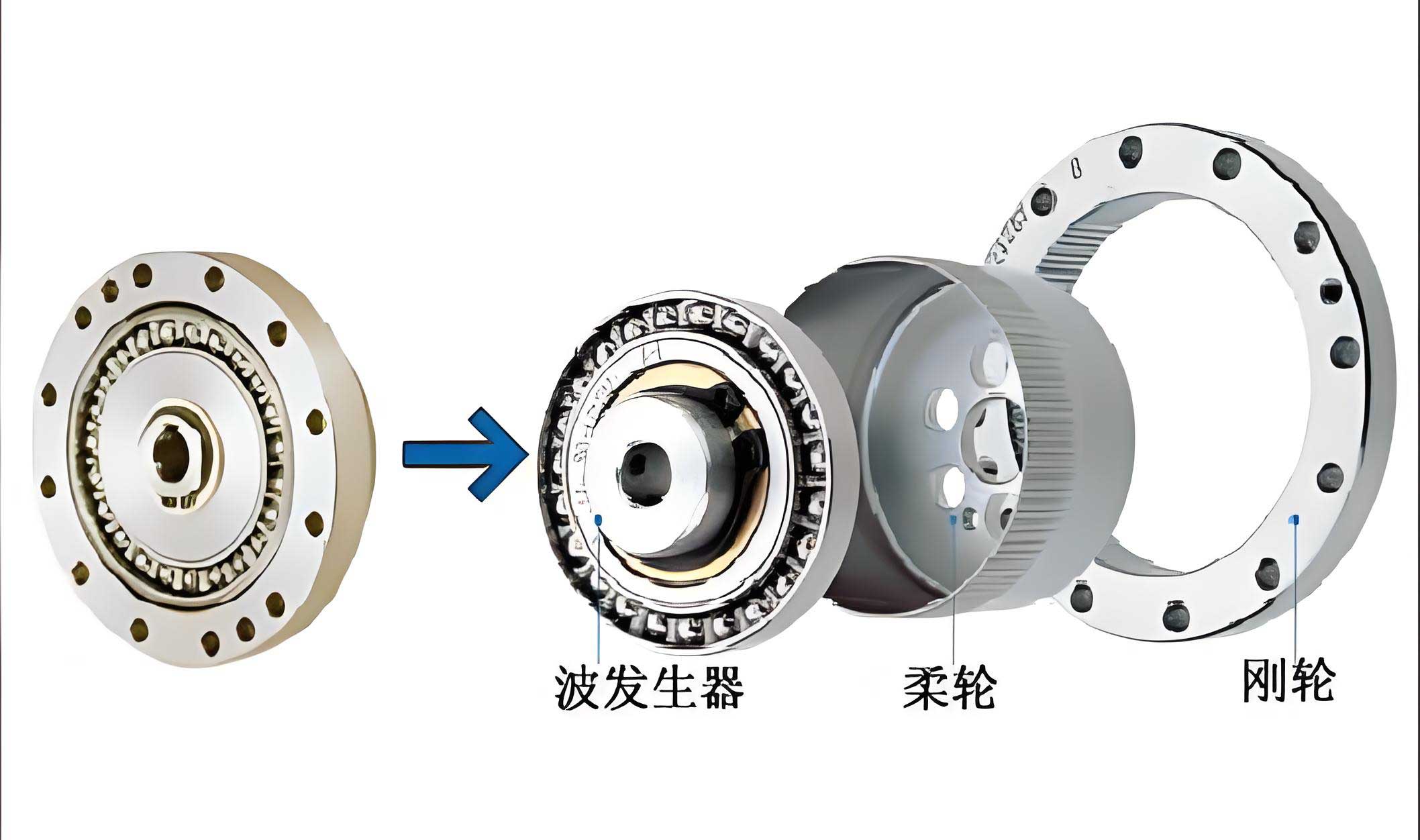
Fundamentals and Mathematical Modeling of the Double-Circular-Arc Tooth Profile
The exceptional performance of a strain wave gear is fundamentally dictated by the precise interaction between the teeth of the flexspline and the circular spline. This interaction is not a simple rigid-body engagement but a complex process governed by the elastic deformation of the flexspline under the action of the wave generator. The deformation pattern of the flexspline’s neutral curve directly influences the conjugate action and, consequently, the transmission performance. Therefore, to study the meshing motion between the teeth, one must first accurately define the flexspline tooth profile and its deformation law, which then allows for the determination of the corresponding circular spline profile.
Geometric Model of the Flexspline Tooth Profile
For this study, I adopt a double-circular-arc profile with a common tangent for the flexspline, known for its favorable contact stress distribution and bending strength compared to traditional involute profiles. To mathematically describe this profile, I establish a moving coordinate system \( S_1(O_1, X_1, Y_1) \) attached to the flexspline tooth. The origin \( O_1 \) is positioned at the intersection of the tooth’s symmetry axis (Y₁-axis) and the tangent line to the flexspline’s neutral curve at that point (X₁-axis).
A schematic of the right-side profile is considered, which consists of three distinct segments: a convex arc \( \overset{\frown}{AB} \), a common tangent straight line \( BC \), and a concave arc \( \overset{\frown}{CD} \). Let point \( M \) be the curvature center of the convex arc and point \( N \) be the curvature center of the concave arc. The primary design parameters defining this profile are summarized in the table below.
| Parameter | Description |
|---|---|
| \( h_f \) | Dedendum (Tooth Root Height) |
| \( h_a \) | Addendum (Tooth Tip Height) |
| \( z_1 \) | Number of Teeth on Flexspline |
| \( r \) | Reference Circle Radius |
| \( R_m \) | Neutral Curve Circle Radius |
| \( t \) | Flexspline Wall Thickness |
| \( \rho_a \) | Radius of Convex Arc |
| \( \alpha_a \) | Central Angle of Convex Arc |
| \( e_a \) | Offset of Convex Arc Center |
| \( l_a \) | Displacement of Convex Arc Center |
| \( \rho_f \) | Radius of Concave Arc |
| \( \alpha_f \) | Central Angle of Concave Arc |
| \( e_f \) | Offset of Concave Arc Center |
| \( l_f \) | Displacement of Concave Arc Center |
| \( \delta \) | Tool Relief Angle (Process Angle) |
| \( s_a \) | Tooth Thickness |
| \( s_f \) | Space Width |
Let \( s \) represent the arc length parameter along the tooth profile. The parametric equations for each segment in the coordinate system \( S_1 \) are derived as follows.
1. Convex Arc Segment \( \overset{\frown}{AB} \):
For \( s \in (0, l_1) \), where \( l_1 = \rho_a (\alpha_a – \delta) \), the position vector \( \mathbf{r}_{AB} \) and the unit outward normal vector \( \mathbf{n}_{AB} \) are:
$$
\mathbf{r}_{AB}(s) = \begin{bmatrix} \rho_a \cos\left(\alpha_a – \frac{s}{\rho_a}\right) + x_M \\ \rho_a \sin\left(\alpha_a – \frac{s}{\rho_a}\right) + y_M \\ 1 \end{bmatrix}, \quad \mathbf{n}_{AB}(s) = \begin{bmatrix} \cos\left(\alpha_a – \frac{s}{\rho_a}\right) \\ \sin\left(\alpha_a – \frac{s}{\rho_a}\right) \\ 1 \end{bmatrix}
$$
where \( (x_M, y_M) \) are the coordinates of the convex arc center \( M \) in \( S_1 \).
2. Common Tangent Straight Segment \( BC \):
For \( s \in (l_1, l_2) \), where \( l_2 = l_1 + \frac{h_1}{\cos \delta} \) and \( h_1 \) is the radial height of the straight segment, the equations are:
$$
\mathbf{r}_{BC}(s) = \begin{bmatrix} \rho_a \cos \delta + x_M + (s – l_1)\sin \delta \\ \rho_a \sin \delta + y_M – (s – l_1)\cos \delta \\ 1 \end{bmatrix}, \quad \mathbf{n}_{BC} = \begin{bmatrix} -\cos \delta \\ -\sin \delta \\ 1 \end{bmatrix}
$$
3. Concave Arc Segment \( \overset{\frown}{CD} \):
For \( s \in (l_2, l_3) \), where \( l_3 = l_2 + \rho_f \alpha_f \), the equations are:
$$
\mathbf{r}_{CD}(s) = \begin{bmatrix} x_N – \rho_f \cos\left(\delta + \frac{s – l_2}{\rho_f}\right) \\ y_N – \rho_f \sin\left(\delta + \frac{s – l_2}{\rho_f}\right) \\ 1 \end{bmatrix}, \quad \mathbf{n}_{CD}(s) = \begin{bmatrix} -\cos\left(\delta + \frac{s – l_2}{\rho_f}\right) \\ -\sin\left(\delta + \frac{s – l_2}{\rho_f}\right) \\ 1 \end{bmatrix}
$$
where \( (x_N, y_N) \) are the coordinates of the concave arc center \( N \) in \( S_1 \).
Derivation of the Circular Spline (Rigid Wheel) Tooth Profile
The conjugate tooth profile for the circular spline is generated by the envelope of the family of flexspline tooth profiles as it undergoes its prescribed elliptical deformation and relative rotation. The condition for contact, derived from gear meshing theory, is expressed by the fundamental equation of gearing. For a point on the flexspline profile \( \mathbf{r}_i \) (where \( i = AB, BC, CD \)) with unit normal \( \mathbf{n}_i \), the meshing equation in matrix form is:
$$
\mathbf{n}_i^T \mathbf{B} \mathbf{r}_i = 0
$$
The matrix \( \mathbf{B} \) encapsulates the relative velocity between the flexspline and the circular spline and is defined as:
$$
\mathbf{B} = \begin{bmatrix}
0 & \dot{\beta} & r\dot{\gamma}\cos\mu – \dot{r}\sin\mu \\
-\dot{\beta} & 0 & r\dot{\gamma}\sin\mu + \dot{r}\cos\mu \\
0 & 0 & 0
\end{bmatrix}
$$
In this formulation, \( \beta \) is the angle between the \( Y_1 \)-axis and the symmetry line of a circular spline tooth space, \( \mu \) is the angle between the deformed flexspline’s polar radius and the \( Y_1 \)-axis, and \( \gamma \) is the angle between the deformed flexspline’s polar radius and the circular spline tooth space symmetry line. The derivatives \( \dot{r}, \dot{\beta}, \dot{\gamma} \) are with respect to the wave generator’s motion parameter.
The coordinate transformation from the flexspline’s moving system \( S_1 \) to a fixed coordinate system attached to the circular spline is given by the matrix \( \mathbf{M} \):
$$
\mathbf{M} = \begin{bmatrix}
\cos\beta & \sin\beta & r\sin\gamma \\
-\sin\beta & \cos\beta & r\cos\gamma \\
0 & 0 & 1
\end{bmatrix}
$$
Finally, the theoretical tooth profile of the circular spline, \( \mathbf{r}’_i \), is obtained by transforming the flexspline profile points that satisfy the meshing equation:
$$
\mathbf{r}’_i = \mathbf{M} \cdot \mathbf{r}_i \quad (i = AB, BC, CD)
$$
This rigorous mathematical framework allows for the precise generation of a conjugate double-circular-arc tooth pair. Building upon this foundation, I can now formulate an optimization problem. The objective is to adjust the key profile parameters \( (\rho_a, \alpha_a, e_a, l_a, \rho_f, \alpha_f, e_f, l_f, \delta) \) to minimize the functional gear backlash—the clearance between non-driving flanks of the teeth—while satisfying constraints related to gear strength, avoidance of interference, and manufacturability. Minimizing this backlash is crucial for enhancing the dynamic performance and positional accuracy of the strain wave gear transmission.
Development of the Dynamic Finite Element Simulation Model
To validate the benefits of the optimized tooth profile and analyze the dynamic behavior under load, I transition from theoretical geometry to a virtual prototyping environment using three-dimensional Finite Element Analysis (FEA). The dynamic contact simulation provides insights into stress distribution, strain patterns, and kinematic response that are difficult or impossible to obtain from purely analytical models.
Model Construction and Meshing
I begin by creating detailed solid models of the three core components: the circular spline, the flexspline, and the elliptical wave generator (modeled as a two-roller cam). The geometric dimensions are calculated based on standard design formulas for strain wave gears, incorporating the optimized tooth profile parameters that result in reduced gear backlash. The models are then imported into a commercial FEA software capable of handling nonlinear, transient dynamics with contact.
A critical step for accuracy and computational efficiency is meshing. I employ a structured, hexa-dominant mesh, which provides better numerical stability and accuracy for contact problems compared to tetrahedral meshes, especially in regions of high stress gradient. The mesh is refined significantly in the tooth contact zones of both the flexspline and circular spline, as well as in the flexspline body where high bending stresses are expected. The final assembly mesh consists of several hundred thousand elements, ensuring a high-fidelity representation of the contact mechanics. The table below details the material properties assigned to each component, which are essential for a realistic simulation.
| Component | Material | Density (kg/mm³) | Young’s Modulus (GPa) | Poisson’s Ratio |
|---|---|---|---|---|
| Flexspline | 30CrMnSiA Alloy Steel | \( 7.85 \times 10^{-6} \) | 206 | 0.30 |
| Circular Spline & Wave Generator | 45 Carbon Steel | \( 7.85 \times 10^{-6} \) | 210 | 0.31 |
Contact Definition and Simulation Procedure
The interaction between components is defined using surface-to-surface contact algorithms with friction. Two primary contact pairs are established:
- Wave Generator Rollers vs. Flexspline Bore: This contact simulates the elliptical deformation of the flexspline. A friction coefficient of \( \mu = 0.02 \) is used to represent a well-lubricated interface.
- Flexspline External Teeth vs. Circular Spline Internal Teeth: This contact pair models the power-transmitting meshing action. A higher friction coefficient of \( \mu = 0.12 \) is applied, typical for gear tooth contacts under mixed lubrication conditions.
The dynamic simulation is conducted in several sequential steps to mimic the real assembly and operation process:
Step 1 – Assembly/Pre-stress: The wave generator is virtually “assembled” inside the undeformed flexspline. This is simulated by applying a radial displacement to the wave generator rollers, forcing them outward along the major axis until the flexspline experiences its nominal radial deflection (e.g., 0.2-0.3 mm depending on design). This step establishes the initial stress state in the flexspline.
Step 2 – Engagement: The circular spline is moved into position along its axis, engaging with the pre-deformed teeth of the flexspline.
Step 3 – Dynamic Loading: A dynamic load is applied. The wave generator is prescribed a rotational velocity, ramping up from 0 to a steady-state operational speed (e.g., 3000 rpm). Simultaneously, a resisting torque is applied to the output member (flexspline cup), ramping up from 0 to the rated load torque (e.g., 10 Nm). The direction of the applied torque opposes the wave generator’s rotation.
Step 4 – Steady-State Analysis: The simulation continues with constant wave generator speed and output load for several cycles to capture steady-state dynamic behavior, including stress fluctuations and kinematic output.
Dynamic Simulation Results and Comparative Analysis
The dynamic FEA simulation yields a wealth of data regarding the performance of the strain wave gear. To evaluate the effectiveness of the tooth profile and gear backlash optimization, I compare key performance indicators from simulations of the baseline (non-optimized) design and the optimized design. The primary focus is on the flexspline, as it is the component subjected to cyclic stress and is most susceptible to fatigue failure.
Stress and Strain Analysis at the Flexspline Dedendum
The tooth root (dedendum) region of the flexspline is a critical area where stress concentration occurs due to bending. Monitoring the stress and strain history here is vital for predicting fatigue life.
1. Maximum Principal Stress and Strain:
The maximum principal stress indicates the highest tensile stress at a point, which is a primary driver for fatigue crack initiation. The results show a clear periodic fluctuation of stress as teeth engage and disengage. A key finding is that the amplitude of the maximum principal stress in the optimized strain wave gear is consistently lower than in the baseline design. A representative comparison reveals a reduction of approximately 6% in the peak cyclic principal stress at the dedendum. Similarly, the maximum principal strain, which is directly related to stress via Hooke’s Law, shows a corresponding reduction in amplitude. The equations governing this relationship are:
$$
\sigma_1 = E \cdot \varepsilon_1 \quad \text{(for uniaxial stress approximation)}
$$
where \( \sigma_1 \) is the maximum principal stress, \( \varepsilon_1 \) is the maximum principal strain, and \( E \) is Young’s modulus. The reduction in both stress and strain signifies a direct improvement in the factor of safety against tensile fatigue.
2. Shear Stress and Strain Components:
Shear stresses can also contribute to failure, particularly under multi-axial fatigue conditions. I analyzed the shear components on three orthogonal planes (XY, XZ, YZ), where Z is the axial direction of the strain wave gear.
- XY-Plane (In-Plane Shear): This component relates to torsional and transverse shear. The optimized design shows a marked reduction in the amplitude of both shear strain \( (\gamma_{xy}) \) and shear stress \( (\tau_{xy}) \) compared to the baseline.
- YZ-Plane (Axial-Radial Shear): Similar significant improvements are observed for the shear components \( \gamma_{yz} \) and \( \tau_{yz} \) in the optimized strain wave gear.
- XZ-Plane (Axial-Tangential Shear): While still showing improvement, the reduction in \( \gamma_{xz} \) and \( \tau_{xz} \) amplitudes is less pronounced than for the other two planes. This suggests the optimization had a stronger effect on certain stress components.
The general relationship for elastic shear is given by:
$$
\tau = G \cdot \gamma
$$
where \( \tau \) is shear stress, \( \gamma \) is shear strain, and \( G \) is the shear modulus \( \left( G = \frac{E}{2(1+\nu)} \right) \).
Critical Observation: By comparing the magnitudes, it is evident that the maximum principal stress values are an order of magnitude larger than the peak shear stress values. This leads to a fundamental conclusion about the failure mode in this strain wave gear flexspline: the primary failure mechanism is likely to be tensile fatigue fracture originating at the dedendum, rather than failure driven by shear. Therefore, the 6% reduction in maximum principal stress achieved through optimization is a highly significant result, directly translating to extended service life and higher load capacity.
Kinematic Response: Angular Velocity of the Flexspline
Beyond stress, the dynamic simulation provides data on the kinematic output. I monitor the angular velocity of the flexspline (output member) under a constant load torque of 7.8 Nm. The plot of angular velocity versus time reveals the dynamic response:
- Initial Phase (0-0.020s): The wave generator begins to rotate from rest. The flexspline, initially stationary, starts to move due to frictional and elastic coupling, but its motion is irregular.
- Transient Phase (0.020-0.045s): As the wave generator speed ramps up to its steady-state value, the flexspline’s angular velocity undergoes a transient oscillation. A distinct feature is a brief period of reversed rotation (negative velocity) caused by the complex interaction of elastic deformation recovery, contact separation, and re-engagement. This phenomenon highlights the dynamic complexity of the strain wave gear meshing process.
- Steady-State Phase (after 0.045s): The system settles into a steady operational state. The flexspline’s angular velocity oscillates with a small amplitude around its theoretical mean value. For a wave generator input of 3000 rpm (314.16 rad/s) and a gear ratio of 80:1, the theoretical output speed is 3.927 rad/s. The simulation shows the steady-state average angular velocity converging to this value, with a periodic fluctuation (or “ripple”) superimposed. The amplitude of this velocity ripple is a direct measure of transmission error and smoothness of operation. The optimized design, with its reduced gear backlash, demonstrates a marginally smaller and more consistent velocity ripple, indicating improved dynamic stability and positional accuracy.
The relationship between input \( \omega_{in} \) and ideal output speed \( \omega_{out} \) for a strain wave gear is:
$$
\omega_{out} = \frac{\omega_{in}}{N} \quad \text{where } N = \frac{z_c}{z_c – z_f}
$$
Here, \( z_c \) is the number of teeth on the circular spline, \( z_f \) is the number of teeth on the flexspline, and \( N \) is the gear reduction ratio. The simulated output validates this kinematic relationship in the steady-state.
Conclusion: The Impact of Optimization on Strain Wave Gear Dynamics
This comprehensive investigation, spanning from precise geometric modeling to advanced dynamic finite element simulation, successfully demonstrates a methodology for enhancing the performance of a double-circular-arc strain wave gear drive. The core strategy focused on optimizing the tooth profile parameters to minimize functional gear backlash.
The dynamic simulation results provide quantitative evidence of the benefits:
- Enhanced Structural Integrity: The optimized strain wave gear flexspline exhibits a systematic reduction in stress and strain amplitudes at the critical dedendum region. The 6% reduction in maximum principal stress is particularly noteworthy, as it directly correlates with the dominant tensile fatigue failure mode. Reductions in shear stress components further contribute to improved multi-axial fatigue resistance.
- Increased Load Capacity and Life: The lower cyclic stress levels imply a higher safety factor and an increased theoretical fatigue life for the flexspline. This allows the strain wave gear to either handle higher loads within the same design envelope or achieve longer service life under the same operating conditions.
- Improved Dynamic Performance: While the primary focus was stress reduction, the kinematic output analysis suggests a trend toward smoother operation, evidenced by a slightly more stable angular velocity output in the optimized design. Reduced gear backlash minimizes non-linear impacts and lost motion during tooth engagement transitions, contributing to lower transmission error and potentially reduced vibration and noise.
In summary, the integration of tooth profile optimization based on rigorous conjugate theory with high-fidelity dynamic contact FEA represents a powerful and universally applicable design and analysis tool for strain wave gears. This virtual prototyping approach enables engineers to explore design trade-offs, predict performance, and validate improvements before physical manufacturing, thereby accelerating the development of higher-performance, more reliable strain wave gear transmissions for the most demanding robotic and aerospace applications.