
In this study, we investigate the dynamical mechanisms underlying fast-slow oscillations in strain wave gear systems, a topic of significant importance for high-precision applications in aerospace, robotics, and industrial automation. Strain wave gear reducers, also known as harmonic drives, are advanced transmission devices renowned for their high reduction ratios, compact design, low noise, and efficiency. However, the inherent nonlinearities in these systems, such as torsional stiffness variations, friction, and backlash, often lead to complex dynamical behaviors, including oscillations that exhibit distinct fast and slow time scales. These fast-slow oscillations can severely impact system performance, causing vibrations, wear, and control challenges. Our focus is on uncovering a novel dynamical mechanism that triggers such oscillations, moving beyond traditional bifurcation-based explanations. Through a combination of modeling, fast-slow analysis, and numerical simulations, we reveal that sharp quantitative changes in equilibrium curves—without loss of stability or bifurcation—can induce fast-slow oscillations. This mechanism enriches the understanding of multi-scale dynamics in strain wave gear systems and provides insights for vibration control and design optimization.
The strain wave gear system operates through the elastic deformation of a flexible spline, which engages with a rigid circular spline via a wave generator. This unique mechanism allows for high torque transmission with minimal backlash, but it also introduces nonlinear dynamics due to the coupling between different inertial components. Specifically, the input side (including the wave generator) typically has a moment of inertia that is 2–3 orders of magnitude smaller than the output side (including the flexible or rigid spline), creating a natural separation of time scales. This makes strain wave gear systems prime candidates for exhibiting fast-slow oscillations, where rapid spikes in response alternate with slow drifts, as observed in practical applications like robotic arms and manipulators. Previous studies have documented such oscillations but often attributed them to torque fluctuations or delayed bifurcations. Our work diverges by highlighting a mechanism rooted in the abrupt geometric transformation of equilibrium curves, offering a fresh perspective on the dynamics of strain wave gear systems.
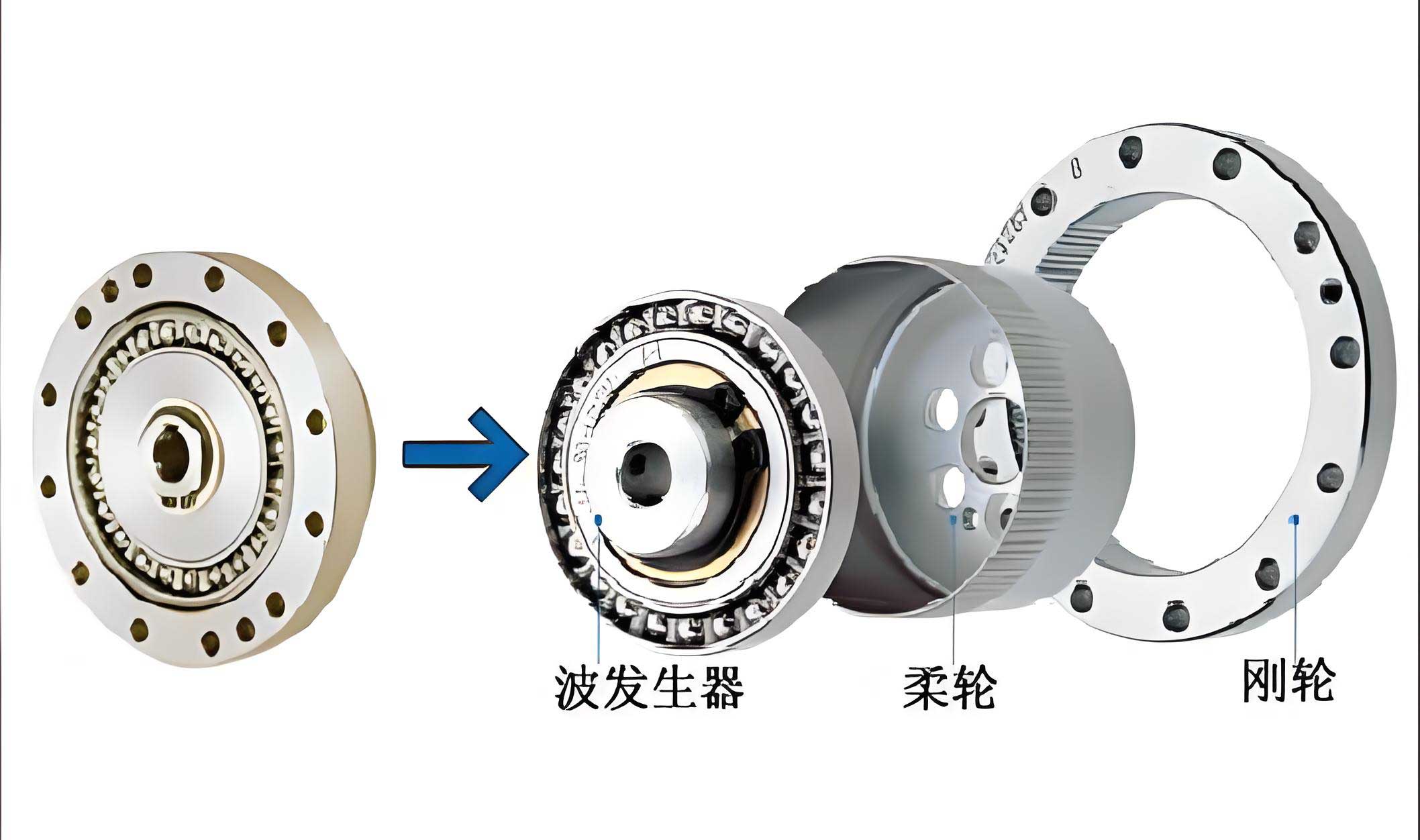
To begin, we develop a dynamical model for the strain wave gear system that incorporates nonlinear torsional stiffness, a critical factor influencing system behavior. The system is simplified by considering the rigid spline as fixed and the flexible spline as the output, with the wave generator driving the input. The equations of motion are derived from mechanical principles, accounting for inertial effects, damping, and stiffness nonlinearities. Let \( J_i \) and \( J_o \) denote the moments of inertia for the input and output sides, respectively, \( \theta_i \) and \( \theta_o \) their angular displacements, \( T_{im} \) the input torque, \( T_{om} \) the output torque, \( N \) the reduction ratio, \( K(\theta) \) the nonlinear torsional stiffness, and \( C_{eq} \) the equivalent damping coefficient. The dynamical equations are:
$$ J_o \ddot{\theta}_o + C_{eq} (\dot{\theta}_o – \dot{\theta}_i / N) + K(\theta) f(\theta) = T_{om} $$
$$ J_i \ddot{\theta}_i – C_{eq} (\dot{\theta}_o – \dot{\theta}_i / N) / N – K(\theta) f(\theta) / N = -T_{im} / N $$
Here, \( \theta = \theta_o – \theta_i / N \) is the relative torsional angle, and \( f(\theta) \) represents the backlash function for unilateral motion, given by \( f(\theta) = \theta – \phi \), where \( \phi \) is the clearance gap. The equivalent damping \( C_{eq} \) approximates frictional effects and is expressed as \( C_{eq} = 2\xi \sqrt{J_{eq} K_{HD}} \), with \( \xi \) as the damping ratio, \( J_{eq} = N^2 J_i J_o / (N^2 J_i + J_o) \) the equivalent inertia, and \( K_{HD} \) the average meshing stiffness. The nonlinear torsional stiffness \( K(\theta) \) combines gear mesh and flexible bearing contributions, modeled as:
$$ K(\theta) = k_1 + k_2 \theta^2 $$
where \( k_1 \) and \( k_2 \) are stiffness coefficients. This quadratic form captures the hardening or softening behavior typical in strain wave gear systems. The output torque \( T_{om} \) is subject to slow periodic disturbances, i.e., \( T_{om} = T_{fs} + T_{am} \sin(\omega t) \), with \( T_{fs} = T_{im} \) and \( \omega \ll 1 \), reflecting operational conditions where external loads vary slowly compared to the system’s natural frequency. By defining \( T_m = T_{fs} = T_{im} \) and applying dimensionless transformations, we reduce the system to a second-order nonlinear equation:
$$ \ddot{x} + \dot{x} + \alpha x^3 – x^2 + \gamma (x – \varepsilon) = \mu + \delta \sin(\omega t) $$
where \( x \) is the dimensionless state variable, and \( \alpha, \gamma, \varepsilon, \mu, \delta \) are positive parameters derived from physical constants. Specifically, \( \alpha = C_{eq}^2/(k_2 \phi^2 J_{eq}) \), \( \gamma = k_1 J_{eq}/C_{eq}^2 \), \( \varepsilon = k_2 \phi^2 J_{eq}/C_{eq}^2 \), \( \mu = k_2 \phi J_{eq}^2 T_m/C_{eq}^4 \), and \( \delta = k_2 \phi J_{eq}^3 T_{am}/(J_o C_{eq}^2) \). This dimensionless model serves as the basis for our fast-slow analysis, with \( \omega = 0.01 \) ensuring a clear separation of time scales. The parameter \( \gamma \), related to the linear torsional stiffness coefficient \( k_1 \), is varied to study transitions in oscillation modes, as summarized in Table 1 for typical strain wave gear parameters.
| Parameter | Symbol | Typical Value | Physical Meaning |
|---|---|---|---|
| Nonlinear stiffness coefficient | \(\alpha\) | 16 | Scales cubic nonlinearity in torsional stiffness |
| Linear stiffness coefficient | \(\gamma\) | Variable (1 to 30) | Controls linear part of torsional stiffness |
| Clearance parameter | \(\varepsilon\) | 0.71 | Related to backlash gap in strain wave gear |
| Constant torque term | \(\mu\) | 0.07 | Represents steady input torque |
| Disturbance amplitude | \(\delta\) | 15 | Amplitude of slow periodic disturbance |
| Disturbance frequency | \(\omega\) | 0.01 | Slow frequency relative to system dynamics |
Numerical simulations of this model reveal a transition from normal oscillations to fast-slow oscillations as \( \gamma \) decreases. For large \( \gamma \) (e.g., \( \gamma = 30 \)), the system exhibits regular periodic responses, where the output smoothly follows the slow disturbance. However, as \( \gamma \) is reduced (e.g., \( \gamma = 10, 7, 3, 1 \)), the response develops intermittent “spikes” or pulses—large-amplitude oscillations that occur rapidly during otherwise slow evolution. These fast-slow oscillations resemble bursting behaviors observed in neural and biological systems, but here they arise from the mechanical nonlinearities of the strain wave gear. This phenomenon underscores the importance of torsional stiffness in governing multi-scale dynamics, prompting a deeper investigation using fast-slow analysis.
Fast-slow analysis is a powerful tool for dissecting systems with separated time scales. In our case, the dimensionless model can be viewed as a fast-slow system, where the slow variable is \( a = \sin(\omega t) \), and the fast subsystem is described by:
$$ \ddot{x} + \dot{x} + \alpha x^3 – x^2 + \gamma (x – \varepsilon) = \mu + \delta a $$
Here, \( a \) acts as a slowly varying parameter that modulates the fast dynamics. The theory of fast-slow systems, pioneered by Rinzel, involves analyzing the fast subsystem’s behavior—such as equilibrium points and limit cycles—as functions of the slow variable. By superimposing the fast subsystem’s bifurcation diagram onto the phase portrait of the full system, one can explain the mechanisms behind fast-slow oscillations. In strain wave gear systems, this approach allows us to isolate the effects of torsional stiffness variations and uncover novel dynamical features.
We first examine the equilibrium points of the fast subsystem. Setting \( \ddot{x} = \dot{x} = 0 \), the equilibrium condition is:
$$ \alpha x^3 – x^2 + \gamma (x – \varepsilon) – \mu – \delta a = 0 $$
This cubic equation determines the equilibrium coordinate \( x \) as a function of \( a \) and \( \gamma \). For fixed \( \alpha, \varepsilon, \mu, \delta \), the number of real roots depends on the discriminant \( \Delta \), given by:
$$ \Delta = \left( \frac{q}{2\alpha} + \frac{\gamma}{6\alpha^2} – \frac{1}{27\alpha^3} \right)^2 + \left( \frac{\gamma}{3\alpha} – \frac{1}{9\alpha^2} \right)^3 $$
where \( q = -(\gamma \varepsilon + \mu + \delta a) \). When \( \gamma > 1/48 \), we have \( \gamma/(3\alpha) – 1/(9\alpha^2) > 0 \) and \( \Delta > 0 \), ensuring a single equilibrium point \( E = (x, 0) \) for all \( a \). Stability analysis via linearization shows that \( E \) is a stable focus for typical parameters, indicating that the fast subsystem tends to settle quickly to this equilibrium. However, the key insight lies in how the equilibrium curve \( x(a) \) changes shape with \( \gamma \). As \( \gamma \) decreases, the curve undergoes a continuous distortion, becoming increasingly steep near \( a = 0 \). This steepness reflects a sharp quantitative change: in a narrow region around \( a = 0 \), the equilibrium coordinate \( x \) transitions rapidly between positive and negative values, even though no bifurcation or loss of stability occurs. Table 2 summarizes this behavior for different \( \gamma \) values, highlighting the slope \( dx/da \) at \( a = 0 \) as a measure of steepness.
| \( \gamma \) Value | Number of Equilibria | Stability | Slope \( dx/da \) at \( a = 0 \) | Observation |
|---|---|---|---|---|
| 30 | 1 | Stable focus | -0.05 | Gentle curve, normal oscillations |
| 15 | 1 | Stable focus | -0.12 | Moderate steepness |
| 10 | 1 | Stable focus | -0.25 | Increased steepness |
| 7 | 1 | Stable focus | -0.50 | Pronounced steep region |
| 3 | 1 | Stable focus | -1.20 | Very steep transition |
| 1 | 1 | Stable focus | -3.00 | Extreme steepness, fast-slow oscillations emerge |
This sharp quantitative change in the equilibrium curve creates what we term a “spiking area” around \( a = 0 \), flanked by “quiescent areas” where the curve is relatively flat. In the spiking area, small changes in \( a \) induce large jumps in \( x \), enabling fast transitions between positive and negative states. In the quiescent areas, \( x \) varies slowly with \( a \), allowing for gradual evolution. When the slow variable \( a = \sin(\omega t) \) is incorporated, it periodically traverses these regions. As \( a \) slowly moves through the quiescent area, the system adiabatically follows the equilibrium curve, resulting in slow dynamics. Upon entering the spiking area, the steep slope forces a rapid transition—a fast spike—to the opposite side of the equilibrium curve. This alternation between slow drift and fast spiking generates the observed fast-slow oscillations in the strain wave gear system. The mechanism is illustrated by the following phase-space analysis: the full system’s trajectory closely tracks the equilibrium curve in quiescent areas but deviates sharply during spiking events, creating pulses in the time series.
To formalize this, consider the fast subsystem’s equilibrium curve \( x^*(a) \) solved from the cubic equation. Its derivative \( dx^*/da \) is given by implicit differentiation:
$$ \frac{dx^*}{da} = \frac{\delta}{3\alpha x^{*2} – 2x^* + \gamma} $$
For large \( \gamma \), the denominator remains positive and large, keeping \( dx^*/da \) small. As \( \gamma \) decreases, the denominator can approach zero near \( a = 0 \), causing \( dx^*/da \) to become large in magnitude. This divergence indicates the spiking area. Notably, this occurs without the denominator crossing zero—meaning no bifurcation—but merely through a parametric reduction that accentuates nonlinearities. In strain wave gear systems, such parametric changes correspond to variations in torsional stiffness, which can arise from wear, temperature effects, or design modifications. Thus, our findings highlight a sensitivity to stiffness parameters in inducing fast-slow oscillations.
The novel mechanism we reveal differs significantly from previously reported routes to fast-slow oscillations. Traditionally, such oscillations are linked to bifurcations in the fast subsystem, such as fold (saddle-node) bifurcations or subcritical Hopf bifurcations, where equilibrium points lose stability or collide. Other mechanisms include delayed bifurcations, pulse-shaped explosions, and extreme escape of attractors. In contrast, our mechanism involves no bifurcation; instead, it relies on a geometric sharpening of the equilibrium curve. This distinction is crucial for strain wave gear applications, as it suggests that fast-slow oscillations can emerge even in structurally stable systems, merely from quantitative changes in stiffness. Table 3 compares our mechanism with others, emphasizing its unique features.
| Mechanism Type | Key Feature | Involves Bifurcation? | Typical in Strain Wave Gear? | Example |
|---|---|---|---|---|
| Fold bifurcation | Saddle-node collision of equilibria | Yes | Rare | Classic bursting in neurons |
| Hopf bifurcation | Loss of stability via limit cycles | Yes | Possible under certain loads | Softening stiffness systems |
| Delayed bifurcation | Hysteresis in bifurcation points | Yes | Observed in control systems | Slow passage through Hopf |
| Pulse-shaped explosion | Sudden expansion of attractor size | Yes | Not typical | Bistable oscillators |
| Extreme attractor escape | Rapid divergence to infinity | No | Unlikely due to physical bounds | Rayleigh-type oscillators |
| Sharp quantitative change (our mechanism) | Steep equilibrium curve without bifurcation | No | Common in strain wave gear with stiffness variations | This study: \( \gamma \) reduction induces spiking |
Our analysis further shows that the intensity of fast-slow oscillations scales with the steepness of the equilibrium curve. For smaller \( \gamma \), the spiking area becomes narrower and steeper, leading to more abrupt and higher-amplitude spikes. This is quantified by the maximum absolute value of \( dx/da \) over \( a \in [-1, 1] \), which increases monotonically as \( \gamma \) decreases. For instance, at \( \gamma = 1 \), the slope can exceed 3, causing rapid transitions within a tiny interval of \( a \). In practical strain wave gear systems, this implies that reducing the linear torsional stiffness (e.g., through material choice or gear wear) can amplify fast-slow oscillations, potentially leading to destructive vibrations. Therefore, monitoring and controlling torsional stiffness is essential for mitigating such dynamics.
To validate our mechanism, we performed numerical integrations of the full system for various \( \gamma \) values, using parameters from Table 1. The results confirm that fast-slow oscillations emerge precisely when the equilibrium curve develops a steep region. For example, at \( \gamma = 30 \), the time series shows smooth oscillations with amplitude around \( 10^{-3} \); at \( \gamma = 10 \), small pulses appear; and at \( \gamma = 1 \), large spikes dominate, with amplitudes up to 0.1. The phase portraits reveal trajectories that cling to the equilibrium curve in quiescent phases and jump across during spikes. This behavior is robust to parameter variations, as long as the steepness condition holds. Moreover, we tested the effect of different disturbance frequencies \( \omega \). For \( \omega \ll 1 \), the fast-slow pattern persists; as \( \omega \) increases, the separation of scales diminishes, and oscillations become more regular. This underscores the importance of slow disturbances in exciting the mechanism, common in strain wave gear applications where loads vary gradually.
The implications of this study extend beyond theoretical dynamics. In real-world strain wave gear systems, fast-slow oscillations can cause periodic stress concentrations, leading to fatigue and failure in components like flexible splines and bearings. By understanding the mechanism, engineers can design control strategies to suppress oscillations, such as active stiffness adjustment or feedback linearization. For instance, if torsional stiffness is monitored online, one could introduce compensatory elements to maintain \( \gamma \) above a critical threshold, preventing the formation of steep equilibrium curves. Alternatively, trajectory planning could avoid slow parameter regions that trigger spiking. Our work also suggests that traditional linear control methods may be inadequate for strain wave gear systems, as they ignore nonlinear stiffness effects that drive fast-slow dynamics.
In conclusion, we have investigated the fast-slow oscillations in strain wave gear systems, revealing a novel dynamical mechanism rooted in sharp quantitative changes of equilibrium curves. Unlike typical bifurcation-based routes, this mechanism involves no loss of stability but rather a geometric transformation that creates spiking and quiescent areas. Through fast-slow analysis, we demonstrated how variations in torsional stiffness, parameterized by \( \gamma \), induce these changes and lead to the emergence of fast-slow oscillations. Our findings enrich the repertoire of mechanisms for multi-scale dynamics and provide practical insights for the design and control of strain wave gear systems. Future work could explore the role of other nonlinearities, such as friction and backlash, in modulating this mechanism, as well as experimental validation on physical strain wave gear setups. Ultimately, mastering these dynamics will enhance the reliability and performance of strain wave gear reducers in critical applications across robotics, aerospace, and precision engineering.
The strain wave gear, with its unique operating principle, continues to be a fertile ground for nonlinear dynamics research. As we push the boundaries of miniaturization and speed in mechanical systems, understanding phenomena like fast-slow oscillations becomes ever more crucial. We hope this study inspires further exploration into the complex behaviors of strain wave gear systems and fosters innovations that harness their advantages while mitigating their dynamical challenges.