
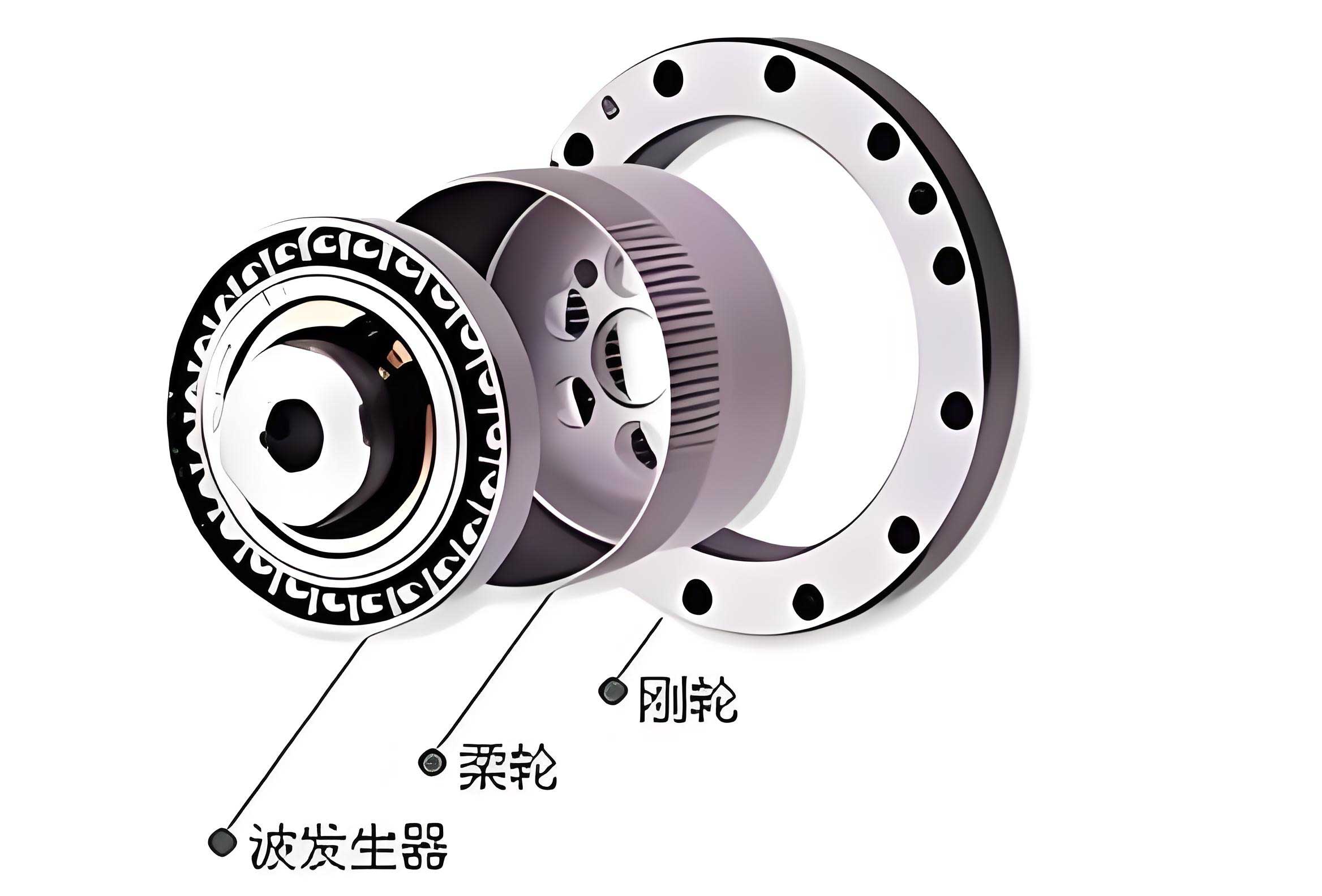
The pursuit of high precision, substantial torque capacity, and compact design in power transmission systems has positioned strain wave gearing, also commonly referred to as harmonic drive, as a pivotal technology in advanced robotics, aerospace, and precision machinery. At the core of this mechanism lies the unique interaction between three primary components: a wave generator, a flexible spline (flexspline), and a circular spline (rigid wheel). The non-uniform deformation of the flexspline, induced by the wave generator, creates a controlled meshing action that results in high reduction ratios within a single stage. The performance of this system is profoundly influenced by the tooth profile geometry employed on the flexspline and circular spline. Among various profiles, the double-circular-arc tooth shape has demonstrated superior characteristics, notably a larger potential conjugation zone and enhanced load-bearing capacity compared to traditional involute profiles. This article presents a comprehensive methodology for optimizing the parameters of a double-circular-arc tooth profile for strain wave gears, leveraging the global search capabilities of a Genetic Algorithm (GA) to maximize a key performance feature known as the “dual-conjugate” interval. We will develop the mathematical framework, detail the optimization model, and analyze the sensitivity of the resulting design parameters.
Fundamentals of Strain Wave Gearing and Double-Circular-Arc Profile
A strain wave gear reducer operates on the principle of elastic kinematics. The wave generator, typically an elliptical cam or bearing assembly, deforms the thin-walled, flexible external gear (flexspline) into a non-circular shape. The rigid internal gear (circular spline) has a slightly different number of teeth (usually two more). As the wave generator rotates, the points of engagement between the flexspline and the circular spline travel circumferentially, causing a slow relative rotation between the flexspline and the circular spline. The fundamental kinematic relationship is given by the gear reduction ratio $i$:
$$i = -\frac{N_f}{N_c – N_f}$$
where $N_f$ is the number of teeth on the flexspline and $N_c$ is the number of teeth on the circular spline. The negative sign indicates that the output rotation is in the opposite direction to the input when the circular spline is fixed.
The double-circular-arc profile for the flexspline is a sophisticated design consisting of three distinct segments on one side of the tooth centerline: a convex circular arc near the tooth tip, a concave circular arc near the tooth root, and a straight tangent line connecting these two arcs. This construction offers a favorable stress distribution and increased contact area during meshing. A schematic and the defining parameters of this profile are crucial for understanding the optimization process. The primary independent design variables that fully describe one flank of the tooth profile are:
- Convex arc radius, $\rho_a$
- Concave arc radius, $\rho_f$
- Tangent line inclination angle, $\gamma$
- Vertical height from the tangent-convex junction to the tooth tip, $h_{l1}$
- Vertical height from the tangent-concave junction to the tooth root, $h_{l2}$
- Pitch circle tooth thickness ratio, $K$
Other parameters like module $m$, addendum $h_a$, dedendum $h_f$, and wall thickness $t$ are typically set based on overall gear design specifications. The mathematical equations for the tooth profile in a local coordinate system attached to the flexspline tooth can be derived accordingly.
Conjugate Theory and the “Dual-Conjugate” Phenomenon
To achieve correct and efficient meshing in a strain wave gear, the tooth profile of the circular spline must be the conjugate of the deformed flexspline tooth profile. This conjugate profile ensures continuous and smooth force transmission. The envelope method is a powerful technique for determining this theoretical conjugate shape. It involves defining the family of curves traced by the flexspline tooth profile as it moves relative to the fixed circular spline and then finding the envelope of this family.
The coordinate transformation and meshing condition are established considering the elliptical deformation of the flexspline’s neutral curve. Let $\phi$ represent the rotation angle of the wave generator. The condition for a point on the flexspline profile to be in contact with the circular spline profile is given by the fundamental equation of gearing, which can be expressed as:
$$
\frac{\partial \vec{r}_c}{\partial \phi} \cdot \vec{n} = 0
$$
where $\vec{r}_c$ is the position vector of the flexspline tooth point in the circular spline coordinate system, and $\vec{n}$ is the unit normal vector at that point. Solving this system of equations simultaneously yields the set of points that form the conjugate circular spline tooth profile. Due to the complexity of the double-circular-arc profile equations and the non-linear deformation, an analytical solution is intractable, necessitating a numerical approach.
A fascinating and performance-critical characteristic of the double-circular-arc strain wave gear is the emergence of a “dual-conjugate” phenomenon. During a full engagement cycle, a single flank of the flexspline tooth can theoretically generate two separate segments of conjugate profiles on the circular spline. The ideal design scenario aims to make these two segments coincide as closely as possible over a significant portion of their length. This overlapping, or “dual-conjugate,” interval implies that both the convex and concave arcs of the flexspline tooth are simultaneously in effective contact with a single, continuous segment of the circular spline tooth. This maximizes the active contact region, leading to:
- Higher load-carrying capacity.
- Improved torsional stiffness.
- Enhanced positioning accuracy and reduced backlash.
Therefore, the primary optimization objective becomes the minimization of the difference between these two theoretically generated conjugate profile segments.
Genetic Algorithm-Based Optimization Model
Traditional parameter optimization methods for this problem can be computationally cumbersome, often requiring exhaustive grid searches over a limited parameter space. We propose a robust and efficient optimization framework based on a Genetic Algorithm. GAs are heuristic search algorithms inspired by natural evolution, capable of handling complex, non-linear, and multi-modal objective functions without requiring derivative information. This makes them exceptionally suitable for our problem where the objective function is implicit and results from a numerical simulation.
Optimization Objective Function:
Let $C_2(s)$ and $C_5(s)$ represent the two discrete conjugate profile segments (Segment 2 from the convex arc and Segment 5 from the concave arc, following the referenced analysis) obtained numerically for a given set of flexspline parameters. First, we fit polynomial functions $P_1(x)$ and $P_2(x)$ to these discrete point sets over their common domain. The objective function $T$ quantifying their mismatch is defined as the Euclidean norm of the difference vector:
$$ T = \lVert \mathbf{F} \rVert = \sqrt{ \sum_{i=1}^{n} \left[ P_1(x_i) – P_2(x_i) \right]^2 } $$
where $n$ is the number of evaluation points. Minimizing $T$ directly promotes the alignment of the two conjugate segments, thereby maximizing the usable dual-conjugate interval in the final strain wave gear design.
Design Variables and Constraints:
The vector of design variables $\mathbf{X}$ for optimization is:
$$ \mathbf{X} = [\rho_a, \rho_f, \gamma, h_{l1}, h_{l2}, K]^T $$
Practical and geometric considerations impose bound constraints on these variables:
$$
\begin{aligned}
m &\leq \rho_a \leq 1.8m \\
m &\leq \rho_f \leq 1.8m \\
4^\circ &\leq \gamma \leq 16^\circ \\
0 &\leq h_{l1} \leq 0.08 \text{ mm} \\
0 &\leq h_{l2} \leq 0.08 \text{ mm} \\
1.1 &\leq K \leq 1.3
\end{aligned}
$$
Here, $m$ is the module. These bounds ensure realistic tooth proportions and manufacturability.
Genetic Algorithm Workflow:
The optimization is executed by integrating the numerical conjugate solver with the GA routine. The following table summarizes the key steps and a typical GA configuration:
| Step | Description | Typical Setting/Operation |
|---|---|---|
| 1. Initialization | Generate a random population of candidate parameter sets (chromosomes). | Population Size = 100 |
| 2. Evaluation | For each candidate, run the conjugate analysis and compute the fitness $1/(T+\epsilon)$. | Higher fitness is better. |
| 3. Selection | Select parents for reproduction based on fitness (e.g., tournament selection). | — |
| 4. Crossover | Combine pairs of parents to create offspring, exchanging genetic material. | Crossover Probability = 0.8 |
| 5. Mutation | Randomly alter some genes in the offspring to maintain diversity. | Mutation Probability = 0.1 |
| 6. Replacement | Form a new generation from parents and offspring. | — |
| 7. Termination | Check if stopping criteria (max generations, fitness plateau) are met. | Max Generations = 100 |
Case Study: Optimization and Sensitivity Analysis
To demonstrate the effectiveness of the proposed method, we consider a strain wave gear with a standard elliptical wave generator and the following specifications: module $m=0.5$ mm, flexspline tooth count $N_f=200$, circular spline tooth count $N_c=202$, gear ratio $i=100$. Fixed parameters are set as: addendum $h_a=0.4$ mm, dedendum $h_f=0.55$ mm, and wall thickness $t=0.85$ mm.
Optimization Results:
Applying the GA-based optimization model, we obtain an optimized set of design parameters that minimize the objective function $T$. The results are presented below:
| Design Parameter | Symbol | Optimized Value |
|---|---|---|
| Convex Arc Radius | $\rho_a$ | 0.71 mm |
| Concave Arc Radius | $\rho_f$ | 0.80 mm |
| Tangent Inclination Angle | $\gamma$ | 10.44° |
| Tangent Height (to tip) | $h_{l1}$ | 0.01 mm |
| Tangent Height (to root) | $h_{l2}$ | 0.07 mm |
| Tooth Thickness Ratio | $K$ | 1.18 |
For this optimal configuration, the calculated objective function value is $T = 5.4 \times 10^{-3}$ mm, with an average point-wise deviation $T_{ave} \approx 9.8 \times 10^{-4}$ mm. This negligible error confirms that the two conjugate segments are virtually coincident, successfully achieving the goal of a maximized dual-conjugate interval for this strain wave gear.
Single-Parameter Sensitivity Analysis:
Understanding the sensitivity of the objective function to variations in each parameter is crucial for setting manufacturing tolerances. A high-sensitivity parameter requires tight control, while a low-sensitivity parameter can have relaxed tolerances, reducing cost without significantly compromising performance. We perform a single-parameter analysis by varying one parameter around its optimum while holding others constant and observing the change in $T$.
The analysis reveals distinct sensitivity characteristics:
- High Sensitivity Parameters: The tangent inclination angle $\gamma$, and the tangent heights $h_{l1}$ and $h_{l2}$ exhibit high sensitivity. Small deviations from the optimal value cause a sharp increase in $T$, degrading the dual-conjugate performance. For instance, a variation of just $\pm 0.01^\circ$ in $\gamma$ can increase $T$ by over 20%.
- Low Sensitivity Parameters: The convex and concave arc radii ($\rho_a$, $\rho_f$) and the tooth thickness ratio $K$ show relatively low sensitivity. They can vary within a broader range while keeping $T$ acceptably low. For example, $\rho_a$ can vary by $\pm 0.01$ mm with minimal impact on the objective function.
This sensitivity insight allows for intelligent tolerance allocation. The following table proposes feasible tolerance ranges that keep the maximum objective function $T_{max}$ below a practical threshold of $0.01$ mm, balancing performance and manufacturability for this specific strain wave gear design.
| Parameter | Optimum Value | Recommended Tolerance Range | Estimated $T_{max}$ |
|---|---|---|---|
| $K$ | 1.18 | [1.18, 1.20] | $9.9 \times 10^{-3}$ mm |
| $\rho_a$ | 0.71 mm | 0.71 ± 0.01 mm | $9.9 \times 10^{-3}$ mm |
| $\rho_f$ | 0.80 mm | 0.80 ± 0.01 mm | $9.9 \times 10^{-3}$ mm |
| $\gamma$ | 10.44° | 10.44 ± 0.01° | $9.9 \times 10^{-3}$ mm |
| $h_{l1}$ | 0.01 mm | 0.01 ± 0.0002 mm | $9.9 \times 10^{-3}$ mm |
| $h_{l2}$ | 0.07 mm | 0.07 ± 0.0002 mm | $9.9 \times 10^{-3}$ mm |
Conclusion
In this work, we have established and demonstrated an effective methodology for the optimal design of double-circular-arc tooth profiles for high-performance strain wave gears. The core of the methodology is a Genetic Algorithm-based optimization model that directly targets the maximization of the functional “dual-conjugate” meshing interval, a key factor for achieving high load capacity and stiffness in strain wave gearing systems.
The primary advantages of this approach are its computational efficiency in exploring a multi-dimensional parameter space and its flexibility in accommodating a larger number of design variables compared to traditional grid-search methods. This allows for a more comprehensive and globally oriented search for an optimal strain wave gear tooth design.
Furthermore, the subsequent single-parameter sensitivity analysis of the optimized design provides invaluable practical guidance. By identifying parameters with low sensitivity (e.g., arc radii and tooth thickness ratio) and those with high sensitivity (e.g., tangent line geometry), manufacturers can strategically allocate tighter tolerances where they are critically needed and permit looser, more cost-effective tolerances elsewhere. This informed approach directly contributes to controlling the final manufacturing precision and cost of the flexspline component without sacrificing the enhanced meshing performance sought through optimization.
The proposed framework is general and can be adapted to strain wave gears of different sizes, ratios, and specific performance requirements, offering a powerful tool for advancing the design and application of this critical precision transmission technology.