
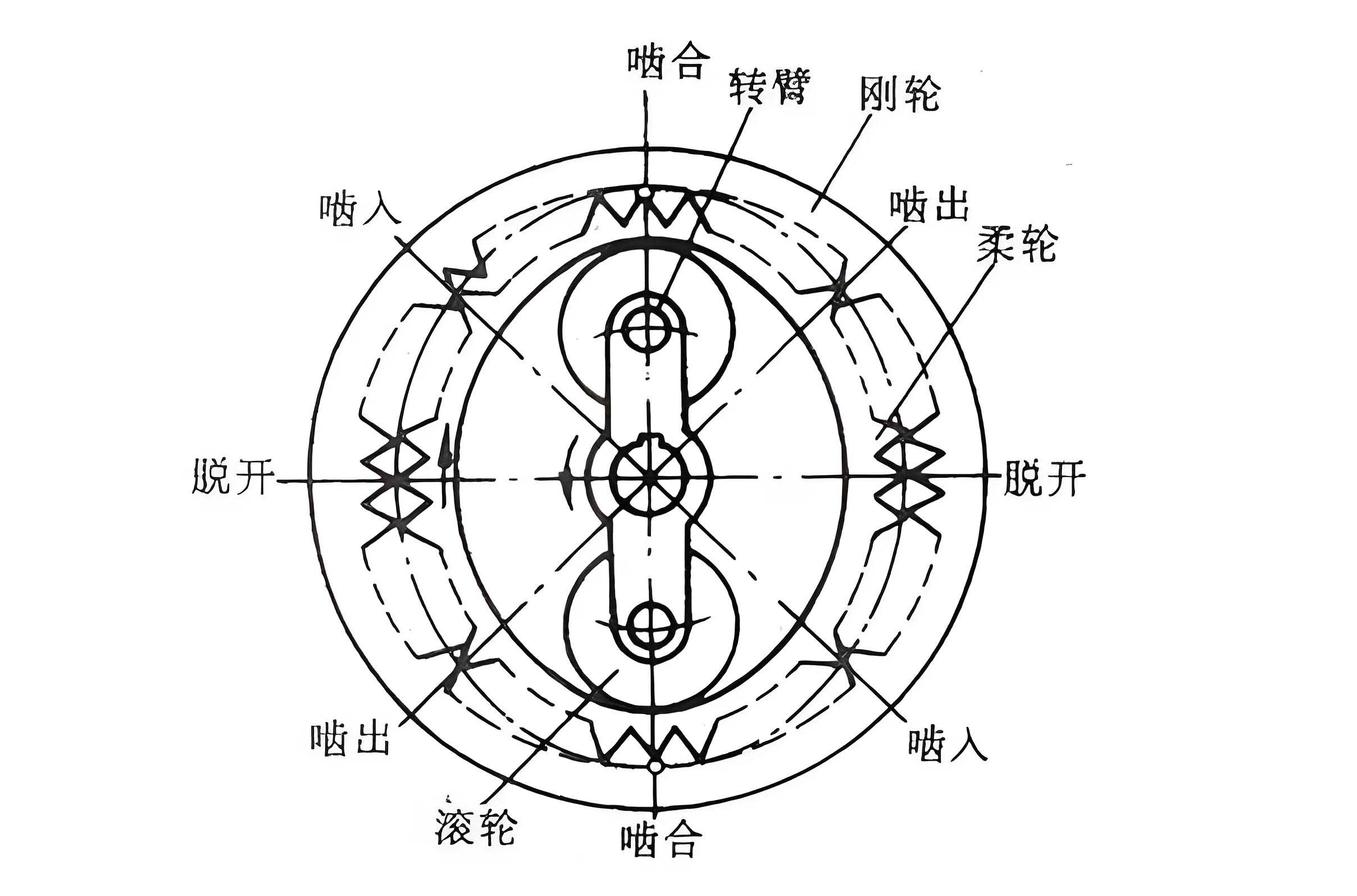
The transmission of motion and power in high-precision applications demands mechanisms that offer exceptional accuracy, compactness, and reliability. Among the various solutions available, the strain wave gear, also commonly referred to as a harmonic drive, stands out for its unique combination of advantages. This ingenious mechanism provides remarkably high reduction ratios within a single stage, achieves near-zero backlash operation, and maintains a very high positional accuracy, all while being notably lightweight and compact. These attributes have cemented its role as a critical component in fields such as robotic joints, aerospace actuators, precision optical equipment, and advanced medical devices. The core of its performance lies in the elastic deformation of a flexible component, the flexspline, which engages with a rigid circular spline via a wave generator. Consequently, the geometry of the interacting tooth profiles on the flexspline and circular spline is paramount, directly dictating the load distribution, transmission efficiency, wear characteristics, and overall longevity of the strain wave gear system.
Over the years, significant research efforts have been dedicated to optimizing the tooth profile for strain wave gears. Traditional profiles like the involute have been studied extensively, with modifications aimed at stress reduction. The S-shaped profile, derived from a rack approximation and curve mapping principle, has gained attention for its favorable characteristics, including a larger potential contact region and more uniform backlash distribution, leading to smoother meshing. However, a primary limitation of the conventional S-profile design method, which relies on simple backlash adjustment from a base profile, is its restricted functional meshing zone. This zone can be further reduced by necessary modifications to prevent interference, ultimately limiting the number of teeth in simultaneous contact and the total contact arc length, which are crucial for load capacity.
To overcome this limitation, conjugate design theories based on precise gearing kinematics have been explored. These methods aim to derive the counterpart tooth profile (e.g., the circular spline’s profile) directly from the meshing motion of a given base profile (e.g., the flexspline’s profile), ensuring theoretically continuous and optimal contact. While powerful, these analytical methods often become intractable or impossible to solve when applied to complex, non-standard tooth profile equations like the S-shape. This presents a significant challenge: leveraging the benefits of the S-profile’s geometry while achieving the extended, theoretically optimal meshing zone promised by conjugate theory.
This article addresses this challenge by proposing a novel synthesis approach: the Effective Edge-Conjugate Point Method based on a numerical envelope technique. This method bypasses the analytical complexities of solving intricate meshing equations for the S-profile. Instead, it employs numerical simulation and advanced point-cloud processing to identify the precise set of points on the moving base profile that define the envelope of its family of positions—these are the effective conjugate points. By fitting a smooth curve to these points, we obtain the conjugate tooth profile. We demonstrate this method by designing a complete conjugate S-profile set for a strain wave gear. The performance of this new design is rigorously compared against a traditional S-profile designed via the backlash adjustment method. Through comprehensive planar numerical analysis and nonlinear finite element modeling, we evaluate key performance metrics such as the meshing zone, the occurrence of multi-point contact, the total number of teeth in mesh, and the resulting contact stress distribution. The results conclusively show that the proposed method successfully enhances the meshing performance characteristic of advanced strain wave gear systems.
Geometric and Kinematic Foundation of the Strain Wave Gear
The accurate design of conjugate tooth profiles for a strain wave gear necessitates a precise mathematical model of the kinematics between its three primary components: the rigid circular spline, the flexible flexspline, and the wave generator. The following establishes the coordinate systems and fundamental relationships.
We define three key coordinate systems:
$$ S_0(O, X, Y) $$ is attached to the wave generator.
$$ S_1(O_1, X_1, Y_1) $$ is attached to the flexspline (specifically, to the cross-section of interest on its neutral surface before deformation).
$$ S_2(O_2, X_2, Y_2) $$ is attached to the fixed circular spline.
The origin $$ O $$ of $$ S_0 $$ coincides with the origin $$ O_2 $$ of $$ S_2 $$. The origin $$ O_1 $$ of $$ S_1 $$ lies on the deformed neutral curve of the flexspline as represented in $$ S_0 $$.
The central kinematic variable is the angular parameter $$ \phi_1 $$, which describes the position of a point on the deformed flexspline relative to the wave generator’s major axis (Y-axis of $$ S_0 $$). Based on the fundamental assumption of constant neutral layer arc length before and after deformation, we have:
$$ r_m \phi = \int_{0}^{\phi_1} \sqrt{ r^2 + \left( \frac{dr}{d\phi_1} \right)^2 } d\phi_1 $$
where $$ r_m $$ is the radius of the undeformed flexspline neutral layer, $$ r $$ is the polar equation of the deformed neutral curve expressed as a function of $$ \phi_1 $$, and $$ \phi $$ is the corresponding angular coordinate on the undeformed circle.
For a standard elliptical wave generator, the deformed neutral curve is given by:
$$ r(\phi_1) = \frac{ab}{\sqrt{a^2 \sin^2 \phi_1 + b^2 \cos^2 \phi_1}} $$
where $$ a $$ and $$ b $$ are the major and minor semi-axes of the ellipse, respectively.
The kinematic relationship between the rotation of the wave generator relative to the circular spline $$ (\phi_2) $$ and the parameter $$ \phi_1 $$ is derived from the relative motion and tooth engagement:
$$ \phi_2 = \frac{z_f}{z_c} \int_{0}^{\phi_1} \sqrt{ r^2 + \left( \frac{dr}{d\phi_1} \right)^2 } d\phi_1 $$
where $$ z_f $$ and $$ z_c $$ are the number of teeth on the flexspline and circular spline, respectively (typically, $$ z_c = z_f + 2 $$).
Other crucial angles for defining the orientation of the flexspline tooth are:
The normal rotation of the flexspline section: $$ \mu = \arctan\left( -\frac{r’}{r} \right) $$ where $$ r’ = dr/d\phi_1 $$.
The angular position of the flexspline section relative to the fixed frame: $$ \gamma = \phi_1 – \phi_2 $$.
The total normal engagement angle (critical for tooth profile orientation): $$ \beta = \gamma + \mu $$.
All angles are defined positive in the counter-clockwise direction. Using $$ \phi_1 $$ as the independent variable allows for a precise parametric description of the entire system’s state, which is essential for the subsequent conjugate design process.
Tooth Profile Design Methodologies
Traditional Backlash Adjustment Method for S-Profile
The conventional design process for an S-shaped tooth profile in a strain wave gear begins with a rack approximation. The relative motion between the flexspline and circular spline is approximated as a rack-and-pinion motion. A chosen generating rack profile (often a simple circular or parabolic arc) is then mapped onto the moving trajectory of the flexspline relative to the circular spline. This mapping, based on the kinematic model using an approximate elliptical cam, yields an initial “approximate” convex tooth profile for both the flexspline and the circular spline.
However, this approximate profile, derived from simplified kinematics, will cause interference when used with the exact elliptical motion of the strain wave gear. Therefore, a planar profile modification is applied. This modification accounts for the difference between the exact and approximate kinematic trajectories and the circumferential strain-induced rotation of the flexspline teeth. The result is a corrected, non-interfering convex base profile. The final step in the traditional method is to generate the mating concave profile. This is done simply by offsetting the convex base profile by a constant clearance value, either inward to create the circular spline’s concave flank or outward to create the flexspline’s concave flank. This method is straightforward but does not guarantee an optimal, conjugate meshing condition; it often results in a limited active meshing region. The key parameters for such a design are summarized below for a typical model.
| Parameter | Symbol | Value | Unit |
|---|---|---|---|
| Module | m | 0.268 | mm |
| Flexspline Tooth Count | z_f | 160 | – |
| Circular Spline Tooth Count | z_c | 162 | – |
| Deformation Coefficient | w_0 | 1.0 | – |
| Addendum Coefficient | h_a^* | 0.6 | – |
| Dedendum Coefficient | h_f^* | 0.75 | – |
Proposed Effective Edge-Conjugate Point Method
This novel method aims to construct a truly conjugate tooth profile numerically, avoiding the analytical difficulties associated with complex profile equations. The process starts with a well-defined base profile, such as the modified S-shaped convex profile of the circular spline obtained from the traditional process (after modification to prevent interference). The core idea is to simulate the family of curves representing all positions of this base profile as it moves according to the exact kinematic equations of the strain wave gear, and then to find the envelope of this family.
The coordinate transformation from the flexspline system $$ S_1 $$ to the circular spline system $$ S_2 $$ is given by the matrix:
$$ \mathbf{M}_{21}(\phi_1) = \begin{bmatrix} \cos \beta & \sin \beta & r \sin \gamma \\ -\sin \beta & \cos \beta & r \cos \gamma \\ 0 & 0 & 1 \end{bmatrix} $$
Thus, the trajectory of a point $$ \mathbf{r}_1 = (x_1, y_1)^T $$ on the flexspline profile, as seen in the fixed circular spline frame $$ S_2 $$, is:
$$ \begin{bmatrix} x_1′ \\ y_1′ \\ 1 \end{bmatrix} = \mathbf{M}_{21}(\phi_1) \begin{bmatrix} x_1 \\ y_1 \\ 1 \end{bmatrix} $$
By varying $$ \phi_1 $$ over a sufficient range, we generate a dense cluster of points representing the swept path of the entire flexspline convex profile.
The envelope of this curve family is its boundary. Numerically, we can compute the boundary of the 2D point cloud using algorithms like the `boundary` function in MATLAB (e.g., `k = boundary(x, y)`), which returns an ordered set of points defining the shape’s perimeter. However, not all points on this geometric boundary satisfy the fundamental condition of conjugate action, which is governed by the meshing equation. For two surfaces to be in contact, the relative velocity at the point of contact must be orthogonal to the common surface normal. When considering the circular spline as fixed, this condition in frame $$ S_2 $$ is:
$$ \mathbf{n}_2 \cdot \mathbf{v}_2^{(12)} = 0 $$
where $$ \mathbf{n}_2 $$ is the normal vector to the envelope (or potential contact point) in $$ S_2 $$, and $$ \mathbf{v}_2^{(12)} $$ is the relative velocity of the flexspline point with respect to the circular spline, expressed in $$ S_2 $$. This can be expanded as:
$$ \mathbf{n}_1^T \mathbf{W}_{21}^T \frac{d\mathbf{M}_{21}}{dt} \mathbf{r}_1 = 0 $$
where $$ \mathbf{W}_{21} $$ is the rotational sub-matrix of $$ \mathbf{M}_{21} $$.
The proposed method integrates this condition into the numerical process. After generating the motion trajectory point cloud $$ (x_1′, y_1′) $$ for the base convex profile, we compute the boundary point set. For each candidate point on this boundary, we identify the corresponding generator point on the base profile and the associated motion parameter $$ \phi_1 $$. We then evaluate the meshing equation. Points that satisfy the equation within a specified numerical tolerance are classified as Effective Edge-Conjugate Points. The collection of these valid points forms a sparse but precise dataset defining the desired conjugate concave profile. A smooth curve (e.g., a spline) is fitted through these points to yield the final, continuous conjugate tooth profile for the flexspline. The same process can be applied in reverse, starting from the flexspline convex profile to generate the conjugate circular spline concave profile. This method inherently accounts for the exact kinematics of the strain wave gear, ensuring the designed profiles are theoretically capable of optimal contact.
Design Instance and Meshing Analysis
Applying both the traditional and the proposed method to the strain wave gear parameters listed above, we obtain two distinct S-profile designs. The traditional method yields profiles with constant initial clearance across the flank. The effective edge-conjugate method produces profiles with a varying clearance that is minimal in the central region of potential contact and increases towards the tip and root, a signature of conjugate action. A planar kinematic simulation over a quarter rotation $$ (\phi_1 \in [0, 90^\circ]) $$ confirms that both designs operate without interference.
The meshing characteristics, however, differ profoundly. Analysis of the conjugate pair designed via the new method reveals two advanced meshing phenomena:
1. Double-Entry/Two-Point Meshing: At a specific instant of engagement (a specific $$ \phi_1 $$), a single tooth on the flexspline makes contact with the circular spline at two distinct points along its flank. This is visualized by finding two different $$ x_1 $$ coordinates (profile points) on the same flexspline tooth that satisfy the contact condition for the same $$ \phi_1 $$ value.
2. Re-Entry/Quadratic Meshing: A single specific point on the flexspline tooth profile enters into contact, exits, and then re-enters contact with the circular spline profile during a single engagement cycle. This is identified by finding two distinct $$ \phi_1 $$ values for which the same $$ x_1 $$ coordinate on the flexspline tooth satisfies the contact condition.
These phenomena directly contribute to a significant extension of the active meshing zone. The table below compares the theoretical meshing intervals for a single tooth pair, considering the convex flank of one component engaging with the concave flank of the other.
| Design Method | Primary Meshing Interval (Degrees of ϕ_1) | Secondary/Extended Meshing Interval (Degrees of ϕ_1) | Total Active Angle |
|---|---|---|---|
| Traditional Backlash Adjustment | 9.561° – 49.589° | None | ~40.0° |
| Effective Edge-Conjugate | 9.561° – 49.589° | 1.146° – 8.365° | ~47.6° |
This extension has a major impact on the global load-sharing capability of the strain wave gear. A planar assembly analysis of a 90-degree sector (40 teeth) was performed, considering a tooth pair to be in a “loaded contact” state if the nominal clearance is less than 3 µm, accounting for elastic deformation under load.
| Design Method | Teeth in Mesh (90° Sector) | Estimated Teeth in Mesh (Full Circle) | Percentage of Flexspline Teeth Engaged |
|---|---|---|---|
| Traditional Backlash Adjustment | 19 | 76 | 47.5% |
| Effective Edge-Conjugate | 22 | 88 | 55.0% |
The effective edge-conjugate design increases the number of simultaneously engaged teeth by approximately 15.8%. This substantial increase directly translates to a higher load capacity and better distribution of forces across the strain wave gear assembly, reducing stress on individual teeth.
Finite Element Analysis and Contact Stress Validation
To validate the kinematic findings and assess the practical mechanical benefits, nonlinear static finite element analysis (FEA) was conducted on full 360-degree models of both strain wave gear designs. The models simplified the flexspline cup as a planar ring with teeth, fixed at its rear mounting surface. The wave generator was modeled as a rigid ellipse, and a pure torque was applied to the flexspline’s inner rim. Contact pairs were defined between all potential tooth flanks with a standard friction coefficient.
The FEA results provide clear and compelling evidence of the advantages of the conjugate design for the strain wave gear:
Extended Contact Patterns: The strain wave gear with the effective edge-conjugate profiles exhibits longer, more distributed contact bands along the tooth flanks compared to the more localized contact patches of the traditional design.
Visual Evidence of Multi-Point Contact: On several teeth in the conjugate design model, two separate regions of high contact stress are visible on a single tooth flank, confirming the predicted two-point meshing phenomenon.
Significant Reduction in Peak Contact Stress: This is the most critical result. The maximum contact stress (Hertzian pressure) was extracted from each simulation.
| Design Method | Maximum Contact Stress (MPa) | Stress Reduction vs. Traditional Method |
|---|---|---|
| Traditional Backlash Adjustment | 141.82 | Baseline |
| Effective Edge-Conjugate | 107.27 | 24.36% |
A 24.4% reduction in peak contact stress is a major improvement for the durability and reliability of the strain wave gear. Lower contact stress minimizes surface pitting, wear, and plastic deformation, leading to a longer operational life, maintained precision, and potentially allowing for more compact or higher-torque design variants.
Conclusion
This study has successfully developed and validated a novel numerical approach, the Effective Edge-Conjugate Point Method, for designing high-performance tooth profiles for strain wave gears. By synergistically combining precise kinematic modeling, numerical simulation of motion trajectories, and intelligent filtering based on the fundamental law of gearing, this method overcomes the traditional analytical barriers associated with complex profiles like the S-shape. When applied to an S-profile base, the method generates a conjugate counterpart that delivers substantial performance gains over the conventional backlash-adjusted design.
The key outcomes for the advanced strain wave gear design are:
1. Expanded Meshing Capability: The conjugate profiles enable both two-point and quadratic meshing phenomena, which theoretically and numerically extend the active meshing zone of each tooth pair.
2. Enhanced Load Sharing: The extended zone translates to a significant increase (approximately 15.8%) in the total number of teeth sharing the load at any given instant within the strain wave gear assembly, with 55% of all flexspline teeth engaged.
3. Superior Stress Performance: Finite element analysis confirms that the more favorable contact conditions reduce the maximum contact stress by over 24%, which is a critical factor in improving fatigue life and reducing wear in precision strain wave gear systems.
This effective edge-conjugate point method provides a powerful, generalizable tool for the design and optimization of tooth profiles in strain wave gears. It allows engineers to harness the benefits of sophisticated profile geometries while achieving the optimal contact characteristics promised by conjugate theory, paving the way for the next generation of high-capacity, high-durability, and ultra-precision strain wave gear transmissions.