
In my research on precision motion transmission, the strain wave gear drive stands out for its unique combination of high reduction ratios, compactness, and exceptional positional accuracy. These attributes make it indispensable in demanding fields such as aerospace robotics and precision instrumentation. The fundamental operating principle relies on the controlled elastic deformation of a flexible spline, typically induced by an elliptical wave generator. The quality of meshing between the flexspline and the rigid circular spline is paramount, directly governing the drive’s transmission error, backlash, load distribution, and overall durability. Achieving an optimal, theoretically zero-backlash conjugate tooth profile pair is therefore a central challenge in the design of high-performance strain wave gear systems.
Traditional methods for solving the conjugate profile of the circular spline often rely on kinematic or envelope theory approaches. A common simplification involves using the angular position on the undeformed flexspline as the independent variable. This necessitates several approximations to make the equations tractable, particularly when enforcing the condition of an inextensible neutral curve during deformation. These approximations, while convenient, introduce inherent inaccuracies in the calculated conjugate tooth profile. This paper presents a precise mathematical framework I developed for determining the exact conjugate tooth profile. The method eliminates traditional approximations by a judicious choice of the independent variable and a rigorous formulation of the deformation kinematics. Using an elliptical cam wave generator as the basis, I will demonstrate the algorithm, compare its results with those from approximate methods, and validate its advantages through finite element analysis.
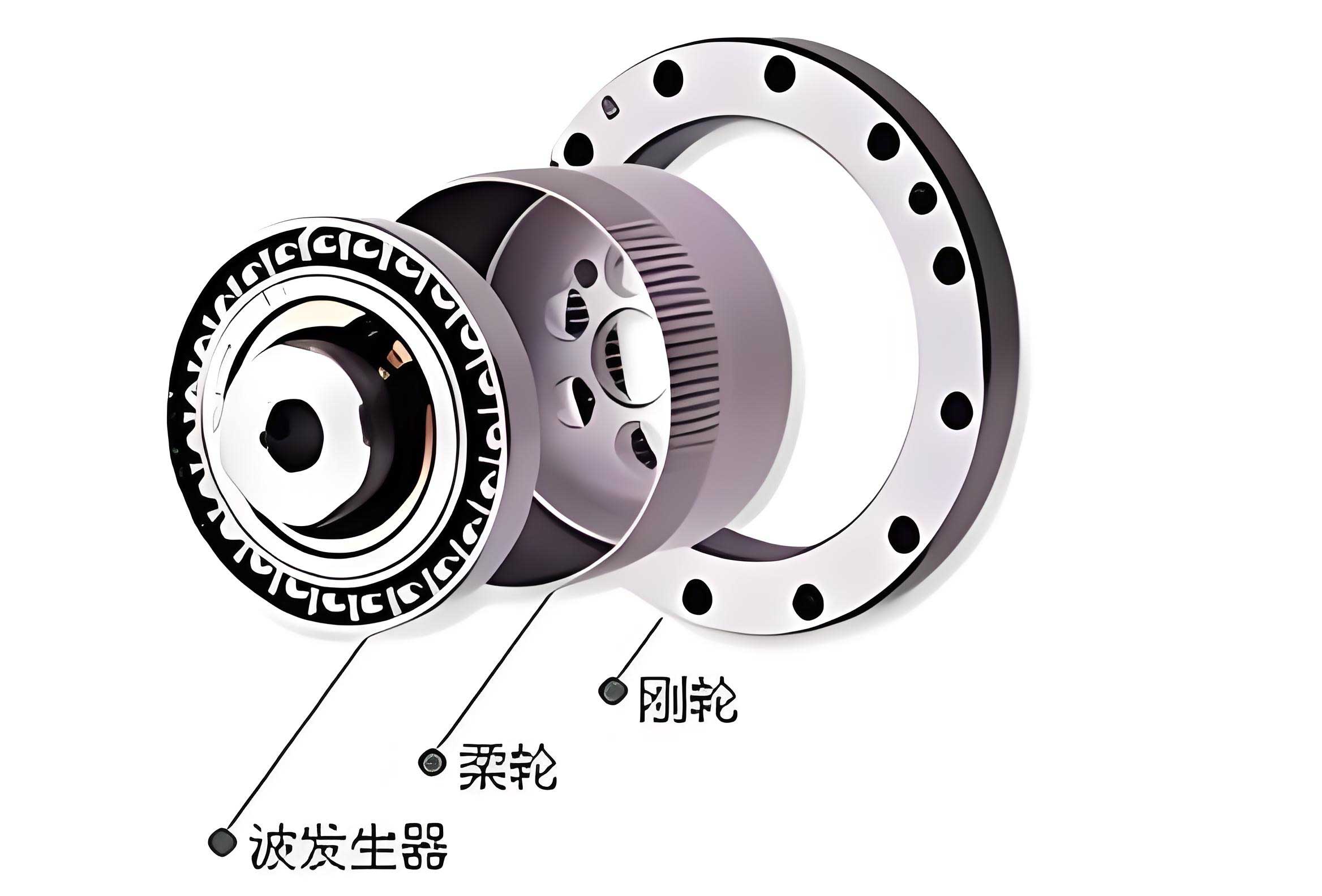
Mathematical Model and Coordinate Systems
The first step in my precise formulation is to accurately describe the geometry and kinematics of the deforming flexspline. The core assumption, consistent with established theory for thin-walled shells, is that the neutral curve (midline) of the flexspline does not change length during deformation—it is inextensible. The wave generator, assumed to be a perfect ellipse in this study, prescribes the final shape of this neutral curve.
I define three primary coordinate systems to track the motion and deformation:
- Fixed Coordinate System \( S_2(O_2, X_2, Y_2) \):** Attached to the circular spline, which is held stationary. The \( Y_2 \)-axis aligns with the symmetry line of a circular spline tooth space.
- Wave Generator Coordinate System \( S(O, X, Y) \):** Attached to and rotating with the wave generator. The \( Y \)-axis aligns with the major axis of the elliptical cam. This system also serves as the polar coordinate system for describing the deformed flexspline contour.
- Flexspline Tooth Coordinate System \( S_1(O_1, X_1, Y_1) \):** Attached to an individual tooth on the flexspline at its mating end. The \( Y_1 \)-axis aligns with the tooth’s symmetry line, and the origin \( O_1 \) lies on the deformed neutral curve.
The critical kinematic relationship stems from the pure-rolling condition between the flexspline’s deformed neutral curve and the circular spline’s pitch circle. If the wave generator (and system \( S \)) rotates by an angle \( \varphi_2 \) relative to the fixed circular spline, the non-deforming rear end of the flexspline rotates by \( \alpha \) in the opposite direction. The angular position \( \varphi_1 \) of the flexspline tooth origin \( O_1 \) in the wave generator’s coordinate system \( S \) is related to \( \varphi_2 \) by the following integral, ensuring no slip at the pitch point:
$$ \varphi_2 = \frac{z_f}{z_c} \int_{0}^{\varphi_1} \frac{\sqrt{r(\varphi_1)^2 + \dot{r}(\varphi_1)^2}}{r_m} \, d\varphi_1 $$
where \( z_f \) and \( z_c \) are the number of teeth on the flexspline and circular spline, respectively, \( r_m \) is the radius of the undeformed flexspline neutral curve, and \( r(\varphi_1) \) is the polar equation of the deformed neutral curve (ellipse) expressed with \( \varphi_1 \) as the independent variable.
The Deformed Neutral Curve and Key Angles
For an elliptical wave generator, the distance from the wave generator center \( O \) to point \( O_1 \) on the flexspline neutral curve is given by the ellipse equation in polar coordinates:
$$ r(\varphi_1) = \frac{a}{\sqrt{1 + \epsilon^2 \sin^2 \varphi_1}} $$
Here, \( a \) is the semi-major axis of the ellipse, and \( \epsilon = \sqrt{a^2/b^2 – 1} \) is the second eccentricity (\( b \) being the semi-minor axis). The value of \( b \) is not independent; it is determined from \( a \) and \( r_m \) by enforcing the inextensibility condition of the neutral curve, which relates the arc length of the ellipse to the arc length of the original circle.
The angle \( \mu \), which represents the rotation of the tooth’s symmetry line (\( Y_1 \)-axis) relative to the local radial vector \( \overrightarrow{OO_1} \), is crucial. It arises because the deformed neutral curve is not perpendicular to the radial line except at the axes of the ellipse. From differential geometry, this angle is precisely:
$$ \mu(\varphi_1) = \arctan\left( \frac{\dot{r}(\varphi_1)}{r(\varphi_1)} \right) = \arctan\left( -\frac{\epsilon^2 \sin \varphi_1 \cos \varphi_1}{1 + \epsilon^2 \sin^2 \varphi_1} \right) $$
where \( \dot{r} = dr/d\varphi_1 \).
The total rotation \( \beta \) of the flexspline tooth coordinate system \( S_1 \) relative to the fixed system \( S_2 \) is a sum of several angular motions:
$$ \beta(\varphi_1) = \gamma(\varphi_1) + \mu(\varphi_1) $$
Here, \( \gamma = \varphi_1 – \varphi_2 \) represents the net rotation of the flexspline’s mating end relative to the wave generator due to the gear ratio and deformation.
Inaccuracies in Traditional Approximate Methods
Before presenting my precise algorithm, it is instructive to clarify where common approximations are introduced in traditional formulations, which often use the undeformed angular coordinate \( \varphi \) as the primary variable.
1. Approximate Arc Length Equality: The inextensibility condition is often stated as an approximate equality between the arc lengths on the circle and the ellipse, using the same variable \( \varphi \):
$$ r_m \varphi \approx \int_{0}^{\varphi} \sqrt{\rho(\varphi)^2 + \left(\frac{d\rho}{d\varphi}\right)^2} \, d\varphi $$
where \( \rho(\varphi) \) describes the ellipse with \( \varphi \) as the input. This is mathematically imprecise because the mapping between \( \varphi \) on the circle and the corresponding point on the ellipse is not linear. The correct, implicit relationship is given by an integral involving the true ellipse parameter.
2. Approximation of the Tooth Tilt Angle \( \mu \): The exact expression for \( \mu \) involves the derivative of the polar radius. A frequent simplification is:
$$ \mu(\varphi) = \arctan\left( \frac{1}{\rho} \frac{d\rho}{d\varphi} \right) \approx -\frac{1}{r_m} \frac{dw}{d\varphi} $$
where \( w(\varphi) = \rho(\varphi) – r_m \) is the radial displacement. This linearization is valid only for small derivatives and ignores the full nonlinear geometric relationship.
These approximations, while reducing computational complexity, can lead to non-negligible errors in the calculated conjugate tooth profile, especially in the region where the flexspline tooth undergoes its initial contact (the first conjugate zone).
Precise Conjugate Solution Algorithm
The cornerstone of my approach is to use \( \varphi_1 \)—the angular position on the deformed neutral curve relative to the wave generator—as the fundamental independent variable. All other geometric and kinematic quantities are expressed precisely as functions of \( \varphi_1 \), as shown in the equations for \( r(\varphi_1) \), \( \mu(\varphi_1) \), and \( \beta(\varphi_1) \). This eliminates the need for the approximate mappings and linearizations inherent in the \( \varphi \)-based approach.
The condition for conjugation between two profiles is that at the point of contact, the relative velocity vector is orthogonal to the common normal vector. This is encapsulated in the equation of meshing. Starting from the coordinate transformation from \( S_1 \) to \( S_2 \):
$$ \mathbf{r}^{(2)} = \mathbf{M}_{21}(\varphi_1) \cdot \mathbf{r}^{(1)} $$
where \( \mathbf{r}^{(1)} \) is a point on the flexspline tooth profile in \( S_1 \), \( \mathbf{r}^{(2)} \) is its coordinates in \( S_2 \), and \( \mathbf{M}_{21} \) is the homogeneous transformation matrix. The equation of meshing can be derived as:
$$ \mathbf{n}^{(1)T} \cdot \mathbf{\Phi}(\varphi_1) \cdot \dot{\mathbf{r}}^{(1)} = 0 $$
Here, \( \mathbf{n}^{(1)} \) is the unit normal vector to the flexspline tooth profile at the point \( \mathbf{r}^{(1)} \), and \( \dot{\mathbf{r}}^{(1)} = d\mathbf{r}^{(1)}/du \) is the profile tangent (with \( u \) as a profile parameter). The matrix \( \mathbf{\Phi} \) is a key component derived from the kinematics:
$$
\mathbf{\Phi}(\varphi_1) = \begin{bmatrix}
0 & -r\dot{\beta} & \dot{r}\cos\mu – r\dot{\gamma}\sin\mu \\
r\dot{\beta} & 0 & \dot{r}\sin\mu + r\dot{\gamma}\cos\mu \\
0 & 0 & 0
\end{bmatrix}
$$
The significant advantage of this formulation is that every element of \( \mathbf{\Phi} \)—\( r, \dot{r}, \mu, \dot{\mu}, \dot{\beta}, \dot{\gamma} \)—can be computed directly and exactly from the explicit functions of \( \varphi_1 \), without resorting to integral representations or approximations.
The numerical solution procedure is then straightforward:
- Discretize the Flexspline Profile: Represent the known flexspline tooth profile (e.g., a double-circular-arc profile) as a set of \( s \) discrete points \( \mathbf{r}_j^{(1)} \) with their corresponding normals \( \mathbf{n}_j^{(1)} \), where \( j = 1, 2, …, s \).
- Solve for Conjugate Points: For each point \( j \), the meshing equation \( f(u_j, \varphi_1) = \mathbf{n}_j^{(1)T} \cdot \mathbf{\Phi}(\varphi_1) \cdot \dot{\mathbf{r}}_j^{(1)} = 0 \) is solved numerically for the corresponding generator angle \( \varphi_{1j} \). This \( \varphi_{1j} \) is the specific wave generator position at which this particular point on the flexspline tooth becomes a contact point.
- Generate the Conjugate Profile: For each solved pair \( (u_j, \varphi_{1j}) \), the transformation matrix \( \mathbf{M}_{21}(\varphi_{1j}) \) is computed. The conjugate point on the circular spline profile is then calculated as \( \mathbf{r}_j^{(2)} = \mathbf{M}_{21}(\varphi_{1j}) \cdot \mathbf{r}_j^{(1)} \). The set of all points \( \mathbf{r}_j^{(2)} \) forms the exact, numerically determined conjugate tooth profile of the circular spline.
Computational Example and Analysis
To demonstrate the impact of the precise algorithm, I applied it to a strain wave gear with a double-circular-arc (DCA) flexspline tooth profile. The key parameters of the drive are listed in the table below.
| Parameter | Symbol | Value |
|---|---|---|
| Module | \( m \) | 0.3175 mm |
| Radial Deformation Coefficient | \( w_0^* \) | 1.0 |
| Flexspline Tooth Count | \( z_f \) | 160 |
| Circular Spline Tooth Count | \( z_c \) | 162 |
| Major Semi-axis of Deformed Curve | \( a \) | \( r_m + w_0^* m \) |
The DCA profile parameters (convex arc radius \( \rho_a \), concave arc radius \( \rho_f \), center offsets, etc.) were chosen based on an optimization for dual-conjugate zone operation, which is desirable for zero-backlash performance.
I calculated the conjugate tooth profiles using both the traditional approximate method and my precise \( \varphi_1 \)-based method. The primary differences manifest in two areas: the conjugate existence domain and the resulting circular spline profile geometry.
1. Conjugate Existence Domain: This refers to the range of \( \varphi_1 \) values for which a valid conjugate point is found for each segment of the flexspline tooth profile. The DCA profile typically exhibits two separate conjugate zones (Zone I and Zone II) per tooth during a full engagement cycle. The comparison revealed a significant discrepancy:
| Method | Conjugate Zone I (degrees) | Conjugate Zone II (degrees) |
|---|---|---|
| Approximate Method | [2.55, 7.79] | [13.65, 46.02] |
| Precise Method (Proposed) | [2.91, 10.88] | [12.49, 46.97] |
The precise algorithm predicts a substantially larger Zone I and a slightly shifted Zone II. More importantly, the gap between Zone I and Zone II is reduced from approximately 5.86° (in the approximate method) to about 1.61°. This smaller gap implies that a greater number of tooth pairs will be in a state of true conjugate contact (rather than tip or root contact) at any given time, which is critical for enhancing the torsional stiffness and positional accuracy of the strain wave gear.
2. Conjugate Profile Geometry: The discrete conjugate points calculated by both methods were fitted to circular arcs to define the manufacturable circular spline DCA profile. The resulting parameters show measurable differences:
| Profile Parameter | Approximate Method | Precise Method | Deviation |
|---|---|---|---|
| Concave Radius \( \rho_f \) (mm) | 0.6170 | 0.6278 | +1.75% |
| Convex Radius \( \rho_a \) (mm) | 0.5505 | 0.5037 | -8.51% |
The effect on the convex flank radius is particularly pronounced. While these differences are on the order of hundredths of a millimeter, they have a direct and magnified impact on the functional backlash of the gear pair, which is typically measured in microns.
Analysis of Backlash Distribution and Finite Element Validation
The ultimate test of a conjugate design is the assembled state under a no-load condition. I simulated the meshing of the flexspline with the circular spline profiles derived from both methods by rotating the wave generator through its cycle. For each angular position, the minimum distance between all potential contacting tooth pairs was calculated to determine the effective backlash (or interference, if negative).
The backlash distribution across multiple tooth pairs in simultaneous engagement is strikingly different. The following table summarizes the statistics for the teeth on one side of the major axis:
| Metric | Approximate Method Design | Precise Method Design |
|---|---|---|
| Average Backlash | ~0.25 μm | ~0.20 μm |
| Maximum Backlash | ~0.55 μm | ~0.32 μm |
| Minimum Backlash | ~0.05 μm | ~0.05 μm |
| Uniformity (Std. Deviation) | Higher | Significantly Lower |
The profile derived from the precise algorithm yields a backlash distribution that is not only smaller on average but also remarkably more uniform. High uniformity in backlash is essential for smooth motion transfer, reduced vibration, and predictable load sharing among tooth pairs in a strain wave gear.
To assess the performance under load, I conducted a 2D plane-stress finite element analysis (FEA) on both gear set designs. The model included the elliptical wave generator (modeled as a rigid contour), the flexible flexspline, and the rigid circular spline. After simulating the assembly process to induce the initial stress state, a static torque of 20 N·m was applied to the circular spline while the flexspline’s non-mating end was fixed.
The FEA results conclusively demonstrate the superiority of the precise design:
- Stress Distribution: In the gear set designed with the precise method, the load is distributed more evenly across the 6-7 primary engaging tooth pairs. The maximum von Mises stress in the flexspline body was approximately 40% lower compared to the approximate design.
- Root Stress: For the main load-bearing teeth, the tooth root fillet stress was consistently 10-15 MPa lower in the precise design.
- Contact Stress: The contact stress pattern on the tooth flanks was more uniform in the precise design, whereas the approximate design showed high stress concentration on only a few teeth.
- Tip Clearance: The precise design showed better clearance for teeth disengaging (near the minor axis), reducing the risk of tip interference under load deflection.
These FEA results validate that the mathematically more accurate conjugate profile leads to tangibly improved mechanical performance, including lower stress peaks and more favorable load distribution, which directly translates to higher torque capacity and longer life for the strain wave gear assembly.
Conclusion and Future Work
In this work, I have presented a rigorous and precise algorithm for solving the conjugate tooth profile of a circular spline in an elliptical cam-based strain wave gear drive. The method’s core innovation lies in adopting the angular coordinate on the deformed neutral curve \( (\varphi_1) \) as the independent variable, which allows for an exact formulation of the meshing kinematics without the approximations common in traditional methods.
The comparative analysis against an established approximate method revealed significant quantitative differences: an expanded and better-positioned conjugate zone, altered circular spline profile geometry, a more uniform and slightly smaller backlash distribution, and—as confirmed by FEA—a demonstrably superior stress state under load. These improvements collectively contribute to a strain wave gear with higher positional accuracy, greater torsional stiffness, improved load-sharing characteristics, and enhanced reliability.
While the demonstration was for an elliptical wave generator, the underlying mathematical framework is general. The precise algorithm can be extended to strain wave gear drives with other wave generator contour shapes (e.g., four-arc cams) by simply replacing the function \( r(\varphi_1) \) and its derivative with the equations describing the new contour. Future work will focus on extending this precise conjugation theory to account for loaded tooth deflection, optimizing the initial flexspline profile for even wider conjugate zones, and experimentally validating the predicted performance gains in prototype strain wave gear units.