
In this article, I will comprehensively review the research progress in the meshing theory of toroidal worm gear drives, a field that has seen significant advancements over the centuries. The worm gear drive, particularly the toroidal type, is renowned for its high load capacity, efficiency, and smooth operation, making it indispensable in heavy-duty applications such as metallurgical, construction, and transportation machinery. The complexity of the geometric shapes of the worm and wheel surfaces, however, poses challenges in manufacturing, driving the need for deeper theoretical insights. My discussion will cover various types, including the Hindley worm drive, plane double-enveloping worm gear drive, conical and double-cone double-enveloping worm gear drives, and toroidal double-enveloping worm gear drives. I will elaborate on the formation principles of worm helicoids, meshing theories, modification methods, and mismatch techniques, incorporating tables and formulas to summarize key points. Throughout, I aim to highlight the evolution of the worm gear drive theory and its implications for practical applications.
The study of worm gear drive meshing theory dates back to the Renaissance, with early conceptual designs, but systematic research began in the 20th century. A worm gear drive involves a worm (a screw-like component) engaging with a wheel, and in toroidal types, the worm’s pitch surface is a torus. This configuration allows for multiple tooth contacts, enhancing load distribution but also introducing sensitivity to errors. Understanding the meshing principles is crucial for optimizing performance and simplifying production. I will start by examining the Hindley worm drive, which laid the foundation for modern worm gear drive developments.
The Hindley worm drive, also known as the straight-sided toroidal worm gear drive, originated in the 18th century. It features a worm with a toroidal pitch surface and a wheel generated to match. The worm’s helicoid is formed by a straight-edged cutting tool, as illustrated in historical diagrams. The meshing theory for this worm gear drive is based on the condition of continuous tangency between surfaces. The fundamental equation for meshing in a worm gear drive can be expressed as:
$$ \vec{n} \cdot \vec{v} = 0 $$
where $\vec{n}$ is the normal vector to the worm surface, and $\vec{v}$ is the relative velocity between the worm and wheel. This equation ensures that contact points move without separation. However, the original Hindley worm gear drive suffered from a ridge on the wheel surface that led to premature pitting. To address this, researchers developed modification methods. One early approach was parabolic modification, derived from natural wear curves. The modification curve, plotted as wheel rotation angle versus deviation, is approximated by a parabola. This method reduces running-in time but is semi-empirical. Alternatively, constant-parameter modification, based on gear meshing theory, simplifies implementation. The table below summarizes key aspects of the Hindley worm gear drive:
| Aspect | Description | Impact on Worm Gear Drive |
|---|---|---|
| Formation Principle | Straight-line tool on rotary table | Produces non-developable ruled surface |
| Meshing Condition | $\vec{n} \cdot \vec{v} = 0$ for continuous contact | Ensures proper torque transmission |
| Modification Methods | Parabolic or constant-parameter | Improves load distribution and longevity |
| Challenges | Sensitivity to errors due to line contact | Requires precise manufacturing |
Moving to more advanced types, the plane double-enveloping worm gear drive (TP worm gear drive) emerged to improve grindability. In this worm gear drive, the worm helicoid is generated by a plane grinding wheel, allowing for precise finishing. The wheel surface is also planar, facilitating manufacturing. The meshing theory involves secondary action, where the worm and wheel surfaces engage in double-line contact during a meshing cycle. This is described by the equation of meshing for double-enveloping surfaces:
$$ \Phi(u, \theta, \phi) = 0 $$
where $u$ is a surface parameter, $\theta$ is the worm rotation angle, and $\phi$ is the wheel rotation angle. The TP worm gear drive exhibits excellent performance but is limited to high reduction ratios. To extend its range, oblique plane versions were developed. Modification techniques for this worm gear drive include angular modification and profile shift. Angular modification, though effective, complicates manufacturing. Profile shift, using constant parameters like process center distance and transmission ratio, is simpler. Based on instantaneous contact line distribution, modified TP worm gear drives are classified into Type I and Type II. Type II is recommended to eliminate secondary contact zones that cause pitting. The mismatch theory for TP worm gear drive aims to reduce sensitivity to errors by introducing point contact. This involves generating the wheel with a mismatched hob, leading to a worm gear drive that tolerates misalignment better. The following formula captures the mismatch condition:
$$ \Delta a + \Delta i \neq 0 $$
where $\Delta a$ is the deviation in center distance and $\Delta i$ is the deviation in transmission ratio during wheel generation. Despite these advances, the TP worm gear drive still faces constraints in multi-tooth contact scenarios.
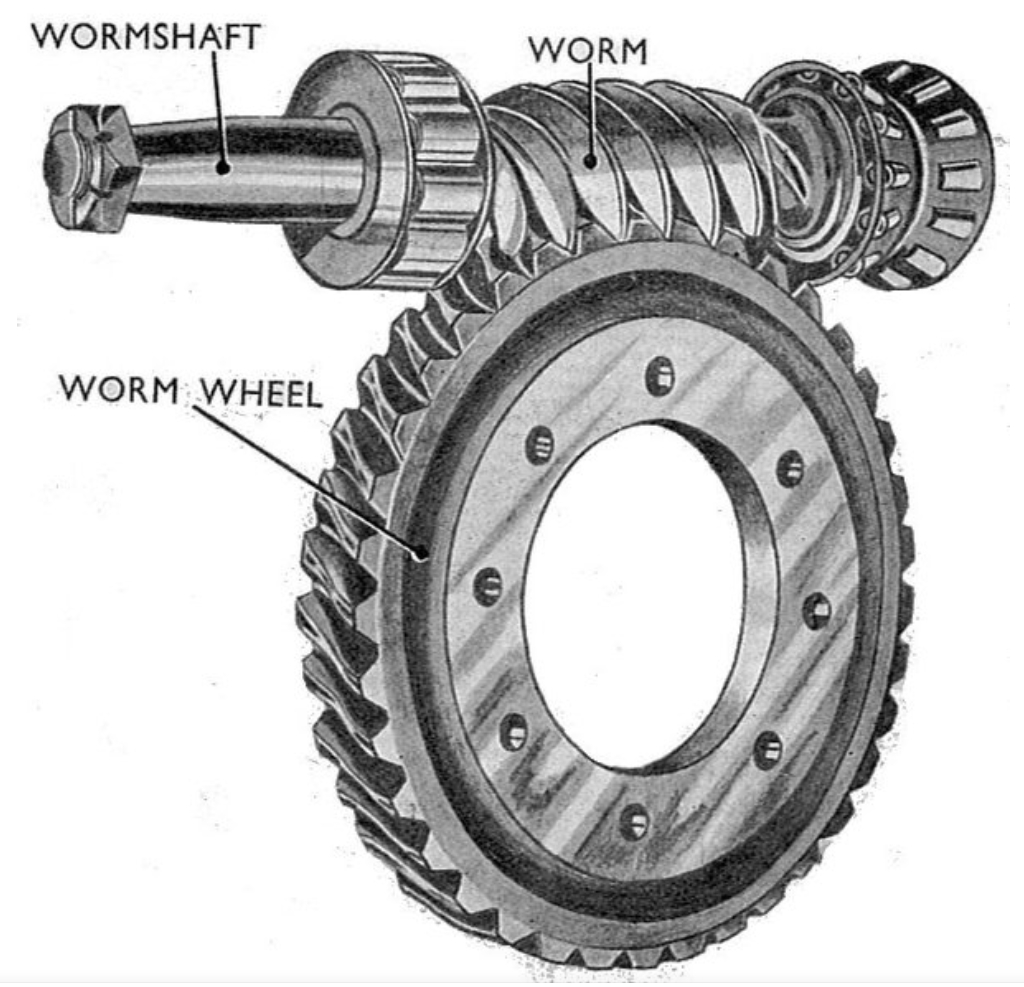
To overcome limitations like tooth pointing and undercutting in multi-start or small-ratio worm gear drives, conical double-enveloping worm gear drives were introduced. The single-cone type (STK worm gear drive) uses a conical grinding wheel to form the worm helicoid. Its meshing theory is similar to the TP type but with a conical generating surface. The double-cone type (DTK worm gear drive) employs two conical wheels, simplifying manufacturing by avoiding tool reversal. The meshing equations involve more parameters due to the conical geometry. For instance, the surface equation of a cone-generated worm can be written as:
$$ \vec{r}(u, \beta) = \vec{r}_0 + u \vec{e}(\beta) $$
where $\vec{r}_0$ is a reference point, $u$ is a length parameter, and $\vec{e}(\beta)$ is the unit vector along the cone generatrix. The DTK worm gear drive shows better resistance to tooth defects and is suitable for a wider range of parameters. Studies indicate that for high ratios and few starts, the TP worm gear drive is preferred, while for low ratios and many starts, the DTK worm gear drive excels. The mismatch characteristics of the DTK worm gear drive are superior due to more adjustable parameters in the grinding wheel. The table below compares conical worm gear drives:
| Type | Generating Surface | Advantages in Worm Gear Drive | Typical Applications |
|---|---|---|---|
| STK Worm Gear Drive | Single cone | Resists pointing and undercutting | Multi-start drives |
| DTK Worm Gear Drive | Double cone | Simpler process, high precision | General heavy-duty uses |
Further expanding the scope, toroidal double-enveloping worm gear drives utilize a toroidal generating surface. The single-toroid type (STT worm gear drive) employs a circular arc profile wheel, offering good meshing properties but poor manufacturability. The double-toroid type (DTT worm gear drive) uses two toroidal wheels, improving processability. The formation principle involves a grinding wheel with a circular cross-section rotating about an axis. The meshing theory for such worm gear drives is complex, governed by equations that account for the curvature match. The general meshing condition for double-enveloping worm gear drives can be extended as:
$$ \frac{\partial \vec{r}}{\partial u} \times \frac{\partial \vec{r}}{\partial \beta} \cdot \vec{v} = 0 $$
Modification methods for DTT worm gear drive include angular modification, which requires helical motion of the tool post, making it intricate. Simplified approaches like center distance modification and transmission ratio modification are proposed. These are based on constant parameters and classified into Type I and Type II. Small-modification Type II avoids curvature interference and is recommended. The mismatch theory for DTT worm gear drive benefits from numerous adjustable parameters, resulting in a worm gear drive that is robust to assembly errors and provides point contact with favorable error curves. The mathematical analysis involves calculating the induced normal curvature, given by:
$$ \kappa_n = \frac{\Phi_{uu} \Phi_{\beta\beta} – \Phi_{u\beta}^2}{|\vec{r}_u \times \vec{r}_\beta|^2} $$
where subscripts denote partial derivatives. This ensures the worm gear drive operates smoothly under load.
In summary, the evolution of worm gear drive meshing theory has profoundly impacted design and manufacturing. From the early Hindley worm gear drive to advanced double-enveloping types, each development has addressed specific challenges. The worm gear drive’s ability to achieve multi-tooth contact is a double-edged sword, offering high load capacity but also sensitivity. Modification and mismatch theories have been pivotal in optimizing performance. For instance, in a worm gear drive, proper modification can enhance lubrication and reduce wear. The ongoing research focuses on novel generating surfaces and digital manufacturing techniques. The future of worm gear drive technology lies in integrating theoretical insights with practical innovations, such as additive manufacturing and smart lubrication systems. As we advance, the worm gear drive will continue to be a critical component in machinery, driven by deeper understanding of meshing dynamics.
To encapsulate key formulas and parameters, I present a comprehensive table summarizing the meshing theories for different worm gear drives:
| Worm Gear Drive Type | Meshing Equation | Key Modification Parameters | Notable Features |
|---|---|---|---|
| Hindley (Straight-sided) | $\vec{n} \cdot \vec{v} = 0$ | Parabolic coefficient, constant shift | Line contact, requires run-in |
| TP (Plane double-enveloping) | $\Phi(u, \theta, \phi) = 0$ | Process center distance, transmission ratio | Double-line contact, grindable |
| DTK (Double-cone double-enveloping) | $\vec{r}(u, \beta) = \vec{r}_0 + u \vec{e}(\beta)$ | Cone angle, wheel position | Resists pointing, simple process |
| DTT (Double-toroid double-enveloping) | $\frac{\partial \vec{r}}{\partial u} \times \frac{\partial \vec{r}}{\partial \beta} \cdot \vec{v} = 0$ | Center distance, tool orientation | Point contact, error-tolerant |
The worm gear drive research has also contributed to broader gear theory, particularly in understanding conjugate surfaces and curvature analysis. The secondary action in double-enveloping worm gear drives, for example, has led to insights into multi-parameter meshing. As we look ahead, the worm gear drive will benefit from computational tools like finite element analysis for stress prediction and optimization algorithms for parameter selection. The integration of IoT sensors in worm gear drive systems could enable real-time monitoring and predictive maintenance, further enhancing reliability. In conclusion, the worm gear drive remains a vibrant area of study, with meshing theory at its core driving innovation across industries.
I hope this review underscores the importance of continued investment in worm gear drive research. By leveraging mathematical models and experimental validation, we can unlock new potentials for this timeless mechanism. The worm gear drive, in its various forms, exemplifies the synergy between theory and practice, and I am confident that future advancements will yield even more efficient and durable designs. Let us embrace the challenges and opportunities in perfecting the worm gear drive for the next generation of machinery.