
In the field of precision mechanical transmission, the strain wave gear, also known as the harmonic drive, represents a pivotal technology due to its exceptional characteristics, including high reduction ratios, compactness, and positional accuracy. Since its inception, the strain wave gear has found extensive applications in aerospace, robotics, medical devices, and other high-precision industries. The core of its operation lies in the elastic deformation of a flexible component, the flexspline, which engages with a rigid circular spline via a wave generator. Understanding the load-induced deformations of the flexspline is crucial for optimizing tooth profile design, ensuring proper backlash under operational loads, and achieving balanced load distribution among the meshing teeth. This study focuses on establishing a theoretical framework for calculating the load deformation of the flexspline in a strain wave gear, explicitly considering the radial compliance of the flexible bearing—a critical yet often simplified component. The flexible bearing, which supports the wave generator, undergoes significant radial deformation under meshing forces, thereby influencing the circumferential and radial displacements of the flexspline tooth ring. Our objective is to derive analytical expressions for these deformations, validate them through finite element analysis, and provide a foundation for setting operational backlash in tooth profile design, ultimately enhancing the load-sharing performance and longevity of strain wave gear systems.
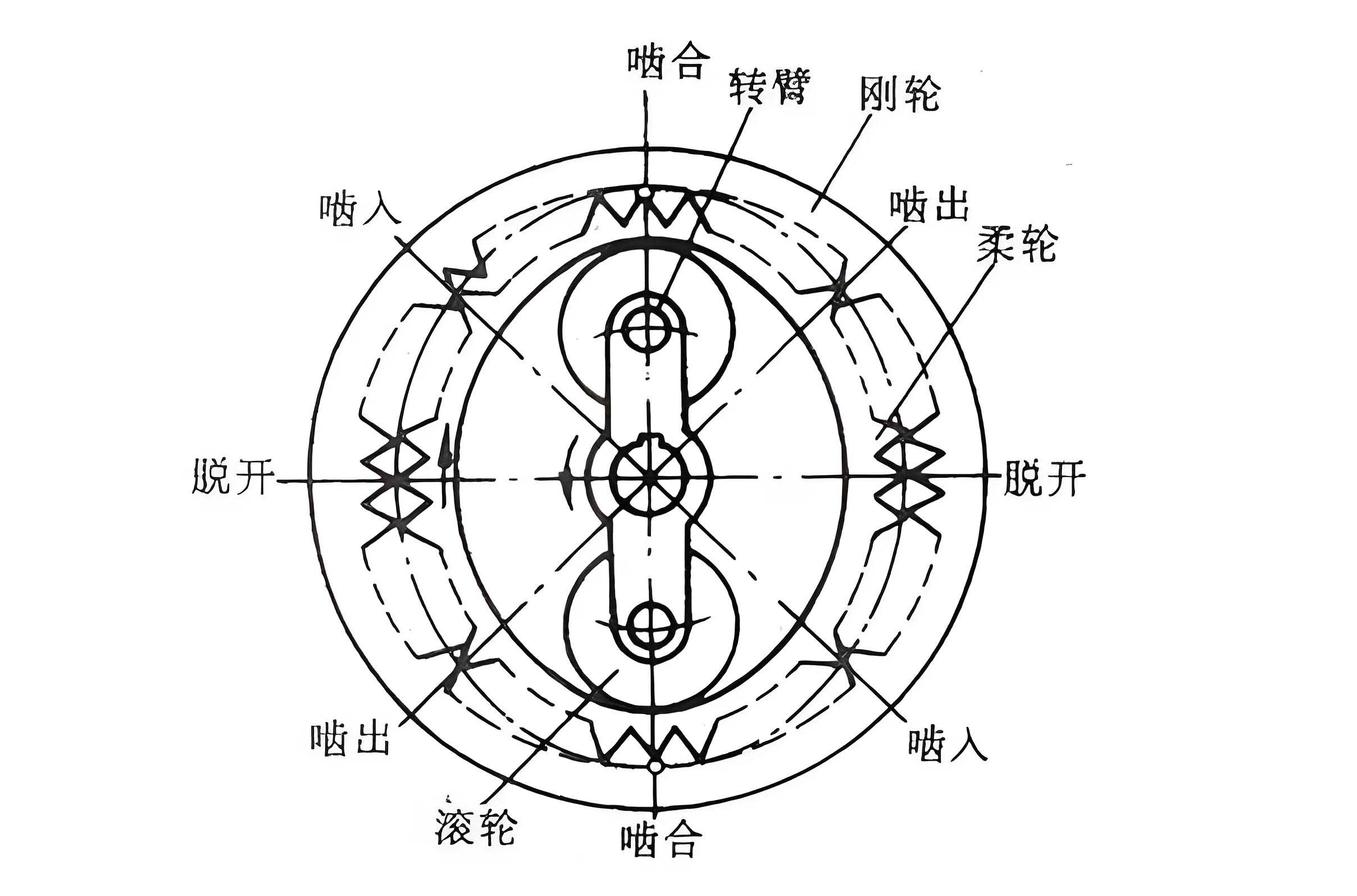
The operational principle of a strain wave gear relies on controlled elastic deformation. The wave generator, typically an elliptical cam assembly with a flexible bearing, deforms the flexspline into an elliptical shape, causing its external teeth to engage with the internal teeth of the circular spline at two diametrically opposite regions. Under no-load conditions, the deformation is primarily governed by the wave generator’s profile. However, under load, the meshing forces introduce additional radial and circumferential displacements. The flexible bearing, composed of a thin-walled outer ring, a set of balls, and an inner ring, acts as a compliant interface. Its radial stiffness under load is non-linear and dictated by Hertzian contact mechanics between the balls and raceways. Ignoring this compliance can lead to inaccurate predictions of tooth engagement and backlash, resulting in suboptimal load distribution, increased contact stresses, and potential premature failure. Therefore, a precise model incorporating the flexible bearing’s radial deformation is essential for accurate load deformation analysis of the strain wave gear.
To model the radial stiffness of a single ball in the flexible bearing, we employ Hertzian contact theory. The contact between a ball and the raceway is approximated as an elliptical contact area under normal load. The maximum contact pressure \(q_{\text{max}}\) for a radial load \(F_r\) is given by:
$$ q_{\text{max}} = \frac{3F_r}{2\pi a b} $$
where \(a\) and \(b\) are the semi-major and semi-minor axes of the contact ellipse, respectively. The elastic approach \(\delta\) (the mutual displacement of the two bodies along the load line) for the contact between the ball and the inner raceway is derived from the deformation compatibility and Boussinesq’s solution for elastic half-space displacement. For the ball-inner raceway contact, the elastic approach \(\delta_1\) is:
$$ \delta_1 = \delta_i \left[ \frac{3F_r (1 – \mu^2)/E}{\rho_i} \right]^{2/3} \rho_i^2 $$
Here, \(\delta_i\) is a dimensionless coefficient dependent on the ellipticity parameter \(e\) of the contact ellipse, \(\mu\) is Poisson’s ratio, \(E\) is the modulus of elasticity, and \(\rho_i\) is the sum of principal curvatures at the contact point for the ball and inner raceway. The coefficient \(\delta_i\) is expressed as:
$$ \delta_i = \frac{2F(e)}{\pi} \left[ \frac{\pi(1 – e^2)}{2E(e)} \right]^{1/3} $$
where \(F(e)\) and \(E(e)\) are the complete elliptic integrals of the first and second kind, respectively. Similarly, for the ball-outer raceway contact, the elastic approach \(\delta_2\) is:
$$ \delta_2 = \delta_e \left[ \frac{3F_r (1 – \mu^2)/E}{\rho_e} \right]^{2/3} \rho_e^2 $$
with \(\delta_e\) calculated analogously. The total radial elastic approach for a single ball, representing the radial displacement of the bearing under load, is the sum:
$$ \delta_r = \delta_1 + \delta_2 $$
This formulation provides the non-linear relationship between radial force and displacement for a single ball. For the entire flexible bearing with multiple balls, the load distribution among balls must be considered. In our analysis, we assume the radial load from the meshing teeth is distributed to the nearest ball based on its circumferential position. The total radial displacement at a given circumferential location on the flexspline tooth ring is the cumulative effect of the compliant bearing support.
The load deformation of the flexspline tooth ring is influenced by three primary factors under operational load: the radial displacement due to flexible bearing compression, the circumferential displacement caused by the stretching of the flexspline under tangential meshing forces, and the inherent clearance between the flexspline and the wave generator. We consider the deformation in the upper half of the flexspline (from the major axis to the minor axis), as the deformation is symmetric. The circumferential coordinate \(\varphi\) is defined, with \(\varphi = 0\) at the major axis position. The meshing force on each tooth has a tangential component \(F_t\) and a radial component \(F_r\), related by the pressure angle \(\alpha\):
$$ F_r = F_t \tan \alpha $$
The tangential forces are not uniform; they consist of an average component that balances the output torque and a fluctuating component that causes circumferential stretching of the flexspline. The average tangential force \(F_{t0}\) over the meshing region (from \(\varphi = -\pi/2\) to \(\pi/2\)) is:
$$ F_{t0} = \frac{2 \sum_{\varphi=-\pi/2}^{\pi/2} F_t(\varphi)}{n_1} $$
where \(n_1\) is the number of teeth on the flexspline. The fluctuating tangential force causing stretch is:
$$ F_{rt}(\varphi) = F_t(\varphi) – F_{t0} $$
The circumferential displacement \(v_P\) at a point due to this stretching, assuming a thin-walled cylindrical model for the flexspline tooth ring, is:
$$ v_P(\varphi) = \int_0^{\varphi} \frac{k F_{rt}(\phi) r_m}{E b_w s} d\phi $$
where \(k\) is an additional load factor accounting for non-ideal effects, \(r_m\) is the mean radius of the flexspline neutral surface, \(b_w\) is the width of the tooth ring, \(s\) is the wall thickness of the flexspline, and \(\phi\) is the integration variable.
The radial displacement \(w\) of the tooth ring is segmented into three regions based on its contact state with the wave generator. Let \(w_H(\varphi)\) be the radial deformation imposed by the elliptical wave generator under no-load conditions, \(u\) the initial clearance between flexspline and wave generator, and \(w_r(\varphi)\) the radial displacement due to flexible bearing compression calculated from \(\delta_r\). In the region from the major axis to a transition point \(M\) (region AB, where the flexspline remains in contact with the wave generator), the radial and circumferential displacements are:
$$ w_1(\varphi) = w_H(\varphi) – u – w_r(\varphi) $$
$$ v_1(\varphi) = -\int_0^{\varphi} w_H(\phi) d\phi + u\varphi + \frac{\varphi w_r^2(\varphi)}{2} + v_P(\varphi) $$
for \(0 \le \varphi \le \varphi_M\). The term \(\frac{\varphi w_r^2(\varphi)}{2}\) approximates higher-order effects of radial displacement on circumferential movement. From point \(M\) to the minor axis (region AM), the flexspline loses contact and forms a circular arc of constant radius. The displacements are:
$$ w_2(\varphi) = w_{H0} – u – \delta_{r,\text{max}} $$
$$ v_2(\varphi) = -(w_{H0} – u – \delta_{r,\text{max}}) \varphi $$
for \(\varphi_M \le \varphi \le 0\), where \(w_{H0}\) is the maximum radial deformation at the major axis under no-load, and \(\delta_{r,\text{max}}\) is the maximum radial displacement of the bearing at the major axis. From the minor axis to the symmetric point in the lower half (region MB’), the deformation is described by a free-form curve satisfying continuity conditions at \(M\) and boundary conditions at the minor axis (\(\varphi = -\pi/2\)). We propose a functional form:
$$ w_3(\varphi) = w_2 [ B_1 (\pi/2 – \varphi) \cos \varphi + B_2 \sin \varphi + C_0 ] $$
$$ v_3(\varphi) = w_2 [ B_1 (\pi/2 – \varphi) \sin \varphi – (B_1 + B_2) \cos \varphi + C_0 \varphi + C_1 ] $$
for \(-\pi/2 \le \varphi \le \varphi_M\). The constants \(B_1, B_2, C_0, C_1\) and the transition angle \(\varphi_M\) are determined by enforcing continuity of radial displacement, circumferential displacement, and slope at point \(M\), and specified displacements at the minor axis. The conditions yield a system of non-linear equations solved iteratively.
To illustrate the application of our theoretical model, we present a detailed numerical example based on a typical strain wave gear configuration. The key parameters are summarized in the table below.
| Parameter | Symbol | Value | Unit |
|---|---|---|---|
| Number of flexspline teeth | \(n_1\) | 240 | – |
| Pressure angle | \(\alpha\) | 25 | ° |
| Flexspline inner radius | \(r_i\) | 30.685 | mm |
| Flexspline length | \(l\) | 33.7 | mm |
| Flexspline wall thickness | \(s\) | 0.435 | mm |
| Tooth ring width | \(b_w\) | 10 | mm |
| Mean radius of neutral surface | \(r_m\) | 31.04 | mm |
| Initial clearance (flexspline-wave generator) | \(u\) | 0.0201 | mm |
| Maximum no-load radial deformation | \(w_{H0}\) | 0.264 | mm |
| Elastic modulus (steel) | \(E\) | 210 | GPa |
| Poisson’s ratio | \(\mu\) | 0.3 | – |
| Flexible bearing ball diameter | \(D_w\) | 5.556 | mm |
| Pitch diameter of bearing | \(d_m\) | 53.26 | mm |
We consider three load conditions representative of operational scenarios for a CSF-25-120 type strain wave gear: Rated Torque (RAT, 67 N·m), Permissible Maximum Average Load Torque (AVT, 108 N·m), and Permissible Peak Torque for Start/Stop (STT, 167 N·m). The tangential meshing force distribution \(F_t(\varphi)\) along the engagement arc (from -90° to 90°) for these conditions, obtained from prior studies, is used as input. The radial force distribution is calculated using \(F_r = F_t \tan \alpha\). These forces are allocated to the nearest balls of the flexible bearing (with 23 balls) over their respective load zones. For each ball, the radial force is the sum of radial forces from teeth within its zone, and the corresponding radial displacement \(\delta_r\) is computed using the Hertzian formulas. The resulting radial displacement \(w_r(\varphi)\) of the tooth ring is interpolated from these discrete ball displacements. The circumferential stretching displacement \(v_P(\varphi)\) is computed via numerical integration of the fluctuating tangential force. Substituting these into the deformation equations for the three regions, we obtain the complete load deformation profiles. The transition angle \(\varphi_M\) and constants are solved iteratively for each load case. The results for radial and circumferential displacements are plotted and analyzed. Key observations include: as load increases, the radial displacement in the meshing region (right of major axis) decreases due to increased bearing compression, while the outward bulge in the disengagement region (left of major axis) becomes more pronounced. The maximum circumferential displacement shifts leftward with increasing load, and its magnitude in the bulge region grows.
To validate our theoretical model, we conducted finite element analysis (FEA) using a detailed 3D solid model. The FEA model comprised the flexspline, flexible bearing (modeled with solid elements for balls and races), and an elliptical cam wave generator. Contact pairs were defined between all interacting surfaces. The flexspline cup bottom was fixed, and the cam was constrained. Meshing forces from the three load cases were applied as distributed pressures on the tooth flanks in the engagement region. Nonlinear static analysis with large deformation effects was performed. The radial and circumferential displacements of nodes on the neutral surface of the tooth ring at the bearing support cross-section were extracted along a path from \(\varphi = -90^\circ\) to \(90^\circ\). The FEA results were compared with our theoretical predictions. The comparison showed good agreement, with minor deviations. The table below summarizes the maximum absolute differences between theoretical and FEA results for radial displacement under each load condition.
| Load Condition | Max. Radial Discrepancy (μm) | Location of Max. Discrepancy (φ) |
|---|---|---|
| RAT (67 N·m) | 2.01 | Near major axis |
| AVT (108 N·m) | 4.35 | Left of major axis |
| STT (167 N·m) | 7.04 | Left of major axis |
The discrepancies are attributed to simplifications in our theoretical load distribution to the bearing balls and the assumption of a perfectly cylindrical stretching behavior for the flexspline. Furthermore, we investigated the axial variation of deformation. According to the straight-generatrix assumption, the deformation at any axial cross-section is proportional to its distance from the cup bottom. For the RAT condition, we compared theoretical and FEA displacements at front, middle, and rear cross-sections of the tooth ring. The table below shows the maximum radial displacement differences at these sections.
| Axial Cross-section | Max. Radial Discrepancy (μm) | Primary Deviation Region |
|---|---|---|
| Front Section | 2.46 | Near major axis |
| Middle (Bearing Support) | 2.27 | Near major axis |
| Rear Section | 9.64 | Near major axis |
The larger deviation in the rear section suggests that end effects and constraint conditions at the cup bottom influence the deformation pattern, which our simple linear axial scaling does not fully capture. Nonetheless, the theory accurately captures the deformation in the critical bearing support section.
The radial stiffness of the flexible bearing is a cornerstone of our model. We performed an additional FEA validation for a single ball assembly under radial load. A model of one ball between inner and outer raceway segments was constructed. A radially directed force was applied to the outer raceway’s outer surface, and the radial displacement was measured. The force-displacement curve from FEA was compared with the theoretical curve derived from the Hertzian approach. The results matched closely, with a maximum deviation of only 5 μm at the highest load, confirming the accuracy of our contact mechanics formulation for the flexible bearing component within the strain wave gear.
The load-induced deformation of the flexspline has direct implications for the operational backlash and load distribution among teeth in a strain wave gear. Backlash, defined as the gap between mating tooth flanks, is critically affected by both radial and circumferential displacements. Under no-load, backlash is designed based on the elliptical deformation. Under load, the additional displacements alter this gap. Using our deformation formulas, the effective backlash under load \(B_L(\varphi)\) can be estimated as the initial no-load backlash \(B_0(\varphi)\) minus the relative displacement of conjugate points on the flexspline and circular spline. A simplified expression accounting primarily for circumferential displacement change is:
$$ B_L(\varphi) \approx B_0(\varphi) – \Delta v(\varphi) $$
where \(\Delta v(\varphi)\) is the change in circumferential displacement of the flexspline tooth from no-load to load condition. This allows designers to set initial no-load backlash such that under operational load, the backlash minimizes to near zero in the primary load-bearing zone without inducing interference, thereby promoting multi-tooth engagement and even load sharing. The ability to predict load deformation analytically enables iterative optimization of tooth profiles for specific load spectra, enhancing the performance and efficiency of strain wave gear systems.
In conclusion, we have developed a comprehensive theoretical methodology for calculating the load deformation of the flexspline in a strain wave gear, explicitly incorporating the radial compliance of the flexible bearing derived from Hertzian contact theory. The model accounts for radial displacement due to bearing compression, circumferential displacement from flexspline stretching, and the effects of initial clearance. The derived formulas segment the deformation into contact and separation regions, providing a complete description of the tooth ring’s displaced shape under load. Validation via detailed finite element analysis shows good agreement in the bearing support cross-section, with minor discrepancies in other axial sections attributable to end constraints. This work underscores the importance of considering flexible bearing deformation in load analysis of strain wave gears. The theoretical framework provides a valuable tool for setting operational backlash in tooth profile design, aiming to achieve more balanced load distribution across meshing teeth, reduce peak contact stresses, and improve the reliability and lifespan of strain wave gear transmissions. Future work could extend this model to include dynamic effects, thermal influences, and more complex wave generator profiles, further refining the predictive capability for high-performance strain wave gear applications.